
"Live like a tree walking!"
-Austin Osman Spare
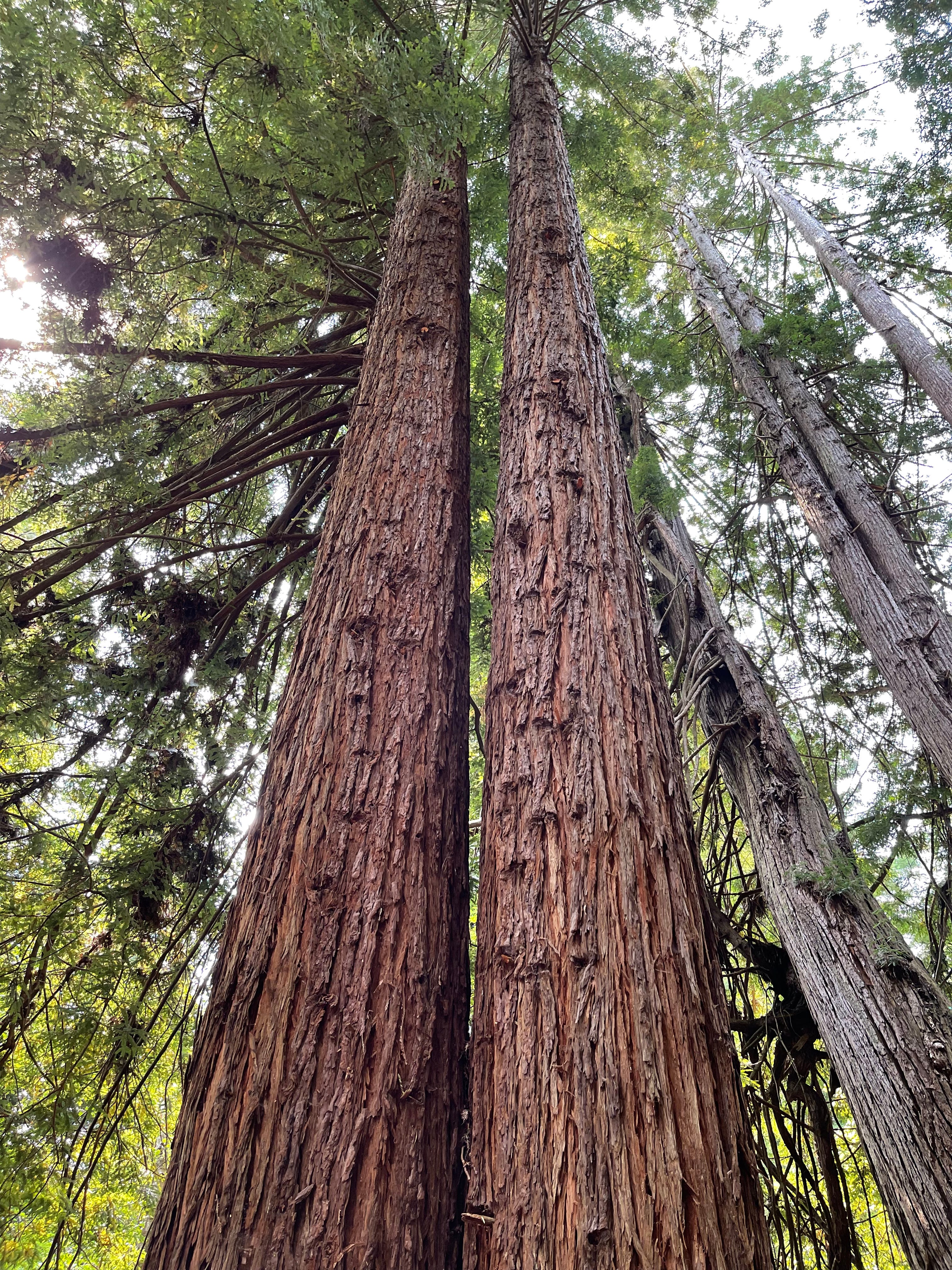
I have a semi-regular dawn ritual of doing santishi (三體勢) standing amidst a group of large old conifer trees at a nearby park. We’re like any other group of friends meeting every week. Except in our case, we’re just standing around rooting into the ground and exchanging *sigh* um, energy. This isn’t just my idea! Famous mid-20th century internal martial arts masters like Yiquan founder Wang Xiangzhai and Aikido founder Ueshiba Morihei would do exercises exchanging energy with trees. Or we can call it something else, if “energy” seems too weird and bogus to the doctrine deliberators here at Congregation Demon Hamb.
This standing/exchange is a thing in Daoist cultivation practices—you choose a tree, then facing it from a reasonable distance, strike up your finest meditation or form posture. Almost any kind of zhanzhuang (站樁) variation—or really any static posture practices that can be held as cultivation training (mudras, swordless chudan-no-kamae from a kenjutsu school, a deep TKD or karate stance, balancing with a cane, sitting in a wheelchair). Every few minutes, you approach a few steps closer to the tree. After 15-25 minutes, you arrive at your destination (the trunk!) and sit down. You’d best not have penciled in any pressing morning plans, because it’s time to hang out with the tree for a while. Starting the day by having a sunrise workout with a tree is surprisingly undervalued in our utopian 21st-century society.
Neijia (內家) standing with-or-without-tree-involvement is the most rapid, repeatable existent method for melting nearly all conscious and unconscious physical tension in one session. I’m pretty certain lots of other postures like those mentioned above can be approached in the same way (I’ve tried several), with fangsong1 (放鬆) as the conceptual basis. Even if a practice is tense or rigid normally or when done correctly, holding any posture up long enough will drop all the extraneous tension and muscle as excess baggage.2 Standing for 30 minutes in santishi or zhanzhuang like this unravels all tight and tense compound layers of muscle and myofascial tension and associated satellite knots and tightened joints. It’s mandatory foundational practice for maintaining structural strength, and if internal cultivation is practiced too, qi control in movement and active use is consistently improved. Maybe it’s not as leisurely and super-comfy as doing seated meditation, but it’s also much harder to be distracted and waste much time thinking about meaningless stuff—because you can’t pantomime proper standing practice; you just won’t do it at all.
After training consistently (daily) for some years doing seated or standing meditation, or maybe martial arts form practice, it will leave you in serious jhana-like (or actual jhana3 derived) bliss. This isn’t emphasized because it’s subjective and also not the purpose of practicing. It’s easy to get attached to these experiences and feelings of bliss and so on. It’s common for Buddhist and Daoist teachers to downplay or de-emphasize such states of absorption in public discussions and materials (it’s also just vanity and bragging; forbidden for a monastic). But it tends to be there in the background much of the time if you regularly practice for a long time and are willing to ditch overindulgence in habits like lust or intoxication.
There’s a whole catalog of correspondences in Daoist neidan (內膽) and neigong (內功) which associates different trees with different qualities and aspects of health according to the usual cosmogenic divisions and cycles. I don’t know if I’m going to invest my time in learning exactly which trees are optimal standing practice hosts at which two hour windows of the day and for which kind of wuxing (五行) organ associations, but it’s interesting how different tree species will gradually become much more discernible to your sensory awareness. I will say that after doing standing practice, "exchanging energy" like this with a tree, for hours afterwards I retain a potent and poignant impression of its unique presence. If I were the main character in Spirited Away, at the end of the movie I’d be remembering that my fellow yoked yokai (妖怪) friend is actually a conifer tree I stand in front of every few days in the lightside world.
What’s nice about it: even if someone is a hapless case whose qigong/neigong/neijia cultivation is delusional LARPing, they still end up spending quality time with a nice tree. It’s certainly a bold contrast to the better known worldwide annual tree tradition in which we become enraptured in awe of a single magical tree only after we’ve killed it and dragged it inside to let it fade from existence while it suffocates and is slaked of its roots as dismembered dead trees burn nearby in a fireplace. That children’s book about the tree was sad but still too nice! Don’t misunderstand me, I’m highly enamored of thee olde weys and festivels. I just thought of it given this is but merely another way to appreciate a tree on a personal level—while boosting your health. I’m not making any particular claims; try meditating extensively regularly in proximity to particular trees; see if you take anything interesting away from it. There’s an Erdtree for everyone out there.
“let loose, unravel, unclench the muscle tension”
Classical Japanese sword systems have a similar approach of making new students do thousands of basic sword strikes in a row until by natural exhaustion they learn how to wield the weapon without excess strength. I’m sure a lot of physical traditions use this approach, though I prefer ones like static standing which don’t even have a chance of injuring the joints or pulling a muscle.
I’m thinking of the jhāna/dhyana as taught within the Theravada Buddhist traditions based upon the Pali Canon. What I’m suggesting is that there are some correlations and overlap in the experiences of the rūpa jhāna, but I am not saying these are actually the same experiences solely because of the experiences of bliss that occurs in each which are non-sensory in their origins (not physical senses of pleasure). Jhāna states in Buddhism are distinct experiences that arise from (and are distinguished by) specific approaches to practice and particular qualities that Buddhist practice develops within especially Theravada Buddhist practices. I mention this because there’s often this modern secular-ish idea that all traditions or practices are really just doing the same thing and are analogous in their experiences. It’s a topic I will get into sometime, but it really is not the case! And the idea that say, the jhāna states and the stages or experiences of neigong/neidan/neijin are fairly directly just like one another is lazy, to say the least.
Comments
Nothing yet. Say the first thing.
Sign in to join the conversation.