
Yang Taijiquan1 is a curious martial art, because when its power is embodied, it does not have a flashy or even discernible appearance. It’s not that Yang Taijiquan does not have a significant psychological and energetic presence and impact of its own, but only fluent students will reliably pick up on it as being different than the usual shiny silk pajama presentation. The method’s functionality is a nuanced sensibility for exploiting the physical tension within another person’s body—even subtle, unconscious tension. Without having trained this sort of practice to a significant level, it is not obviously visible.
The Yang Taijiquan system emerges in early 19th century China, with lineage founder,
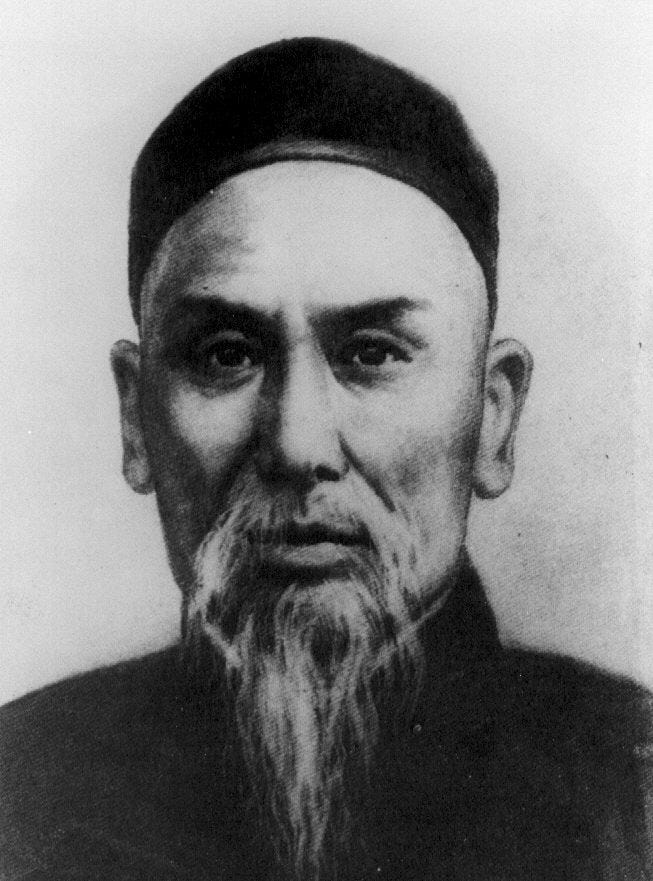
Yang Luchan. Yang’s reputation as an unbeatable fighter in the early 19th century came from his deep understanding and articulation of the described free-hand fighting approach to sensing and exploiting another fighter’s “hardness”. His Taijiquan method undetectably calibrates crucial information from an attacker’s incoming conscious and unconscious physical tension. Sensing unconscious tension in others requires first deeply unraveling the unconscious tension in oneself. Significant amounts of regular meditation practice can do this, but meditation does not train how to drop conscious and unconscious tension in perpetuity while engaging in optimized physical exertion with the body.
When an attack is being deflected through briefly connecting limbs, Taijiquan receives and absorbs the momentum by turning the waist and sinking into the ground on a rooted leg, like a coiled spring storing up potential energy. Turning and deflecting the attack in this way reveals simultaneously a returning vulnerable attack line through which the coiled spring can release its energy in response. When the limbs cross and an attacker is being received, they seem to land on almost nothing, which is the softness of Taijiquan, before they are returned force down a line which disrupts their center of balance.
This seems too broadly vague and simple, as though important technique or movements have been left out of the description. It’s this simplicity, expressed in the Taijiquan Classics’ Insights into the Thirteen Postures2 by the dictum "receiving is releasing"3, which explains the function of the art as a combat method. Other peer and descendant arts like Yiquan and Taikiken4 have also recognized and deconstructed this dynamic. If this sensitivity and softness is properly developed, all the usual particular variations in stepping and limb expression gradually become less significant and easy to work out. The specific way the body’s expressions manifest will match the physical attack dynamic of the attacker or duifeng (對風)5, whose movement and approach will determine the speed and force needed in response. Taijiquan’s developed sensitivity allows the naturally accorded reciprocal response to incoming attacks. A thoughtful person can learn to apply these skills to non-physical exchanges as well.
The degree to which this method can be used depends of course on extensive long-term training under someone skilled, and then for truly advanced abilities, natural skill as well. Undoubtedly Yang Luchan, a man born into difficult circumstances and of humble class origins, besides his extensive training for many years also had a remarkable natural affinity for this sort of sensitive fighting method, and some luck as well. The Qing dynasty enforced a society of rigid class distinctions which typically were only changed by the continued dynastic tradition of government examinations. His knowledge and talent in the martial arts let him rise from a low social status to a commendable official role, someone with a historic international cultural legacy.
Most of the Yang Taijiquan traditions retained today are traced to Yang Luchan’s youngest grandson, Yang Chengfu. Chengfu was born towards the end of the Qing dynastic system and society Yang Luchan lived in. He was iconic for his imposing physique and impressive, adept demonstrations of his family’s tradition of “soft” martial skills. After disdaining the family training and its professional security background as a child, Chengfu found himself teaching the art publicly to civilians, instead of privately for military and fighting experts. The dissolution of the Qing Dynasty and its segregated class structure meant he could teach Taijiquan in response to popular interest during the Nationalist Chinese Republic period. People from all backgrounds now wanted to train in the martial arts—especially for their health benefits.
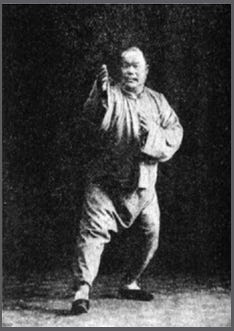
Being born in the late Qing dynasty amidst rigid social class divisions meant Yang Chengfu was illiterate, and it’s through the writing of his new, young, well-educated students, like Zheng Manqing and Chen Weiming, that his teachings were published. This transmission of material in the early 20th century is the most common resource of Yang family Taijiquan, and the oldest demonstration and open exposition of the art available to the public and as a visual media record.
The Energy at the Top of the Head should be Light and Sensitive
Sink the Chest and Raise the Back
Relax the Waist
Distinguish Full and Empty
Sink the Shoulders and Drop the Elbows
Use the Mind and not Strength
Unity of the Upper and Lower Body
The Unity of Internal and External
Continuity without Interruption
Seek Stillness in Movement
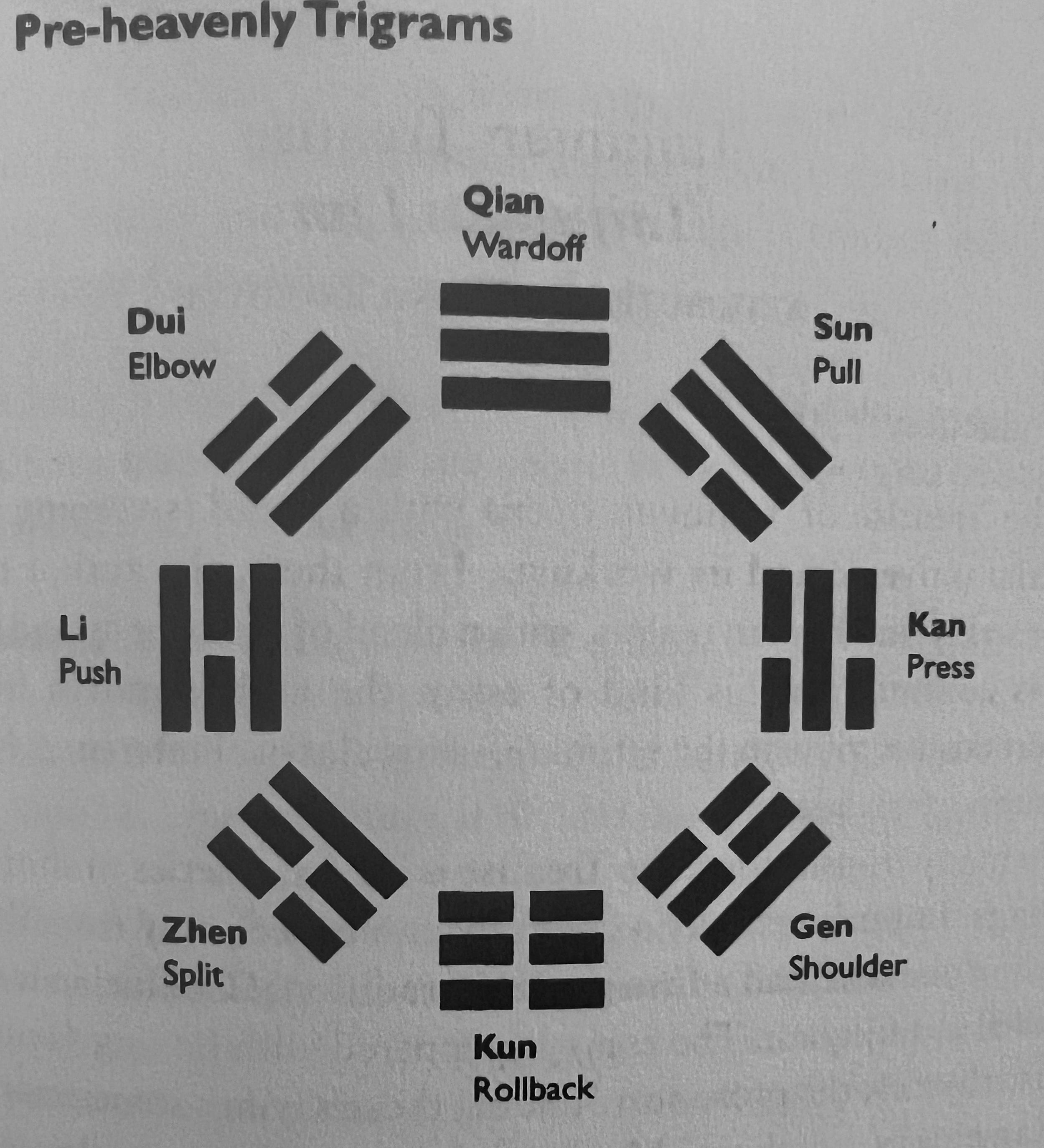
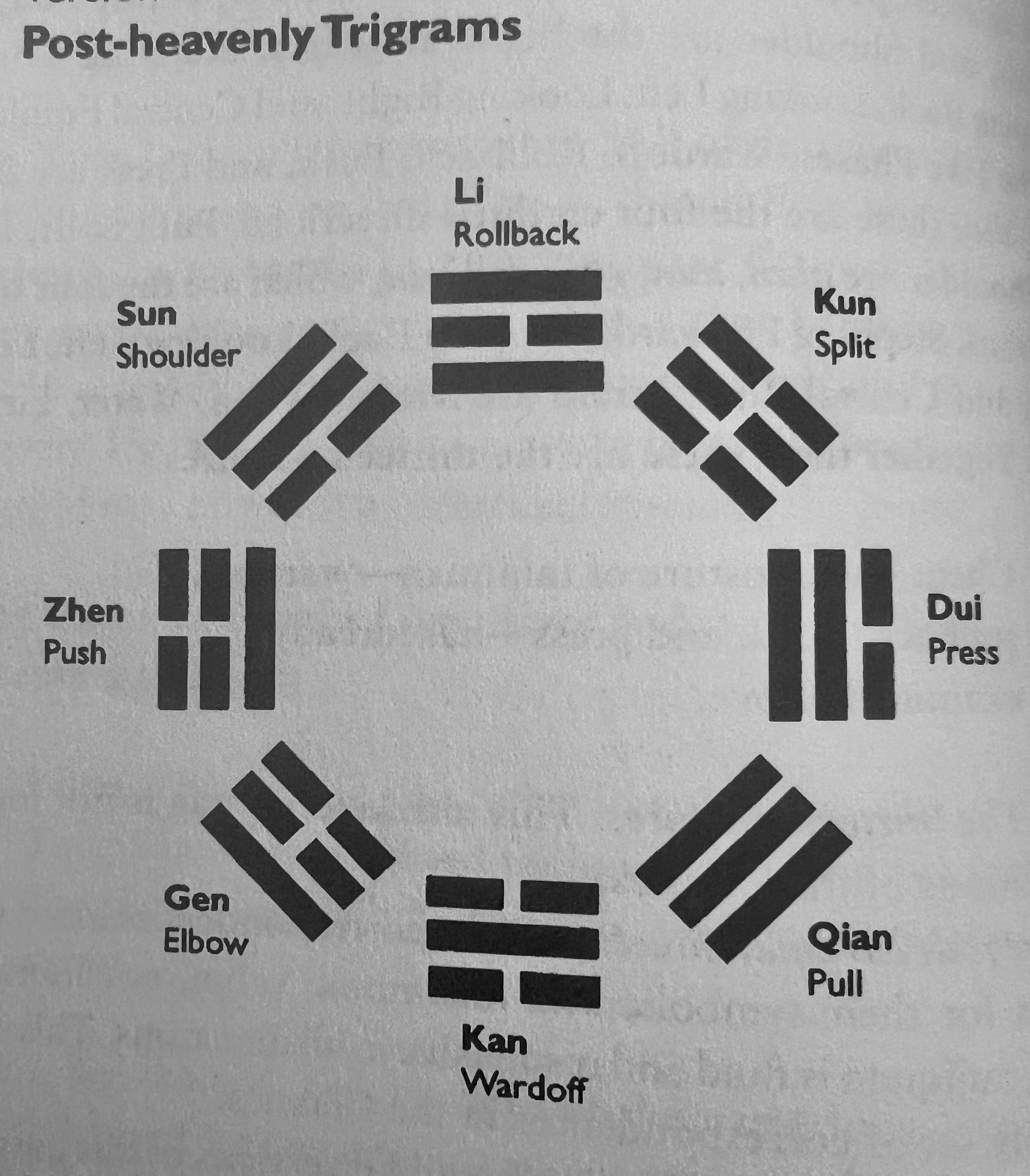
Most of these ten points make limited sense to beginners or outsiders, pointing to larger ideas and experiences for ongoing students to examine. Something like “Distinguish Full and Empty” refers to not only the separation of weight entirely into the rooting leg, but the entire body, and learning to recognize the feeling of fullness and emptiness all over in different variations of all eight primary moves or expressions of structural and physical power (listed in the two bagua images below). So there’s a lot to unpack here, and for fresh beginners or outsiders, a couple of these points in full discussion are already excessive or abstract. But “Relax the Waist” and “Continuity without Interruption” and a couple of others highlight some of the aspects at play when embodying our mantra of the day (receiving is releasing!).
Yang Chengfu’s most well-known student internationally was Zheng Manqing. Zheng later moved to Taiwan and eventually the USA, bringing along several highly talented young students who became great teachers themselves. Zheng notably compliments his teacher’s qualities, instead being a short, engaging university professor with a classical education and natural creative talent. He too was a person who seemed to represent both and yet neither a past era and a newly emerging one.
Zheng Manqing decided to condense the length of his teacher’s forms, and so the Zheng Manqing Yang Taijiquan form moves through 37 form postures, instead of the original 103. It takes 10-15 minutes to perform continuously through, whereas the original version takes 30-40 minutes His reasoning for condensing the size can be found in his collection of essays, Thirteen Treatises of Chuang Tzu. He also taught his own succinct set of underlying fundamental principles for Yang Taijiquan.
Verticality (coccyx tucked in slightly so entire spine is straight line; head and eyes up and level)
Waist (turning) is the master-and-commander of all bodily movement
Separation of weight ("empty stepping" like a cat)
fangsong 放鬆 (let loose, unclench muscle tension), ongoing “dynamic relaxation”
Fair Lady’s Wrist (keep fingers extended, palm/wrist/forearm linear & flush)
These abridged five core principles can be more easily committed to short-term memory, and are more understandable to a new beginner to Taijiquan. Each of these principles can be broken down into countless sub-principles, but ultimately all five principles point to derivations of a single natural process of movement. Although there is less exposition into the broader fabric of the art’s philosophical and even metaphysical qualities, Zheng notably emphasized fangsong or "letting go, unclenching muscle tension" as a universal principle to be considered across the system’s practices.
Fangsong heeds particular attention because its embodiment reveals Taijiquan’s essential realization to give up physically grasping, clinging, or forcing as reactionary impulses or patterned behaviors. We must let go of tensile, contracted muscular force or strength in order to dismantle inclinations toward tension and stiffness and clinging. Meticulously training fangsong itself is rare in martial arts systems (even ones that claim to be “soft” or both soft and hard), and even among the neijia systems close to Yang Taijiquan it is not as central to the curriculum. Above I mentioned that to sense unconscious tension in others, first a person must unravel the unconscious tension within themselves. Abandoning, unraveling the unconscious tension of one’s own physical body and psyche—fangsong is the realized aspect that allows a person to become incredibly sensitive and dial in their physical touch to any softness or lightness.
A student who practices regularly will gradually embody Taijiquan facility in daily life, regardless of their age, and even despite many physical injuries/conditions/disabilities.
Some common examples of stuff that happens:
Never being knocked down or falling over by being bumped into or jostled
Never again rolling over the foot or twisting the ankle
Never accidentally using the back/spine to lift something heavy
Effortlessly keep your balance when standing on boats as they bob in the water (“sea legs”)
Barely needing handles or poles to stand on chaotic public rail system trips
Immense structural and balancing boost to any movement-focused activity: dancing, sports, hiking, Renaissance Faire axe-throwing
Extra-sensory natural maneuverability around other people in all life circumstances. This is something which may actually drive you insane, because the obliviousness and bodily awareness of other people accordingly gets worse as your own sensitivity and skilled maneuverability increases. Fortunately you also become a lot more extremely chill through this process and everything is still cool.
Still, all such minor “perks” of regular Taijiquan training only embody the “receiving” aspect of receiving-is-releasing, missing the returning of force, the “releasing” phase. I emphasize the “releasing” aspect because it is common for many people to find attacking and harming others to be an extremely draining challenge, even when merely engaged in a martial arts class (and not a dangerous random real circumstance). It is probably a common experience for a lot of folks who train in Taijiquan today.
Returning/releasing force needs to be completely kinesthetically realized as intrinsically connected to the yielding phase of incoming force, so that the student automatically responds to incoming attacks by yielding-and-responding as a completely coupled, ingrained bodily expression. The return attack does not rely on conscious aggression and emotion, but relaxed, assertive reciprocation of force intent and energy. Healthily learning this from someone sensible who isn’t delusional or a maniac, and eventually gaining personal evidence of its functionality by applying it with all sorts of different kinds of physiques and personalities, the person who is originally incapable of physical self-defense will mentally drop the concerns. Subsequently such students will be able to dial in the intensity of their response and test their capacity for doing so under different pressure testing scenarios.
Like the perpetual training of fangsong, “receiving-is-releasing” must become absolutely embedded into the automatic movements and senses of the body over many years. Taijiquan learned properly thus becomes a vehicle of transformation: the individual will develop new natural reactions over time, stop feeling anxious or stressed out about physical attacks now that they no longer react uncontrollably to physical engagements.
DEMON HAND ENCOURAGEMENT: It is a significant threshold, a real milestone, for people inhibited towards even self-defensive violence to get to this stage via following the principles and concepts. This level of skill is also far more impressive of an achievement than it is for someone with minimal or zero qualms about hitting other people or dealing with conflicts. Arriving here is arguably what a stereotypical “McDojo” black belt ranking symbolizes (but often does not actually represent or confirm). If you get to this point, whatever you do, don’t stop now.
Natural further development is training to continue an exchange without breaking connection or flow, reacting to the duifeng’s counter by yielding, or else following their physical adjustment with subsequent new strikes through inevitable new vulnerabilities being revealed. So the follow-up to “releasing” reciprocal force down/through a line of vulnerability and balance is to maintain the connection with and to control the duifeng even as they move and react in different ways. Now continuous follow-up strikes can simply be trained as a fine skillset of following the flow of the exchange, the natural movement of its energy.
Yang Luchan deeply understood and practiced how to innocuously deflect and reciprocate any manner of incoming attack—repeatedly in a connected, flowing chain of strikes or exchanges if necessary. We don’t know what the Yang system looked like under him, or how it differed from what comes down to people today. What we do understand from practicing the Yang systems is that he unraveled unconscious tension in himself, then sensed it in others without them perceiving it, then as a simultaneous or connected reciprocation of their attacks would blast them through their vulnerable center of balance. The opportunity does seem rare today, but anybody who can properly learn under a legitimately talented Yang stylist is able to become highly skilled at fighting in this way if they really decide to. They won’t learn by memorizing techniques, but instead by embodying the Yang family’s principles and ideas.
Attributed to Wu Yuxiang, Song of Thirteen Postures, Exposition of Insights on the Practice of Tai Chi.
Barbara Davis translates this passage: “Receiving is the same as throwing; throwing is the same as receiving.”
This is actually a branch lineage of Japanese Yiquan. Though Taikiken (大気圏) seems to be a direct localization of the term Taijiquan (太極拳) in the Japanese language, Taikiken is actually Taiqiquan in Chinese (the middle character is different in the names of the two arts regardless of which language). Taijiquan in Japan is referred to as Taikokyuken.
Duifeng (對風) is a Chinese martial arts term which is a bit abstract/clumsy rendered into English, referring to the other involved person in the martial exchange. Japanese has a directly equivalent term, uke (受け), which is used.
These pre/post heaven bagua sequences, with the traditional interpretation of the eight basic moves/energies of Yang Taijiquan as they align with the eight trigrams, are from The Taijiquan Classics by Barbara Davis.
Comments
Nothing yet. Say the first thing.
Sign in to join the conversation.