
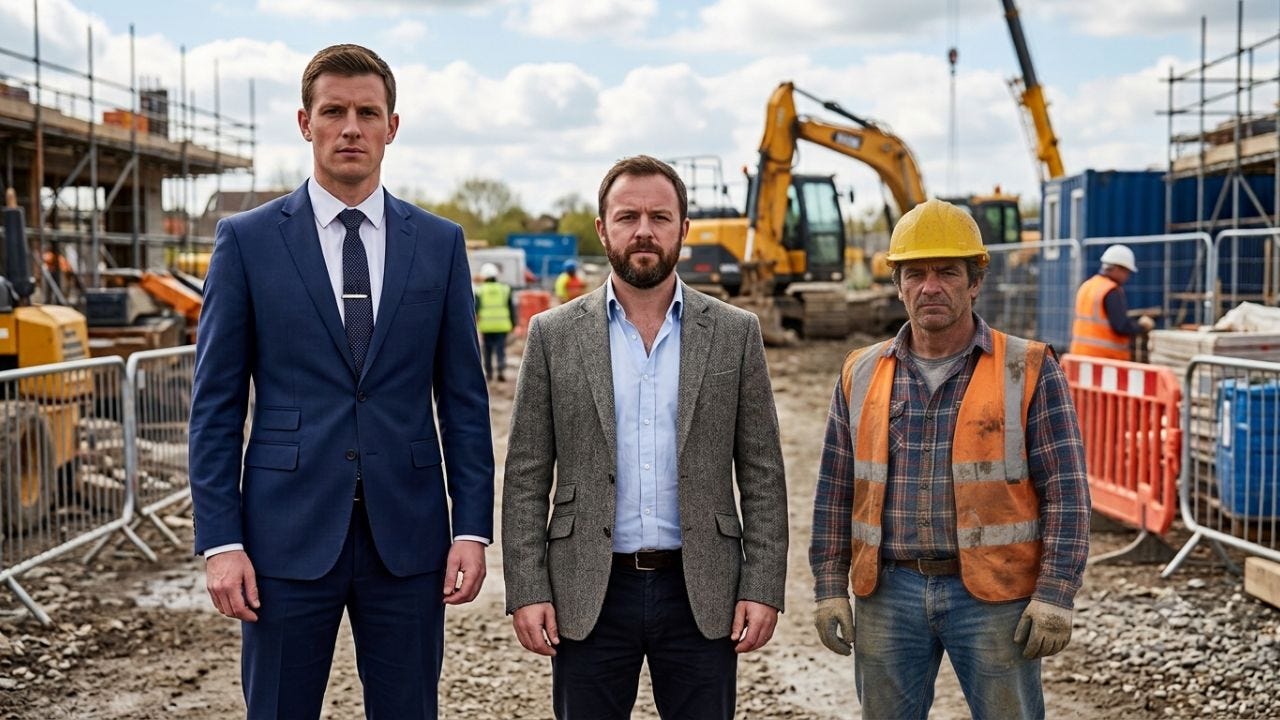
Sixty years ago, The Frost Report broadcast a brief comedy sketch that skewered the British class system with surgical precision. John Cleese, Ronnie Barker, and Ronnie Corbett stood side by side in descending order of height. Cleese looked down on Barker because he was upper class; Barker looked up to Cleese but down on Corbett because he was middle class; and Corbett, standing at the bottom, simply knew his place. It was a brilliant piece of satire because everybody instantly recognised the absurd, rigid hierarchy that governed post-war Britain.
If you transfer that three-tier model into the UK demolition and construction sector today, the dynamic feels uncannily familiar. The uniforms have changed from bowler hats and cloth caps to pristine suits and mud-splattered workwear, but the underlying social architecture remains completely intact.
At the top stand the Tier 1s, institutional funding partners, and major land developers. They are the industrial upper class. Housed in glass-fronted city offices, and speaking fluent compliance and sustainability, they hold the land banks, secure the planning consents, and control the capital flows. They operate in a world of strategic frameworks and five-year investment cycles, far removed from the noise and grit of the actual site.
In the middle sit the main contractors. They are the middle class of the sector, caught in a permanent state of commercial anxiety. They manage the supply chain and absorb immense contractual risk. They are constantly looking upwards to secure their place on coveted framework agreements and looking downwards to ensure the workforce adheres to strict corporate policies. They trade in management software, procurement portals, and risk registers.
At the bottom, clad in steel-toe boots and high-visibility gear, are the thousands of sub-contractors, plant hirers, and specialist contractors. They are the working class of the industry. They are the ones who operate the equipment, pay the spiralling red diesel bills, and take on the physical hazards of the job.
In the traditional view of corporate hierarchy, power flows strictly downward. The top commands, the middle coordinates, and the bottom executes. The boardroom looks down on the regional site office, and the site office looks down on the excavation pit. For decades, the industry has operated under the quiet assumption that those who control the money hold all the cards, while those who operate the machinery are merely replaceable line items on a balance sheet.
Except the entire pyramid is resting upside down on its point.
If a major developer’s board of directors takes a fortnight away from their desks to refine their corporate messaging, what happens on site? Nothing. The earth continues to be dug, the concrete continues to be crushed, and the site is cleared strictly on schedule. The physical momentum of the project does not hesitate for a single second.
If a main contractor becomes embroiled in a month-long contractual dispute, what happens on site? The machine operators still arrive on time, the machines still hum along, and the project proceeds precisely as planned.
Now invert the experiment. Suppose the specialist sub-contractors, the demolition contractors, and the plant operators decide to pull off site for forty-eight hours.
The immediate reality becomes glaringly, painfully obvious. The developer’s share price stumbles as project milestones collapse and institutional investors grow nervous. The main contractor’s project managers panic as liquidated damages accumulate at thousands of pounds a day. The middle and upper tiers face a stark truth: despite all their corporate weight, their firms do not own a single excavator, nor do they employ a single person capable of operating one.
For all the strategic frameworks, financial leverage, and commercial management at the top, the entire multi-billion-pound sector relies fundamentally on the expertise of people with grease on their trousers. The developers provide the capital and the main contractors manage the paper, but physical progress hinges entirely on the specialists in the dirt.
The traditional class system assumes that those at the top hold all the power simply by virtue of their position. In reality, those at the bottom hold the keys. Rather than looking down on those beneath them in the industry hierarchy, the middle and upper classes should know their place.

No posts
Comments
Nothing yet. Say the first thing.
Sign in to join the conversation.