
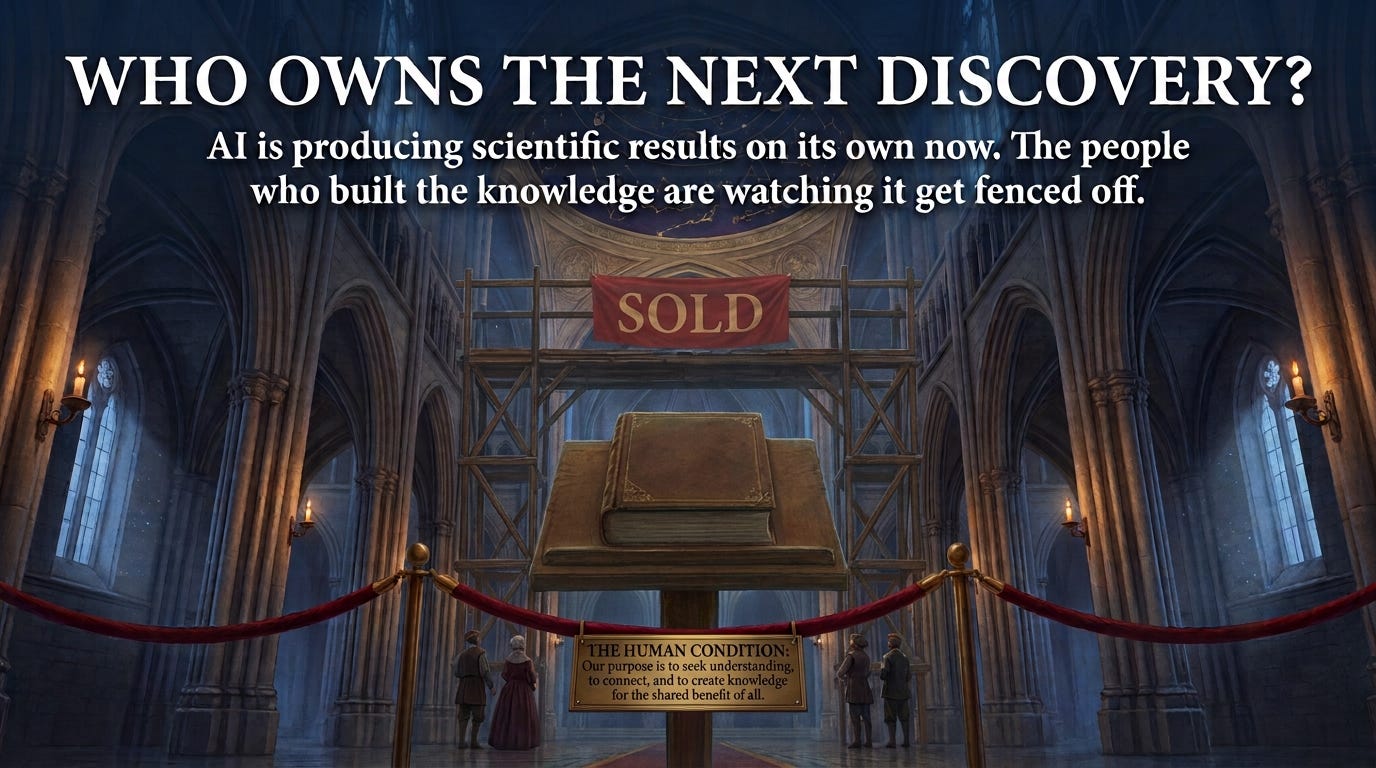
Hsin-Yuan Huang, a Caltech theorist, gave a talk last week at UC Berkeley’s Simons Institute titled How to Respond to the Automation of Research. I went in expecting the video to be about how AI is giving researchers the power to advance their fields, the way it already did with protein folding and drug discovery. Instead what unfolded in front of me was a room slowly realizing they were being cut out of research entirely, and a speaker who had admitted to having a panic attack while preparing the presentation the night before. Two years ago, I had begun to feel it myself: being automated out of purpose and out of a career was the inevitable goal. A chasm was opening below me with no social safety net to catch me, and the gains that should have lifted everyone were being sucked up by large corporations. Now I was watching it come over them.
“Research used to hold a sacred place in human society.”
The talk’s abstract had begun with Huang’s own sentence: “Research used to hold a sacred place in human society.” He had named what made it sacred: it was scarce, a thousand years ago the richest man in the world could not buy a theorem; it was selfless, a lifetime devoted to discoveries that would benefit everyone; it was timeless, much of what we learn today was discovered thousands of years ago. He would spend the next hour explaining why the first half of that sentence was already past tense.
He asked that the talk be a discussion more than a lecture. He did not have the answers, he said, and the community would have to think the questions through together. He apologized for what he was about to say and hesitated over how much detail to share. He had anonymized the story he was about to tell. At another conference, a researcher had presented a new question. Someone in that audience heard the question, put it into an AI with two thousand dollars of compute, and thirty minutes later, before the talk had ended, the machine had found the result. It had also found a new question, a sharper version of hers with broader implications. She had spent months formulating the question. The answer, and a better one, arrived while she was still at the podium.
The answer, and a better one, arrived while she was still at the podium.
Who owns that discovery? The person who spent months formulating the question? The person who paid for the compute? Or the AI? He let them hang.
Two days before, Robin Kothari, a theoretical computer scientist at Google Quantum AI, posted the same crisis from the other side. “Frontier LLMs can now solve many quantum computing and theoretical computer science problems that I’ve personally spent weeks or months working on. How is everyone else dealing with the existential crisis that accompanies this reality?” He works for the company building some of those models.
Among the replies, hopeful looks for their future, were the standard objections. Huang had heard all of them before, and he went through them one by one. The first thing you hear is that real research requires accumulated knowledge. He pointed to a paper from three years ago, MemGPT, that gave LLMs long-term memory; since then, thousands of papers have refined the technique. Frontier models, he said, “can also all design and improve their memory system on their own, because they already have read tons of papers.” The cycle feeds itself.
The second thing you hear is that humans will still be needed to verify results. True, Huang said: machines make mistakes, hallucinate, and build on errors. But “you can set up a verifier that sits right next to it and do adversarial attack on the output generated by the generator,” turning “a weaker LLM that have a certain physical error rate into an LLM that have lower logical error rate.” Machines already verify machines.
The third thing you hear is that progress will plateau once the internet is fully trained on. “That’s also not quite true.” Weaker models generate synthetic data to train better ones, and the process keeps going from there. Progress stops, he said, only when a single model is “a perfect reasoning machine.” At which point full automation has already arrived.
He was methodical. Watching it, I recognized something. I have made these arguments myself. These are the same reactions I and others have had when presented with AI, or any previous technological advancement. Then there are those whose hubris is believing they will be spared: the machines will take every other field, but not theirs. It is the same feeling Garry Kasparov, the world chess champion, felt when Deep Blue beat him: sure he would win, he refused to accept it. I have reached for each of these arguments at different points over the past few years, whenever the models got better and the dread got closer. Huang had done the work of testing them. They did not hold.
Full automation of research was probably inevitable, he said. The timeline was not clear: a few years, or twenty, or longer. Yet the machinery was already running.
He is the CTO of Oratomic, a quantum computing company; in an hour of talking, he never mentioned it. The talk opened with a disclaimer: he was speaking on his own behalf, as a theorist and researcher, and the ideas were not representative of any institution. If anyone in that room should have been excited about what was coming, it was him: the future he described would be good for his business. He was part of the existential crisis the entire room was having; the panic attacks were how it showed up in him. Whatever his reasons, the boat is the same: he and his company now face the threat of full commoditization.
Huang was talking to his peers, people whose careers are organized around the assumption that producing new knowledge is hard, scarce, and human. The silence that followed was the kind you get when a room full of people is doing the same arithmetic and arriving at the same sum.
Umesh Vazirani, the host, suggested that research after AI might be like chess after Deep Blue. Humans are no longer competitive, but the community of people who play is larger than ever. To me, it felt like a consolation prize: people would keep playing chess for the love of it, while computers made all the real advancements. One researcher brought up that even if people kept playing for love, the real question was economics: fewer jobs, less funding, fewer spots in graduate programs.
A self-described idealist offered the gentlest version: if the machines generate the ideas and the results, there is still a lot for humans to do, because it matters that someone consume them and make meaning. It collapsed in the same breath. With recent developments, he found it hard for one person to keep up with the results, let alone know what was being done in the fields. The audience was drowning too.
Dorit, a researcher in the audience, rejected the analogy entirely. “Research is more like movement than chess. There are robots who move faster than us, cars move faster than us. Movement is important for us to our very core, and we don’t delegate movement to others. We move.”
Research is more like movement than chess. There are robots who move faster than us, cars move faster than us. Movement is important for us to our very core, and we don’t delegate movement to others. We move.
She drew on the why of her choice to be in the field, the pull of inner passion and motivation that drives us all. You can let a machine play chess for you and still be a person who plays chess. You cannot let a machine do your thinking for you and still be a person who thinks.
The host offered an answer: whatever AI does will become commoditized, and credit shifts to whoever asks the question. Once machines can ask questions too, the askers are superfluous.
I have watched hard-won craft get absorbed, automated, and replaced before. But those questions Huang posed are personal. This was the act the people in that room had been told was immune: producing new knowledge, the thing you do after the machines have taken everything else. And his story had demonstrated, with two thousand dollars of compute, that it was not immune at all.
Nancy stood up. She had already pushed the point once, minutes earlier, in its bluntest form: “We can’t afford to lose learning because then we’ll become banal animals. We need to legislate learning as an inevitable and inalienable human activity.” Now she went further. The future Huang had described would not arrive under any system that valued human beings. “Rich institutions will realize research is only economically valuable to the extent that it produces tangible output for society, and then there won’t be that encouragement for researchers to get into research for the love of it.” She was a researcher. She was naming capitalism, unprompted, at a quantum computing workshop, because the math had led her there.
I understood why she was the first to stand. I would feel differently about this technology if I trusted the institutions that govern it. If I believed elected officials were working to ensure everyone’s wellbeing. If the economic system valued human flourishing the way it values quarterly returns. The fear is real. The technology is real. And the fear is about what the system will do with it.
Dorit was right. But she was describing the best-case scenario, where the economics allow us to keep doing the work for its own sake. Economics will not allow it. That analogy fails for a second reason she did not name: the chess engine makers never got to decide whether humans keep playing. Research engine makers will get to decide whether humans keep doing science, because they will own the journals, the compute, the funding, and the output. We can keep playing. The question is whether we will be allowed to.
We can keep playing. The question is whether we will be allowed to.
“Can I just say that I’m finding this discussion a little bit pointless?” OpenAI and Anthropic are losing a ton of money, he said; they need many billions just to survive; they are the two companies driving cloud demand from Microsoft and the whole circle of investment. “If they were to shut down, would we all still be able to use LLMs?”
Huang picked up where he had left off: what’s left for us? The old answers were falling apart. Money now buys theorems. A rich person can pay for a discovery without devotion. Lost theorems simply regenerate. What is my economic value in this, he asked himself. What remained, he said, were three things: ownership of what the machines produce, choice over what they do, and the dream of a future worth building. He pointed to the professions that already run mostly on those three values: angel investors, venture capitalists. There could be a world where research is like that.
Money now buys theorems.
He ended the talk by confessing he did not know what to do about any of it. The last word went to a participant who had once nearly chosen philosophy over computer science: “I’ve been kind of resisting the urge to just start a philosophy discussion.” The conversation, he said, “just boils down to what is the meaning of life and living.”
It was happening, with slight variations, across the field, and not just in quantum computing. I went looking for how far it had spread. It did not take long. What Huang described would not arrive as a single event. It would arrive as waves, and each wave was already moving, each one a force at the same coalescing inflection point, each one pushing which way the path goes. The automation: machines solving what had resisted people for decades. The environment: billions plowed into AI and data centers, some of it financing the market itself is starting to doubt. The cheapening: a Chinese lab shipping a near-frontier model for pocket change. And the refusal: a bill to give the public half of the largest AI companies, organizers in every field, socialist candidates winning. Every player was in motion. No path was fixed yet.
The first wave was the automation itself. In February, Google DeepMind’s Aletheia was deployed against seven hundred open problems from Paul Erdős’s collection of conjectures. It produced sixty-three technically correct solutions and resolved four open questions autonomously. Its results were of publishable quality. In May, OpenAI announced that an internal reasoning model had disproved the Erdős unit distance conjecture, a problem in discrete geometry that had stood since 1946. The proof was real, destabilizing enough that OpenAI declined to release it.
In 2024, the Nobel Prize in Chemistry went to Demis Hassabis and John Jumper, both Google DeepMind employees, for AlphaFold, which predicted the structures of all 200 million known proteins. More than three million researchers across 190 countries now use it. The award was the highest institutional validation that AI-produced science is science, and it went to the company that built the model. Thousands of structural biologists whose work made the training data possible were not on the stage.
The second wave was the environment it was arriving into. Huang had the vision; the environment was not in it. That system shapes what we build: at best we do not realize the consequences; at worst we know them and do it anyway. Several researchers in the room had described using it, finding it genuinely useful. United States private AI investment reached two hundred eighty-five billion dollars last year. The National Science Foundation’s NAIRR, the federal government’s public AI compute, runs on thirty-five million dollars a year. That is roughly what one large lab spends training a single frontier model for a few days.
This ratio is a policy choice. The means of producing scientific knowledge are concentrating in the same institutions that already control search, social media, cloud infrastructure, and the models themselves. When researchers publish, they train the models that will replace them. Every paper uploaded to arXiv, every dataset shared for reproducibility, every lecture posted online becomes raw material for systems owned by Google, Microsoft, Meta, and OpenAI. The collective output of the global scientific community, centuries of publicly funded labor, is absorbed into proprietary infrastructure and sold back as a service.
Fragility is already visible. On The Tech Report a week after the talk, Ed Zitron called the AI bubble “a series of different ghost stories used to ignore financials.” Nvidia had just offered to backstop $250 billion of OpenAI’s financing, a deal he called “the final boss of circular financing.” That fragility does not return the commons to the public. Infrastructure, data, and trained models remain behind the fence.
The third wave was the cheapening. On July 31, DeepSeek re-post-trained V4-Flash, its budget 284-billion-parameter model, and it beat the company’s own flagship V4-Pro on all nine agent benchmarks at fourteen cents per million input tokens, reported by the TechTimes. A near-frontier model for less than the cost of a text message. That frontier is no longer something only five American companies can own. Models are getting cheap enough to escape. The question is whether the means of running them ever will.
The fourth wave was the refusal: refusing to live in a world where human advancement is only a hope. The enclosure is literal. That May, Elsevier joined a class-action lawsuit against Meta, alleging the company illicitly used copyrighted books and journal articles to train its Llama models. It spent decades extracting profit from publicly funded research by charging universities to access their own work and is now fighting the AI company that scraped the same material without paying. They are suing each other over who gets to keep the fence.
The mathematicians had been watching from a different angle. arXiv was their infrastructure too. On June 2, sixteen mathematicians from fifteen universities released the Leiden Declaration on Artificial Intelligence and Mathematics. It demands disclosure of AI use in proofs, human responsibility for verification, and resistance to corporate influence over research direction. More than twenty-six hundred researchers have signed, including Terence Tao. It is a fight to keep that commons alive: arXiv, free and researcher-run for three decades, the infrastructure the entire field depends on. The declaration came two weeks after OpenAI’s Erdős proof, a major mathematical result from a proprietary model no one could inspect, a scientific milestone arriving with terms of service attached.
The workshop where Huang spoke had been asking the same question from the other direction: whether the community would still exist to set the terms. It did not stop at declarations. In March, Sanders and Ocasio-Cortez introduced a national moratorium on AI data center construction. In June, Sanders followed with a bill to give the public fifty percent ownership of the largest AI companies through a sovereign wealth fund, public ownership of the machines that produce knowledge, in bill form. In July, New York became the first state to pause large AI data center construction. Public ownership, worker control, universal guarantees: ideas unutterable a decade ago now win primaries and pass ballot measures. The DSA is now the largest socialist organization in the US in generations.
These are small things measured against the scale of what is arriving. A declaration. A lawsuit. A workshop full of physicists asking each other what it means to be human. But they are more honest than most of what passes for the AI conversation, which treats the technology as an external force. Ownership, access, and control are choices being made right now, by specific institutions, with specific interests.
We get to choose the future. We get to fight for a future worth dreaming of. From the floor, the researcher had named the system. Capitalism.
The researchers in that room were physicists who followed the math to its conclusion. Richard Wolff talks about overdetermination: no single cause pushes history. Waves converge. They had spent their careers studying wave functions: every possible future held at once, weighted by everything acting on the system, until a measurement collapses it into one reality. The superposition is still open. The amplitudes are still being set. In physics, the collapse happens to the system from outside. In history, there is no outside; we are terms in the equation, and organizing changes the amplitudes. We can dream of a future worth building, as Huang did, as the whole room did. But if we do not own what the machines produce, we do not have the choice.
The path is not fixed yet, and that is what an inflection point is for. That environment the technology is arriving into was not built for it. It can be rebuilt. We get to choose the future. We get to fight for a future worth dreaming of. From the floor, the researcher had named the system. Capitalism.
This column explores a central question: What should technology’s role be in a world beyond capitalism? Today’s technological landscape is largely shaped by profit, commodification, and control—often undermining community, creativity, and personal autonomy. CommonBytes critiques these trends while imagining alternative futures where technology serves collective flourishing. Here, we envision technology as a communal asset—one that prioritizes democratic participation, cooperative ownership, and sustainable innovation. Our goal? To foster human dignity, authentic connections, and equitable systems that empower communities to build a more fulfilling future.
No posts
Comments
Nothing yet. Say the first thing.
Sign in to join the conversation.