
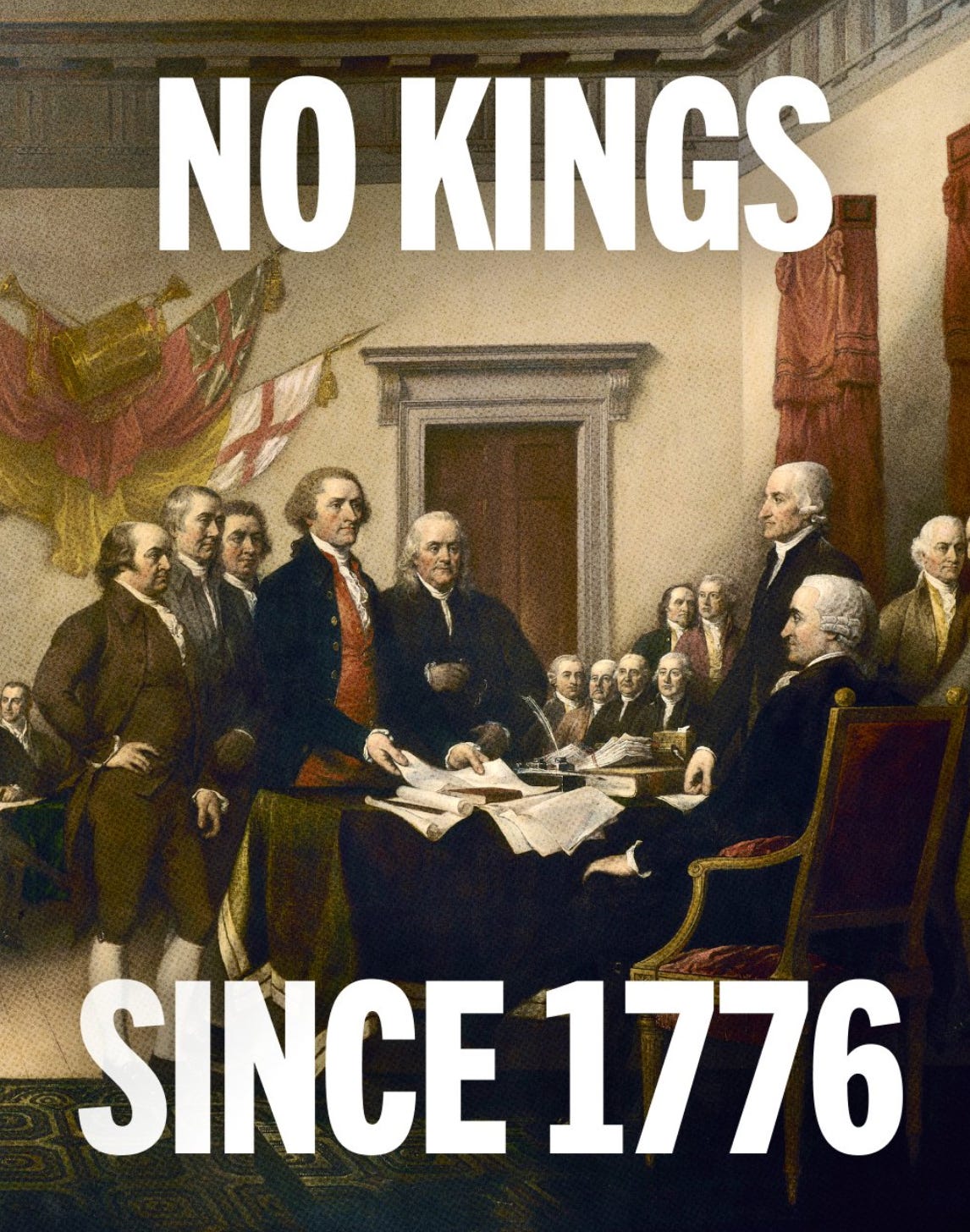
1. Protests are Growing.
The March 28, 2026 actions produced more than 3,300 organized events across the
country and an estimated 8 million participants, making it perhaps the largest
single-day protest in American history. That follows 5 million participants in
June 2025 and nearly 7 million in October 2025. The photos tell the
story: flags waving, crowds energized, signs both pointed and witty, and a
spirit of defiant humor. The protests have been overwhelmingly peaceful,
which makes them harder to dismiss and easier for others to join.
2. Cracks in the Monolith.
Until recently, Congress has largely folded in the face of Trump threats. But
the coverup of the Epstein files has exposed real fissures in the Trump coalition, and the war in Iran is straining MAGA’s “America First” base. Sen. Thom Tillis dismantled Kristi Noem in Congressional hearings, and Pam Bondi
destroyed herself. Republican Senators are increasingly uneasy, and are
beginning to question the actions of cabinet officials.
That Senate Republicans abandoned Trump’s proposed SAVE Act is
also telling. Constitutionally suspect and politically reckless, the measure
risked disenfranchising not just Democrats but millions of Republican
voters lacking ready access to proof of citizenship. Roughly 21 million
Americans lack such documentation; 2.6 million have no government-issued photo ID. Efforts to restrict mail-in voting run headlong into reality; more than 40 states allow it, including eight and Washington, D.C., which conduct their elections entirely by mail.
Meanwhile, public tolerance for ICE’s tactics is eroding. Americans still broadly support deporting violent offenders—but draw a sharp line at the detention of children, the arrest of legal residents, or the use of excessive force against citizens. Roughly two-thirds of Americans now say ICE enforcement has gone too far.
3. Trump’s Popularity is Tanking.
Poll after poll shows a steady decline. Democrats are racking up wins in key special elections across the country, flipping 29 Republican seats in state and Congressional elections since Trump took office. Just last Tuesday, liberals in Wisconsin easily won another state Supreme Court seat. And while Republicans won the election to replace Marjorie Taylor Greene in Congress, the Democratic challenger massively overperformed – another warning sign the GOP can’t ignore.
4. Democrats Are Finding Their Voice.
For a party in the minority, clarity and victories are hard-won, but Congressional Democrats are beginning to deliver both. During the recent government shutdown, they seized the moment—standing up for TSA workers and forcing Senate Republicans to back down. They’ve also fielded a deeper, more disciplined group of candidates, putting far more seats in play this fall, including Senate races once written off as unwinnable.
5. Legal Resistance Remains Mobilized—and is Winning Key Victories.
The administration has been sued—a lot. Even setting aside immigration detention cases, it has now lost at least 150 cases in lower courts. Leading the fight has been 23 Democratic state Attorneys General, alongside a network of legal advocacy groups, who move quickly – often within days – to challenge Trump’s unconstitutional orders.
A significant battle now involves Trump’s attempts to nationalize elections by seizing state voter lists. In May 2025, the U.S. Department of Justice demanded that states turn over voter registration lists, not just publicly available data like names and addresses, but highly sensitive information, including driver’s licenses and Social Security numbers.
A majority of states have refused, including at least eight led by Republican election officials. Even deep-red states such as Idaho and West Virginia — where Trump won overwhelming majorities –-resisted this intrusion.
The DOJ responded with lawsuits to compel compliance. So far those efforts have fallen flat. Federal courts have dismissed four such cases – in California, Georgia, Michigan and Oregon, underscoring both the legal weakness of the administration’s position and the continued strength of institutional checks.
1. An Uncertain War in Iran.
The administration has offered no clear rationale for military intervention—and appears to have no exit strategy. Whether the recent a “ceasefire” can bring an end to the conflict, or merely delays Trump’s threats to annihilate “an entire civilization” for another two weeks, the risks of escalation, more American casualties, and wider economic instability remain.
2. Making Voting More Difficult.Across multiple states, election rules are being reshaped to entrench GOP power, with new congressional maps in Texas, North Carolina, and Missouri, limits on early
voting, and stricter ID requirements. Texas reduced the number of its polling
places, Iowa eliminated nine days of early voting, and Georgia made providing
water to voters waiting in line a crime. 16 states, mostly in the south, now prohibit or restrict use of drop boxes. Utah, South Dakota, and Mississippi recently joined nine other states in requiring proof of U.S. Citizenship to vote.
3. A Slow-Moving Judiciary Meets Fast-Moving Power.
While many administration actions have been overturned by the courts, this takes time, and Trump continues his attempts to manipulate the legal system. Following the failure of the SAVE ACT, Trump issued another executive order to restrict mail-in voting and centralize voter verification. Almost immediately, a coalition of more than 20 states —led by California, Massachusetts, Nevada and Washington —filed a lawsuit in federal court to block the order. Virginia recently joined the action.
4. The Remaking of the Federal Government.
Key institutions are under sustained pressure. Noem, Bondi, and Bovino are now gone, but don’t hold your breath that we will get a “kinder and gentler” ICE or DOJ. Kash Patel continues to undercut the legitimacy of the FBI. The Justice Department’s Civil Rights Division has been hollowed out, with about 250 attorneys (or 70% of the component) having left, been reassigned, or resigned since January, 2025. Confidence in federal law enforcement is being undermined. Science-based policymaking, particularly in health under RFK,Jr., is under attack.
5. Midterm Elections Remain the Major Battleground.Reports—denied but persistent in light of a memo circulating among MAGA faithful—suggest possible federal intervention at polling places this fall. Trump says he
“knows nothing” about this, but he said the same of the Project 2025 document. Even the suggestion of deploying federal agents raises alarms. States are beginning to respond. Eight state secretaries of state have written the administration to oppose the option, and Virginia and Nevada just passed state laws against it. ICE personnel and funding increases and the administration’s rapid building of detention centers throughout the country only fuels the concern.
1. Keep Up Peaceful Public Protests and build “coalitions of the willing.”
Public demonstrations remind people they are not alone—and signal to leaders that the public is engaged. The next major mobilization is May 1. You need not agree with all protesters about every issue, but numbers make a difference. U.S. history show protests work, but they do not substitute for electoral power. If Republicans maintain control of Congress after the midterms, the constraints on presidential action will weaken further.
2. Vote for key issues—and good candidates.
If you live in Virginia, support the state referendum on April 21 to counter GOP plans to control Congress by skewing congressional districts. Vote as early as possible and in person if you can. Don’t let changing rules catch you off guard.
3. Plan 6-8 months in advance.
Check your registration today. Then get five others to do the same. Know your rights. Connect with local organizations. A handful of calls or door knocks each week can matter more than you think. Google your local political party to get information and volunteer. Rogan’s List always has discrete tasks for volunteers, including these options.
4. Invest where it counts.
Support candidates and organizations strategically. In our area, our former Congressperson, Tom Perriello, needs your help. If your local race is safe, look elsewhere. Here are some flippable seats. The DCCC continues to update its “Red to Blue” list with the best prospects. Every State Blue is committed to creating grassroots communities of people like you who want Democrats to fight everywhere.
Interested in state races? Forward Majority, States Win (formerly Sister District), and The States Project are working for candidates in state legislative races. If your state legislator is safe, help flip a district in another state. The Downballot provides much useful information about state races.
5. Support the legal fight.
Legal advocacy groups will shape the battlefield in 2026. They need support. Prominent groups include Democracy Forward, Democracy Defenders Fund, the Brennan Center for Justice, the ACLU, and Elias Law Group. Democracy 2025 lists groups that focus litigation on civil rights, immigration, and democratic institutions.
The political environment is changing. The opposition is expanding. The window is now open—but it is up to us to widen it. That will take discipline, persistence, and strategy equal to the moment. Momentum can dissipate as quickly as it forms. Opportunity alone is never enough; only sustained effort can take advantage of this opening to bring the change we all desire.
Comments
Nothing yet. Say the first thing.
Sign in to join the conversation.