
Father’s Day and our Nation’s 250th birthday invite reflections on our children and the nation they are inheriting. Most parents want the same things for their sons and daughters: health, safety, meaningful work, loving relationships, and the freedom to build lives of purpose. We push them to develop judgment, compassion, and a sense of responsibility to others. We want them to have a fair chance. We hope that they can live in a country in which they can be proud.
These aspirations are neither partisan nor ideological. They are widely shared regardless of politics or views of the person occupying the White House.
The success and happiness of our children often depends on their own efforts. They can be aided by support they receive from family, friends, teachers, and mentors. Or just lucky. But much is shaped by the country in which we live — and by the public choices that determine its direction.
Today, those choices feel unusually consequential. Our world is marked by uncertainty and risk, where the path forward seems less clear, and more perilous, than at any point since the end of the Second World War.
As we look to the future, our children and country face significant challenges. Here are several that give cause for concern, together with options to address them. Some solutions can come with the next election; others may take decades. But we ignore these at our peril—and at great cost for future generations.
Your family may be among the Americans fortunate enough to receive employer-sponsored health insurance. Or, if their income is limited, they may qualify for Medicaid. But what about those who must buy insurance on their own, either in the private marketplace or through the health care exchanges?
Their challenge has recently become more difficult. Despite President Trump’s promises of better and cheaper health care, the so-called “Big Beautiful Bill” took direct aim at the Affordable Care Act by dramatically reducing the marketplace subsidies that help millions of Americans afford coverage.
As a result, over 20 million Americans saw increases in their health insurance premiums for Marketplace coverage in 2026, and higher bills are projected for 2027.
When premiums climb, families sometimes step in to subsize the cost. For many, however, this is not an option; instead, they will simply drop coverage. Marketplace enrollment is projected to fall by 7.3 million persons this year. In Virginia, 389,000 people were enrolled in Virginia’s Insurance Marketplace at the end of 2025. That number has now dropped to 298,000.
This will increase the burden on our hospitals, many of which are already challenged economically. The insured’s only option for care may be the emergency room — assuming one remains nearby.
A recent report from the Center for Healthcare Quality and Payment Reform concludes that almost 300 hospitals nationally risk closure in the next several years, including 13 in Virginia. Rural communities are especially vulnerable. Of the ten states with the largest number of hospitals at risk, nine voted for Trump in the last election.
When uninsured patients cannot pay, the costs do not disappear. Hospitals absorb some of them, and states often reimburse part of the bill with taxpayer dollars. And while health insurance does not guarantee good health outcomes, it make it easier to access care and improve health outcomes.
Medicaid changes enacted by Congress further complicate matters. If you are poor and depend on Medicaid, the Trump plan may force you off coverage as it reduces federal aid to the states by $665 billion between 2025 and 2034. New eligibility requirements will mean fewer people will qualify and more will go without coverage.
This problem cannot be fixed without electing a different Congress in the Midterms. Congress has the power to restore the subsidies and the funding. In the meantime, some hope can be found in the states. Virginia and 14 other states, including DC, provide fully state-funded coverage for income-eligible children, and are passing short term fixes to fill some of the gaps. Ten states—California, Colorado, Connecticut, Maryland, Massachusetts, New Jersey, New Mexico, New York, Vermont, and Washington—have created premium subsidies to reduce the cost of insurance in their marketplaces. Ultimately, a new President in 2028 will see the importance restoring the federal cuts and improving access to health care.
Most parents teach their children a simple principle: if you work hard and play by the rules, you should have the chance to go as far as your ability will take you, no matter your wealth and connections.
But what happens when the rules themselves seem negotiable? Each day seems to bring another broken norm, another crossed line, and another example of powerful people avoiding accountability. This is the kind of conduct we usually associate with fragile democracies, not our own.
How do we explain the pardoning of hundreds who attacked the Capitol and injured police officers on January 6? Or efforts to reward some of them afterward? How do we justify the continued failure to fully release the Epstein files so that the full scope of wrongdoing can be known? What if one of the victims was your daughter, and the most powerful person in the world was blocking perpetrators from being held accountable?
How do we rationalize presidential pardons and commutations granted to major Trump donors and political allies convicted of fraud—including one that defrauded the Medicare program $1.3 billion? Or the administration’s recent quashing of a federal investigation of whether improper payments were made to secure a commutation for private equity executive David Gentile, previously convicted by a jury of defrauding small investors out of $1.6 billion?
If our children are disillusioned with government, these events help explain why. Many elected officials I know, including those with views sharply different from mine, appear honest and serve with good intentions. Yet Americans increasingly see public office less as a vehicle for service than as an avenue for private gain. This administration’s conduct has only increased that cynicism and should concern anyone who values ethical government, regardless of party.
That distrust is fueled by reports that President Trump’s personal wealth increased by approximately $1.4 billion in a single year. Forbes recently argued that the President has repeatedly leveraged his office for financial benefit. Unlike most predecessors, who avoided stock purchases while in office or took other steps to prevent conflicts of interest, Trump’s investment advisers remain active in the market. Shortly before the Commerce Department approved the sale of Nvidia chips to China, Trump purchased shares in the company. After the announcement, the stock rose, increasing the value of his investment. Similarly, Dell shares surged after Trump publicly encouraged investors at a White House event to “go out and buy a Dell.” In another example of influence peddling, Trump and Commerce Secretary Harold Lutnick recently engineered a mining deal with Kazakhstan that directly benefits their children—hardly something you or I could, or would, do.
At the same time, many internal safeguards designed to expose misconduct have been weakened or removed. Shrinking the federal workforce has made many employees wary of reporting government impropriety. But Trump went farther, firing 17 Inspectors General, the independent watchdogs who have long played a critical role in uncovering corruption and government inefficiency on his first days back in office. By the end of 2025, 55 percent of the 38 presidentially appointed Inspector General positions remained vacant.
The combination of weakened oversight, growing perceptions of self-dealing, and the use of presidential clemency for well-connected allies sends a troubling message: that accountability depends less on the law than on proximity to power. When citizens believe that there is one set of rules for ordinary Americans and another for those with money and influence, trust in government inevitably suffers.
Trump has concluded that loyalty matters more than competence. At the FBI, Director Kash Patel has overseen the removal of numerous career officials. Secretary of “War” Pete Hegseth engineered the departure of key military leaders. Justice Connection, a group of former Department of Justice employees, reports that 75 percent of attorneys from the Civil Rights Division have been fired or forced out since Trump took office, largely because they participated in cases he disliked or disputed department policy. Acting Director of National Intelligence Bill Pulte is now firing intelligence personnel whose expertise is critical to identifying terrorist threats.
When loyalty becomes more important than competence, government eventually loses its ability to fulfill its most basic responsibilities. The recent debacle at the Lincoln Memorial Reflecting Pool is a vivid illustration. The pool has required repairs for
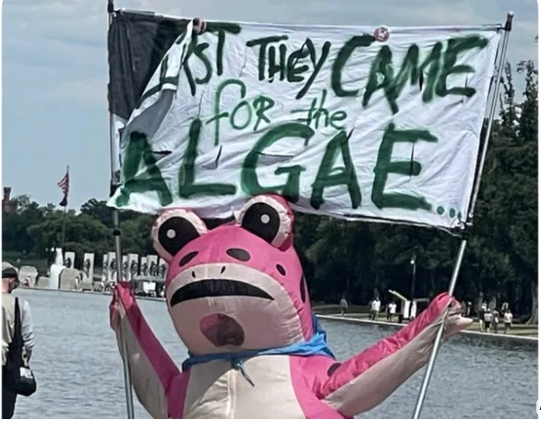
decades, and President Trump promised to restore it in time for the nation’s 250th anniversary, including painting its bottom what he called “American flag blue.” The plan has been a disaster. The administration awarded a $1.7 million no-bid contract to a company headed by a Trump campaign donor who had previously been convicted of bribery and had little relevant experience. The result is a project plagued by problems: safety fences now surround a reflecting pool that has become both an eyesore and a hazard.
When expertise is discounted and loyalty is rewarded above all else, failure becomes more likely—not just at a memorial in Washington, but throughout the institutions on which Americans depend.
Good news and new hope. The midterm elections hold prospects of a new Congress willing to exercise its constitutional oversight responsibilities and hold hearings on these and other examples of corruption, favoritism, and incompetence.
At the state level, prosecutors can charge individuals who violate state law, even if Trump has pardoned them for similar conduct in federal cases. Wisconsin and Nevada, for example, have active cases against individuals involved in the “fake electors’ scheme.” New Mexico has reopened an investigation into events at Epstein’s ranch in the state after closing the inquiry in 2019 at the request of federal authorities. And while the federal investigation involving Gentile has ended, the New York State Attorney General may still open her own inquiry.
State attorneys general can also intervene. Recently, twenty-four of them filed suit in federal court to overturn Trump’s agreement with the IRS, which granted broad protections to him, his family, and his business interests while creating a $1.776 billion slush fund to reward Trump allies who had violated the law. A federal court has now blocked the fund pending trial.
And courts have resisted Trump’s efforts to legally harass and prosecute prominent people with whom he disagrees. Cases against James Comey and Letitia James were dismissed, though Comey was later reindicted in another federal court. This week, the chief judge of the United States District Court in Minnesota quashed six grand jury subpoenas targeting state and local elected officials, including Gov. Tim Walz, saying they “were not issued to investigate, but to harass, coerce, and retaliate.”
It is difficult for the public to follow the many ways Trump has used his position for private gain and sought to intimidate those demanding accountability. But follow we must, because understanding the threat is essential to countering it.
Freedom and liberty mean little if votes are suppressed or disregarded. Using the erroneous claims that the 2020 election was “stolen”, many conservative states have passed new laws to make voting more difficult. Between January and May of this year, lawmakers in Florida, Kansas, Kentucky, Mississippi, Nebraska, New Hampshire, South Dakota, Utah and West Virginia adopted new measures that laws Between January and restrict access to voting. Florida, Mississippi, South Dakota and Utah now require proof of citizenship before a person can register to vote in state and local elections.
Similar actions are being pushed by Trump. His administration is trying to assert federal control over elections that have historically been administered by state and local officials.
The President has demanded access to every state’s voter files—a move that would give the federal government, regardless of who holds the presidency, greater power to determine who is eligible to vote. To date, he has failed. Many states refused to provide their files, prompting the Department of Justice to sue in federal court to force compliance. Trump has now lost every case that has reached a federal trial court ruling. In late June, the 6th Circuit Court of Appeals upheld one of those rulings, setting up a possible appeal to the U.S. Supreme Court.
Those court defeats, however, did not stop the FBI from raiding and gathering data from election offices in Georgia. Nor have they ended Trump’s push for voter lists. He recently held a popular housing bill hostage, hoping to force Congress to give him access to this information.
Trump has also targeted mail-in voting, which is used by 30 percent of all voters. In eight states—California, Colorado, Hawaii, Nevada, Oregon, Utah, Vermont, and Washington—plus Washington, D.C., a majority of voters cast ballots by mail, and ballots are automatically sent to eligible voters before an election.
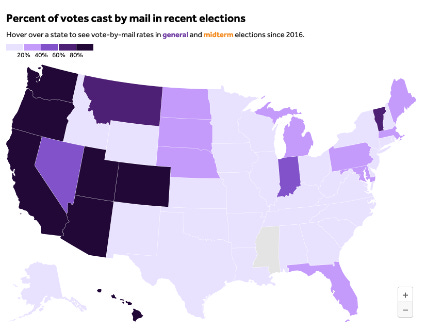
Trump’s March executive order restricting mail-in voting is likely unconstitutional, but no court has yet voided it. Particularly troubling were Trump’s demands, now blocked by a federal court, that the U.S. Postal Service, despite its status as an independent corporation, refuse to deliver ballots from voters in states that decline to provide the administration with their voter rolls. And reports surfaced this week that the administration is threatening to withhold federal homeland security funds from states unless they adopt a sweeping set of election changes, including providing voter lists.
Trump recently declared that failure to enact the SAVE Act, with its sweeping changes to election administration, is a “national emergency.” What this means for elections this fall is not clear. Federal and state laws largely bar the deployment of federal agents to polling places, but Trump allies like Steve Bannon suggest that federal forces should be stationed at voting sites during the midterms. The administration has never ruled out the use of ICE for this purpose, and Acting Attorney General Todd Blanche has publicly endorsed this option.
The explosion of the agency’s size (up 10,000 to a total of 22,000 in 2025) and expansion of its budget from $6 billion to $85 billion in the last two years only increases the anxiety.
Our children learn about democracy not from textbooks alone, but from watching how elections are conducted. If Trump succeeds, our elections will be fundamentally transformed, and our children’s ability to cast a meaningful vote could be in peril. Even if these executive orders are ultimately overturned, they create confusion, chill participation, and make it harder for millions of Americans—regardless of party—to cast a ballot. Imagine if these lists were cross-checked against a list of gun owners to reduce their ability to vote.
To date, courts have supported keeping elections in the hands of state and local officials and denied Trump’s efforts to restrict mail-in ballots and invade Americans’ privacy by assembling state voter files. This week, the U.S. Supreme Court dismissed a Republican lawsuit attacking early voting, and held that all mail ballots postmarked by Election Day are counted, so long as they arrive within five days later. Currently, 14 states have laws allowing mail ballots postmarked by Election Day to be counted if they arrive after.
Some states – including California, Colorado, Connecticut, Illinois, Maryland, Minnesota, New York, Oregon, Virginia, and Washington—have passed their own Voting Rights Acts to protect access to the ballot. Even leaders in some red states have not fully embraced the Trump agenda. Legislative leaders in Indiana, Georgia, and South Carolina refused to join the hyper partisan redistricting train. And Ohio Republican Gov. Mike DeWine recently vetoed a bill that would have required voters to include a copy of their ID when requesting a mail-in ballot.
It is difficult to remain calm in the face of so many serious challenges coming at us so quickly. They will not be easy to overcome. First step is keeping informed. Next is combating them as much as we can—and supporting leaders who do the same. But ultimately, this November’s elections is a chance to turn the tide. If enough Americans show up to vote, the difference can be enormous.
In the Next Installment, I will explore the following trends that have only gotten worse in the last several years. Our 250th birthday is a perfect time to consider the American Dream and how more can gain access to it.
It is Harder to Get Ahead
Cultural Conflict and the Loss of Freedom
The Balkanization of America
Comments
Nothing yet. Say the first thing.
Sign in to join the conversation.