

There’s a lot of noise online re’ education: low grades generally, some children in the United States not being able to keep up with international academic standards, and the role of EdTech in education.
The Atlantic stated in October 2025:
‘ … At the start of the century, American students registered steady improvement in math and reading. Around 2013, this progress began to stall out, and then to backslide dramatically … The decline began well before the pandemic, so COVID-era disruptions alone cannot explain it. Smartphones and social media probably account for some of the drop. But there’s another explanation … a pervasive refusal to hold children to high standards.’ (1)
That’s a bold statement: ‘a pervasive refusal to hold children to high standards.’
In a study titled ‘The Unintended Consequences of Academic Leniency,’ the researchers agree with the Atlantic statement:
‘ … more lenient standards could distort incentives for low-achieving high school students, undermining their motivation to succeed and widening achievement gaps on tests like the ACT. Lowering standards, that is, hurts rather than helps already struggling students..’ (2)
So, a lack of motivation is the result of lenient standards, which doesn’t serve the students who are battling to learn.
Why?
We need to be motivated to learn, because being motivated to learn stimulates the brain neurophysiologically, which we’ll dive into later in this article.
Although finding the source of the quote below has proven to be a challenge, it is nonetheless true:
‘The mind is not a vessel to be filled, but a fire to be kindled.’
Motivation has an important role to play in acquiring knowledge, and educators who can inspire this emotion will play a significant role in the success of their pupils.
In addition, economist Eric Hanushek describes the difference between schooling and learning: schooling refers to the amount of time students stay in class vs learning, which is a measure of what they actually know and can do.
Hanushek believes, which intuitively makes sense, that it’s easier to keep kids in school, but it’s more valuable to teach them, which is the metric that educators and policymakers should pay attention to, not how long they’re in their classrooms. (3)
The Harvard Gazette, addressing reading scores, in a September 2025 article stated:
‘ … This month, average reading scores for high school seniors - released by the Nation’s Report Card - fell to their lowest level since 1992 … American students’ literacy skills peaked in roughly the middle of the last decade and have fallen significantly since that time.’ (4)
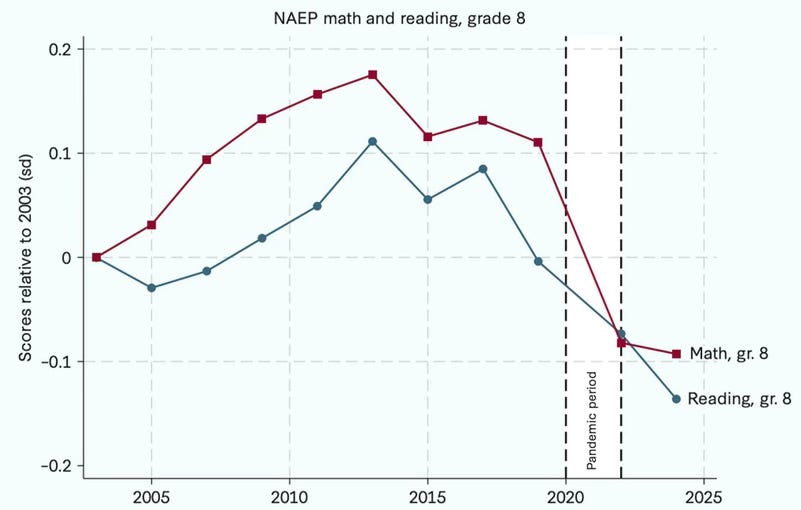
The Hoover Institute suggests that blaming Covid is not reasonable because the educational system has been in crisis since 2013, which the graph below shows clearly. (5)
The Trends in International Mathematics and Science Study (TIMSS) report shows results from 4th graders across 63 education systems, and 8th graders across 45 education systems, every four years.
The TIMSS report also collects information about curriculum, school technology use, teacher preparation, and other measures of school context:
‘… American students still score above the international average on TIMSS, but they rank below children in the highest-performing nations, including Japan, Singapore, and Korea.’
… Other countries that previously lagged behind the United States, such as Australia, Poland and Sweden - have jumped ahead of the US in some subjects and grade levels …
… In math, American 4th graders’ scores fell 18 points after 2019, while 8th graders’ scores fell by 27 points - the biggest drop since the United States began participating in the test in 1995.’ (6)
In addition, Pew research shared 2024 highlights from The Organisation for Economic Co-operation and Development (OECD) which is an intergovernmental organisation with 38 member countries, founded in the 1960s:
U.S. students ranked 28th out of 37 OECD member countries in math:
Among OECD countries, Japanese students had the highest math scores and Colombian students scored lowest.
U.S. students ranked 12th out of 37 OECD countries in science:
Japanese students ranked highest and Mexican students ranked lowest. (7)
However, global educational scores have generally been declining for the past two decades, according to the Program for International Student Assessment (PISA) as the image below highlights.
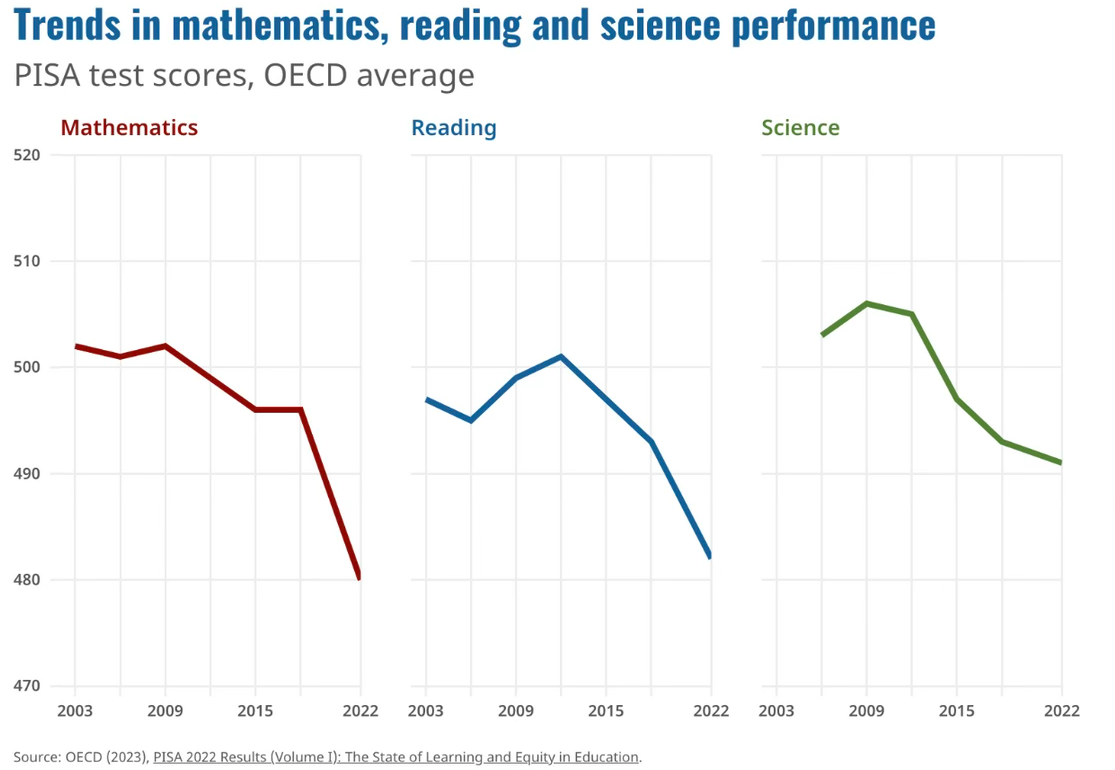
One hypothesis is that technology is distracting teenagers, although students were asked about technology distraction for the first time only in the 2022 PISA.
Forty-five percent of students said they feel anxious if their phones are not near them and, specifically related to math lessons, sixty-five percent report being distracted by digital devices during such. (8)
In relation to spending on education, schools in the United States spend an average of $20,387 per pupil, which is the 3rd-highest amount per pupil (after adjusting to local currency values) among the 40 other developed nations according to the Organisation for Economic Co-operation and Development (OECD). (9)
However, isn’t EdTech going to remedy all education-related ills?

Antero Garcia, associate professor in the Stanford Graduate School of Education said the following on a podcast in 2023, which feels like a lifetime ago in relation to where technology has since moved:
‘ … As a professor of education and a former public school teacher, I’ve seen digital tools change lives in schools … Given the substantial amount of scholarly time I’ve invested in documenting the life-changing possibilities of digital technologies, it gives me no pleasure to suggest that these tools might be slowly poisoning us… Despite their purported and transformational value, I’ve been wondering if our investment in educational technology might in fact be making our schools worse.’ (10)
Furthermore, according to the EdTech Evidence Exchange (EEE), schools spend a lot of money on EdTech, and most of the time it’s a waste of their limited funds.
According to the EEE, educators estimate that 85% of EdTech tools are poor fits or poorly implemented and reveal very weak returns for the $25 billion or more annually spent on EdTech in the US alone.
A published article describes the problem succinctly:
‘ … school procurement of EdTech is rarely based on rigorous or independent evidence.’ (11)
Many other researchers agree. (12, 13, 14, 15)
And Emily Cherkin, an American vocal advocate for screen-free education quotes what Steve Jobs said over a decade ago, in her article on why EdTech shouldn’t be in classrooms:
‘I used to think that technology could help education … But I’ve had to come to the inevitable conclusion that the problem is not one that technology can hope to solve. What’s wrong with education cannot be fixed with technology. No amount of technology will make a dent.’ (16)
Obviously, shifts in educational processes haven’t led to the breakthroughs educators and parents have been promised.
As the author of the excellent ‘Seven Myths about Education,’ Daisy Christodoulou noted:
‘ … The biggest contemporary myth about education is the idea that knowledge no longer matters. People now say that know-how is more important than knowledge, since children don’t need to know things they can look up on their smartphones at any time.’ (17)
This article is an attempt to explain how the brain learns so that we’re able to fix what’s gone wrong in our educational institutions.
In 2017 Daniel Willingham proposed a simple theory about how we learn:
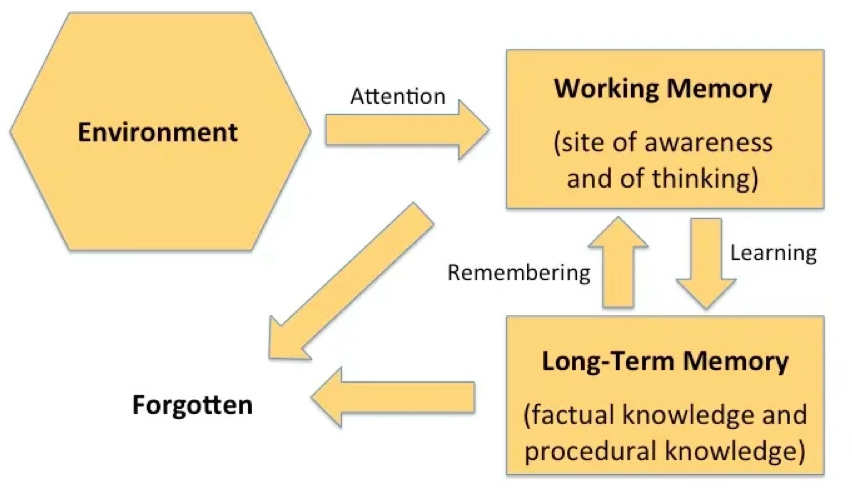
We integrate information from our environment with facts and procedures we’ve previously stored in our long-term memory (LTM) using our working memory (WM) which allows us to temporarily store and manage the information we’re exposed to.
This allows us to make sense of new inputs, and we then transfer this - what we learn - into LTM. The image below is a simple visual explanation of how this happens. (18)
[NOTE: In Part 2, I add a concept to the above image, which researchers have hypothesised about, which is useful to know, and use.]
So, learning starts with filtering stimuli from the environment to allow focus on the content requiring attention.
A quiet and distraction-free environment supports attention and sustained focus.
As mentioned in an article I wrote on attention on Substack, there are two types of attention:
1) Controlled and conscious attention, wherein we decide what to pay attention to and focus on that, to the exclusion of anything else, and
2) Stimulus driven attention, wherein something in the environment draws our attention, also known as being ‘distracted’ from what we were focused on.
Whatever we pay attention to becomes part of our short term, or WM.
But it can easily slip away if we don’t continue to pay attention to it.
That means we have to stay focused on what we’re focussed on, which keeps that information in our WM. Only then do we have a chance to integrate it into what we already know, or make a new memory.
However, can we still do this effectively?
Cognitive load refers to the amount of space, or ‘bandwidth’ the brain has to process information - what capacity our WM has at any point. (19)
In order for us to optimally support our WM we need to eliminate as much extraneous cognitive load as possible.
In other words, we need to ensure that we’re not distracted while we’re focussing on the knowledge we’re trying to learn. Otherwise it can’t move into our LTM.
It’s not hard to imagine what happens when attention can’t be sustained.
To read or listen to the article about attention-fracture please click the button below:
Despite knowing that attention is precious, and is a very important part of learning, there are still many ‘neuro-myths’ about how we learn.
One of the most pervasive is that different people learn differently.

‘Learning styles’ are a subjective categorisation which asserts that different people learn knowledge in different ways.
More than likely, you have heard of so-called visual, kinaesthetic, and auditory learners.
This theory suggests that if you know what ‘learning style’ you prefer, and use that ‘style’ to access and learn knowledge, you’ll have a better learning outcome.
Perhaps you’ve colluded with this idea and categorised yourself or your child into one of these categories and even structured learning to fit this personalised ‘label.’
Unfortunately, it is one of the most pervasive learning myths, with an estimate of, on average, over 95% of educators worldwide believing in and advocating for this ‘neuro-myth.’ (20, 21)
In a recently published study, the researchers tackled this pervasive myth about students preferred learning styles:
’The persistence of learning styles as a concept in educational discourse and research is paradoxical, given the overwhelming evidence discrediting the matching hypothesis, the notion that aligning teaching methods with students’ preferred learning styles enhances achievement.’ (22)
The ongoing discussion may have more to do with the ‘correlation vs causation’ challenge - that is, students learn during focussed and distraction-free periods of attention, regardless of which method of instruction is being used.
However, whichever one is used at a particular time, which is also effective, may become their preferred ‘style’ of learning.
Next, let’s examine some observational research.

Piaget famously observed his own children at play to try and learn how they were learning and thinking.
Based on what he observed, he developed his theory of cognitive development, and proposed that children move through a sequence of four stages, characterised by (among other things) increasing ability to use abstract thought.
To test predictions of his theory, Piaget conducted experiments by asking children to perform carefully devised tasks.
In one task, they were asked to solve problems with a balance scale, using weights with differing characteristics.
And if you’ve ever heard of ‘object permanence,’ defined as a foundational concept in infant cognition, which refers to a child’s understanding that objects continue to exist even when they cannot be seen, heard, or touched,’ then you’re already acquainted with Piaget’s seminal work.
Piaget had stumbled upon the brains ability to develop mental representations, or ‘schemas,’ (more on this later), which in the case of ‘object permanence,’ allow infants to retain the idea of an object in their mind even though the object may no longer be visible.
Although Piaget correctly theorised that we experience cognitive development from ‘cognitive disequilibrium,’ wherein we learn from the mismatch between what we expect and reality, he wasn’t correct in assuming that our brain automatically reorganises its mental models, or schemas, without explicit guidance.
That is, this ‘updating’ of knowledge isn’t an automatic phenomena. We have to actively engage with the new knowledge before it becomes part of our LTM.
Piaget did however observe that as his children got older they were able to grasp more complex concepts, which underpins what we now know about brain development. (23, 24, 25)
This observation leads us naturally to how specific periods of time serve the developing brain.
All behavioural and cognitive change is underpinned by brain change.
However, brain change isn’t uniform across our life-span.
The early years of a child’s life are ones of rapid growth for the body and brain.
A young brain is primed to learn and change very quickly because this helps it adapt to a wide range of environments and experiences that may all be important for its survival.
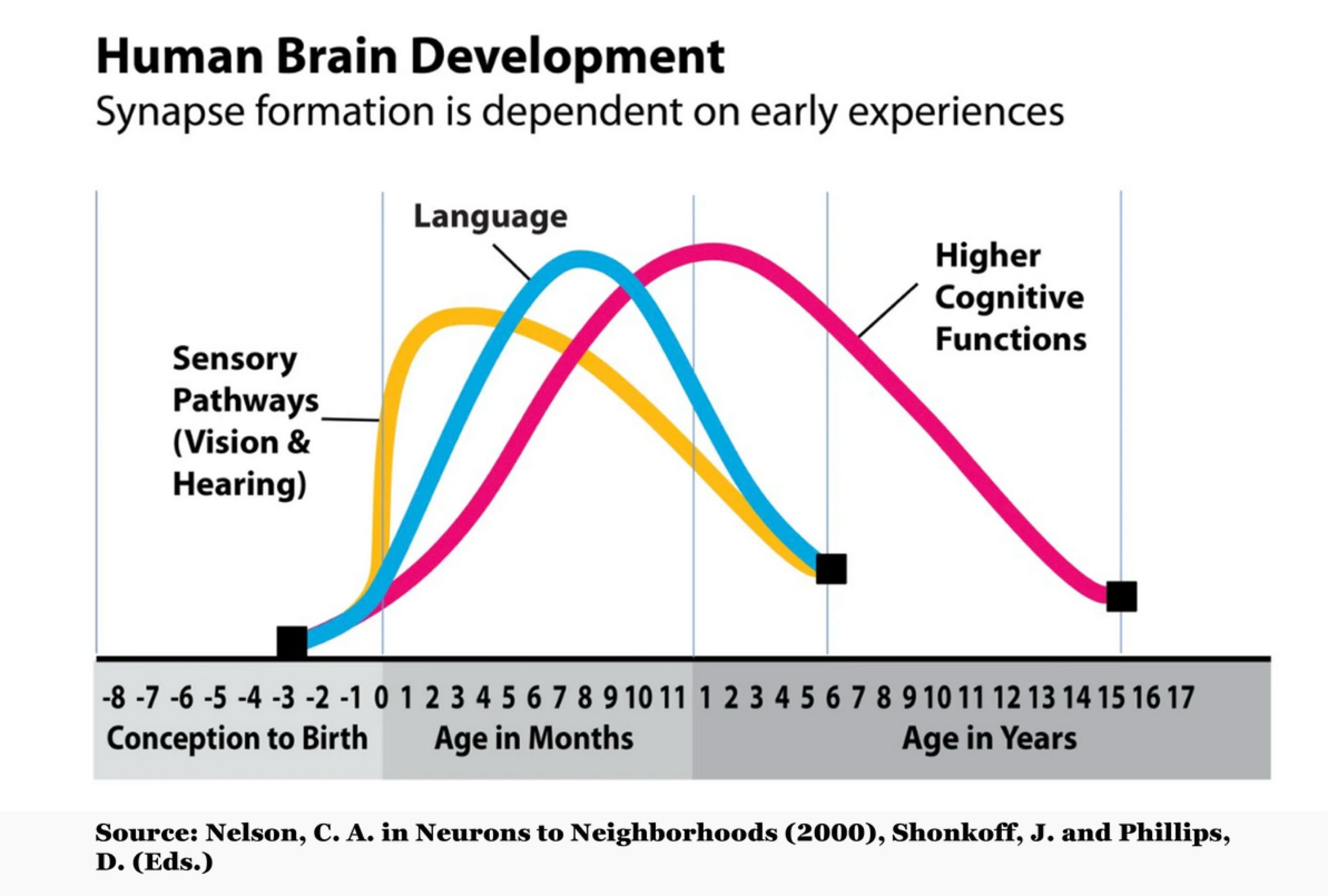
Specific periods of time act like ‘windows’ for specific learning activities to occur, which simply means that neurons are connecting at a very rapid pace and strengthening connections to support specific activities and knowledge.
Researchers call these specific periods of time ‘windows of neurodevelopmental opportunity’
Researchers also call this period of time ‘transient exuberance’ because its underpinned by temporary, but dramatic, and rapid growth.
Exuberant growth forms part of what’s happening to the developing brain, and occurs via rapid connections between neurons that are being used.
Researchers estimate that about 40 percent of these connections will be lost. (26, 27, 28)
Something called ‘synaptic pruning,’ is also occurring, wherein neural connections are reduced, leaving those that have been used regularly much stronger.
This pruning process leads to more efficient brain function in that it allows for focus on a few specific, complex skills, which leads to mastery of such.
In other words, whatever we focus on and whatever we experience will shape which of these neural connections will be maintained and which of them will be pruned.
Again, the old and familiar neuroscience nugget comes to mind: ‘neurons that fire together wire together.’
This is why its easier to learn a new language in your first seven years of life. The brain is primed to learn language quickly - so makes it easier to do so - because it supports survival.
Transient exuberance occurs during the first few years of life, and pruning continues throughout childhood and into adolescence in various areas of the brain. (26, 27, 28)
The image below highlights the specific ages where the brain is focussed on supporting rapid neuronal connectivity and consolidation of neural pathways.
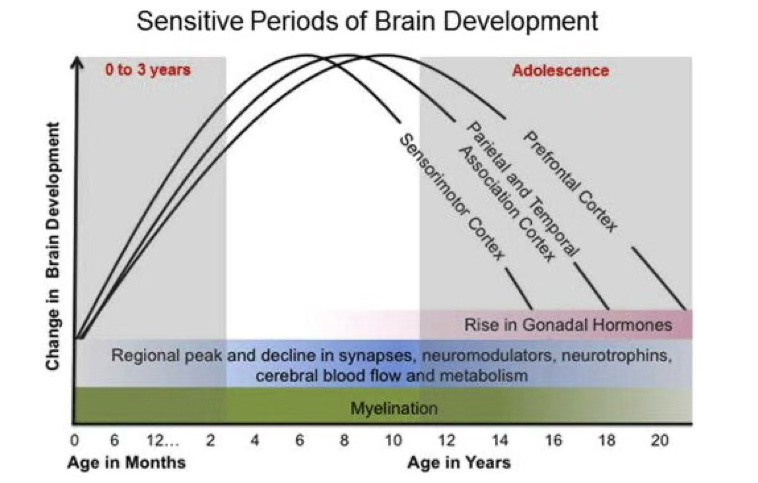
[NOTE: I included two graphs, albeit different ones, regarding this topic because it is critically important to understand that these periods of development are significant and underpinned by very rapid neural development - they are when the brain is extra sensitive to optimal and less-than optimal experiences.]
For more about opportunistic windows of development please click the button below:
Barbara Oakley, a distinguished professor of engineering and a world recognised expert on how the brain learns, stated succinctly in a recent peer-reviewed article:
‘ … Compared to other primates, humans are late bloomers, with exceptionally long childhood and adolescence. The extensive developmental period of humans is thought to facilitate the learning processes required for the growth and maturation of the complex human brain … (29)
Basically, during the first two and a half decades of life, the human brain is a neuronal construction site, and learning processes direct its shaping through experience-dependent neuroplasticity.
Formal and informal learning, which generates long-term and accessible knowledge, occurs via neuroplasticity, which creates functional and adaptive structural changes in brain networks.
‘Since experience-dependent neuroplasticity is at full force during school years, it holds a tremendous educational opportunity.’ (29)
Oakley describes two specific types of learning, namely biologically primary knowledge, which is composed of skills like language and facial recognition.
In other words, we don’t have to be explicitly taught how to speak our home language or to recognise our family and friends.
We learn these skills as we develop, naturally.
However, biologically secondary knowledge, generally requires deliberate instruction.
Think of the subjects that allowed our culture to thrive and are still required to keep our society functioning well, like reading, mathematics and science. (19, 29)
Brains are not wired to effortlessly pick up this type of knowledge. It requires deliberate instruction which means we have to be taught the principles and rules that underpin these subjects.
Leaning about these principles and rules initially requires focussed attention which activates our WM. As we engage with the knowledge regularly, and practice the rules, it moves into our LTM.
Then it becomes easy to retrieve the knowledge when we need to use it.
Unfortunately, there’s been a trend in education to allow students to discover what they need to learn in relation to these subjects. (29)
This is also referred to as ‘student-guided learning,’ or, as per Christodoulou, ‘guide on the side.’
However, this strategy doesn’t acknowledge, firstly, the difference between primary and secondary biological knowledge, and secondly, that knowledge and skills are ‘two sides of the same coin.’
This means that we need to have specific knowledge embedded in our memory before we can develop skills around the knowledge.
Imagin, for excample, trying to grasp calculus before you’ve been taught the basics of algebra.
And, we cannot rely on external tech-devices - like the internet or EdTech - to store the knowledge we need.
In fact, emerging research is highlighting that when we rely heavily on external aids it hinders deep understanding. (29)
Why?
Deep understanding isn’t gained by skimming information which is how we generally engage with external, tech-devices.
And understanding locks in knowledge.
We need memory - stored knowledge - to know what and how to use new knowledge.
We need to know what we know - and don’t know.
And we need them both to learn optimally:
One memory system is for explicit facts and concepts we consciously recall, known as declarative memory.
The second memory system is dedicated to skills and routines that become second nature, known as procedural memory.
In relation to these two systems, Oakley states:
‘ … Building genuine expertise often involves moving knowledge from the declarative system to the procedural system - practicing a fact or skill until it embeds deeply in the subconscious circuits that support intuition and fluent thinking … ’ (29)
In other words, our WM and LTM play a significant role in procedural memory.
You can also think of this as ‘neural friction,’ in that there’s activity occurring within and between neurons while information is being learned, practised, considered and then re-called, or remembered.
Oakley explains this is how a chess master can instantly recognise strategic patterns, or how a novelist effortlessly deploys a rich vocabulary. (29)
They’ve spent countless hours internalising knowledge that’s reshaped their neural networks.
Contrast this to what’s known as the ‘Google effect,’ which is the tendency to forget knowledge that we know is readily available through search engines like Google. (30, 31)
We simply don’t commit this knowledge to our memory because we know that it’s easy to access online.
We also don’t commit it to memory because we’re not motivated to do so.
The brain simply skims information, which uses little neural energy, and then ‘offloads’ the memory to the internet, before it has a chance to become deeply embedded knowledge.
This process is also called ‘cognitive offloading.’
And, because the brain loves to save energy, we unfortunately develop a neural pathway - aka a habit - to do just such.
We remember where to find information, NOT what it is.
And soberingly, a recent meta-analysis revealed that:
‘ … this phenomena is also more likely to happen while using a mobile phone to browse the Internet rather than a computer.’ (31)
As if adding insult to injury, apart from not encoding what we don’t pay attention to, by allowing Google to become our third, external memory, research also reveals we also inflate our sense of self-esteem artificially because we think we know what we’ve accessed. (32)
So, we become confident, but we’re actually ignorant - misplaced confidence - because we know where to find the information, but we haven’t learned anything but that.
Epictetus’s famous quote, is very apt here:
‘It is impossible for a man to learn what he thinks he already knows.’
Firstly, what’s ‘schemata?’
Schemata (plural) are mental frameworks that organise the data we gather and learn, and schema (singular) refer to a specific mental framework.
Schemata actively generate expectations based on what we already know (prior knowledge) which enables the brain to quickly grasp new knowledge.
They are abstract structures that can also exist outside the brain, in computer code or written text. (29)
In addition, whenever we learn something new or have an experience, relevant groups of neurons connect to each other, which allows for stronger connections.
Again, the ‘fire together and wire together’ phenomena.
These strengthening neural connections form what is called an ‘engram.’
It’s the biological foundation of memory.
You can think of an engram as a neural ‘imprint’ left behind by what you’ve learned.
And it doesn’t matter what it is, whether it’s the knowledge that 4 X 4 = 16, or a personal experience.
This knowledge creates a distinctive network - one that exists in physical form - and lasts long after the initial learning occurred.
So, schemata are different to engrams, which are physical traces that a memory leaves in our brain.
We build different schemata by repeatedly encountering related knowledge and actively connecting new details into existing knowledge.
If we have to search for each new piece of knowledge without it being added to what we’ve already consolidated we fail to build lasting schemata.
Oakley suggests this is like ‘trying to complete a jigsaw puzzle by checking the picture on the box for every single piece, rather than developing a sense of how the pieces fit together.’ (29)
Unfortunately, when we ‘offload’ our cognition, this is precisely what happens.
We have to re-visit the knowledge somewhere else, because it’s not been encoded within a schema related to that knowledge.
It doesn’t exist within our neural tissue.

Wonder why you learn (and recall) well in a specific place?
Oakley states:
‘ … memory retrieval works best when current conditions match those present during learning. This explains why returning to a place where you first learned something, can suddenly trigger vivid recollections; the environmental cues reactivate the associated engram.’ (29)
When you successfully recall something you know, the same engram neurons that fired together during the original learning experience are activated again.
And, activating just a small subset of these engram neurons can cause that entire memory network to become active via what is called ‘pattern completion.’
But there’s an important distinction to be noted here:
‘The cue about where to find a memory is quite different than a cue that activates the memory itself.’ (29)
The comparative example Oakley provides is of a student remembering that they can ask an AI/LLM agent to explain photosynthesis but that doesn’t activate the same neural networks as remembering how plants convert sunlight into energy.
These two cognitive activities - where knowledge is held and what the knowledge itself is - are not the same.
One is a ‘memory pointer,’ while the other has become part of the brains internal schemata, and is imbedded in neural tissue.
So, the memory pointer can be to the internet generally too, as in ‘The Google Effect,’ not just to an AI/LLM.
Something else worth noting: When we successfully retrieve a memory, the engram neurons become temporarily more excitable.
What does this mean?
For the next few hours subsequent retrievals are easier and more accurate, which explains why spaced retrieval as a learning tactic is effective for consolidating knowledge in our LTM. (33, 34)
In Part 2 we’ll uncover why not all memories are consolidated in the same way, why researchers are hypothesising about a new type of memory, how external devices rob our brain of consolidating deep knowledge, what the ’85% rule’ is, why memorisation still matters, the perfect storm of ‘abstract thinking + EdTech,’ why reading from a physical book and writing with a pen are important, how emotions impact learning and what the six, evidence-based practices of learning are. The summary, conclusion and full set of references, and extra reading will end Part 2.
NOTE: None of this content was generated by AI.
Comments
Nothing yet. Say the first thing.
Sign in to join the conversation.