
The Russian chip designer Baikal Electronics announced plans to take on NVIDIA directly in the AI-accelerator market. The new Baikal-AI-E1000 chip is designed for edge-AI usage (that is, directly on an AI-enabled drone, for example) and is supposed to be the equivalent of the NVIDIA Jetson Orin NX. The new Baikal-AI-D1000 is supposed to be the equivalent of the NVIDIA L40S, a datacenter GPU used for LLM fine-tuning and other generative AI applications. Both of these “Russian” chips will support the Compute Unified Device (CUDA) ecosystem developed by NVIDIA, so programs written for these NVIDIA chips would also work on these Russian ones.
Please help our affiliate 501c3 by sharing this post widely. They are using anti-corruption methods and techniques to undermine the Russian invasion of Ukraine.
Does this mean that Russia is catching up in the AI race? No. Not even close. Baikal Electronics merely announced “plans” for these chips. The company hopes to release them in 2029 or 2030. The first versions of the NVIDIA Jetson Orion NX were released in January 2023 and the NVIDIA L40S in August of that year. So, in the most optimistic scenario, Baikal Electronics will be six years behind NVIDIA, which is nearly an eternity in the chip production business. Like NVIDIA, Baikal does not actually make its own chips. It uses contract manufacturers to produce the chips it designs and markets. Before 2022, Baikal's contract manufacturer was TSMC of Taiwan, the same one NVIDIA uses. Taiwan has cut Russian chipmakers off from TSMC, so what chipmaker could actually produce these Baikal chips? The obvious candidate is SMIC of China. NVIDIA’s Orin is
The Baikal chips won’t be made in Russian factories, that is for sure. Russia’s chip production can only achieve 350nm lithography! One ambitious Russian chipmaker, MCST, hopes to reach 28nm process technology by 2030. The 2030 date for these Baikal chips, assuming they ever emerge, might be based on a bet that SMIC or some other Chinese chipmaker will reach the scale and precision needed by then. Whatever the reason, this SMIC-Baikal partnership will subsidize demand for Chinese AI chips while establishing a proving ground to help develop China’s domestic AI chip manufacturing.
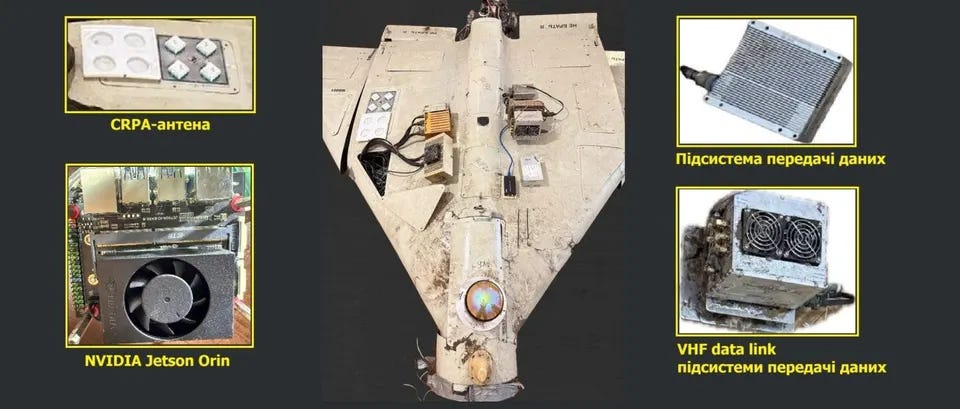
Severing the China/Russia semiconductor nexus both diminishes future Russian capability while also denying China a testing ground and funding source for its domestically manufactured AI chips. The NVIDIA Jetson Orin NX is used directly in Russian weapons. Ukrainians sifting through the wreckage of Shahed drones have
These NVIDIA AI chips were probably purchased openly in China or the UAE (where they cost about $500 each) and then shipped into Russia (or even carried in carry-on luggage between Shenzhen and Kazan). They allow Shahed drones to navigate while their communications are jammed and even recognize and attack targets autonomously. Even if this new Baikal chip is going to be outclassed by the time it comes to market (if it ever does), a 5-year-old chip design may still be good enough to pilot a suicide drone. Kalashnikov automatic weapons don’t have to be advanced to kill, and computer vision AI is currently good enough for AI-guided Shaheds. Imagine Russia in 2030 building fleets of AI-enabled suicide drones to threaten Europe or Ukraine (again). Maybe that is what Baikal’s leadership has in mind, instead of trying to keep up with AI models from the US, Europe, and China.
This matters for the US because Shaheds are the weapon Iran has used to outlast the US Navy. Thus far, there has been no indication that the Shahed drones Iran has used against the US Navy have been AI-enabled. Put differently, Iran is deploying a less-capable, cheaper Shahed model against the US than the one currently being deployed against Kyiv. Not only has Ukraine proven more competent at dealing with the threat, but China is watching and learning. The Insider recently exposed how China is using this war as a learning experience. So Russian efforts to improve its military must be seen through the lens of Beijing enabling Moscow, so that China can improve the People’s Liberation Army. Whether your interest is in Chinese or Russian aggression, slowing down China’s technological and industrial advances is key. The Trump administration and Republican theory is to resist China while befriending Russia. European governments tend to want to do the reverse. Both sides of the Atlantic have
But as the Ukraine war is demonstrating over and over, Moscow and Beijing are outsmarting both of them.
This piece is a reposting from our affiliated 501c3, DKP. Please help them by sharing it widely. Americans need to understand that China is using Ukraine as a proving ground for improving the Chinese People’s Liberation Army. Supporting Ukraine isn’t the only reason to help Ukraine finish this war.
Comments
Nothing yet. Say the first thing.
Sign in to join the conversation.