

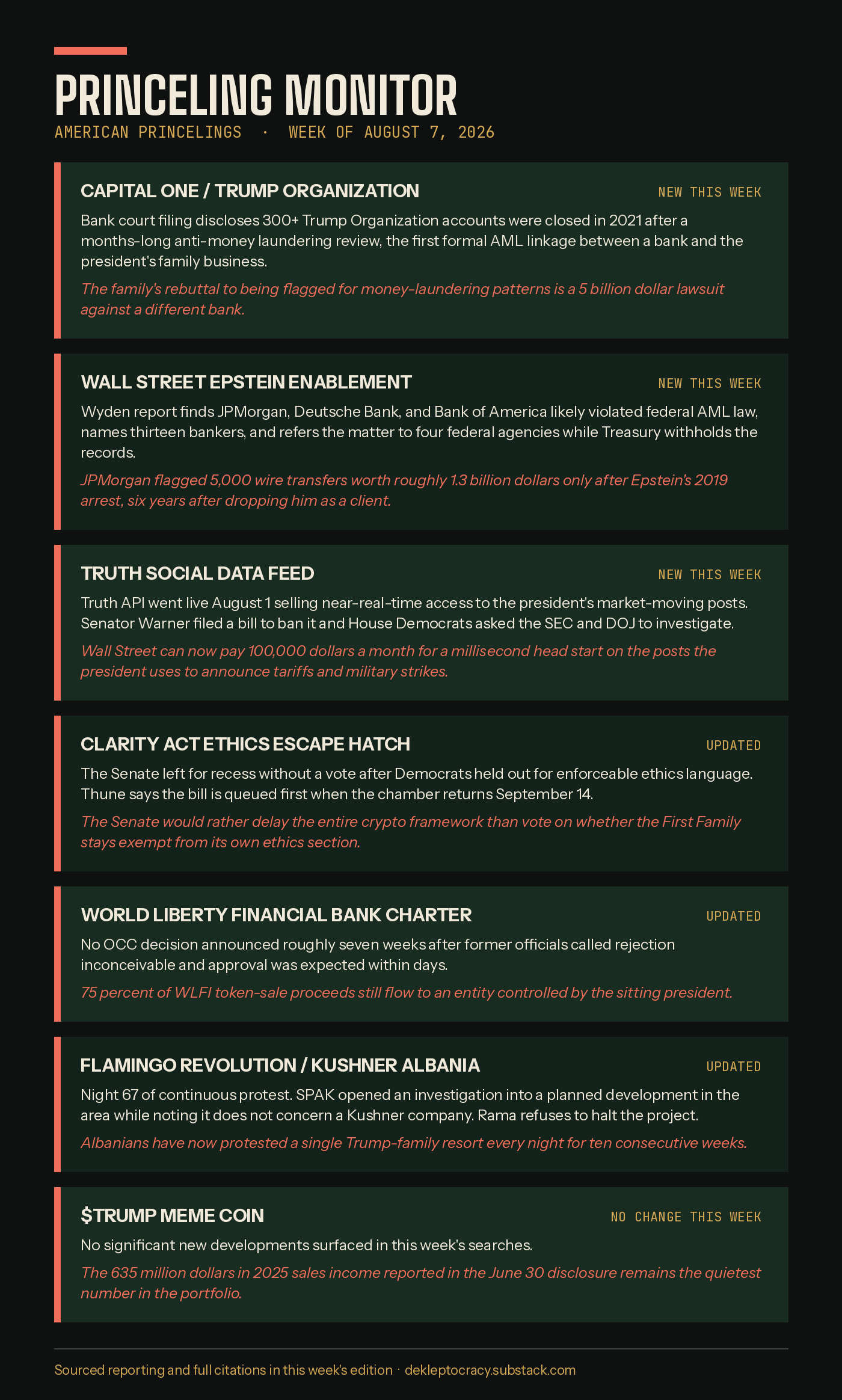
Capital One closed more than 300 Trump Organization accounts in 2021 “for anti-money laundering” reasons. Not over the insurrection, like Trump claims. The bank says its financial-crimes professionals spent months studying the transaction patterns and found activity “among the types of activity flagged by federal banking guidance.” Reuters reports it is the first time any financial institution has formally tied money laundering concerns to the sitting president’s family business. The family’s response was not an explanation of the transactions. It was a lawsuit, plus a companion suit against JPMorgan Chase seeking $5 billion for the indignity.
The through-line this week is what lawlessness looks like once it becomes routine. January 6 should have been disqualifying. The money movements that made a bank’s compliance team walk away should have been disqualifying. Neither was enforced, and unenforced law is just a suggestion with letterhead. The federal government will not police this family. The current Justice Department answers to it. The last one declined to try, and the Senate just left town rather than vote on an ethics section. That leaves exactly two tripwires still functioning in America: bank compliance departments and state regulators. This week produced hard evidence about both, and a reminder that the only regulator ever to put a dollar figure on the Epstein banking scandal was a state agency. If state attorneys general do not start to use statutes like New York’s Martin Act, the story of this term will be written by the lawless.
David Kirkpatrick’s accounting in The New Yorker documents $4.05 billion and counting in family profits. House Oversight Democrats track $9.7 billion, including digital-asset paper wealth. And Reuters has counted more than $2.3 billion from crypto ventures alone since the second term began. There is ample evidence that state governments can use their powers. The thing lacking is initiative from the people in charge of them.
Capital One Says It Closed Trump Organization Accounts After Anti-Money-Laundering Review
Reuters August 1, 2026
The Trump Organization and Eric Trump sued Capital One in a Florida federal court, claiming the bank “debanked” them for political reasons after January 6. Capital One’s motion to dismiss, filed Friday night after a judge twice tossed earlier complaints and allowed months of discovery, answers that the documents and the plaintiffs’ own allegations “make clear that Capital One closed Plaintiffs’ accounts for anti-money laundering (‘AML’) reasons.” More than 300 accounts. “Months of analysis and a careful review,” by a team the bank says carries decades of law-enforcement experience. The bank is careful to note, per NPR and The Hill, that it never accused the family firm of illegal money laundering, only that the patterns it found are the kind federal banking guidance tells banks to flag, which is the sentence compliance lawyers write when they mean everything short of the word. The case is before Judge Roy Altman, a Trump appointee who has already dismissed the complaint twice. Consider the incentive structure on display. When no prosecutor will open your books, being flagged for money-laundering patterns is not a legal risk. It is a fundraising narrative and a $5 billion counterclaim industry (our money laundering Spidey Senses did not need the assist, but we appreciate a bank doing the documentation for us).
Looking the Other Way, How Wall Street Banks Enabled Jeffrey Epstein’s Sex Trafficking
Senate Finance Committee August 4, 2026
If Capital One shows what it looks like when a compliance department does its job, Senator Ron Wyden’s 67-page report shows what happens when it doesn’t. Four years of investigation, including an in-camera review of suspicious activity reports at Treasury, found that JPMorgan Chase, Deutsche Bank, and Bank of America likely violated federal anti-money laundering law in their handling of Jeffrey Epstein. The numbers are obscene. Epstein ran 134 accounts at JPMorgan. In seventeen years the bank filed just seven timely reports covering 4.3 million dollars, then, weeks after his 2019 arrest, retroactively flagged more than 5,000 wire transfers worth roughly 1.3 billion dollars, including payments to women in Russia and Belarus through banks now under U.S. sanctions. Bank of America waved through 170 million dollars from billionaire Leon Black to Epstein, then concluded years later the wires had “no verifiable business purpose.” One executive coached Epstein to route cash withdrawals through his aviation accounts. Another signed off on continuing to work with him after his termination with a one-letter email, “Y.” The report names thirteen bankers and refers the matter to the DOJ, Treasury, the Federal Reserve, and the OCC, per American Banker. JPMorgan and Bank of America dispute the findings. Now, the part relevant to this newsletter. Treasury Secretary Scott Bessent refused three separate requests to produce the Epstein bank records, then handed them to House Republicans instead, and Senator Mike Crapo blocked Wyden’s bill to compel production on the Senate floor. The only enforcement anywhere in this two-decade saga came from a state. New York’s Department of Financial Services fined Deutsche Bank 150 million dollars in 2020. State regulators, take the hint. The American Prospect calls it a portrait of banks protecting their “wall of cash.” We call it the operating manual for the Capital One story above, because the lesson every ultra-wealthy client just learned is that the reporting system only bites six years late, if ever.
If this reporting is useful to you, support Dekleptocracy’s work with a small-dollar donation. [ActBlue link placeholder, insert before publishing]
Trump Media Launches Truth API, Selling Faster Access to the President’s Posts
Associated Press July 16, 2026
The feed went live on August 1. Trump Media’s Truth API, announced July 16, sells financial firms a licensed, machine-readable, near-real-time pipe into the platform’s top accounts, including @realDonaldTrump and the official @WhiteHouse account, for as much as 100,000 dollars a month, with a discount to 60,000 for a three-year commitment. The president announces tariff decisions and military operations on Truth Social, often before any official channel, so a millisecond head start is worth real money to high-frequency traders. Axios distilled it cleanly. The same presidential power that moves markets now feeds a business empire that enriches the president. Senator Mark Warner introduced a bill Monday to ban the practice outright, calling it “corrupt.” Representative Jamie Raskin sent the company a letter demanding answers, and Representatives Ritchie Torres and Angie Craig asked the SEC and DOJ to investigate. Former SEC official Renée Jones notes that selling premium access to a feed the president uses for de facto government announcements could implicate the misappropriation doctrine and the STOCK Act. The company’s defense is that the posts are public. Gentle reminder: federal investigators are already probing eerily timed trades placed ahead of the president’s tariff and Iran announcements, with no evidence so far tying the family to those trades. Somebody clearly understood the value of arriving early. Now that advantage has a rate card, and the landlord is the one making the announcements. Also, NY State AG Letitia James regulates the banks and hedge funds paying the president for this. Yet, she chooses to sit this one out.
Senate Won’t Vote on Crypto Clarity Act Before Its Summer Break
CoinDesk August 6, 2026
Reminder #2: The last edition walked page by page through the CLARITY Act’s “ethics” section, the family exemption, the enforcement monopoly handed to Trump’s own Justice Department, the $500,000 penalty cap against $1.4 billion in disclosed crypto income, and the retroactive amnesty that erases every violation on January 20, 2029. This week, the Senate skipped town without voting on any of it. Majority Leader John Thune blamed “the Dems,” praised Senator Cynthia Lummis, and promised the bill is “queued up first thing” when the chamber returns on September 14. Democrats Chris Murphy, Chris Van Hollen, and Jeff Merkley formalized their opposition after a merged draft dropped the ethics language they had demanded, including provisions empowering state attorneys general. Read the negotiating posture for what it is. The bill’s sponsors would rather delay the entire American crypto framework than accept an ethics section that binds the First Family or lets a state enforce it. That priority is the tell, because the stakes are structural. The anti-money laundering system that flagged Epstein late and the Trump Organization on time runs through banks. A parallel crypto rail with a friendly regulator, a developer safe harbor, and a statutory exemption for the president’s family is engineered to route around the last working tripwire in Western finance. Every senator who votes for that architecture in September is choosing to be a willing enabler. Many states regulate the players in the crypto market. They seem to be as captured as their federal counterparts.
Albania’s Protesters Reach Night 67 Demanding Rama’s Resignation
Oculus News August 5, 2026
Flamingo Revolution update, for those keeping vigil with us. The movement over the $4.6 billion Kushner-and-Ivanka-linked resort scheme on Sazan Island and the Narta Lagoon reached night 67 this week, nightly since the end of May and now among the longest continuous civic protests in Albania’s modern history. The crowds marched from Skanderbeg Square to the prime minister’s office, chanting “Rama in prison, Berisha in prison,” and, per Balkanweb, closed night 66 with the promise “more tomorrow.” The demands have hardened from canceling the resort to the resignation of Prime Minister Edi Rama and the departure of the entire political class. Albania’s special anti-corruption prosecutor SPAK has opened an investigation into a planned development in the area, while telling CBS News the probe “does not concern any company associated with Mr. Kushner.” BIRN’s Reporter.al has meanwhile traced the Zvërnec development company to a Dutch trust structure that obscures its ultimate owners, consistent with the shell-company reporting by Lindita Cela we covered in July. Rama has not moved an inch. Now hold the two capitals side by side. Tirana has filled the streets every single night for ten weeks over one Trump-family resort. Washington closed a week featuring a money-laundering court filing, a suppressed-report scandal, and a $100,000-a-month presidential trading feed, and the streets are quiet. The outrage differential remains the most damning metric we track. As for World Liberty Financial’s federal bank charter, the one former OCC officials said was “inconceivable” to reject, no decision has been announced as of this writing, seven weeks after approval was expected within days. We are watching the docket so you don’t have to.
Thanks for reading. Please share it with friends and family.
Support Dekleptocracy’s transparency mission. Dekleptocracy Alliance is a 501(c)(4) organization that puts anti-corruption on the national political agenda by seeding an activist anti-corruption ecosystem. It is funded solely by your small-dollar donations. The Dekleptocracy Journal is supported by Substack subscriptions from people like you. Thank you for your support. Truly.
Comments
Nothing yet. Say the first thing.
Sign in to join the conversation.