
“QVSE Exchange is a stock exchange strictly regulated by the U.S. Securities and Exchange Commission (SEC) and the Financial Industry Regulatory Authority (FINRA).”
After investigating hundreds of online investment schemes, I have learned not to judge these operations by how professional their websites look. The important questions are always behind the interface: Who owns the company? Who regulates it? Where does the money go? Are the investments real? And can the claims being used to establish trust actually be independently verified?
So I started investigating QVSE.
What initially caught my attention was how familiar the model felt. There were elements that reminded me of BG Wealth Sharing: copy trading, cryptocurrency funding, international recruitment and an investment platform wrapped in the language of financial legitimacy. That did not mean the two operations were connected, and I wasn’t going to suggest otherwise without evidence.
Then I found something I wasn’t expecting.
In July 2026, the Securities and Exchange Commission of Ghana published a warning naming online entities it said were promoting and offering investment products without the required licence. BG Wealth was on that list. So was Quant Vest Stock Exchange.
That was enough to make me look considerably deeper.
I began preserving QVSE’s own documents and statements, examining its corporate records, regulatory claims, website history, copy-trading model, cryptocurrency deposit system and legal agreement. I found a Colorado corporation formed years after QVSE says it began operating, a stock certificate apparently identifying Marc Hudon as the holder of ten million shares, conflicting statements about SEC and FINRA regulation, and a legal agreement that appeared to have been published before somebody finished filling in the template.
None of those findings, individually, proves that QVSE is a scam.
But they raise questions that anyone considering sending cryptocurrency to this platform deserves to have answered.
And that is where this investigation begins.
QVSE presents itself as an established American financial technology company. On its platform, it states that it was “Founded in April 2022 | Headquartered in New York, USA”, positioning itself as a bridge between cryptocurrency and the U.S. stock market.
So I started with something basic: I went looking for the company behind the name.
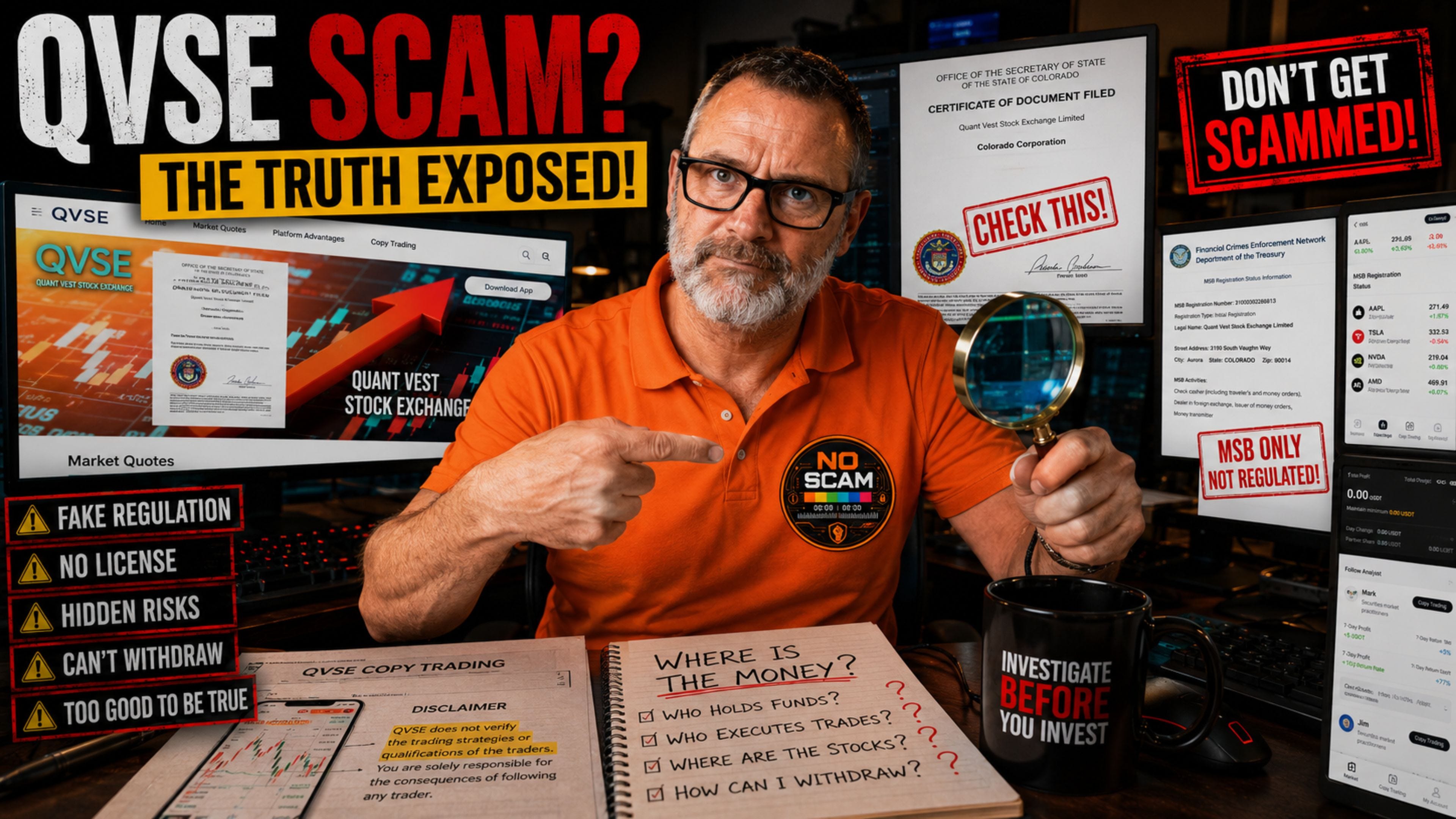
The corporate entity I identified is Quant Vest Stock Exchange Limited, a Colorado corporation under entity number 20251650652. The Colorado Secretary of State certificate I reviewed records its Articles of Incorporation as filed on 9 June 2025.
That creates an immediate gap in the story. QVSE says it was founded in April 2022, but the American corporation bearing its name appeared more than three years later. That doesn’t prove QVSE didn’t exist beforehand. There could have been another company, jurisdiction or earlier structure.
But where is it?
The current website doesn’t provide an obvious explanation for what legal entity operated QVSE between April 2022 and June 2025. The current domain, qvsewx.com, doesn’t help establish that history either. When I checked the Wayback Machine, I found no archived captures of the domain. A urlscan.io capture confirms the QVSE platform was operating there by 5 August 2026, but that is a long way from demonstrating a business operating since 2022.
Then another document gave me a name.
QVSE displays what purports to be stock certificate number 001, dated 9 June 2025. It names Marc Hudon as the owner of ten million fully paid and non-assessable shares in Quant Vest Stock Exchange Limited.
The certificate itself says the company is authorised to issue 10,000,000 common shares. On its face, therefore, the document appears to show Hudon receiving the entire authorised share capital.
I am not treating that certificate alone as independent proof that Marc Hudon ultimately owned, beneficially controlled or continues to own QVSE. Share ownership can change, and a document displayed by the company needs to be independently tested. But it gives me something important to investigate: a named individual apparently connected to the ownership of the Colorado corporation from the day it was formed.
There is also the question of where QVSE is actually based.
The platform describes itself as headquartered in New York, while its FinCEN documentation gives 3190 South Vaughn Way, Aurora, Colorado 80014 as the business address. Promotional material has also associated a QVSE spokesperson named Robert Hayes with New York, but I have yet to establish the substantial New York headquarters implied by QVSE’s own description.
None of these discrepancies alone answers the larger question of whether QVSE is legitimate.
What they do is establish that the corporate history investors are being presented with is not yet the corporate history I can independently reconstruct.
By June 2025, the trail becomes much clearer: the Colorado corporation appears, the stock certificate naming Marc Hudon is dated the same day, and the FinCEN registration follows.
The missing piece is the three years QVSE says came before it.
QVSE leans heavily on regulation to establish trust. Across its platform, investors are shown references to FinCEN, the SEC, FINRA, SIPC, RIA status, AML and KYC. To somebody unfamiliar with U.S. financial regulation, that collection of acronyms can create the impression of a business surrounded by layers of government oversight.
So I separated the claims and checked what each one actually meant.
The clearest point is QVSE’s FinCEN Money Services Business registration. The document displayed by QVSE identifies Quant Vest Stock Exchange Limited under MSB registration number 31000302288613. I am not suggesting that document is fabricated.
But the document itself contains an important warning that deserves far more attention than the registration number.
FinCEN states that it does not recommend, approve or endorse any business that registers as a money services business, and that it does not verify the information submitted by the MSB.
That matters because QVSE is not merely presenting itself as a money transmitter. It tells investors they can deposit cryptocurrency, convert it into U.S. dollars and use those funds to trade American stocks and ETFs.
Then the regulatory story becomes much less clear.
In one legal disclaimer, QVSE states that it is:
“a stock exchange strictly regulated by the U.S. Securities and Exchange Commission (SEC) and the Financial Industry Regulatory Authority (FINRA)”
Yet elsewhere, under its own compliance qualifications, QVSE says:
“SEC/FINRA/SIPC registration is underway”
Its roadmap goes further, stating that it intends to:
“Complete the upgrade of SEC securities dealer license” in 2026.
Those statements do not sit comfortably together.
If QVSE is already strictly regulated by FINRA, why is FINRA registration still described as being underway? If securities-dealer registration is still being pursued, what regulated entity is currently executing the U.S. stock trades QVSE says customers can make today?
QVSE also lists:
“RIA (Registered Investment Advisor) – SEC Regulatory”
as an existing compliance qualification.
Again, that is a specific claim that should be capable of independent verification through a clearly identifiable legal entity, registration number and regulatory record.
This is where the distinction becomes crucial.
A FinCEN MSB registration is not the same thing as SEC registration, FINRA membership, SIPC protection or authorisation to operate a securities exchange.
Those are different legal and regulatory relationships, and investors should not be expected to treat one as proof of the others.
By this point, the question was no longer whether QVSE could display a certificate.
The question was whether the regulatory status being presented to investors actually matched the financial services the platform claimed to provide.
Once I started questioning QVSE’s regulatory claims, I turned to the documents investors are actually expected to accept when using the platform. One of those was the QVSE International Stock Copying Platform Disclaimer and Liability Waiver Agreement.
For something presented by a company claiming to operate inside the regulated U.S. financial system, I expected the legal language to be precise.
Instead, I found what appeared to be an unfinished template.
Under “Applicable Law,” QVSE’s agreement states:
“This Agreement shall be governed by and construed in accordance with the laws of [for example: Delaware].”
Then comes the arbitration provision:
“Any dispute shall be resolved by arbitration before the American Arbitration Association (AAA) in [name of state].”
Those placeholders appear in a document investors are being asked to accept. The governing state has not been filled in. Neither has the state where arbitration is supposedly meant to take place.
That would be unusual enough for an ordinary online business. It becomes much harder to reconcile with a platform declaring in the very same agreement that it is a “stock exchange strictly regulated” by the SEC and FINRA.
The document contains another contradiction. One section is headed “Non-registered investment adviser,” while elsewhere on QVSE’s platform the company lists “RIA (Registered Investment Advisor) – SEC Regulatory” among its compliance qualifications.
Then there is the liability clause.
QVSE says that, even if part of its disclaimer fails, the platform’s total liability will not exceed “the total amount of fees you paid in the past 12 months.” Not the amount deposited. Not the value supposedly invested. The fees paid.
Whether that provision would ultimately be enforceable is a matter for the appropriate legal jurisdiction — which makes the unfinished governing-law clause even more remarkable.
The agreement also warns that users could lose “all or more than” their initial investment. That caught my attention because elsewhere QVSE’s roadmap says options and leveraged trading are planned for 2027.
Yet another page already advertises:
“Leveraged Trading — Unlimited Potential.”
So once again, QVSE’s own documents appear to be telling different versions of the same story.
I didn’t need to speculate about what somebody outside the company thought QVSE was doing. I was simply comparing QVSE’s statements with other statements published by QVSE.
And they weren’t lining up.
The heart of QVSE’s offer is its copy-trading system. The platform tells investors they do not need to analyse the market themselves. Instead, they can follow experienced trading experts or quantitative strategies and allow QVSE to automatically copy their trades.
For somebody with little investment experience, the attraction is obvious. QVSE describes copy trading as “Super convenient”, says users can avoid complicated processes such as stock selection, market monitoring and technical analysis, and tells them there is “No need to choose” because they can directly copy professional traders.
On another part of the platform, the message becomes even simpler:
“Follow Analysts — Easy Profits.”
That is a powerful marketing statement when the same platform specifically says its service is suitable for novices and people who do not have time to research financial markets.
But when I examined QVSE’s disclaimer, the responsibility suddenly shifted.
QVSE says the traders displayed on its platform are based on algorithmic recommendations and that it does not verify their trading strategies or qualifications. Investors are told they must evaluate the traders themselves and accept responsibility for the consequences of following them.
That raises an obvious question.
How can QVSE confidently market these people as “professional traders” and “experienced trading experts” while simultaneously saying it does not verify their qualifications?
The same problem applies to performance. QVSE promotes “Transparent performance”, saying investors can view traders’ historical returns and risk indicators in real time. But a performance figure displayed inside QVSE’s own platform is only as reliable as the data behind it.
I want to know whether those historical trades can be independently verified. Are these real people trading through identifiable brokerage accounts? Do the returns correspond with genuine transactions in the underlying securities? Who calculates the performance figures? Can an investor verify them anywhere outside QVSE?
The platform also tells users that following several traders can “disperse risks” and reduce exposure to a single strategy. That principle only works if the traders and strategies are genuinely independent. Five profiles on a screen do not create diversification if the underlying activity cannot be verified.
Then there is the recruitment infrastructure.
QVSE’s menu includes “Invite Friends,” and a urlscan.io capture from 5 August 2026 preserved a registration URL containing the parameter inviteCode=5gFf. That confirms the platform is technically capable of attributing registrations to invitation codes.
At this stage, I have not established what, if anything, QVSE pays people for those referrals. I have not seen enough evidence to call it a multi-level compensation structure or claim that commissions are tied to deposits.
But I know the invitation mechanism exists, and I want to know exactly how it is rewarded.
For me, that is the larger issue with QVSE’s copy-trading proposition. Investors are being encouraged to remove much of the difficult decision-making from investing and trust supposedly experienced professionals instead.
Yet when responsibility matters, QVSE’s own disclaimer tells them something very different:
You chose the trader. You accepted the risk. And QVSE didn’t verify their qualifications in the first place.
After working through QVSE’s regulatory claims and copy-trading model, I came to the question that matters most to me in any investment investigation: what actually happens to the money?
QVSE says investors can deposit USDT, USDC, Bitcoin and Ethereum, including through networks such as ERC-20 and TRC-20. According to the platform, customers receive an “exclusive recharge address”, their cryptocurrency is automatically converted into U.S. dollars, and those dollars can then be used to trade American stocks and ETFs.
QVSE specifically refers to companies such as Apple and Tesla and says it supports trading through markets including the NYSE and NASDAQ.
On the surface, the process sounds simple. Behind the screen, however, a genuine transaction should involve considerably more infrastructure.
If an investor sends USDT to QVSE and subsequently sees Apple shares displayed in their account, who actually purchased those shares? Which broker executed the order? Who cleared and settled it? Where are the securities held? Can the investor transfer them to another brokerage? Is there an independently verifiable trade confirmation showing that the transaction occurred outside QVSE’s own database?
These questions become especially important when QVSE itself says its SEC/FINRA/SIPC securities-dealer registration is still underway.
Naming the NYSE or NASDAQ on a website does not demonstrate that customer orders are actually reaching those exchanges. Likewise, displaying a portfolio balance does not prove the underlying securities exist.
A number on a dashboard is not a share certificate.
QVSE makes another significant claim about what happens before the supposed stock purchase. On its cryptocurrency deposit page, the platform says it uses “multi-signature cold wallet storage” and that “fund custody is audited by regulatory authorities.”
If that statement is accurate, it should be straightforward to identify the authority conducting those audits, the entity responsible for custody and the regulatory framework governing the customer funds.
I have not seen QVSE identify that regulator in the material I reviewed.
The cryptocurrency component gives investigators another way of testing the story. Blockchain transactions leave a public trail. If existing QVSE investors provide the deposit addresses they were given, those wallets can potentially be followed to see whether customer funds remain separated, converge into common collection wallets, move to identifiable exchanges or travel elsewhere.
Several investor addresses would be particularly useful because patterns often become visible when transactions from supposedly independent accounts are compared.
QVSE also says the process works in reverse: customers can sell their U.S. stocks and withdraw the proceeds as cryptocurrency or fiat currency. Taken literally, the platform is describing a complete financial chain:
cryptocurrency → U.S. dollars → U.S. securities → U.S. dollars → cryptocurrency or fiat.
There should be independently verifiable institutions somewhere along that chain.
That is the evidence I want to see.
Because ultimately, whether a QVSE dashboard says an investor owns Apple, Nvidia or Tesla is not the important question.
The important question is whether those shares were ever purchased at all.
The reason I began investigating QVSE was because the operation felt familiar. The combination of cryptocurrency deposits, copy trading, supposedly experienced traders and impressive regulatory language reminded me of other investment platforms I have investigated, particularly BG Wealth Sharing.
A resemblance is not evidence of a connection.
Then I found something more concrete.
On 22 July 2026, the Securities and Exchange Commission of Ghana published a warning identifying online entities it said were promoting and offering unlicensed investment products in Ghana. The regulator stated that the entities on its list had not been licensed to conduct capital-market activities and advised the public to desist from investing in their products.
Among those named was Quant Vest Stock Exchange (QVSE).
And on the same regulatory warning was BG Wealth.
That does not establish that QVSE and BG Wealth are operated by the same people. I have not established shared ownership, wallets, infrastructure or management, and I am not going to manufacture a connection simply because two names appear on the same list.
What it does establish is that both operations came to the attention of the same securities regulator, which publicly warned that neither was licensed to conduct the capital-market activities being offered in Ghana.
For QVSE, that warning is particularly significant because so much of the platform’s credibility is built around regulation.
Investors are shown a FinCEN MSB registration, references to SEC regulation and RIA status, FINRA and SIPC, AML and KYC compliance, and claims that customer fund custody is audited by regulatory authorities. Yet QVSE’s own material also says some SEC/FINRA/SIPC registration is still underway, while Ghana’s securities regulator has separately warned that QVSE is not licensed to conduct capital-market activities there.
This investigation has therefore left me with questions QVSE should be able to answer.
What is the SEC registration supporting its claimed RIA status? Which FINRA-regulated broker-dealer actually executes customer stock trades? Where are those securities held? Which regulator audits QVSE’s claimed customer-fund custody? What entity operated QVSE during the three years before the Colorado corporation appeared? What is the relationship between Marc Hudon and the company today? Where is the claimed New York headquarters? And how are the qualifications and performance of QVSE’s supposedly professional traders independently verified?
Most importantly, if an investor sends cryptocurrency to QVSE and the platform subsequently tells them they own U.S. stocks, there should be evidence outside QVSE’s own system demonstrating that those securities genuinely exist.
At this stage, I am not claiming that every representation made by QVSE is false. The FinCEN MSB registration, for example, appears to correspond with an actual registration. But FinCEN itself makes clear that MSB registration does not mean it recommends, approves or endorses the business.
That distinction is exactly why investors need to look beyond certificates, acronyms and impressive-looking dashboards.
QVSE has made substantial claims about its history, regulation, traders, custody and access to U.S. financial markets. The burden should not be on investors to simply believe those claims. QVSE should be able to prove them.
Until that happens, I would not send this platform my money.
And if you are already involved with QVSE, I want to hear from you. Deposit wallet addresses, withdrawal records, trading statements, WhatsApp or Telegram groups, promoter presentations, referral information and communications with QVSE could help establish what is really happening behind the platform.
The dashboard can tell investors one story.
I want the evidence to tell us whether that story is true.
This investigation relies entirely on OSINT — Open Source Intelligence — meaning every claim made here is based on publicly available records, archived web pages, corporate filings, domain data, social media activity, and open blockchain transactions. No private data, hacking, or unlawful access methods were used. OSINT is a powerful and ethical tool for exposing scams without violating privacy laws or overstepping legal boundaries.
I’m DANNY DE HEK, a New Zealand–based YouTuber, investigative journalist, and OSINT researcher. I name and shame individuals promoting or marketing fraudulent schemes through my YOUTUBE CHANNEL. Every video I produce exposes the people behind scams, Ponzi schemes, and MLM frauds — holding them accountable in public.
My PODCAST is an extension of that work. It’s distributed across 18 major platforms — including Apple Podcasts, Spotify, Amazon Music, YouTube, and iHeartRadio — so when scammers try to hide, my content follows them everywhere. If you prefer listening to my investigations instead of watching, you’ll find them on every major podcast service.
You can BOOK ME for private consultations or SPEAKING ENGAGEMENTS, where I share first-hand experience from years of exposing large-scale fraud and helping victims recover.
“Stop losing your future to financial parasites. Subscribe. Expose. Protect.”
My work exposing crypto fraud has been featured in:
Coffeezilla 2026): Featured in the investigation exposing the alleged $328M Goliath Ventures Ponzi scheme
Bloomberg Documentary (2025): A 20-minute exposé on Ponzi schemes and crypto card fraud
News.com.au (2025): Profiled as one of the leading scam-busters in Australasia
OpIndia (2025): Cited for uncovering Pakistani software houses linked to drug trafficking, visa scams, and global financial fraud
The Press / Stuff.co.nz (2023): Successfully defeated $3.85M gag lawsuit; court ruled it was a vexatious attempt to silence whistleblowing
The Guardian Australia (2023): National warning on crypto MLMs affecting Aussie families
ABC News Australia (2023): Investigation into Blockchain Global and its collapse
The New York Times (2022): A full two-page feature on dismantling HyperVerse and its global network
Radio New Zealand (2022): “The Kiwi YouTuber Taking Down Crypto Scammers From His Christchurch Home”
Otago Daily Times (2022): A profile on my investigative work and the impact of crypto fraud in New Zealand
No posts
Comments
Nothing yet. Say the first thing.
Sign in to join the conversation.