
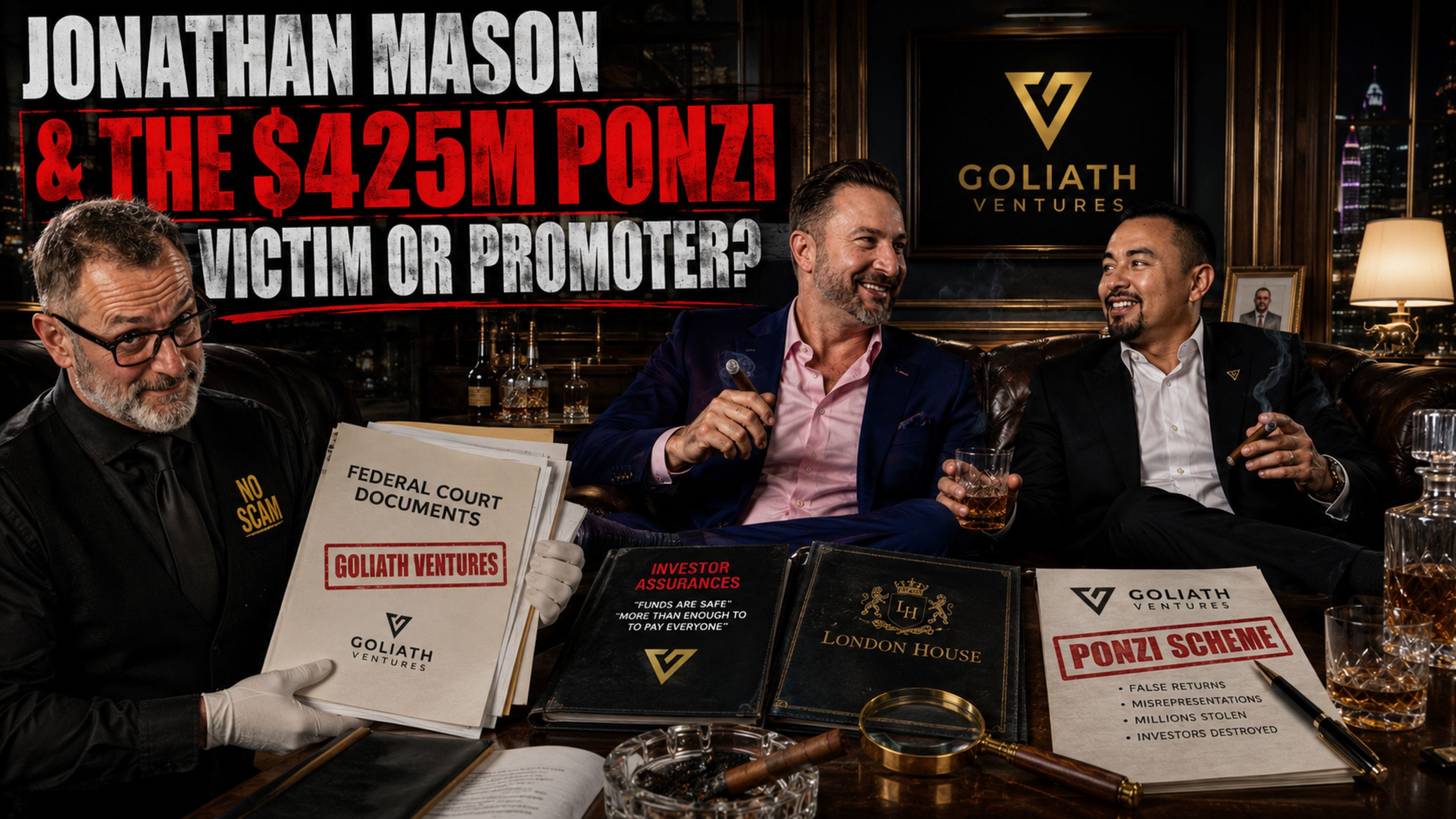
“The only difference is that Eric said, after all investors paid, profit would be ‘a few hundred million’ Vs ‘100 to 200’. Other than that it looks accurate.” — Jonathan Mason, November 18, 2025
But this investigation is not about using hindsight to declare that everyone surrounding Delgado must have known what he was doing.
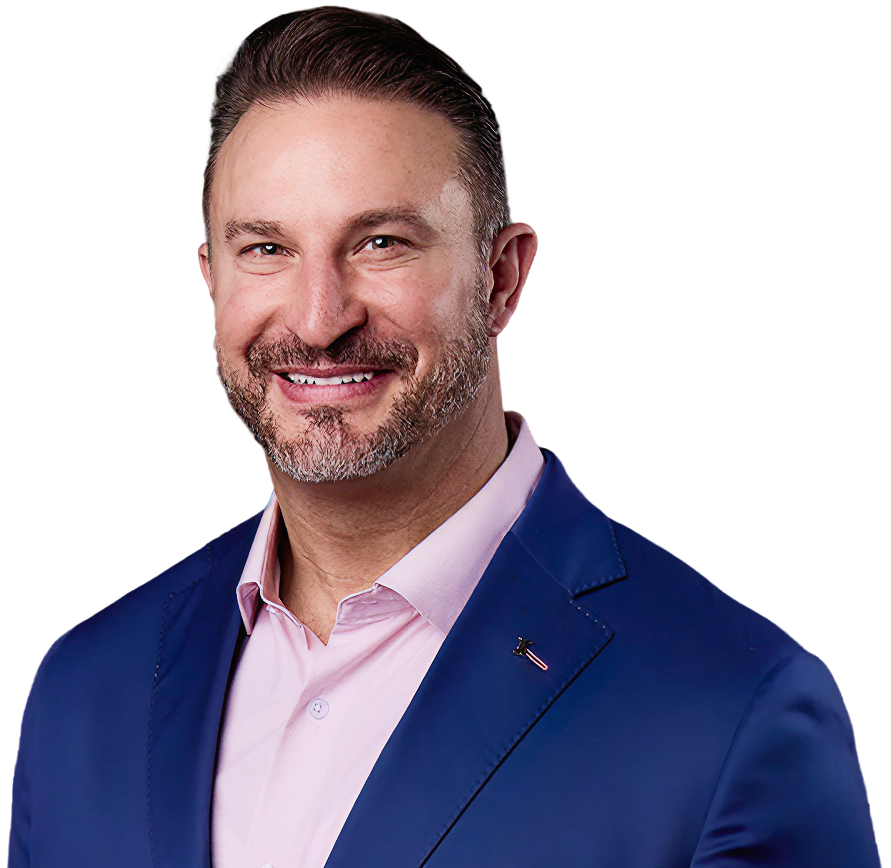
Jonathan Mason
It is about Jonathan Mason, what he was telling investors while Goliath was still alive, and a significant new federal court filing in which Mason is now fighting back against allegations that he knowingly participated in the fraud.
On August 17, 2026, Mason filed a 15-page motion seeking Rule 11 sanctions against Prestige Florida Property Investment LLC and its counsel. His argument is deliberately narrow. Mason is not asking the court to decide whether Delgado committed fraud. Instead, his lawyers argue that Prestige has failed to identify a reasonable factual basis for allegations that Mason knew Goliath lacked insurance, knew it could not return investors’ principal, knowingly withheld those facts, knew Goliath was a Ponzi scheme or agreed with others to defraud Prestige.

Those are serious allegations, and they require serious evidence.
Mason’s lawyers make a point I believe deserves to be reported fairly. They argue that communicating with investors, receiving compensation connected with his partner-services role or passing along information supplied by Goliath does not, by itself, prove that Mason knew the information was false. They also say Mason had substantial skin in the game himself. According to the motion, before Prestige invested another $1 million, Mason disclosed that his own initial principal in Goliath exceeded $3 million. Prestige’s principal allegedly responded that Mason having that much invested made him comfortable because Mason had to “tell the story.”
That defence matters.
But I have spent months going through the Goliath evidence, following the collapse as it happened, reviewing court filings, communications, agreements and the explanations investors were given as their distributions stopped. And when I put Mason’s latest legal arguments beside the contemporaneous documents already sitting in the federal court record, another question emerges.
What exactly was Jonathan Mason relying upon when he reassured investors?
By August 2025, Goliath was circulating an “Independent Evaluation Report” from BlackBlock Management Services claiming the company maintained an average collected balance of 115% or more of partner balances, possessed sufficient reserves to satisfy any withdrawal or distribution request, and held 100% or more of all partner balances at all times during the review period. Buried beneath those extraordinary conclusions, however, was an important qualification: the report was based exclusively upon financial data and information provided to BlackBlock by Goliath itself.
Then distributions began to stop.
On November 18, 2025, after Mason arranged a call with Goliath attorney Eric Clayman, investor Alex Reece sent Mason a detailed written summary of what he understood Clayman had told them. According to Reece, Clayman said he had personally reviewed Goliath’s balances, that there was enough money to cover everything taken from clients with another $100–$200 million left over, that payments should resume within one or two weeks, and that he would not remain involved if he believed something was wrong.
Mason didn’t respond by distancing himself from those representations.
He corrected one number.
According to Mason, Clayman had actually said that after all investors were paid, the remaining profit would be “a few hundred million” rather than $100–$200 million. Mason then wrote: “Other than that it looks accurate.”
That email does not prove Jonathan Mason knew Goliath was a Ponzi scheme. It does not prove he knew the representations being made to investors were false. And it certainly does not establish criminal liability.
But it is evidence of what investors were being told, what Mason was prepared to confirm in writing, and the extraordinary financial picture being presented while Goliath was approaching collapse.
So I went back through the documents.
This investigation is about separating what can actually be proved from what has merely been alleged. It is about giving Mason’s new defence the scrutiny it deserves while applying exactly the same standard to the representations that helped investors believe their money was safe.
Because the real question is no longer simply whether Jonathan Mason lost money in Goliath.
It is what he knew, what he verified, what he repeated to others — and whether the documentary record supports the story now being told in federal court.
Jonathan Mason did not enter this story as somebody standing on the sidelines watching Goliath Ventures operate. According to the Federal Lawsuit filed by Prestige Florida Property Investment LLC, Mason was directly involved in the relationship between Prestige and Goliath. The complaint identifies him as Goliath’s Director of Partner Services and alleges he was the primary person who solicited Prestige, discussing Goliath’s supposed liquidity-pool strategy and the returns available through it. Mason’s latest filing does not deny that he communicated with Prestige or that he received compensation connected with partner services. What he strongly disputes is the much more serious allegation that those activities were undertaken with knowledge that Goliath was fraudulent.
That distinction is important. There is a considerable difference between introducing somebody to an investment that later collapses and knowingly recruiting them into something you understand to be a fraud. The Prestige lawsuit attempts to bridge that gap by alleging Mason knew Goliath lacked the protections being represented, knew it could not return investors’ principal, withheld that information and was aware the enterprise was operating as a Ponzi scheme. Mason says those allegations go beyond the evidence and are precisely why he is now seeking sanctions.
The documentary record does, however, show Mason occupying an investor-facing position. On November 14, 2025, when Prestige was trying to close an account, Mason responded from a goliathventuresinc.com email address, telling Alex Reece that he had sent a letter to “our attorney” and explaining that the attorney would prepare the paperwork necessary to close the account. His signature identified him as Jonathan Mason of LMT Financial, while the email itself came from jon@goliathventuresinc.com.
And Mason wasn’t presenting himself as someone who merely recommended Goliath and walked away. According to his own latest court filing, he had substantial money inside the operation himself. On July 28, 2025, when Reece and Shane Kennedy were considering investing another $1 million and asked how much Mason personally had invested, Mason says he disclosed that his initial principal exceeded $3 million. His lawyers now point to that disclosure as a powerful fact cutting against the allegation that he knowingly sent other people into a scheme he understood was fraudulent.
There is logic to that argument, and I don’t intend to pretend otherwise. If Mason genuinely believed Goliath was legitimate and had millions of his own dollars exposed, that matters when considering what he knew at the time.
But it also helps explain why his involvement could have carried so much weight with prospective investors.
Prestige wasn’t simply hearing extraordinary claims from Christopher Delgado. According to Mason’s own filing, Reece specifically said he took comfort from knowing Mason had so much of his own money invested. In other words, Mason’s personal financial commitment appears to have become part of the credibility surrounding the opportunity, whether Mason intended it that way or not.
That is where Jonathan Mason becomes important to this investigation.
The question isn’t whether having millions invested makes him guilty of anything. It doesn’t. The question is what happened when a man with millions of dollars of his own money supposedly inside Goliath became an important point of contact for other investors—and what information he relied upon when he helped reassure them that their money was safe.
To understand what Jonathan Mason was introducing people to, I went back to the agreement Prestige actually signed with Goliath Ventures. Dated November 21, 2024, the 20-page document carefully described the arrangement not as an investment, but as a “joint venture” between Goliath and the participant. In fact, the agreement went out of its way to state that it “shall not be considered an investment product, investment offering or a security in any way whatsoever.”
But when I examined how the arrangement actually worked on paper, the language became far more interesting. The participant was required to contribute a minimum of $100,000, either through cryptocurrency or by wiring funds directly to Goliath Ventures. Goliath would then supposedly use cryptocurrency in liquidity pools involving assets such as Bitcoin, Ethereum and USDC. The explanation was that these pools generated exchange fees, rather than conventional investment interest. Goliath selected the available pools, completed the pairing and even reserved the right to change the pools or methods of operation at its own discretion.
Then came the part that would obviously matter to anyone considering handing over six figures.
Under “Distribution of Profits,” the agreement stated that the partner would receive “guaranteed monthly profits” and specified a 4% monthly distribution rate for Ethereum, Bitcoin and USDC. The participant could either receive those monthly payments or compound them. Whatever profit remained after the partner’s distribution belonged to Goliath.
That combination deserves attention. On one page, the document insists this is not an investment product or offering. A few pages later, it talks about a minimum $100,000 contribution and guaranteed monthly profits of 4%.
Four percent every month is not a trivial number. On $1 million, that represents $40,000 a month, before considering compounding. The agreement itself does not demonstrate that those returns were fraudulent, nor does it tell us what Mason personally believed about them. But it does establish exactly what participants were being offered and why the opportunity could have appeared so attractive.
The agreement also attempted to portray the participant as actively involved in the decision-making. It said both parties would work together to decide which liquidity pools to use and declared that neither party was managing the other’s cryptocurrency. Yet Goliath performed the initial analysis, selected the available pools, received the contribution, completed the pairing and reserved discretion to alter its methods. The document even stated that Goliath could make certain decisions on the partner’s behalf.
There was another assurance buried in the agreement that becomes especially significant knowing what happened later. It said that if a participant wanted to withdraw, Goliath would process the request within a reasonable time and aim to return the relevant cryptocurrency within 24 to 72 hours, although withdrawals could sometimes take longer. Elsewhere, the agreement allowed Goliath to delay withdrawals for up to 180 days under specified circumstances such as suspicious activity, exchange delays or other events it believed required investigation.
So this was the proposition sitting behind the conversations Mason was having with Prestige: put at least $100,000 into what Goliath insisted was a joint venture rather than an investment, allow Goliath to deploy the funds through its supposed cryptocurrency liquidity strategy, and receive 4% every month.
The next question was obvious.
What evidence were investors being shown to convince them that Goliath actually had the money to support it?
By August 2025, Goliath Ventures was not simply relying on sales conversations and glossy explanations of cryptocurrency liquidity pools. It was circulating what it presented as an “Independent Evaluation Report” prepared by BlackBlock Management Services. For anyone already invested—or considering putting more money in—the document appeared to answer the most important question of all: was the money actually there?
The report, dated August 13, 2025, said BlackBlock had reviewed Goliath’s financial statements and records and concluded that the company had been transparent and cooperative. More importantly, it claimed Goliath maintained an average collected balance of 115% or more of partner balances, held sufficient reserves to satisfy “any and all partner requests for withdrawal or distribution,” and was in receipt of 100% or more of all partner balances throughout the review period.
Those are powerful statements.
If I were an investor reading that document at the time, I can understand why it would have been reassuring. Goliath was not merely saying, “trust us.” It appeared to have an outside organisation confirming that the company had more money than it owed investors and could satisfy every withdrawal request.
But there was a qualification buried at the bottom of the report that matters enormously now.
BlackBlock stated that its report was based exclusively on the financial data and information provided to it by Goliath Ventures, and warned partners not to rely solely on the report when evaluating the merits of a financial transaction.
That distinction is crucial.
The report did not say BlackBlock independently traced every dollar, verified every cryptocurrency wallet or independently confirmed the existence of every reserve. What it actually said was that it had reviewed information supplied by Goliath and reached its conclusions from that material.
Yet this report became part of the credibility surrounding the business.
And that matters in Jonathan Mason’s case because his latest sanctions motion specifically points to the BlackBlock report as one of the pieces of information available to him when he was communicating with investors. His lawyers argue that Mason was not inventing assurances out of thin air; he was relying on information coming from Goliath, including a report that appeared to show sufficient reserves.
That is a legitimate point.
But it also creates another question.
How much independent verification did Jonathan Mason personally perform before passing those assurances on to people who trusted him?
Because by this stage, Prestige was not merely relying on a contract promising 4% a month. It was looking at a company that claimed it had been independently reviewed, claimed it held more than enough reserves, and had people like Mason communicating directly with investors.
The illusion of safety was not built from one statement.
It was built from layers of reassurance.
And within a few months, those reassurances would begin to unravel.
One of the strongest points in Jonathan Mason’s defence is also one of the reasons investors appear to have trusted him.
In his latest filing, Mason says that before Prestige made its second and much larger investment, he disclosed that his own initial principal in Goliath Ventures exceeded $3 million. His lawyers argue this matters because it cuts against the idea that Mason knowingly encouraged others to put money into a fraud he understood would eventually collapse.
According to the motion, on July 28, 2025, Prestige’s principals Alex Reece and Shane Kennedy were considering investing another $1 million and asked Mason how much of his own money he had in Goliath. Mason says he answered that his initial principal was more than $3 million. The filing then points to Reece’s response as evidence of how important that disclosure was: Reece allegedly said Mason having that much invested made him more comfortable because Mason had to “tell the story.”
That sentence tells us a lot.
Mason’s own investment was not merely a private financial decision. It appears to have functioned as social proof. If the person introducing you to Goliath had millions of dollars of his own money at risk, that could reasonably make the opportunity feel more credible. It created the impression that Mason was not simply earning a commission from other people’s money—he was financially exposed alongside them.
From Mason’s perspective, that is part of his defence.
From an investigative perspective, it is also part of the story of why people believed him.
Those two things can be true at the same time.
Mason’s lawyers go further. In his April Motion to Dismiss, they argued that Mason and his family lost approximately $7 million in the same scheme and described him as a victim rather than a participant in the fraud. They said the complaint improperly placed Mason at the centre of a scheme he neither knew about nor caused, despite the fact he had no role in Goliath’s financial management and no access to the records that would have revealed what was actually happening inside the company.
That argument deserves to be taken seriously. Losing millions of dollars is not proof of innocence, but neither is it irrelevant. It can support the possibility that Mason genuinely believed Goliath was legitimate.
But there is another side to it.
If Mason had more than $3 million invested, was close enough to Goliath to communicate directly with other investors, received commissions or relationship-based compensation and became a trusted point of reassurance, then the natural question is not simply whether he lost money.
The question is what due diligence did he perform before putting millions of his own money at risk—and before helping other people feel comfortable doing the same?
Because his personal investment may explain why investors trusted him.
It does not, by itself, explain why the underlying representations were reliable.
One of the clearest factual disputes between Prestige and Jonathan Mason concerns a $600,000 withdrawal made shortly before Goliath Ventures began experiencing its more serious payment problems.
Prestige’s original federal complaint says that in September 2025 it requested the withdrawal of $600,000 and that Goliath delayed payment until October 16, 2025. The complaint uses that sequence as part of its wider allegation that Goliath was beginning to struggle with investor withdrawals as the operation moved towards collapse.
Mason says that timeline is wrong.
In his August 17, 2026 sanctions motion, Mason states that the documentary records show Prestige requested the $600,000 withdrawal on September 23, 2025, and received the money the following day, September 24. His lawyers argue that this is not a minor technical disagreement. If the records support Mason’s version, then the allegation that Prestige waited until October 16 for the $600,000 would materially misrepresent what actually occurred.
That is exactly the kind of dispute where I think the evidence has to come before the narrative.
I am not going to repeat Prestige’s original timeline as established fact simply because it appeared in the complaint. Mason has specifically challenged it and says there are transaction records demonstrating a 24-hour turnaround. Unless evidence emerges showing otherwise, his challenge needs to be reported prominently.
But the successful $600,000 withdrawal does not end the story.
After receiving that money, Prestige still had approximately $700,000 remaining with Goliath. By November, with distributions becoming a growing concern, Prestige wanted the rest of its money returned and the account closed. That later withdrawal became a very different experience: according to the complaint, the remaining principal was never returned before the federal lawsuit was filed.
This distinction is important because it gives us a more accurate picture of how the collapse unfolded.
Goliath did not simply stop paying everybody at once. Prestige appears to have successfully recovered $600,000 shortly before the situation deteriorated further. Then, only weeks later, the remaining $700,000 became trapped while investors were being given a series of explanations about audits, banking problems, MSB accounts and restricted wallets.
That is where the chronology becomes critical.
Because the next stage of the story is not about whether Goliath had ever returned investor money.
It is about what investors were told once the payments began to stop.
By November 2025, the confidence surrounding Goliath Ventures was beginning to collide with something far more important than presentations, contracts and third-party reports.
The money was becoming harder to get out.
On November 13, 2025, Prestige asked to close its account and have the approximately $700,000 remaining with Goliath returned. The following day, November 14, Jonathan Mason responded, explaining that because this involved closing the account, the process was different. Mason said he had sent a letter to Goliath’s attorney, who would prepare the necessary paperwork, and that he would forward it for signature once he received it.
At this point, Prestige had already successfully withdrawn $600,000 earlier in the year—although, as we have seen, Prestige and Mason now dispute exactly how quickly that earlier withdrawal was processed. This time, however, the remaining money did not come back.
Then, on November 17, 2025, Goliath sent a mass communication to participants announcing that monthly distributions were being temporarily halted.
The explanation was a forensic audit.
Goliath described the audit as evidence of its commitment to “transparency and trust” and said a third-party forensic CPA firm was reviewing the company’s liquidity strategy. Investors were told the audit would ultimately provide what Goliath called “irrefutable proof” that their allocations were funding genuine activity and demonstrate the robust health of the fund.
But buried inside all that reassuring language was the information investors really needed to know.
Goliath said the audit team, together with legal counsel, had recommended a temporary halt to operations. As a result, monthly distributions would be delayed. The company said it could not provide an exact timeframe but assured participants:
“rest assured you will receive your monthly distribution as planned.”
Goliath claimed that pausing outgoing distributions was necessary to give auditors unrestricted access to trace every movement of funds since the company’s inception. Going “offline,” investors were told, would actually help safeguard their deposits and compounding while allowing the audit to be completed.
That explanation deserves close attention because only three months earlier, Goliath had circulated the BlackBlock report claiming the company possessed sufficient reserves to satisfy “any and all partner requests for withdrawal or distribution.”
Now distributions were being paused, and Prestige was waiting for the return of its remaining principal.
At this point, however, investors were not being told Goliath was insolvent. They were not being told hundreds of millions of dollars were missing. They were being told almost the opposite: the money was supposedly safe, the underlying operation was healthy, and the delay was part of a controlled forensic process designed to prove it.
That distinction matters.
The reassurance did not disappear when the payments became a problem.
It intensified.
And on November 18, 2025, just one day after Goliath announced the distribution delay, a phone call involving attorney Eric Clayman would produce one of the most important pieces of evidence in the Jonathan Mason story.
On November 18, 2025, just one day after Goliath told participants that distributions had been temporarily halted, Jonathan Mason arranged a phone call between Prestige and Eric Clayman, Goliath’s outside corporate attorney. We do not have a recording of that conversation in the documents I reviewed, so I cannot independently verify every word that was spoken. What we do have is something almost as useful: a detailed written summary sent to Mason immediately afterwards, followed by Mason’s written response confirming the substance of it, with one specific correction.
According to Alex Reece’s email, Clayman was presented during the call as far more than an attorney simply passing along information from his client. Reece recorded that Clayman said he was himself a partner and investor in Goliath, that his father also had money invested, and that he had personally examined Goliath’s balances. Clayman allegedly said the audit and banking problems were responsible for the delays and predicted that monthly payments would resume within one to two weeks.
Then came the reassurance that stands out.
Reece wrote that Clayman had personally reviewed Goliath’s balances and said the company had enough money to cover all the funds it had taken from clients, with more than $100 million to $200 million left over. Reece also recorded Clayman as saying that Christopher Delgado personally had enough money to pay clients, but that Clayman had advised against doing so because he did not want Delgado to “pierce the corporate veil.”
There was more. According to the email, Clayman confirmed that Goliath was generating money through liquidity pools, said the cryptocurrency downturn had not harmed the operation because increased trading volume was beneficial, and reportedly told those on the call that he would not be involved with Delgado or Goliath if he believed something was wrong because of the potential consequences for his life and his law licence. Investors were also allegedly told that if they wanted out, they simply needed to tell Delgado and request their funds back.
Those are extraordinary assurances to receive when distributions have just stopped.
But what makes this email particularly valuable as evidence is what happened next.
Reece did not keep his recollection private. He sent it directly to Mason and specifically asked him to confirm the points or correct anything he had misunderstood. Shane Kennedy also replied, thanking Mason for arranging the call and describing Clayman’s information as “correct and most reassuring.”
Mason then responded in writing.
And rather than rejecting the summary, disputing Clayman’s supposed review of the balances, questioning the claim that Goliath could cover its investors, or distancing himself from the assurances being given, Mason identified one difference in Reece’s account.
That difference concerned how much money Goliath supposedly had left over after everyone was paid.
It is that correction—and what Mason wrote immediately afterwards—that turns this email chain from a recollection of a telephone conversation into one of the most important documents in this investigation.
Jonathan Mason’s response to the November 18 Email is one of the clearest pieces of contemporaneous evidence in this entire story.
After Alex Reece sent Mason a detailed summary of what Eric Clayman had allegedly said on the call, Mason did not reject the account. He did not say Reece had misunderstood the discussion. He did not dispute that Clayman had represented Goliath as having enough money to cover investors.
Instead, Mason corrected the number.
“The only difference is that Eric said, after all investors paid, profit would be ‘a few hundred million’ Vs ‘100 to 200’. Other than that it looks accurate.”
That is Mason’s own written response.
The distinction matters because the correction actually makes the reassurance stronger, not weaker.
Reece believed Clayman had said Goliath would have roughly $100 million to $200 million left over after covering investor obligations. Mason replied that Clayman had said the remaining profit would instead be “a few hundred million.” He then confirmed that the rest of Reece’s summary appeared accurate.
This does not prove Mason personally inspected Goliath’s bank accounts or cryptocurrency wallets. The email does not establish that he independently verified Clayman’s statements. It does not prove Mason knew any representation was false.
But it does establish something important.
While investors were trying to understand why their money had stopped moving, Mason was prepared to confirm in writing a picture of Goliath as extraordinarily well capitalised.
According to the summary Mason largely confirmed, Clayman had supposedly reviewed the balances personally, believed Goliath had enough money to cover everything taken from clients, expected payments to resume within one or two weeks, and was comfortable enough with the company that he and his own father allegedly had money invested.
That is not a vague reassurance such as “things will be fine.”
It is a specific financial representation about solvency and reserves.
And this is precisely where Mason’s latest sanctions motion becomes interesting. His lawyers now argue that Prestige cannot establish that Mason knew Goliath was insolvent, knew representations were false or had access to the internal financial information necessary to discover the fraud. That may ultimately be a valid legal argument. Knowledge is a separate issue and must be proved with evidence.
But Mason’s November email leaves an obvious investigative question.
If he did not have access to Goliath’s true financial position, what gave him enough confidence to confirm that the company would supposedly have “a few hundred million” remaining after investors were paid?
Perhaps Mason was simply repeating what Clayman had said during the call.
Perhaps he genuinely believed it.
Perhaps the BlackBlock report and the information supplied by Goliath convinced him the money existed.
Those possibilities matter because they go directly to Mason’s defence.
But they do not make the email disappear.
The document shows an investor asking Mason to verify a series of extremely reassuring statements at a moment when withdrawals and distributions were already becoming a problem. Mason corrected one figure upward and wrote that everything else looked accurate.
That is why I keep coming back to the same distinction throughout this investigation.
The evidence I have reviewed does not allow me to say Jonathan Mason knew Goliath was a Ponzi scheme when he wrote that email.
What it does allow me to ask is what evidence he relied upon before helping investors believe there were hundreds of millions of dollars still sitting behind Goliath.
By Christmas Day 2025, investors had already been told that distributions were delayed because Goliath Ventures had temporarily halted operations to complete a forensic audit.
Then Christopher Delgado gave Prestige a different explanation.
On December 25, 2025, Delgado replied directly to an investor asking for an update on distributions. He said Goliath was setting up a Money Services Business account, or MSB, which he described as the mechanism needed to facilitate crypto, fiat and wire transactions. According to Delgado, the account had already been approved in November and was expected to be active before December 15, but Goliath was then unexpectedly told it would not become operational until January 1, 2026.
Delgado described that development as the reason distributions had stopped.
He wrote that the delay had “halted distributions for our company” and said that, going forward, all partners would be required to create USDC wallets. He also claimed the MSB account would remove the banking and money-movement problems Goliath was experiencing and allow the business to “continue operations as normal.”
That is a noticeably different explanation from the one investors received just over a month earlier.
On November 17, Goliath had said the pause was necessary because auditors needed unrestricted access to trace every movement of funds and complete a forensic review. Investors were reassured that their distributions would be paid once that process was finished.
Now, on Christmas Day, the problem was being presented as an MSB account that had not yet become active.
Those explanations are not necessarily mutually exclusive. A company could be dealing with an audit and banking infrastructure problems at the same time.
But when a business handling hundreds of millions of dollars changes the reason why investors cannot access their money, that change deserves scrutiny.
What matters here is not simply that two different explanations existed.
It is that both explanations were reassuring.
In November, the message was that the delay was part of a controlled forensic audit designed to strengthen transparency and validate the operation. In December, Delgado said the problem was essentially administrative and temporary: the MSB account had been approved, it would become active on January 1, and normal operations would resume.
At no point in those communications were investors being told that Goliath lacked the money to pay them.
They were being told the system around the money was temporarily preventing it from moving.
That distinction matters because it helps explain why investors continued to wait.
By this stage, the pattern was becoming clear: the problem was always being described as temporary, technical and solvable.
But January would bring yet another explanation.
January arrived, but the promised return to normal operations did not.
On January 19, 2026, Goliath circulated another update to participants, this time in the form of a letter from attorney Eric Clayman addressed to “Partners and Directors.” By then, investors had been waiting through the forensic-audit explanation, the banking explanation and Delgado’s Christmas Day assurance that the MSB account expected on January 1 would remove the problems preventing distributions.
The January letter revealed that this still had not happened.
Clayman explained that Goliath had explored numerous ways of transmitting funds—including wires, ACH transfers and cryptocurrency—but claimed the “only feasible manner” was through an MSB. He said Goliath was approximately 80 days into what was normally a 90-day MSB application process and had been told the application could be approved at any time.
That wording immediately raises a question when compared with Delgado’s Christmas Day email.
Delgado had told the investor that Goliath had received “approval back in November” and that the account, although approved, simply would not be created and active until January 1. Yet on January 19, Clayman was describing Goliath as still approximately 80 days into the application process and waiting for approval.
Perhaps there is an explanation for the difference between those two descriptions. The documents I have reviewed do not provide one.
But the MSB was no longer the only problem.
Clayman’s letter also disclosed that Goliath had learned its international wallets had been restricted, supposedly because of policy violations. According to the letter, Goliath was disputing those restrictions and expected them to be lifted, but Clayman acknowledged that the problem had contributed to delays.
Once again, however, the message to investors remained reassuring.
Clayman wrote that he understood the frustration surrounding delayed exits and distributions, said Goliath was actively pursuing solutions, and stated that he anticipated providing another update within approximately seven days. He also asked participants not to overwhelm staff with repeated questions while the company worked through the problems.
By this point, the explanation for why investors could not get their money had evolved considerably.
First, distributions were paused so a forensic audit could supposedly examine every transaction. Then Delgado said an already-approved MSB account had unexpectedly been delayed until January 1. When January 1 came and went, investors were told the MSB application was still being processed and that Goliath’s international wallets had also been restricted.
Yet only two months earlier, investors on the November 18 call had allegedly been reassured that Goliath could cover everyone and still have “a few hundred million” left over—a description Mason subsequently confirmed as accurate.
That is what makes this sequence so important.
The assurances about the money remained enormous. The explanations for why nobody could access it kept changing.
The explanations eventually ran out.
By February 18, 2026, Prestige Florida Property Investment LLC had taken the dispute to federal court. Its complaint alleged that what had been presented as a cryptocurrency “joint venture” was actually a massive Ponzi scheme built around promises of guaranteed 4% monthly returns, supposed liquidity pools and assurances that investor principal was safe. Prestige said approximately $700,000 of its principal remained unpaid.
Jonathan Mason was named alongside Christopher Delgado, Eric Clayman, Goliath Ventures and BlackBlock Management Solutions. The allegations against Mason were serious. Prestige accused him of acting as its primary solicitor, receiving commissions based on investment secured, making or participating in representations about Goliath’s safety and liquidity, selling unregistered securities and participating in a civil conspiracy. The complaint went considerably further, alleging that Mason knew Goliath lacked the capacity to return all investor principal and was aware the operation was fraudulent.
Those remain allegations in civil litigation, and that distinction is particularly important in Mason’s case.
What is documented, however, is the extraordinary sequence leading into that lawsuit. In August, investors had been shown a BlackBlock report saying Goliath maintained sufficient reserves to satisfy “any and all” withdrawal requests. In November, distributions stopped, supposedly because of a forensic audit. The following day, Mason confirmed an investor’s account of a conversation in which Clayman allegedly said Goliath could pay everyone and still have “a few hundred million” remaining. By Christmas, Delgado blamed the delay on an MSB account. By January, investors were told the MSB application was still progressing and that Goliath’s international wallets had also been restricted.
Then the story moved far beyond disgruntled investors and unpaid withdrawals.
On February 24, 2026, federal prosecutors charged Christopher Delgado in connection with what they described as an approximately $328 million Ponzi scheme. Delgado later pleaded guilty on June 23 to conspiracy to commit wire fraud, wire fraud and money laundering. Then, on August 11, the SEC and CFTC brought their own civil enforcement actions, with the SEC alleging Goliath had raised at least $425 million from more than 1,300 investors and the CFTC alleging at least $397 million from approximately 1,600 customers.
That subsequent enforcement history matters because it fundamentally changed the context surrounding all those earlier reassurances.
But it does not automatically tell us what Jonathan Mason knew in November 2024, August 2025 or even during those frantic final months of 2025. Mason was not Christopher Delgado, and evidence proving Delgado’s conduct cannot simply be transferred onto everybody who worked with, promoted or invested through Goliath.
That is precisely the distinction Mason is now asking the federal court to recognise.
His position is essentially that he was caught inside the same collapsing operation as the people he introduced to it—an investor who had millions of dollars of his own money exposed, relied upon information supplied by Goliath and its advisers, and ultimately became a victim himself.
Prestige sees something very different. Its lawsuit portrays Mason as an important part of the machinery that brought money into Goliath and helped maintain investor confidence through representations about returns, insurance, liquidity and solvency.
Those competing versions of Jonathan Mason now sit at the centre of this story.
And on August 17, 2026, Mason decided that simply defending himself was no longer enough.
He asked the federal court to sanction the people accusing him.
On August 17, 2026, Jonathan Mason escalated his defence.
Rather than simply asking the court to dismiss the claims against him, Mason filed a Rule 11 motion for sanctions against Prestige Florida Property Investment LLC and its lawyers. In plain terms, Mason is arguing that some of the allegations being made against him are not merely wrong, but so lacking in factual support that the people advancing them should face consequences for continuing to pursue them.
The motion is important because Mason is not trying to relitigate the entire Goliath collapse in one filing. His lawyers repeatedly narrow the issue to Mason-specific knowledge. They argue that Prestige has failed to produce evidence showing Mason knew Goliath lacked insurance, knew it could not return investor principal, knew the representations being made were false, or knowingly agreed with others to participate in a Ponzi scheme.
That is a significant distinction.
Mason’s position is essentially that Prestige has evidence he communicated with investors, received compensation tied to partner relationships and repeated information supplied by Goliath, but none of those things automatically prove fraudulent intent. His lawyers argue that the complaint improperly takes facts showing involvement and turns them into allegations showing knowledge.
The sanctions motion also leans heavily on Mason’s own financial exposure.
According to the filing, Mason had disclosed before Prestige’s additional $1 million investment that his own initial principal in Goliath exceeded $3 million. His lawyers argue that this is fundamentally inconsistent with the idea that Mason knowingly encouraged others to put money into an operation he understood was fraudulent. They also point back to the broader claim made in his earlier motion to dismiss that Mason and his family lost approximately $7 million in Goliath.
Again, that does not prove Mason was innocent of every allegation.
But it is relevant evidence.
The motion also attacks specific factual assertions made by Prestige. One of the clearest examples is the $600,000 withdrawal. Prestige had described the withdrawal as delayed, whereas Mason says records show the request was made on September 23, 2025, and the money was returned the very next day. His lawyers use that dispute as an example of why they believe the complaint paints Mason’s conduct in a misleading light.
Mason also disputes the way Prestige has characterised the November 18 phone call with Eric Clayman.
His lawyers argue that Prestige has misattributed language in the email chain to Mason and blurred the distinction between what other participants said and what Mason himself wrote. In an Earlier May Filing, Mason specifically complained that Prestige had treated the phrase “correct and most reassuring” as if it came from him, when the email chain shows those words were written by Shane Kennedy, not Mason.
On that point, Mason is right to insist on precision.
When the allegation is fraud, who said what matters.
But the same precision also requires us to look at what Mason did write.
His actual response was that Clayman had said the remaining profit after investors were paid would be “a few hundred million” rather than $100–$200 million, followed by the words: “Other than that it looks accurate.”
That is why this sanctions motion does not end the investigation.
It sharpens it.
Mason’s lawyers are asking the court to separate documented involvement from proven knowledge of fraud. That is a legitimate legal argument, and one I think should be taken seriously.
But it leaves another question standing.
If Mason did not know Goliath’s internal financial reality, and if he did not have access to the records necessary to discover the fraud, what was the basis for the financial assurances he was comfortable confirming to investors?
That is the line this investigation now has to follow.
Strip away the legal terminology and Jonathan Mason’s argument comes down to an important distinction: being involved with Goliath Ventures is not the same as knowing Goliath Ventures was a fraud.
Mason is not claiming he never communicated with Prestige. He is not arguing that he had no financial relationship with Goliath, or that he never received compensation connected with bringing or servicing partners. His sanctions motion instead targets the much more serious allegations concerning his state of mind—that he knew representations were false, knew Goliath could not return investor principal, deliberately withheld those facts and knowingly participated in a Ponzi scheme.
That distinction matters because Prestige’s original complaint goes a long way beyond describing Mason as a salesperson or relationship manager. It alleges that Mason represented that Goliath’s principal was liquid, accessible and insured; that he was motivated by commissions based on the amount of investment he secured; and that Mason and Delgado knew Goliath did not have insurance and lacked the capacity to return all investor principal. The complaint ultimately alleges that Mason acted “with knowledge and intent” while aware that the scheme was fraudulent and constituted a Ponzi scheme.
Those are not small allegations.
Mason’s position is that Prestige needs evidence connecting him personally to that knowledge. His August filing argues there is no Mason-specific evidence showing that he controlled Goliath’s bank accounts, wallets or financial records, knew its true financial condition, knew the BlackBlock report was unreliable, or possessed information demonstrating that Delgado was operating a Ponzi scheme. From Mason’s perspective, Prestige has taken evidence that he sold or supported the opportunity and used it to infer knowledge that has not actually been established.
There is also a legal reason Mason is concentrating so heavily on this issue.
Several of Prestige’s claims depend on proving some form of knowledge, intent or participation—not merely showing that Mason repeated something that later turned out to be false. Mason’s lawyers therefore argue that the court cannot simply lump him together with Delgado and treat evidence concerning Goliath’s internal fraud as evidence of what Mason personally knew.
That is a fair distinction for any investigation to preserve as well.
I have spent enough time investigating Ponzi schemes to know how dangerous guilt by association can become. When one operation collapses, everybody who appeared in a photograph, attended an event, introduced an investor or earned money around it can suddenly be described as if they all possessed the same information as the person controlling the money.
Evidence does not work that way.
But neither does Mason’s argument erase the documented role he played.
The federal complaint alleges Mason was the primary solicitor for Prestige’s investment and received commissions based on investment secured. The contemporaneous emails show him communicating with Prestige as problems developed. And when investors asked him to verify their recollection of Clayman’s extraordinary statements about Goliath’s financial position, Mason responded that the “few hundred million” figure was the only difference and “other than that it looks accurate.”
So there are really two separate questions here.
The first is the question Mason wants the court to answer: Is there sufficient evidence that Jonathan Mason actually knew Goliath was fraudulent?
The second is the question I am interested in as an investigator: What factual basis did Jonathan Mason have for the assurances he communicated or confirmed to people putting substantial amounts of money into Goliath?
Those questions should not be confused.
And Mason may ultimately prevail on the first without ever fully answering the second.
Jonathan Mason’s sanctions motion is focused on a specific legal question: what evidence does Prestige actually have that Mason knew Goliath Ventures was fraudulent? That is an important question, but it is not the only question raised by the documents I have reviewed.
The motion does not fully explain what independent due diligence Mason conducted before putting millions of dollars of his own money into Goliath, introducing Prestige to the opportunity or communicating information about its financial condition. It argues that Mason did not control Goliath’s bank accounts, cryptocurrency wallets or internal financial records and therefore did not possess the information necessary to know the representations were false.
That may support Mason’s argument about knowledge.
But it creates an uncomfortable flip side.
If Mason did not have access to Goliath’s underlying financial information, how was he able to assess whether the representations he was communicating to investors were actually true?
The BlackBlock report provides one possible answer. Mason’s motion points to that report as information available to him, and on its face it was certainly reassuring. It claimed Goliath maintained an average collected balance of at least 115% of partner balances and sufficient reserves to satisfy every withdrawal or distribution request. But the report itself also disclosed that its conclusions were based exclusively upon financial information supplied by Goliath.
That leaves a gap between being given reassuring information and independently establishing that information was reliable.
The same problem appears in the November 18 email exchange. Mason may have simply been confirming what he heard Eric Clayman say on the phone. His email does not prove that Mason personally examined hundreds of millions of dollars in assets. In fact, his current position appears to be that he did not have access to Goliath’s internal financial information.
Yet when an investor asked Mason to check a detailed summary claiming Goliath could pay everybody and still have enormous reserves remaining, Mason corrected the amount to “a few hundred million” and said: “Other than that it looks accurate.”
That is the unresolved issue I keep coming back to.
There is an enormous difference between saying, Eric told us there were a few hundred million dollars left over, and communicating to an investor that a summary of those assurances “looks accurate.” The latter naturally raises the question of what Mason understood the basis of those representations to be.
The motion also does not resolve the broader issue of compensation. Prestige alleges Mason was motivated by commissions based on the investments he secured, while Mason’s sanctions filing acknowledges compensation but disputes the inference that receiving it demonstrates fraudulent intent.
I agree with Mason on the narrow point: receiving a commission does not prove somebody knew they were promoting a fraud.
But compensation still matters when assessing the relationship. If someone is financially rewarded for bringing money into an opportunity, while simultaneously using their own substantial investment and information supplied by the company to reassure prospective participants, readers are entitled to understand exactly what verification occurred before those assurances were given.
None of this proves Mason knew Delgado was running a Ponzi scheme.
That conclusion requires evidence, not hindsight.
But Mason’s sanctions motion largely answers the question “Where is the evidence that I knew?”
It does not fully answer the equally important question:
“What evidence did I have to believe the things I was telling investors were true?”
Jonathan Mason is entitled to challenge allegations he believes cannot be supported by evidence. If Prestige cannot establish that Mason knew Goliath Ventures was fraudulent, it should not simply assume that knowledge because he recruited investors, received compensation or worked closely with the company.
But Mason’s latest motion also gives him an opportunity to answer questions that exist independently of whether Prestige can prove fraudulent intent.
I have now reviewed the agreement Prestige signed, the BlackBlock report circulated to investors, the communications surrounding the suspension of distributions, Mason’s contemporaneous emails and the arguments his lawyers are making in federal court. Taken together, they leave several straightforward questions I believe Mason should be given the opportunity to answer:
What due diligence did you personally conduct on Goliath Ventures before investing your own money and introducing the opportunity to others?
What evidence did you see that convinced you Goliath could legitimately generate the guaranteed 4% monthly distributions contained in its Joint Venture Agreement?
Did you independently verify Goliath’s cryptocurrency wallets, bank balances, liquidity-pool activity or reserves? If not, who were you relying upon to verify them?
What did you understand BlackBlock Management Services had independently verified before Goliath circulated its August 2025 report claiming sufficient reserves to satisfy “any and all” partner withdrawals and distributions? The report itself stated that it relied exclusively on financial information supplied by Goliath.
What was the exact nature of the compensation you received from Goliath? How was it calculated, how much did you receive in total, and was any portion directly connected to the amount of money introduced by you or investors under your relationships?
When Alex Reece asked you to verify his November 18 summary of Eric Clayman’s statements, what evidence did you personally have supporting the claim that Goliath could repay investors and still have “a few hundred million” in profit remaining?
When you replied “Other than that it looks accurate,” were you merely confirming what you remembered Clayman saying, or were you also confirming that you believed those statements about Goliath’s financial position were accurate?
Did you ever personally see evidence of the hundreds of millions of dollars Clayman was reportedly describing?
When Goliath stopped distributions in November, were you told the primary reason was the forensic audit? When did you first learn that an MSB account was supposedly preventing distributions?
How do you reconcile Delgado’s December 25 statement that the MSB had been approved in November and was merely waiting to become active with Clayman’s January 19 description of Goliath as still approximately 80 days into a 90-day application process?
When did you first learn that Goliath’s institutional or international wallets had reportedly been restricted, and did that information cause you to question earlier representations about Goliath’s liquidity?
At what point did you personally begin to suspect that something was seriously wrong with Goliath Ventures?
Once you became concerned, what did you tell the investors you had introduced or serviced?
Your lawyers say your initial principal exceeded $3 million and have previously stated that you and your family ultimately lost approximately $7 million. Can you document the amount invested, distributions received, withdrawals made and the resulting net loss?
Finally, with everything now known about Goliath Ventures, do you still maintain that the assurances you communicated to Prestige were reasonable based on the information available to you at the time?
These are not questions designed to presume Mason’s guilt.
In fact, some of the answers could substantially strengthen his position.
If Mason was himself deceived, if he invested millions based upon the same representations being supplied to other investors, if he was shown convincing but ultimately false financial information, and if he had no access to the records that would have exposed what Delgado was actually doing, that evidence belongs in this story too.
But there is another possibility that also needs to be tested: that extraordinary financial claims were being repeated and reinforced without the independent verification those claims deserved.
The documents currently establish pieces of that story. They do not answer every question.
Jonathan Mason can.
After following Goliath Ventures from the promises to the payment delays, the changing explanations and ultimately the federal cases that followed, I have learned one thing repeatedly: the evidence has to lead the story.
That applies to Christopher Delgado. It applies to the people who promoted Goliath. And it applies equally to Jonathan Mason.
Mason’s August 17 sanctions motion raises legitimate issues. Prestige has made serious allegations about what Mason supposedly knew, including that he knew Goliath lacked insurance, could not return investor principal and was operating as a Ponzi scheme. If those allegations cannot be supported with Mason-specific evidence, then they should not be presented as established facts simply because we now know what happened inside Goliath.
Mason also has facts in his favour that cannot simply be ignored. He says he had more than $3 million of his own principal invested, and his lawyers have previously said he and his family ultimately lost approximately $7 million. His substantial personal exposure appears to have reassured Prestige before it invested further. Mason says he relied upon information supplied by Goliath and material such as the BlackBlock report, which purported to show that Goliath had more than sufficient reserves.
That could be the story of a man who was deceived himself.
But being a victim does not automatically remove every question about what happened before the collapse.
The documents show Mason communicating directly with investors while Goliath was operating. They show Prestige relying upon his own substantial investment as a reason to feel more comfortable. They show him involved when Prestige attempted to exit. And, most importantly to me, they show what happened after distributions stopped and investors desperately wanted to know whether their money was still there.
On November 18, Alex Reece sent Mason a detailed account of Eric Clayman’s reassurances and asked him to correct anything he had misunderstood. Mason did exactly that. He corrected the estimated surplus from $100–$200 million to “a few hundred million” and then wrote: “Other than that it looks accurate.”
I cannot turn that email into evidence of knowledge that it does not contain.
But I am equally unwilling to pretend it does not matter.
If Mason had no access to Goliath’s true financial records—and that absence of access is now part of his defence—then I want to understand what gave him confidence in the extraordinary financial picture being presented to investors. Was he relying entirely on Clayman? On Delgado? On BlackBlock? Was he shown wallets or account balances? Did he independently verify anything? Or was he, like the investors who trusted him, accepting information that ultimately proved catastrophically unreliable?
Those are factual questions, not accusations.
The BlackBlock report illustrates why those questions matter. Investors were shown a document claiming Goliath held enough reserves to satisfy “any and all” withdrawal and distribution requests, while the report itself disclosed that its conclusions relied exclusively on financial information supplied by Goliath.
Then the withdrawals became a problem.
Investors were first told distributions had been halted because of a forensic audit. Delgado later blamed an MSB account that he said had already been approved but would not become active until January 1. When January arrived, Clayman described Goliath as still progressing through the MSB application process and disclosed that international wallets had also been restricted.
Through all of this, the underlying message remained remarkably consistent: the money supposedly existed; something else was simply preventing investors from getting it.
We now know where the Goliath story ultimately went.
What we do not yet know is precisely where Jonathan Mason fits within it.
Maybe the evidence will ultimately support his position that he was another victim—someone who lost millions while trusting the same representations he passed on to others. Maybe further discovery will reveal information that changes that picture. That is what litigation, documentary evidence and proper investigation are supposed to determine.
I am not interested in replacing that process with assumptions.
But accountability does not require me to presume guilt either. It requires me to keep asking questions when the documents leave questions unanswered.
Jonathan Mason has now asked a federal judge to scrutinise the evidence behind the allegations made against him.
I think that is entirely fair.
And I think it is equally fair for the investors who trusted him—and the public now reading those same documents—to scrutinise the evidence behind the assurances Jonathan Mason helped communicate about Goliath Ventures.
Because in an investigation of this scale, nobody should be convicted by association.
But nobody should be protected from legitimate questions by association either.
This investigation relies entirely on OSINT — Open Source Intelligence — meaning every claim made here is based on publicly available records, archived web pages, corporate filings, domain data, social media activity, and open blockchain transactions. No private data, hacking, or unlawful access methods were used. OSINT is a powerful and ethical tool for exposing scams without violating privacy laws or overstepping legal boundaries.
I’m DANNY DE HEK, a New Zealand–based YouTuber, investigative journalist, and OSINT researcher. I name and shame individuals promoting or marketing fraudulent schemes through my YOUTUBE CHANNEL. Every video I produce exposes the people behind scams, Ponzi schemes, and MLM frauds — holding them accountable in public.
My PODCAST is an extension of that work. It’s distributed across 18 major platforms — including Apple Podcasts, Spotify, Amazon Music, YouTube, and iHeartRadio — so when scammers try to hide, my content follows them everywhere. If you prefer listening to my investigations instead of watching, you’ll find them on every major podcast service.
You can BOOK ME for private consultations or SPEAKING ENGAGEMENTS, where I share first-hand experience from years of exposing large-scale fraud and helping victims recover.
“Stop losing your future to financial parasites. Subscribe. Expose. Protect.”
My work exposing crypto fraud has been featured in:
Coffeezilla 2026): Featured in the investigation exposing the alleged $328M Goliath Ventures Ponzi scheme
Bloomberg Documentary (2025): A 20-minute exposé on Ponzi schemes and crypto card fraud
News.com.au (2025): Profiled as one of the leading scam-busters in Australasia
OpIndia (2025): Cited for uncovering Pakistani software houses linked to drug trafficking, visa scams, and global financial fraud
The Press / Stuff.co.nz (2023): Successfully defeated $3.85M gag lawsuit; court ruled it was a vexatious attempt to silence whistleblowing
The Guardian Australia (2023): National warning on crypto MLMs affecting Aussie families
ABC News Australia (2023): Investigation into Blockchain Global and its collapse
The New York Times (2022): A full two-page feature on dismantling HyperVerse and its global network
Radio New Zealand (2022): “The Kiwi YouTuber Taking Down Crypto Scammers From His Christchurch Home”
Otago Daily Times (2022): A profile on my investigative work and the impact of crypto fraud in New Zealand
No posts
Comments
Nothing yet. Say the first thing.
Sign in to join the conversation.