
“Shame and isolation are what make sextortion work. The person targeting you is counting on you staying silent. Speaking up is not something to be ashamed of. It is the first step toward stopping them.”

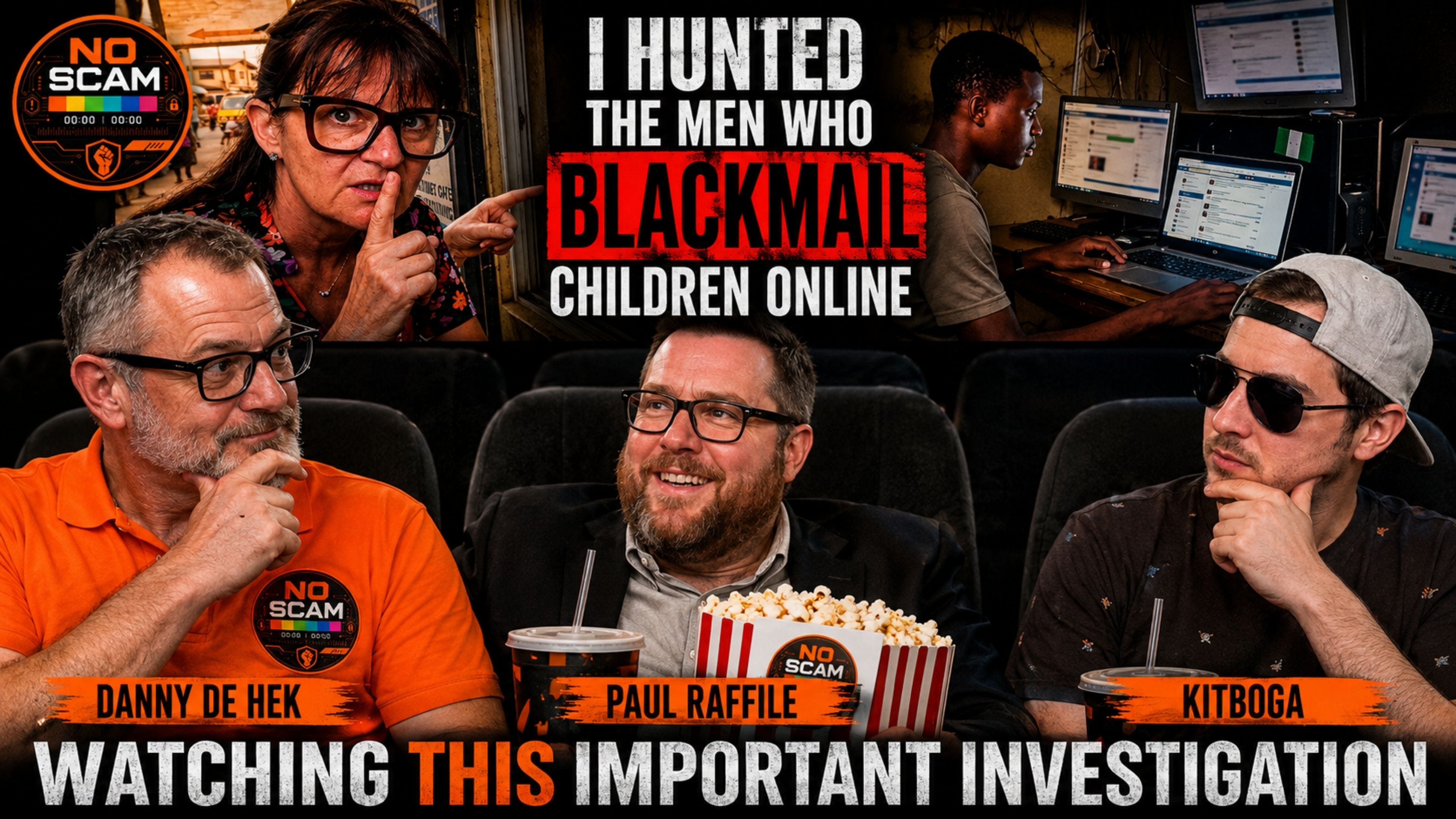
I Hunted the Men Who Blackmail Children Online
This isn’t my investigation, and I’m not claiming it is. The credit belongs to Erin West, founder of Operation Shamrock, cybercrime researcher Paul Raffile, renowned scam-baiter Kitboga, and the team at Sumsub, who supported the production. Together they travelled to Nigeria to investigate the criminal networks behind online sextortion, documenting not only how these scams operate but also the wider ecosystem that allows them to thrive. Their work combines traditional investigative journalism, cyber threat intelligence, open-source intelligence, and on-the-ground reporting to expose a crime that is claiming lives around the world.
As someone who has spent years investigating organised online fraud, I recognised many of the same patterns I see in investment scams. Criminals exploit trust, manipulate emotions, isolate their victims and create a false sense of urgency to pressure people into making irrational decisions. The difference here is that the leverage isn’t financial greed—it’s humiliation. Within a matter of hours, a teenager can go from chatting with what they believe is another young person online to being threatened with the public release of intimate images unless they pay. The emotional impact is immediate, and in far too many cases, the consequences have been tragic.
After studying the documentary, reading through hundreds of public comments from viewers, and reviewing the background of the investigators involved, one message became impossible to ignore: awareness is one of the most powerful tools we have. Parents want to know how to protect their children. Teachers want resources they can share. Young people need to understand how quickly these scams unfold, and social media companies are facing growing calls to do far more to detect and disrupt this criminal activity before lives are destroyed. That is why I’m writing this article. Not simply to recommend an excellent investigation, but to build on it, explain why it matters, and help ensure its message reaches as many people as possible.
One of the reasons this investigation carries so much weight is who conducted it.
This wasn’t a group of content creators chasing views or producing sensational headlines. It brought together professionals with decades of experience in cybercrime, intelligence, criminal prosecution and scam disruption, each bringing a different skill set to uncover a criminal enterprise that often hides behind fake social media profiles, encrypted messaging apps and international borders.
Together, they didn’t simply describe the problem.
They went looking for the people behind it.
Leading the investigation is Erin West, a former Deputy District Attorney in Santa Clara County, California, who spent 26 years prosecuting crime, including eight years with the REACT High-Tech Task Force investigating cryptocurrency crime, SIM-swapping and digital financial fraud. Today she leads Operation Shamrock, bringing together law enforcement, investigators and private industry to disrupt transnational organised crime before more people become victims. Throughout the documentary, her background as a prosecutor is unmistakable. She asks difficult questions, challenges inconsistencies and never loses sight of the victims behind the investigation.
Working alongside Erin is Paul Raffile, a cybercrime researcher whose career spans intelligence, national security and corporate threat analysis. Before specialising in organised cybercrime, Paul supported intelligence operations targeting terrorist organisations, including ISIS, before moving into senior intelligence roles in the private sector. More recently, his work investigating financial sextortion has helped shape safety improvements across major social media platforms and has been featured by organisations including NBC News, Bloomberg, BBC and The New York Times. His ability to connect seemingly unrelated pieces of digital evidence is one of the driving forces behind this investigation.
Then there’s Kitboga.
Millions know him as one of the world’s most recognisable scam baiters, famous for wasting countless hours of scammers’ time on YouTube and Twitch. This documentary, however, showcases another side of his work. Instead of entertaining an online audience, Kitboga uses his experience and purpose-built investigative tools to help gather intelligence that supports a genuine cybercrime investigation. It’s a reminder that technology developed by independent researchers can become incredibly powerful when placed in the hands of experienced investigators.
The investigation was also supported by Sumsub, whose contribution went well beyond sponsorship. The company recognised that raising public awareness is one of the most effective ways to combat online fraud and helped provide the resources needed to take this investigation from computer screens to the streets of Nigeria. Investigative journalism of this quality doesn’t happen by accident. It requires time, expertise, collaboration and, importantly, organisations prepared to support work that serves the public interest.
As I watched the documentary, one thing became increasingly clear.
This wasn’t about sensationalising Nigeria.
It wasn’t about producing dramatic content for social media.
It was a carefully planned investigation built on research, intelligence gathering, collaboration and evidence.
That’s an approach I respect because it’s the same philosophy I try to apply in my own investigations. When experienced professionals combine their skills with a genuine commitment to protecting the public, they don’t just expose individual scammers—they help all of us better understand the systems that allow organised cybercrime to thrive.
Every investigation has a starting point.
In this case, it began with a question every parent should ask:
How quickly can a teenager become the target of a sextortion scam?
Rather than relying on second-hand accounts or victim statements, Erin West and Paul Raffile decided to experience the process themselves. They created what they believed was a realistic teenage social media profile and waited.
They didn’t have to wait long.
Suspicious friend requests began appearing almost immediately. Conversations quickly moved onto private messaging platforms and, before long, the fake teenager was being blackmailed by someone claiming to possess compromising images. One of the documentary’s most sobering findings is just how quickly everything happened.
These scams don’t take weeks or months to develop. They can unfold within hours.
Watching those conversations unfold made something else abundantly clear.
This wasn’t spontaneous. It was a well-rehearsed process.
The fake profile had been carefully designed to resemble exactly the type of account scammers actively seek out, particularly teenage boys, who have become an increasingly common target for financial sextortion. The criminal quickly attempted to build trust before steering the conversation towards the exchange of intimate images. Once that line had been crossed, the friendly conversation disappeared. In its place came threats to send the images to friends, classmates and family members unless payment was made immediately.
Fear.
Embarrassment.
Urgency.
Those three emotions became the scammer’s most powerful weapons.
One pattern immediately caught my attention.
The criminals had no interest in maintaining the illusion once they believed they had control. The romance was never real—it was simply the bait. The moment they thought they had leverage, every message became focused on extracting money.
I’ve seen this pattern repeatedly throughout my own investigations.
Whether it’s a fake investment platform, a romance scam or a cryptocurrency Ponzi scheme, the mechanics are remarkably similar. Trust is manufactured. Pressure is applied. Victims are pushed into making emotional decisions before they have time to think clearly. The only real difference here is that the weapon isn’t false promises of profit—it’s the threat of public humiliation.
Then came the first real clue.
The messages were being sent from a +234 telephone number, suggesting a connection to Nigeria. That alone wasn’t proof of where the scammer was located, but it provided the investigators with their first thread to follow. Rather than paying the demand or ending the conversation, Erin and Paul did what experienced investigators do best.
They started gathering evidence.
Every message.
Every phone call.
Every interaction.
Each became another piece of intelligence that would eventually lead them far beyond their computer screens and into the heart of one of the world’s most notorious cybercrime hotspots.
At this point, the documentary shifts gears.
It stops explaining how sextortion works and starts showing how real cybercrime investigations unfold.
Instead of treating the blackmail attempt as an isolated incident, Erin West and Paul Raffile began collecting evidence like experienced investigators. Their objective wasn’t simply to identify one scammer. They wanted to understand the infrastructure behind the operation—how these criminals communicate, how they receive money, and whether the digital breadcrumbs could eventually lead them to the people responsible.
One of the investigation’s biggest advantages was the involvement of Kitboga.
Millions know him as one of the world’s best scam baiters, but this documentary showcases another side of his work. Drawing on years of experience interacting with online fraudsters, he helped the team use carefully designed investigative tools to gather intelligence. Rather than exploiting software vulnerabilities or hacking into systems, the investigators encouraged the scammer to voluntarily interact with technology that revealed valuable clues about where they were operating. It was a clever reminder that, in many investigations, the most useful evidence comes from understanding human behaviour, not breaking computer systems.
The first breakthrough pointed towards Lagos, Nigeria.
It wasn’t the exact location they were hoping for, but it confirmed they were looking in the right part of the world. Like many investigations I’ve carried out over the years, this wasn’t the dramatic “case closed” moment television has conditioned us to expect. Real investigations rarely work that way.
Every clue simply narrows the search.
Each piece of evidence eliminates possibilities, strengthens the timeline and creates another lead to follow. At this stage, the investigators still had no confirmed identity and no precise address. What they did have was enough evidence to justify taking the investigation much further.
That patience really stood out to me.
It would have been easy to focus entirely on exposing one individual, but Erin and Paul understood something that anyone investigating organised fraud quickly learns: criminals rarely work alone.
These scams operate within networks supported by fake social media accounts, stolen photographs, anonymous messaging platforms, money mules and payment systems capable of moving funds across borders within minutes. Finding one scammer would have been a success. Understanding the ecosystem supporting that scammer was far more valuable.
Eventually, the digital trail reached its limit.
Rather than ending the investigation there, the team did something many online investigations never do.
They got on a plane.
Travelling to Nigeria transformed the documentary from an online experiment into genuine investigative journalism. Instead of relying solely on digital evidence, they met academics, local experts, community members and, ultimately, the very people carrying out these crimes. From that point onwards, the investigation stopped being about a single blackmail attempt and became an examination of the social, economic and criminal ecosystem that allows organised sextortion to continue targeting young people across the world.
Up until this point, the investigation is about finding a scammer.
Then it becomes something much bigger.
Rather than stopping once they identified where the blackmail was coming from, Erin West and Paul Raffile asked a far more important question:
Why has this form of cybercrime become so deeply embedded in parts of Nigerian society?
Instead of relying on stereotypes or sensational headlines, they travelled deeper into the communities, speaking with academics, local contacts and, most remarkably, with self-confessed Yahoo Boys themselves. What emerged wasn’t an excuse for criminal behaviour, but a much more complete picture of the environment that allows these scams to flourish.
One conversation particularly stood out.
Professor Oye Nuga, who has spent years researching cybercrime in Nigeria, challenged the simple explanation that poverty alone creates scammers. He described the concept of relative deprivation—the idea that people compare themselves with those around them and become increasingly willing to take risks when they believe legitimate opportunities are beyond their reach. He also explained how BM—short for blackmail—evolved from traditional romance scams. Instead of spending months manipulating adults into sending money, criminals discovered they could target teenagers, create panic within hours and receive smaller but far more frequent payments. From a criminal’s perspective, it became a more efficient business model.
One of the documentary’s most confronting moments takes viewers into the disturbing world of Yahoo Plus.
This is a subculture where some scammers believe ritual practices, charms and spiritual ceremonies will bring them greater success committing fraud. Accompanied by trusted local guides, the investigators witness ceremonies involving ritualists and animal sacrifices carried out on behalf of active scammers. Whether those rituals have any real power is almost irrelevant. What matters is what they reveal: cybercrime isn’t simply individuals sitting behind computers. In some communities, it has become surrounded by an entire support system that reinforces and normalises criminal behaviour.
Then came the interviews I found hardest to watch.
Erin and Paul sat face-to-face with young men who openly admitted running romance scams and sextortion operations. Some explained they stole photographs from adult performers to create fake female identities. Others described using Instagram and Snapchat because that’s where teenagers are easiest to find. Several claimed they had stopped carrying out sextortion after hearing about teenage suicides linked to these crimes, although the investigators quite rightly questioned whether those claims were genuine or simply an attempt to present themselves more favourably once cameras were rolling.
That scepticism resonated with me.
Throughout my own investigations, I’ve learned that when people are confronted with overwhelming evidence, they often minimise their involvement or attempt to rewrite history. It doesn’t necessarily mean they’re lying about everything, but investigators should never accept those statements at face value without independent evidence.
By the end of this section, I realised something important.
Teenagers aren’t being targeted by one scammer sitting behind one computer.
They’re being targeted by a criminal ecosystem.
The documentary reveals people selling stolen photographs for fake profiles, others providing bank accounts and payment services, individuals moving money, and entire networks supporting those carrying out the scams. By the time a teenager receives that first threatening message, they may already be facing an organised operation that has refined its methods over many years. Understanding that bigger picture is essential, because if we only focus on catching individual scammers, we’ll never dismantle the system that continues producing them.
Throughout the documentary, it’s easy to become absorbed in the investigation itself—the digital trail, the interviews, the journey across Nigeria and the eventual confrontation with the suspected scammer. But beneath every piece of evidence lies the real reason this investigation matters.
These crimes are not simply financial scams. They are psychological attacks that have cost young people their lives.
The investigators repeatedly return to this point because it fundamentally changes the way we should think about sextortion. This isn’t about losing money. It’s about exploiting fear, shame and isolation at one of the most vulnerable moments in a young person’s life.
One statement from Erin West stopped me in my tracks.
According to the investigation, more than 60 teenage boys are known to have taken their own lives after becoming victims of sextortion. Whether every individual case is ultimately determined by the relevant authorities, the scale of the tragedy is impossible to ignore. These criminals understand exactly what they’re doing. They deliberately create panic, convince victims that their lives are about to be destroyed, and demand immediate payment while the victim is emotionally overwhelmed. Tragically, paying rarely ends the ordeal. Once someone sends money, they often become the target of repeated demands, with the threats continuing for as long as the criminals believe there is more to extract.
As I worked my way through the hundreds of comments beneath the documentary, another reality emerged.
The victims are not anonymous statistics.
Some viewers openly admitted they had experienced sextortion themselves. One described paying the blackmailer, only to be threatened again anyway. Others thanked the investigators for explaining how these scams work, saying they intended to share the documentary with their children, friends and wider families. The overwhelming response wasn’t one of entertainment—it was one of education. People recognised that understanding these scams before becoming a victim could make all the difference.
Another thing that stood out was the compassion shown by the community. Rather than blaming victims for making a mistake or sharing intimate images, many comments encouraged young people to speak up and seek help. That perfectly reinforces one of the documentary’s most important messages:
Silence is the scammer’s greatest weapon.
Criminals rely on victims believing they are alone, too embarrassed to tell a parent, teacher or trusted adult. Breaking that isolation removes much of the scammer’s power and often becomes the first step towards stopping the abuse.
For parents, teachers and carers, there is an important lesson here. Conversations about online safety cannot begin after a child becomes a victim. They need to happen before the first friend request arrives, before the first private message is exchanged, and before a teenager finds themselves facing impossible choices under extreme emotional pressure. If this documentary achieves anything, I hope it encourages more families to have those conversations. Awareness won’t stop every scam, but it may give a frightened young person the confidence to ask for help instead of believing there is no way out.
After days of following digital clues, consulting experts and building local contacts, the investigation reached its defining moment. Using information gathered through their research network, the team connected a phone number to bank account details, real names and, ultimately, a physical location. What had started as an anonymous online blackmailer was no longer hidden behind a fake profile and a messaging app. Erin West and Paul Raffile travelled to the suspect’s hometown and made contact directly. It was an extraordinary moment because it demonstrated something scammers often believe is impossible—that the people they target can sometimes find them too.
Then came the confrontation.
The suspected scammer denied being responsible, insisting he was simply a tradesman selling shoes and refusing to show his face. Erin, drawing on decades of experience as a prosecutor, left him in no doubt about the seriousness of the investigation. She explained that they knew who he was, where he lived, who he associated with, and that the evidence gathered had already been handed to the authorities.
Then she delivered the message that, in my opinion, defines the entire documentary.
“We’ve had 60 suicides that we know about from the bad work that you do. I know who you are and you’re going to jail.”
Whether that individual is ultimately prosecuted remains to be seen, but the anonymity these criminals depend upon had been shattered. For perhaps the first time, the hunter had become the hunted.
Not everyone was satisfied with the ending.
After reading through the comments beneath the documentary, I noticed one question appearing repeatedly:
“Why wasn’t he arrested?”
Some viewers questioned why the investigators revealed their hand before law enforcement acted. Others argued the operation should have remained covert until an arrest had been made. Those reactions are understandable, particularly from people accustomed to television crime shows where every investigation concludes neatly within the final few minutes.
The reality is very different.
Real investigations rarely end with instant justice.
Gathering evidence is only one part of the process. Arrests depend on local law enforcement, available evidence, jurisdiction, prosecutorial decisions and international cooperation. Erin and Paul openly acknowledge that, despite handing everything they had gathered to the authorities, no arrests had yet been made. Rather than manufacturing a dramatic ending for the sake of good television, they chose transparency. In my view, that honesty strengthens the documentary rather than weakening it.
Ultimately, I don’t believe the success of this investigation should be measured by whether one individual is eventually prosecuted. Its greatest achievement is much broader. It demonstrates that organised sextortion is not an invisible crime, that experienced investigators can expose how these criminal networks operate, and that public awareness remains one of the most powerful tools we have. If this documentary encourages parents to have difficult conversations with their children, prompts technology companies to strengthen their safeguards, or gives even one frightened teenager the confidence to seek help instead of suffering in silence, then it has already achieved something that no single arrest ever could.
As the credits rolled, I found myself thinking less about the individual scammer and more about the system that allows these crimes to continue.
That’s where I Hunted the Men Who Blackmail Children Online really succeeds.
It doesn’t present sextortion as the work of a handful of bad actors. It exposes an interconnected ecosystem involving social media platforms, messaging apps, payment systems, organised criminal networks and victims spread across multiple countries. If we’re serious about protecting young people, that’s the bigger picture we need to understand.
One message echoed throughout the entire investigation.
Prevention is always better than reaction.
By the time law enforcement becomes involved, a teenager may already have experienced severe emotional trauma, paid money they couldn’t afford to lose, or believed their life had been permanently ruined. Erin West and Paul Raffile make a compelling case that the companies operating social media platforms, messaging services and payment systems occupy the earliest point in that chain. They’re uniquely positioned to detect suspicious behaviour, disrupt criminal accounts and make it significantly harder for organised networks to reach vulnerable young people in the first place. Prevention won’t stop every crime, but it has the potential to stop many of them before a victim ever receives that first threatening message.
The public response reinforced that message.
As I read through hundreds of comments beneath the documentary, I noticed remarkable consistency in what people were asking for. Parents wanted resources they could share with their children. Teachers spoke about raising awareness in schools. Many viewers called for stronger action from technology companies, while others highlighted the need for greater cooperation between governments and law enforcement. Surprisingly few people believed arrests alone would solve the problem. Most recognised that enforcement is only one piece of a much larger puzzle.
Another theme stood out to me.
Many Nigerian viewers thanked the investigators for exposing these criminal networks while also reminding the audience that the overwhelming majority of Nigerians are honest, hardworking people. I think that’s an important distinction to preserve. This documentary isn’t an indictment of a nation. It’s an investigation into organised criminals operating within that nation. Similar cybercrime networks exist across the world, and the objective should never be to stereotype an entire country. It should be to expose those responsible, understand how they operate and support the people working to stop them.
That’s ultimately why I’ve chosen to dedicate my own platform to promoting this investigation.
I spend much of my time exposing cryptocurrency scams, Ponzi schemes and organised online fraud. Every now and then, however, someone else produces work that deserves to be amplified because the public benefit is simply too important to ignore.
Erin West, Paul Raffile, Kitboga and everyone involved in this production haven’t just created a compelling documentary. They’ve created an educational resource that I genuinely believe has the potential to save lives.
If it encourages one parent to have an important conversation…
If it gives one frightened teenager the confidence to ask for help…
Or if it motivates one technology company to strengthen its safeguards…
…then sharing their work has been well worth it.
There are plenty of videos online exposing scammers. Some are entertaining. Others are educational. Very few combine professional investigative techniques, on-the-ground reporting, cyber threat intelligence and public awareness as effectively as I Hunted the Men Who Blackmail Children Online.
If you’re a parent, watch it with your teenagers.
If you’re a teacher, consider whether it could help start an important classroom discussion about online safety.
If you work in law enforcement, cybersecurity, education or child protection, I believe this documentary provides valuable insight into how these criminal networks operate and why international cooperation remains essential.
And if you’re a young person, remember this above everything else:
If someone online threatens to expose intimate images unless you pay them, you are not alone. Do not keep it to yourself. Do not continue negotiating. Do not believe the threats define your future. Tell a trusted adult immediately and report what has happened. The shame belongs entirely to the criminal—not to you.
I’d like to congratulate Erin West, Paul Raffile, Kitboga and the entire team behind Sumsub for producing one of the most compelling cybercrime investigations I’ve watched in a long time. It isn’t often that I dedicate an article to promoting someone else’s work, but outstanding investigative journalism deserves to be recognised and shared. Raising awareness is one of the strongest weapons we have against organised cybercrime, and this documentary is an excellent example of why.
I encourage you to watch the full investigation, share it with your family, friends and colleagues, and help keep the conversation going. Every parent who understands how sextortion works, every teenager who recognises the warning signs, and every educator who starts a conversation about online safety represents another opportunity to stop these criminals before they create another victim.
Watch the full investigation here:
If this article encourages just one family to have an honest conversation about online safety, or gives one frightened teenager the confidence to ask for help instead of suffering in silence, then it has achieved exactly what I hoped it would.
This investigation relies entirely on OSINT — Open Source Intelligence — meaning every claim made here is based on publicly available records, archived web pages, corporate filings, domain data, social media activity, and open blockchain transactions. No private data, hacking, or unlawful access methods were used. OSINT is a powerful and ethical tool for exposing scams without violating privacy laws or overstepping legal boundaries.
I’m DANNY DE HEK, a New Zealand–based YouTuber, investigative journalist, and OSINT researcher. I name and shame individuals promoting or marketing fraudulent schemes through my YOUTUBE CHANNEL. Every video I produce exposes the people behind scams, Ponzi schemes, and MLM frauds — holding them accountable in public.
My PODCAST is an extension of that work. It’s distributed across 18 major platforms — including Apple Podcasts, Spotify, Amazon Music, YouTube, and iHeartRadio — so when scammers try to hide, my content follows them everywhere. If you prefer listening to my investigations instead of watching, you’ll find them on every major podcast service.
You can BOOK ME for private consultations or SPEAKING ENGAGEMENTS, where I share first-hand experience from years of exposing large-scale fraud and helping victims recover.
“Stop losing your future to financial parasites. Subscribe. Expose. Protect.”
My work exposing crypto fraud has been featured in:
Coffeezilla 2026): Featured in the investigation exposing the alleged $328M Goliath Ventures Ponzi scheme
Bloomberg Documentary (2025): A 20-minute exposé on Ponzi schemes and crypto card fraud
News.com.au (2025): Profiled as one of the leading scam-busters in Australasia
OpIndia (2025): Cited for uncovering Pakistani software houses linked to drug trafficking, visa scams, and global financial fraud
The Press / Stuff.co.nz (2023): Successfully defeated $3.85M gag lawsuit; court ruled it was a vexatious attempt to silence whistleblowing
The Guardian Australia (2023): National warning on crypto MLMs affecting Aussie families
ABC News Australia (2023): Investigation into Blockchain Global and its collapse
The New York Times (2022): A full two-page feature on dismantling HyperVerse and its global network
Radio New Zealand (2022): “The Kiwi YouTuber Taking Down Crypto Scammers From His Christchurch Home”
Otago Daily Times (2022): A profile on my investigative work and the impact of crypto fraud in New Zealand
No posts
Comments
Nothing yet. Say the first thing.
Sign in to join the conversation.