
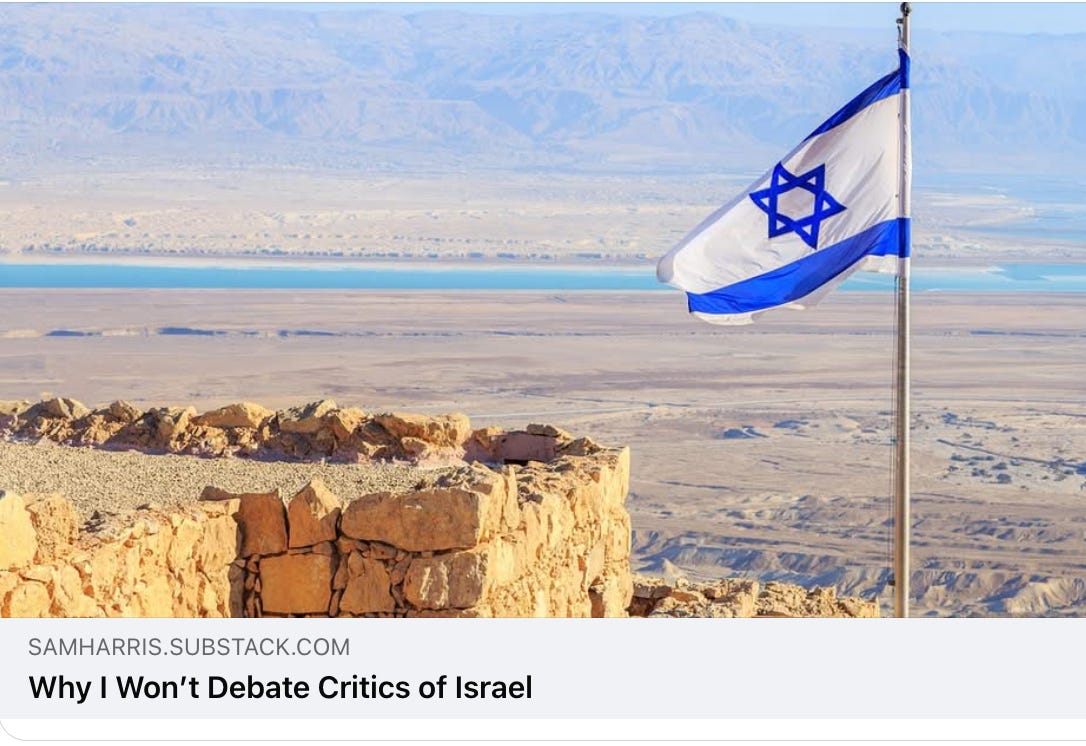
“Many readers and podcast listeners have been dismayed by my enduring support for Israel and now urge me to debate someone—really anyone—drawn from a growing cast of scholars, grifters, and moral lunatics who have made that beleaguered country their professional or psychiatric obsession. […] My views about the conflict in the Middle East will not fundamentally change unless my critics produce evidence that Israel has become as evil as her enemies.”
—Sam Harris
A post by Sam Harris is making the rounds, on why he won’t interview/debate critics of Israel. I’m someone interested in how we engage with opponents, and how our overly pessimistic views of “them” can amplify conflict. I think Sam makes a mistake in seeing his opponents on this topic as more dumb and/or malicious than they are, and therefore as unworthy of engagement as equals—which is just a common dynamic in toxic conflict in general.
The mistake, as I see it, is in thinking that one shouldn’t be able to be harshly critical of Israel because Israel has, the argument goes, done much less horrible things than their opponents have done. Leaving aside entirely the question of who has done more horrible things, I think this argument is weak because: it’s possible to believe that Palestinian people have done much more barbaric/uncivilized things than Israeli people have, WHILE STILL BEING harshly critical of Israel. One way that can be is that people can “expect more” from Israel, in the same way that people can “expect more” from the United States when the U.S. is in combat with enemies many view as less modern/civilized/enlightened (again, I’m talking perceptions here).
One could also be harshly critical of Israel while still being highly pro-Israel. For example, a person can believe that Netanyahu and camp have acted in unreasonable ways that will only amplify conflict and lead to hurting Israel in the long run.
Also, Sam’s view that one can’t criticize a group/nation until they are doing things that are as horrible and degraded as their enemies doesn’t make much sense to me. It doesn’t seem a view that we, as a society, would want to promote. If everyone held that view, there would be little to no incentive for a country/group to “take the high road” and do the right thing; there would be perverse incentives for a group to simply aim to be perceived as just-slightly-morally-better than one’s enemies, which isn’t a great motivator for morally good conduct.
Again, I’m not interested in who is right or wrong on these topics (meaning with the public work/writing I do); what I am interested in is how people in conflict can view their opponents and perceived enemies in overly pessimistic and insulting ways, and how that can amplify toxicity.
I think if Sam Harris were a little more removed from this topic, emotionally, he might be more willing to examine how there can be conflict-amplifying behavior on the part of pro-Israel people. One of the more obvious examples of this, to me, is the frequent labeling of a wide range of Israel-criticism, no matter how reasoned and defensible, as representing “antisemitism.“ I think it’s obvious that one can be both pro-Israel WHILE ALSO seeing that this excessive-filtering-for-antisemitism is a real phenomenon, and a conflict-amplifying one. I wish Sam Harris were up for examining that; that would be a good thing; and it wouldn’t weaken his other stances on Israel (although I think he likely thinks it would).
One could make an analogy here to how some antiracism activists are overly quick to see disagreement with antiracism ideas as representing racism (something I write about in Defusing American Anger). But this is how toxic conflict works: we will often do the mental work necessary to show (to others and to ourselves) why our opponents/enemies are morally bankrupt and/or stupid, and thus not worth engaging with.
To be clear, also, none of this is to argue that there are not extremely unreasonable people and “moral lunatics” on the anti-Israel side. We’re focusing here on Sam’s apparent contention that there is no one worth engaging with, at all, amongst Israel-critical people.
This is also something that happens amongst Israel critics. As I talk about in this piece, there are some on that “side” who do what Sam does: speak as if their opponents are moral lunatics who aren’t worth engaging with.
One of the more enlightening episodes of my podcast (for me, personally) was this talk I had with Yakov Hirsch, who walks through the historical/philosophical reasons for why Jewish and pro-Israel people are so quick to perceive and label things as “antisemitism.” This goes back to philosophical views on what the nature of Nazis and the Holocaust were (e.g., the “banality of evil” causal views vs. deep-and-entrenched-antisemitism causal views). Yakov is a critic of Israel (who I do not believe is a grifter, moral lunatic, deranged, or irrationally obsessed) and someone who I think seeks to understand different points of views, including those of his opponents, and I liked talking to him for that reason. That talk is here:
At the core of my writings on conflict is the idea that it is simply easy for smart and compassionate people to reach dramatically different conclusions about all sorts of things. The more we act as if wide swaths of our fellow citizens are stupid and/or morally-bankrupt, and thus not worth engaging with (basically, the definition of contempt), the more we’ll amplify conflict.
And note that one can do this while lobbying hard for one’s views and, in fact, I think the ability to acknowledge others’ have defensible points actually makes you better able to persuade others of your point of view (when our social instincts lead us to wrongly think the opposite; that treating opponents’ views with more respect will hurt our position).
Some people will dislike me and be angry at me for this post; they will think that I’m morally bad for defending people and ideas they see as morally bad. But the truth is that I’m used to that; that is the same kind of criticism I’ve gotten on many topics from both “sides” of the American political conflict. For example, my writing about the above dynamics in the realm of antiracism activism has led to people calling me a fascist, a racist, and much more. Just as my attempt to help pro-Trump Americans see how Trump and their “side” has contributed to our societal/political toxicity — which is necessary for understanding the “other side” — has gotten me much grief and insults. But hopefully you can see that my goal in these areas is not to argue for a specific stance; it is to discuss the meta-level stance of how-we-engage-with-opponents… to help people see that we can act in conflict-amplifying ways and even self-harming/defeating ways when we’re overly pessimistic about others.
No posts
Comments
Nothing yet. Say the first thing.
Sign in to join the conversation.