
Welcome Avatar!
Unlike stocks or bonds, a crypto token does not inherently represent a legal claim on anything. A token is a digital asset whose rules are defined by code.
Tokens can have functional features that have nothing to do with money, such as storage for computing. People can decide they want to make use of a token and find a way to purchase that token, ascribing it a “value.”
The existence of the token could mean something important, but it could also mean nothing at all.
Meanwhile, stocks and bonds have financial value backed by well established legal agreements.
Common stock represents an ownership interest in a company (you get to share in the upside). Bonds are a legal obligation between borrower and lender that require the borrower to meet certain obligations (interest payments, principal payments, etc.).
A company’s “capital structure” is its composition of equity and debt that make up its value.
A typical (highly simplified) company might look something like this:
Enterprise value: $100
Cash: $10
Debt: $50
Equity value: $60
Simplified Enterprise Value = Equity Value + Debt - Cash
Here’s how a DAO or crypto venture might look:
Treasury: $10
Token market cap: $50
Venture entity’s equity value: $10?
Debt: $0
This becomes confusing.
Does the treasury belong to the corporate entity or to the token holders?
What we end up with is something like having two overlapping capital structures.
Understanding what value is captured where could be the difference between your tokens going up 10x or being worth zero from a single tweet announcement.
When Pump.fun acquired trading terminal Padre last year, the existence of a PADRE token didn’t mean PADRE holders owned the company being acquired or were entitled to the acquisition proceeds. The token collapsed and Pump.fun eventually promised holders an airdrop after the fact.
The dual token/equity structure is once again under scrutiny today due to the structure at Venice/VVV.
Venice announced it crossed $100 million in annualized revenue, making it one of the most commercially successful businesses at the intersection of crypto and AI. We covered Venice in a deep dive back in February (we’re usually 6 months ahead of Crypto Twitter narratives).
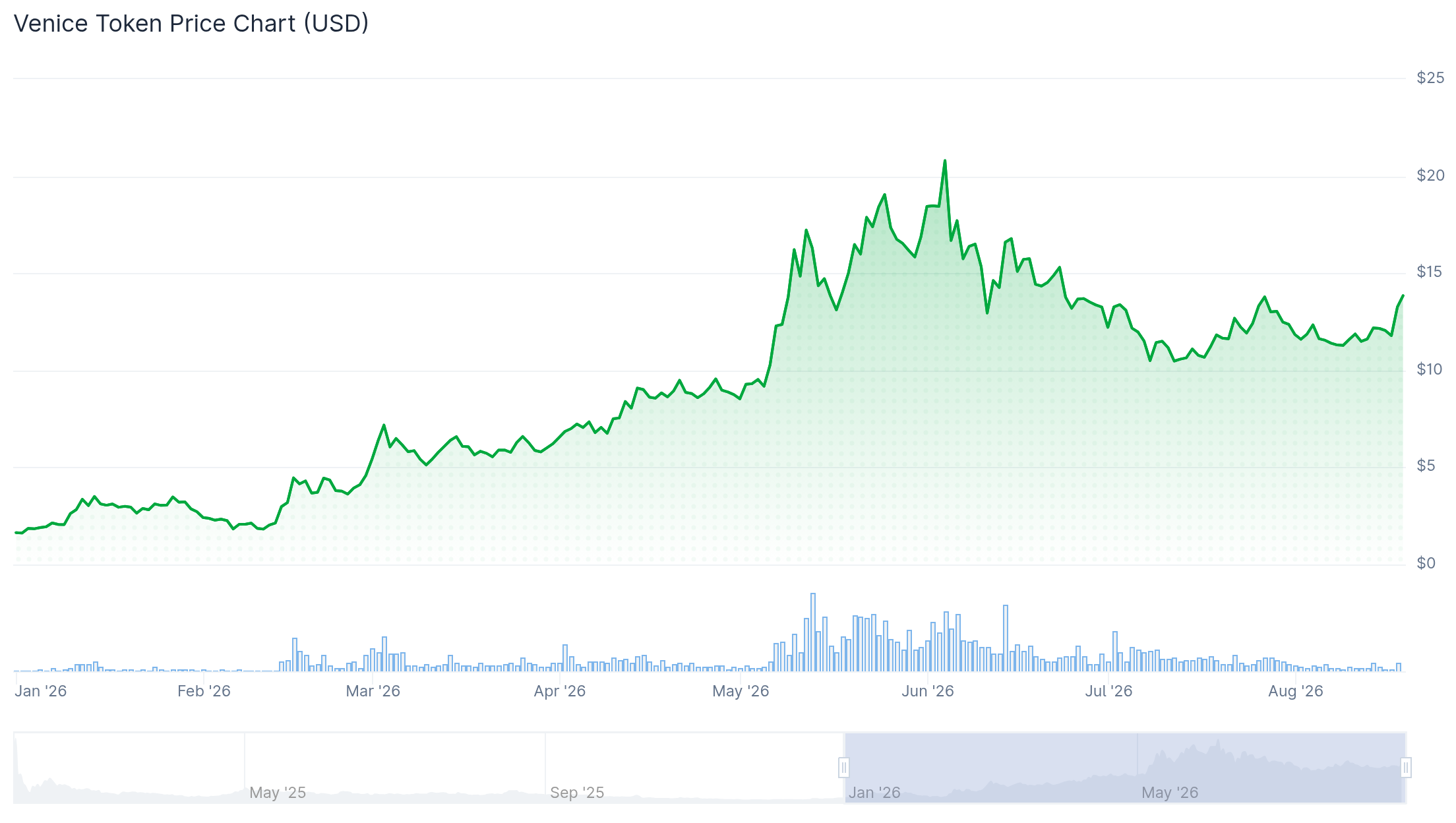
There are effectively two ways to own exposure (and only one that public market investors can play).
Value is available at Venice (the private company) and VVV (the publicly traded crypto token).
Last month, Venice raised its first outside funding round of $65 million in a Series A led by Dragonfly at a $1 billion equity valuation. Coinbase Ventures, F-Prime, North Island Ventures and others participated. At the time Venice had 3.5 million registered users and was processing approximately 1.3 trillion AI tokens per month.
The VVV token has a market cap of ~$650 million.
In summary, what we have is:
Venice equity: $1 billion valuation
VVV: $650 million circulating market cap
Venice annualized revenue: $100 million
So where is this value creation actually going to flow?
The equity side is relatively simple. Shareholders own part of Venice the corporation. If Venice eventually becomes worth $5 billion or $10 billion the equity holders participate in that appreciation according to the rights attached to their shares. The Series A investors didn’t just buy equity though.
The investment included:
8.98% of Venice equity
A 1.5 million VVV vesting token grant
The right to purchase another 5 million VVV over the following eight years
Note: management announced investors would pay an additional $66.5 million to Venice to purchase the 5 million VVV, implying an exercise price of $13.30.
VVV currently has several primary functions. You can stake it to earn additional VVV. Holding and staking certain amounts can provide access to paid Venice products such as Venice Pro. VVV is also the asset required to create DIEM, Venice’s tokenized AI compute product.
Users stake VVV and then lock that staked VVV to mint DIEM. Each staked DIEM provides $1 of Venice API credit per day and the DIEM can later be burned to unlock the corresponding staked VVV.
All that is to say there is actual demand tied to using the product.
Venice has implemented mechanisms through which platform revenue is used to purchase and burn VVV. More Venice revenue means more VVV purchases and burns which lowers VVV supply and offsets some emissions. It has also introduced fixed token burns associated with new Venice subscriptions (separate burn amounts for Pro, Pro+ and Max subscriptions).
Buying VVV does not mean you own part of Venice. However, the tokenomics are such that more demand for platform means built-in demand for the token.
Despite its better than usual tokenomics structure, economic alignment is still not ownership. Tokenholders benefit from Venice’s growth only to the extent that the business grows and token value capture mechanisms remain in place.
That brings us to the core investment question: can Venice operate a token that captures enough of the economics created by the company that both assets can become valuable simultaneously?
A company could theoretically become worth $10 billion and its token becomes worth several billion if the token serves as a key piece of the network and increasingly large amounts of revenue create structural demand for the token.
The crypto industry has spent years experimenting with what tokens are actually supposed to represent. Governance rights and “community ownership” has proven to not be enough. Giving users a token while a private company captured the actual profits was also obviously not enough.
The biggest risk with a equity plus token structure is obvious by now (and covered by us many times over the years). The company owns the valuable business while tokenholders get some vague combo of governance, utility and promises about decentralization.
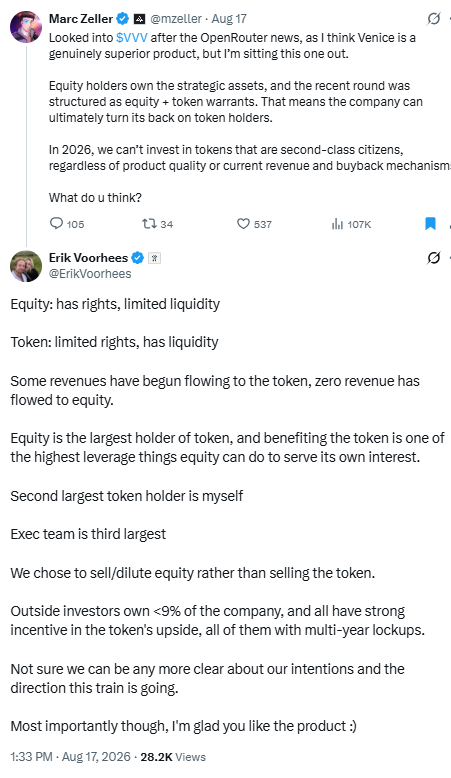
In this case, founder Erik Voorhees is arguing that Venice’s shareholders are strongly incentivized to increase the value of VVV.
Venice owns:
The operating company and its contractual rights to future cash flows
A large treasury position in VVV
If Venice sends $10 million of company cash toward VVV, VVV holders benefit. Venice shareholders also benefit because the company owns a large amount of VVV.
The statement that “no revenue has flowed to equity” is largely meaningless since equity does not need to receive a dividend to gain value. And while diluting equity instead of selling the token is a noble claim, investors aren’t in the business of losing money. Presumably, there is a plan presented to investors in the Series A that sees them making a return on their equity investment (and yes, part of this would be the token grant/warrants).
Ultimately a founder’s priority is managing all stakeholders and capital providers. You, as the public market retail investor, are just one type of stakeholder, and should always think critically about anything presented by management.
Autist note: Be mindful of the circularity problem here. Venice equity owns a huge VVV treasury. VVV is valuable partly because Venice promises to direct economic value toward VVV. So Venice equity is more valuable because it owns VVV while VVV is more valuable because Venice equity controls a business that supports VVV. There is some genuine underlying value because Venice has a real operating business but the cross-ownership means reflexive valuation / double counting risk. You cannot just say Venice’s total ecosystem valuation is $1 billion valuation + $650 million VVV market cap.
Voorhees’ argument is more compelling than what we typically get in these situations, so VVV definitely warrants a deeper look.
Venice is VVV’s largest holder. Management owns significant VVV. Its new investors own both equity and token exposure. Venice chose to dilute its equity rather than sell VVV. And actual Venice revenue is already being used to purchase and burn tokens.
But there is still an important distinction between management being incentivized to make VVV valuable and the claim VVV will have on Venice’s economics.
If Venice grows from $100 million to $500 million of revenue, what percentage of that incremental economic value actually reaches VVV?
This is the billion dollar question and answering it requires going considerably deeper than the headline tokenomics.
On Thursday, we’re going to put numbers around it for paid subscribers. We’ll break Venice/VVV into its component pieces and analyze the specifics around valuation and value capture so you can decide whether VVV is capturing enough value to be investable.
Become a paid subscriber to get Thursday’s Deep Dive.
Paid subscribers also get access to:
All of our past posts
Weekly Deep Dive Report
A comprehensive bi-weekly DeFi Roundup
Bi-weekly Q&A sessions with our team
Until next time..

Disclaimer: None of this is to be deemed legal or financial advice of any kind. These are opinions from an anonymous group of cartoon animals with Wall Street and Software backgrounds.
We now have a full course on crypto that will get you up to speed (Click Here)
We offer the Prediction Markets module on a standalone basis (Click Here)
Security: Our official views on how to store Crypto correctly (Click Here)
No posts
Comments
Nothing yet. Say the first thing.
Sign in to join the conversation.