
Every stablecoin forecast you’ve read—including the Treasury Secretary’s own—is a bet on human behavior: the saver in Buenos Aires, the merchant in Lagos, the remittance from Houston to Manila. But the fastest-growing holder of digital dollars over the next five years won’t be human at all. It will be software with a funded wallet. Bessent built the reserve architecture for a machine economy he wasn’t modeling—and this week, while Washington argued about the CLARITY Act, the machine economy started moving in.
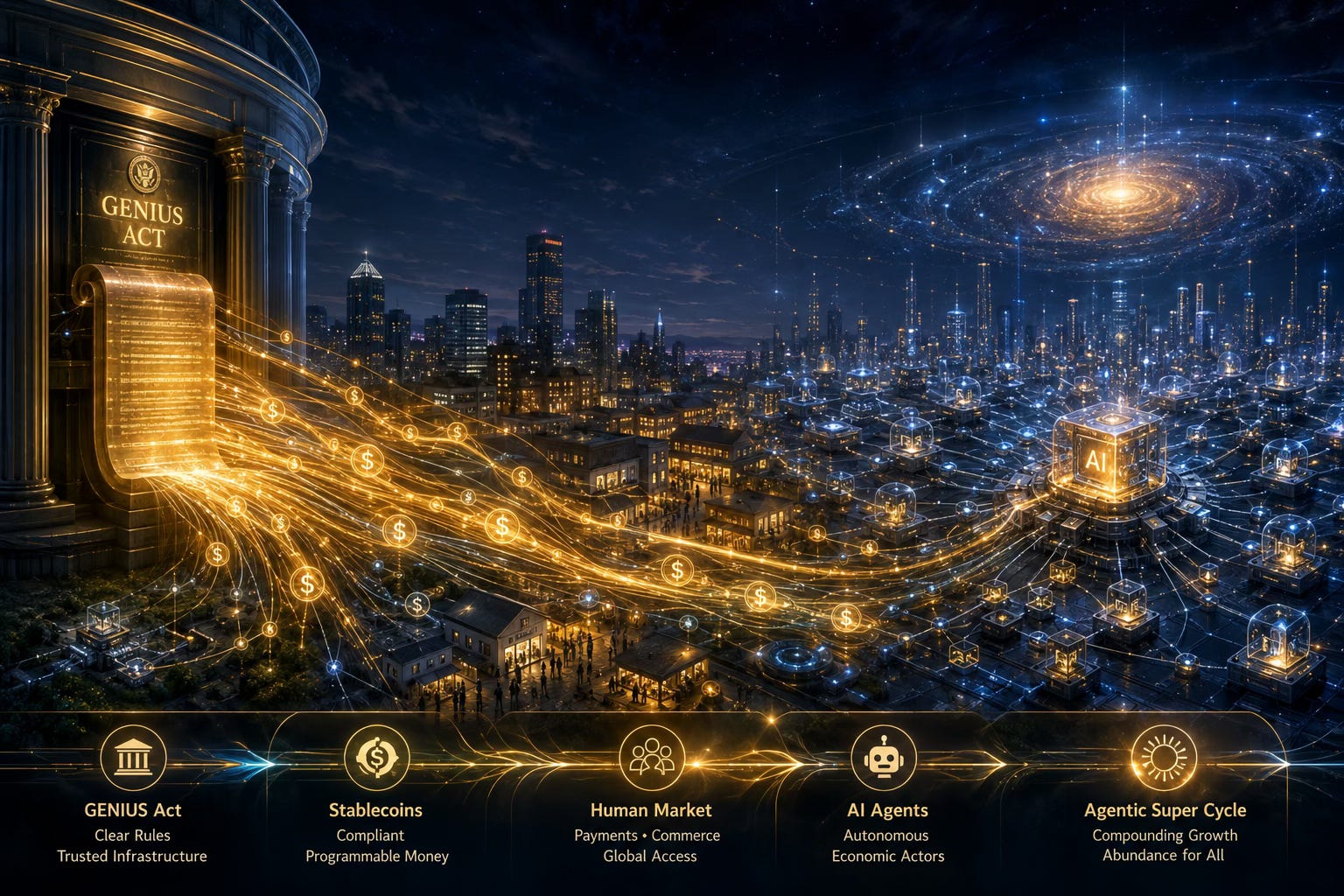
While most of the financial press was distracted with coverage of whether the CLARITY Act would pass before the August deadline, Cloudflare quietly shipped the most important piece of Treasury-market infrastructure you’ve never heard of.
On August 4, as part of its Agents Week rollout, the company launched Cloudflare Wallets —programmable stablecoin wallets built for AI agents—along with human-readable payment handles at cloudflare.pay. The design is simple and telling: a human funds an Account Wallet, then spins up Virtual Wallets for individual AI agents, each governed by an allowance, an allow-list of approved merchants, and a hard cap on transaction size. The agent goes out and buys what it needs—API calls, data, compute, content—without a human approving each purchase.
Nobody covering the launch described it as fixed-income news. It is fixed-income news. And to understand why, you have to go back to a bet the Treasury Secretary placed in July 2025—and the part of that bet even he didn’t price.
AI agentic wallets change everything.
Let me be precise about what Cloudflare actually shipped this week: only the handle-claiming is live—funding and full payment functionality arrive in the coming months. But to simply brush this news aside as just another soft launch of an AI product with no existing market fit misses the more compelling point. Human stablecoin wallets are of course nothing new and Cloudflare, like many other firms in the sector, has been assembling in public all summer ahead of the GENIUS Act going live. The bigger innovation that’s happening is that companies are now building seamless bridges between human stablecoin wallets to their AI agentic alter egos.
On July 1, Cloudflare launched its Monetization Gateway, which lets any website or API charge AI agents per request, settled in stablecoins over the x402 protocol. In June, Amazon wired x402 into CloudFront and into Bedrock AgentCore, letting agents purchase services in USDC across AWS infrastructure. And the protocol underneath all of it is governed by the x402 Foundation, which Cloudflare and Coinbase stood up in September 2025 precisely to standardize machine-to-machine payments. A company that fronts roughly one in five websites—and says the majority of web traffic is now bots, not humans—just finished building both sides of a marketplace where software buys from software and settles in tokenized dollars. That is not a crypto product launch. That is the plumbing of a new economy being bolted into the internet’s load-bearing walls. And it confirms my longstanding theory that crypto will be the economic layer of the AI agentic economy and stablecoins will be the currency of that economy.
What the GENIUS Act actually enables.
Now rewind back to July 18, 2025—the day President Trump signed the GENIUS Act. In his statement on enactment, Treasury Secretary Scott Bessent made a prediction that read, at the time, like standard bill-signing enthusiasm: the law would “buttress the dollar’s status as the global reserve currency, expand access to the dollar economy for billions across the globe, and lead to a surge in demand for US Treasuries, which back stablecoins.”
A month earlier, Bessent postedthe arithmetic on X: reporting projected stablecoins could become a $3.7 trillion market by decade’s end, and because the GENIUS Act requires every regulated stablecoin to be fully reserved in cash, insured deposits, and short-dated Treasury bills, every dollar of issuance is a dollar of private-sector demand for U.S. government debt.
By August, the Financial Times reported that he’d held private discussions with Tether and Circle about tailoring short-term debt issuance to meet that demand. And by November, at the Treasury Market Conference, he made it official strategy: the stablecoin market, then around $300 billion, would “grow tenfold by the end of the decade thanks to the innovation made possible by the GENIUS Act,” and stablecoin issuers would be factored into Treasury’s long-term debt management. It was the first time a Treasury Secretary had ever positioned stablecoins as a pillar of U.S. debt financing. I’ve been writing about this since the spring—the mechanism I call the Bessent Doctrine: as foreign central banks retreat from Treasuries, the gap gets filled not by sovereigns but by regulated stablecoin issuers, with the underlying claimant shifting from the People’s Bank of China to a merchant in Lagos or a saver in Buenos Aires.
What Bessent didn’t account for when the GENIUS Act became law: global stablecoin demand fueled not just by humans, but by AI agentic wallets.
Look at how every stablecoin forecast in circulation is actually constructed—including, respectfully, the Treasury Secretary’s own. Bessent’s $3 trillion. Citi’s $4 trillion. Standard Chartered’s $2 trillion by 2028. JPMorgan’s more cautious $500 billion. Different analysts, different assumptions, same architecture: every one of them is built by adding up human demand curves. Remittances from Houston to Manila. Savers in Argentina fleeing the peso. Merchants settling cross-border invoices. Corporate treasury desks. DeFi collateral. Every input in every model is a person, or an institution run by persons, making financial decisions at the speed people make them.
That was the right way to model stablecoins in 2025, when humans were the only economic actors on earth. It is not the right way to model them now—because the marginal holder of a dollar-denominated stablecoin over the next five years won’t be a human being at all. It will be a piece of software with a funded wallet. And software demand doesn’t scale like human demand. It scales like the internet.
The GENIUS Act’s authors were legislating for the Lagos merchant and the Buenos Aires saver. But, what they actually built—whether anyone in the room knew it or not—is the reserve architecture for the machine economy. This week’s Cloudflare launch is what that thesis looks like arriving.
The Stablecoin Strategist delivers enforcement-focused intelligence on stablecoin regulation for operators, counsel, and institutions navigating the GENIUS Act cycle. This is analysis, not legal advice; no attorney-client relationship is formed by reading it.
No posts
Comments
Nothing yet. Say the first thing.
Sign in to join the conversation.