
Welcome to the latest edition of Defense Tech and Acquisition.
The biggest stories across the Department and the defense industry this week:
Deputy Feinberg requires cost/pricing data for all tiers of supply chain
New hypersonic weapons, seaglider, and 3D printing solutions emerge.
Army evolves C2, EW, and HPM capabilities
Navy drops $22B on Tomahawks, Orca completes 1,000 mile trek
Air Force advances ACE construct with C2 demo and real-world exercise
Space Force may see supply chain bottlenecks constrain ambitions
Europe still open for U.S. despite push for domestic industrial buildup

BLUF: Deputy Secretary Feinberg signed a memo that the DOW must have maximum insight into cost and pricing data from industry to negotiate the best price for weapon systems and other contracts.
This directive to the warfighting acquisition workforce resets the Department’s expectations regarding supplier cost and pricing information.
Full transparency throughout all tiers of the supply chain applies to all contractors and subcontractors.
This requirement supports negotiations for products and services valued at $10M or more, regardless of whether cost and pricing data requires certification.
Directed USW(A&S) to establish fair and reasonable contract profit margins by applying commercial best practices tailored to each product or service line.
Contracting officers must have access to actual cost information at both the prime and supplier levels for these contract actions.
Establish APIs to pull cost information directly from contractors’ ERPs.
During post-award contract administration, accurate and timely submission of Cost and Software Data Reporting (CSDR) is vital for the effective management of our major acquisition programs.
In non-commercial, sole-source acquisitions where CSDR data is not in use, the USW(A&S) Deal Team collaborates with the DCAA to determine cost-effectiveness by comparing actual costs to prices paid.
The Department does not intend to limit profitability when contractors realize efficiencies after negotiating a fair and reasonable price based on a realistic baseline. This effort ensures that transparency and measurement of negotiation outcomes become ingrained standards within our acquisition system.
Our Take: This could radically change the DoW-industry relationship by requiring extensive cost data at prime and sub level, regardless of contract type. The expanded expectation of direct access to industry ERP systems and the department establishing fair and reasonable margins will be… interesting. While the intent is to provide acquisition professionals better data to negotiate, it could have a chilling effects for many companies to enter or stay in the defense industry if they have viable commercial businesses.
To achieve U.S. objectives in the face of existing and future challenges, America’s national security S&T posture must be focused, resilient, agile, and secure.
This will include:
Building our S&T workforce
Enhancing R&D infrastructure
Targeting Federal R&D funding
Fostering partnerships with non-Federal stakeholders
Leveraging ally and partner capabilities.
Pillars
Focusing Techno-Strategic Competition
Maintain and advance U.S. tech advantage on the battlefield
Leverage tech to counter strategic threats to the homeland
Shape tech competition toward areas of U.S. strength
Building Technological Resilience
Anticipate national security challenges and emerging opportunities
Lead in transformative emerging tech areas
Enable the national resilience architecture
Keep foreign adversaries out of critical tech systems and supply chains
Accelerate the Pace of Innovation
Incentivize and enable innovators to contribute to national security.
Remove unnecessary administrative and regulatory burdens
Accelerate acquisition reform - Agencies should use OTAs where appropriate for eligible research, prototype, and production projects.
Protect National Security S&T
Strengthen research security
Modernize foreign investment screening and security
Strengthen and streamline export controls and data transfer restrictions
Updated List of Critical and Emerging Technologies
Advanced Manufacturing and Materials | AI and Autonomy | Biotech | Comms and Networking | Directed Energy | Future Computing | Hypersonics and Advanced Materials | Info Management and Cybersecurity | Nuclear Energy | PNT | Quantum | Semiconductors and Microelectronics | Sensing and Signature Management | Space
To facilitate going fast, DIU’s latest initiative is the Bridge Program.
Conceived and developed over the past year by Sarah Pearson, a former Navy officer, technology executive and current chief of strategic initiatives at DIU.
The Bridge Program seeks to drive long-term, systemic reform across the DoW.
The Bridge Program is executing a targeted strategy to eliminate critical bottlenecks, specifically around security clearances, access to classified spaces, technology accreditations and testing.
By dismantling these operational barriers, the program seeks to broaden the DoW’s commercial engagement aperture, mitigate risks, accelerate capability development and maximize adoption rates to deliver best-in-class commercial technologies directly to the warfighter.
The July announcement by the President on a $10B investment in Pennsylvania’s defense industry included investment in four shared commercial classified facilities, one of which will be built in Pittsburgh using the joint funding model that the Bridge Program is prototyping.
Bridge Program has contracted for nine additional commercially owned and operated sites across the U.S., including Austin, Texas; San Francisco; Boston; Charleston, South Carolina; Chicago; Cleveland; Louisville, Kentucky; and New York.
The Bridge Program’s second line of effort focuses on establishing the fastest and most trusted accreditation portfolio within the department.
The third line of effort T&E draws on DIU’s core competency, prototyping commercially derived technologies inside the department’s developmental and operational test infrastructure.
“When successful, we will have demonstrated a new model, a model where classified infrastructure is resourced based upon usage and becomes operational within months, not years, of the need arising. Our partners within USW(I&S), USW(A&S), and USW(R&E), as well as DIA, DCSA, and the armed services have been the single greatest unlock in achieving the early success we’ve seen so far.” Sarah Pearson, DIU Strategy Director
Related: DIU tries to transition tech to the frontlines faster with launch of new Bridge Program


BLUF: Castelion aims at building more affordable and usable hypersonic weapons that can be churned out at high production rates.
Castelion provided the first view of its Blackbeard hypersonic weapon.
The first look at what has been billed as a lower-cost missile comes as the company announces that it has secured $1B in new financing, which it says will help get its first hypersonic weapon into production as part of its ambitious manufacturing strategy.
While hypersonic weapons have very attractive qualities, they are extremely expensive and that cost will likely keep them from being bought in large quantities or used against wider target sets.
Castelion is focused on trying to shift that, building hypersonic capabilities that can be bought in large quantities and used more freely, even if they have reduced performance.
A profile photo reveals a weapon with a ballistic missile-like booster, on top of which is mounted an unpowered hypersonic glide vehicle (HGV).
Castelion previously said that it was aiming to have a more finalized Blackbeard design by 2027, so there is still potential for more design changes to come.
Related: Castelion Raises $1B Series C
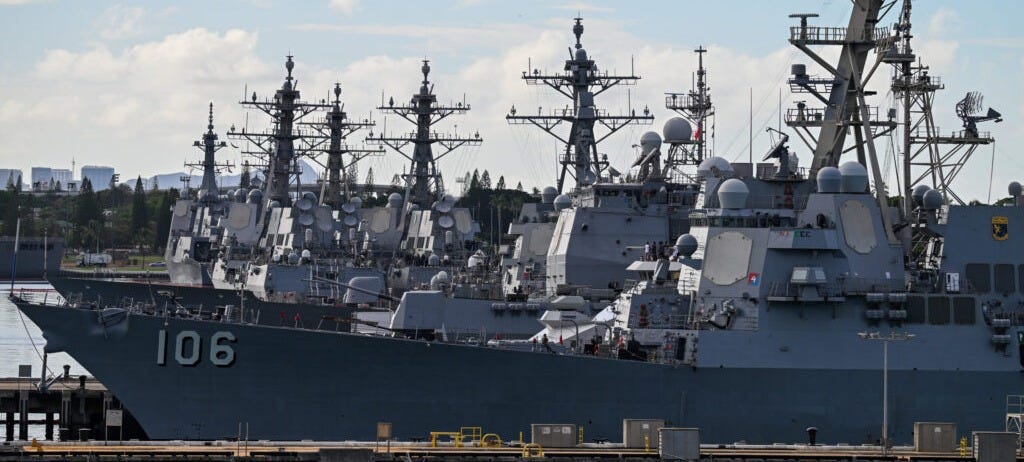
BLUF: The Naval Postgraduate School and its nonprofit partner FLEETWERX tested a new, networked approach to 3D printers and other high-tech tools they call distributed advanced manufacturing at RIMPAC.
Distributed advanced manufacturing uses a secure but unclassified (IL-4) cloud to link over 50 sites with many different types of 3D printers, computer-controlled tools like CNC lathes and milling machines, and even robotic boats that made unmanned supply runs.
Some of the tools were on ships participating in RIMPAC, but many others supported the exercise from bases, depots, universities, and businesses back in the United States, taking orders over the network and then sending the parts out via commercial delivery services.
Over two weeks they had 2,741 part requests.
Of the requests that were a good fit for the tech, the team managed to produce about 75 different parts.
Some high-demand parts, like batteries and circuit boards, can’t be practically produced by 3D printing. And some parts passed inspection and preliminary testing, only to fail in unexpected ways once installed
“If we got into a high-intensity conflict right now in the Indo-Pacific, it would be difficult to meet all of the repair and resupply needs. Just being able to make everything talk to each other is frankly amazing. A big part of the project is just mapping out where all those resources are, figuring out what their strengths and weaknesses are, and what we can send to them to produce.” Morgan Bower, FLEETWERX Program Manager

BLUF: REGENT Craft’s autonomous Seaglider drone, Squire, took part in a 13-day military experimentation event called Silent Swarm in Michigan, testing electronic warfare payloads alongside uncrewed systems from across the U.S. military.
Silent Swarm ran July 13 to 24 across Michigan’s Northern Lower Peninsula and the Alpena Combat Readiness Training Center, using the site’s combined ranges, airspace and waterways.
The exercise focused on electromagnetic spectrum operations, testing how small, multi-domain uncrewed systems can employ and defend against signals including radar, communications, navigation, infrared and directed energy.
Squire operated with various payloads across multiple mission types over the 13 days, testing electronic attack, electronic protection and EW support roles.
REGENT said the event gave the company feedback from military and civilian experts across the Air Force, Army, Coast Guard, Marine Corps and Navy.

BLUF: The new drone system packs a 100km range and 600mm armor penetration, deploying from mobile truck containers.
Rheinmetall has successfully demonstrated its new FV-014 loitering munition system integrated with a modular Containerized Missile Launcher, utilizing a vehicle-mounted, hidden-launch architecture that reflects the tactics seen in Ukraine’s 2025 “Operation Spider’s Web”.
This system shares strong operational commonalities with the Ukrainian mission through its use of a modular, standard ISO container launcher that can house up to 18 munitions on a standard transport truck.
This architecture formalizes the “Trojan horse” logistics of Operation Spider’s Web, which relied on concealing strike drones inside modified cargo truck enclosures to infiltrate target areas undetected.
The FV-014 loitering munition is designed for mobility and can combine surveillance, target identification, and precision strike in a single platform.
It is capable of operating at ranges up to 100km and can function effectively against both armoured and unarmoured targets.
BLUF: DARPA concluded its Lift Challenge last week, and although none of the participants achieved the desired goal of building a drone capable of lifting four times its weight, they came close.
DARPA announced that AVIDrone pushed the limits with its electric helicopter design that lifted an unprecedented payload-to-weight ratio of 3.84 to 1.
In practical terms, that means the company’s Katana heavy-lift drone, weighing 29.3 pounds, lifted and carried a payload weight of 112.4 pounds across approximately five nautical miles.
AVIDrone, a Canadian company with U.S. headquarters in Maryland, specializes in cargo delivery drones for the defense and commercial sectors.
By placing first, AVIDrone won $1.25M in prize money.
“Heavy vertical flight as the next great technological inflection point that is economical for widespread adoption.” Phillip “Donna” Smith, Lift Challenge PM

BLUF: SOCOM plans to hold multiple events to assess industry solutions in the coming months.
SOCOM PEO for SOF digital applications is planning to test and evaluate new mission autonomy software that could boost drone operations.
SOCOM is pursuing the effort in partnership with the SOFWERX innovation hub to support the Unmanned Systems Autonomy and Interoperability (UxSAI) program.
Officials seek decentralized and collaborative mission autonomy solutions for heterogeneous, multi-platform, multi-domain unmanned systems that can seamlessly integrate into the Collaborative Heterogeneous Autonomy Operations Software (CHAOS) baseline.
Software is a critical enabler of the tech employment concepts that the department and components like SOCOM are pursuing. Officials are looking for open, modular platforms to enhance interoperability and avoid vendor lock.
OSC is pleased to announce the formal Notice of Funding Opportunity (NOFO) for OSC's National Security Fund Finance (NSFF) program has been posted.
OSC's National Security Fund Finance program aims to provide capital support to credit funds addressing shortages, gaps, and vulnerabilities in critical minerals vital to United States national security.
Complete proposals due by Nov 1.
Other Defense Tech News:

BLUF: Blue Ops and Havoc plan to integrate Havoc’s collaborative autonomy software and command-and-control capabilities across multiple Blue Ops uncrewed surface vessels, including the Variant 7 and additional platforms as they are introduced.
The integration is intended to enable coordinated multi-vessel operations and expand the range of autonomous functions available to U.S. and allied defense customers.
The partnership builds on Blue Ops’ Modular Open Systems Architecture (“MOSA”) approach to maritime systems, which is designed to support the rapid integration of autonomy, sensors, communications, payloads, and other mission technologies based on evolving operational requirements.
Havoc’s collaborative autonomy technology has been successfully deployed on behalf of the DoW in multiple operational contexts.
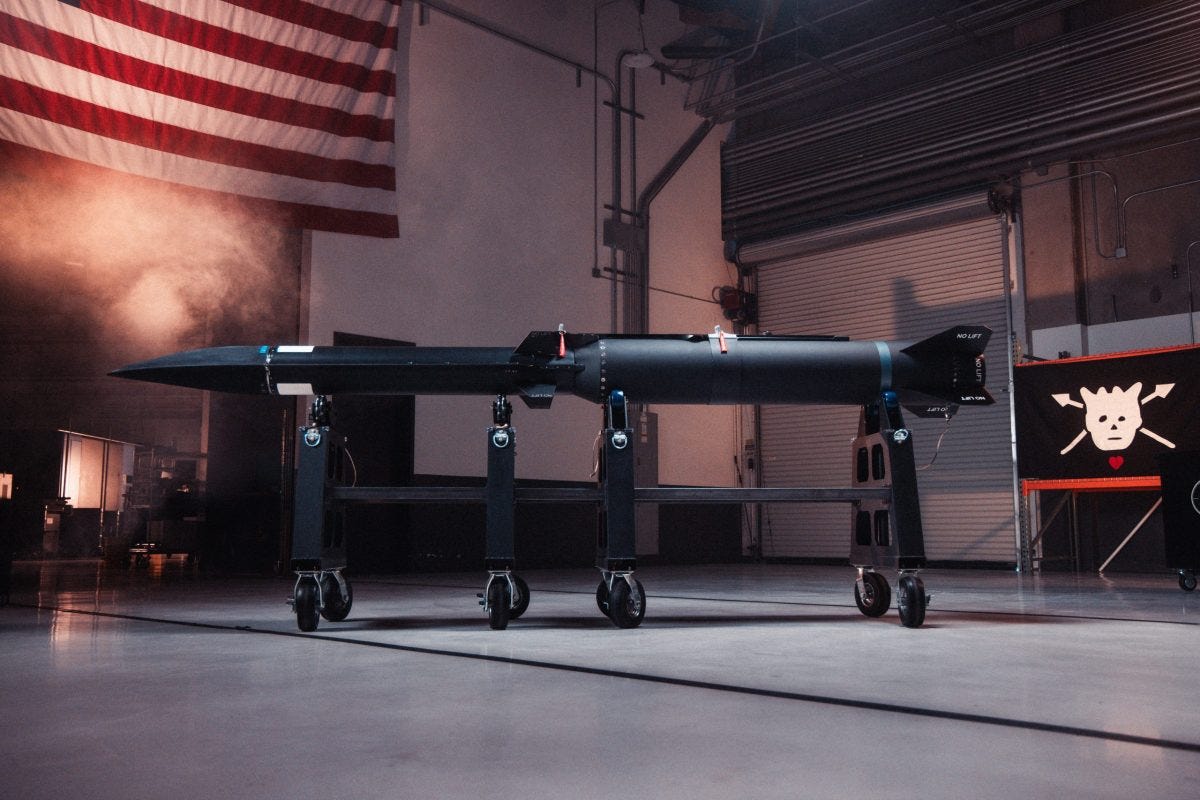
BLUF: Castelion, a defense-tech startup seeking to mass produce lower-cost hypersonic weapons, has raised more than $1B in new financing to expand missile production and develop a broader portfolio of offensive and defensive weapons.
The funding will be used to expand production of Blackbeard, Castelion’s hypersonic strike missile, at its manufacturing complex in New Mexico, while accelerating work on a longer-range precision strike weapon and defensive systems for air and missile defense.
Castelion and its investors are betting on the Pentagon’s drive to produce missiles and other munitions faster and in much larger quantities after recent conflicts exposed strains in U.S. weapons stockpiles and manufacturing capacity.
The U.S. Navy has emerged as its main customer.
It awarded Castelion ~$50M in February to advance Blackbeard toward an early operational capability.
It followed in April by a ~$105M award to integrate, test and certify the weapon on the F/A-18E/F Super Hornet.
Blackbeard still faces integration, flight testing and certification before reaching the operational fielding Castelion is targeting for next year.
The Pentagon in May signed a framework agreement with Castelion for a two-year Blackbeard production contract with a minimum production rate of 500 missiles annually following successful testing and validation.
Our Take: This is huge. Castelion has been one of a handful of companies that is showing the Pentagon how they can build and produce at scale a new generation of affordable missiles across multiple capability areas.

Jacob Schwandt and Jerry McGinn
BLUF: Last year’s Small Business Innovation Research (SBIR) reauthorization debate was among the most contentious in the program’s four-decade history. Nowhere was that clearer than in the debate over SBIR “mills.”
The argument was that firms with Beltway connections and grant-writing expertise collected an outsized portion of the funding, with fewer results to show for it as demonstrated by commercialization, investments, and patents.
This led to reforms including language that set annual proposal caps and a new premium award tier tied to matching private funds.
Two business models coexist within the program today.
Firms on the dual-use route develop commercial technology for both defense and civilian customers and finance that work partly with VC funds.
Firms on the defense route build for the military. They finance development through contracts and are judged by the follow-on business they win.
Whether firms that win large numbers of SBIR contracts create demonstrably valuable innovation, as measured by conversion into follow-on defense contracts, patents, and private investment, sits at the heart of the debate.
This drive to restructure the program, however, is informed by three structural misperceptions regarding the SBIR program:
Mills win awards but rarely “demonstrate commercial traction or follow-on contracts with non-SBIR dollars.” Over its time in the program, the median “mill” has won roughly 50 cents in non-SBIR DOD contract dollars for every SBIR dollar received, compared with 16 cents for the 3-9 group.
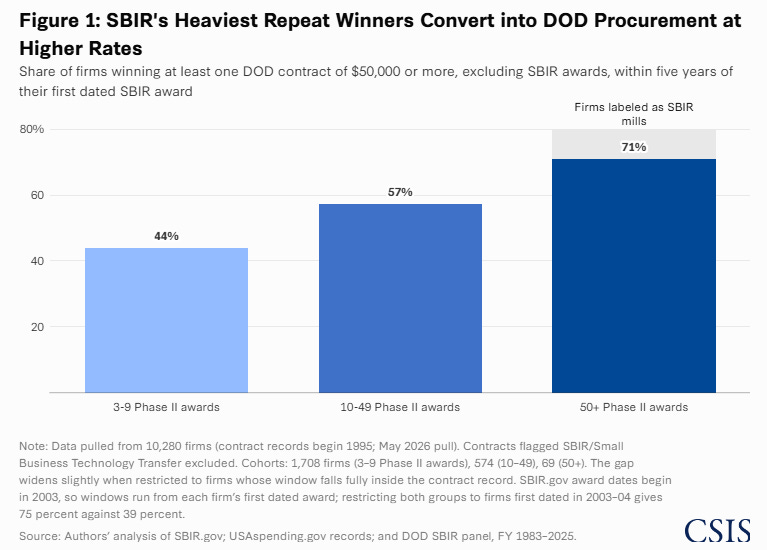
Mills innovate less. at a per-firm rather than per-dollar level, the picture inverts: 55 percent of the heaviest winners produced at least one patent within five years of an award, compared with 30 percent of the 3–-9 group.
Mills rarely merit private investment. In the five years after an award, about one in 20 mills report a venture-style equity raise with the SEC, compared with roughly one in 10 of the 3–9 group.
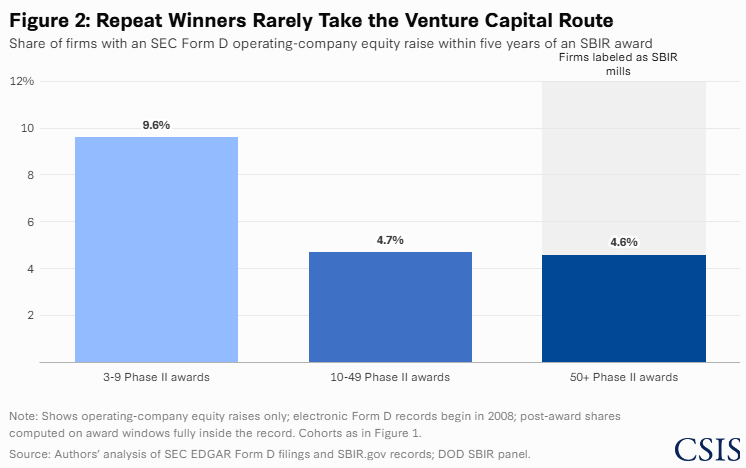
Overall, the data suggests that many repeat winners follow a distinct business model: develop technologies through SBIR funding and commercialize through federal procurement. Venture-backed firms generally pursue a different path.
Our Take: While this topic has generated a lot of heated debate, we do think it’s possible to acknowledge that both sides are accurate. The data shows that the mills are generating solutions of some value and it also shows that the goal of using SBIR to pull novel ideas from small businesses may be more challenged. It seems fairly clear to us that these “mills” are tracking government needs much more closely and offices are using SBIR funds (which are unallocated) to fund projects that they were not able to get in the appropriated bills. This alignment is likely why they transition to programs better as opposed to truly novel solutions that require more time to gain government buy-in. We think SBIR should be used for true small businesses and to germinate ideas the government isn’t already working but we also recognize that some of these more “captured” solutions may be getting to the warfighter and contributing to fielding needed capabilities - so it’s a mixed bag.


BLUF: Anduril, one of the primary performers on the Army’s Soldier Borne Mission Command program, recently made headsets available to the Army for testing and is gearing up for the next phase of the prototyping effort.
The SBMC project aims to develop soldier-worn heads-up displays equipped with augmented reality, night vision, AI, and C2 capabilities that can connect with other systems such as drones, among other features.
The initiative was launched in the wake of struggles with the Army’s Integrated Visual Augmentation System (IVAS) program, which sought to provide similar technology for troops to enhance their battlefield capabilities and boost training but received negative feedback from soldiers who tested the equipment.
Soldiers complained about the weight and form factor of IVAS devices and reported experiencing nausea while using them.
For phase two, the government has approved Anduril’s pursuit of a new design that includes a digital interface. Additionally, some new camera systems will be incorporated into the phase two equipment.
“We’ve already delivered phase one systems. Two weeks ago, we had testing with the 75th Ranger Regiment at our Seattle test site, so out in the field in field-like conditions, getting feedback, getting iteration for them, so that we can incorporate that into our phase two design and make those updates iteratively and rapidly with end users.” Quay Barnett, Anduril GM of warfighter systems
BLUF: Army teams will expand the NGC2 ecosystem out to I Corps later this year.
Army will manage the delivery process of modernizing their tactical hardware.
They will work to accomplish this goal through C2NOW by divesting their routine tactical systems and pouring time and resources into advanced mobile data networks that are resilient, even while on the go.
Army leaders will also continue to iterate with 4ID and 25ID.
They will establish baselines and award contracts for the enduring capabilities they select within those divisions, while also exploring and keeping an eye out for ways to integrate the cloud-enabled element of the NGC2 ecosystem into additional formations.
The ecosystem now has 45 apps, and more than 60 vendors (and counting) are working on the platform. The firm and growing partnership between the Army and private sector has been crucial to these successes surrounding NGC2.
“Our signal community, represented within the 4th Infantry Division and its capable soldiers, was able to play a big role in the resilience part of NGC2. Our industry partners have given us a lot of great tools, and their ability to understand and develop proficiency in using those [tools] and overcoming technical tactical challenges out in the box was just very impressive. It gives me a lot of confidence about the path that we’re on when it comes to delivery of NGC2.” Joe Welch, PAE C2/CC2

BLUF: Gen. Christopher LaNeve takes aim at a cutting-edge drone unit, one of several moves he has made since taking over the Army
The Army took a major step to prepare for wars of the future in January when it established a new battalion in Europe to master the art of fighting with drones and ground robots.
But the much touted drone assault battalion is being phased out.
After participating in a major exercise in Germany in August and September, the unit will report its findings to guide future experimentation, shed its drone assault role and refocus on its core warfighting tasks as an airborne infantry battalion.
The elimination of a futuristic drone battalion is part of a broader back-to-basics approach ordered up by Gen. Christopher LaNeve.
The Army didn’t say how it plans to speed the service’s abilities in drone warfare after the drone-assault battalion is phased out.
In a memo to the force, LaNeve outlined his plans for the direction of the Army.
Army forces must be prepared to overcome the most complex challenges our adversaries can impose and master an operational environment that looks fundamentally different from the battlefields of yesterday,
LaNeve vowed the Army would continue to change and establish units with advanced cyber, EW, and AI technologies.

BLUF: With no new starts for electromagnetic spectrum operations (EMSO) capabilities budgeted for FY27, the Army is looking to leverage prototypes and broad requirements from other programs to get new kit in the hands of soldiers.
Earlier this year, the Army published two documents in the name of getting new kit to soldiers faster.
Characteristics of Need (CoN) for EMSO systems, which is a guiding document that outlines broad based needs as opposed to hyper-specific requirements,
Rapid Electromagnetic Warfare & Signals Intelligence Commercial Solutions Offering (REWSI) Commercial Solutions Opening (CSO), which is a library of capabilities to choose from.
With the desire to leverage commercial systems and soliciting industry ideas to continue to continue to get after gaps through the CoN, there’s two ways to skin that cat.
The Army is looking at experimentation in small quantities working with the Army’s V Corps, taking advantage of R&D funds. The REWSI will allow the Army to pick and choose capabilities from a library of commercial systems creating constant competition and ensuring they don’t have the same thing that might not work for every formation in every theater.
The Army is looking to piggyback on requirements of other existing programs, both EW specific and non-EW. Other programs have EW requirements, and the Army can use some of that funding to provide more EW gear.
With the CoN and CSO approach now, however, it provides the team more flexibility to get new capabilities to units if technology advances or if there are formation changes within the Army.
BLUF: Army speakers discussed next-generation integration, including C2, intelligence and fires in the counter-C2 fight.
“Operation Jailbreak, is an initiative that has brought together Army and industry for joint hackathon events. We’ve had a number of iterations on Jailbreak, continuing to iterate there. Expect that there will be an intel-focused on in the not-too-distant future to get after, so that would be what I point industry to, to make sure you’re tracking that, engaging that wholeheartedly and getting after delivering capability.” Chris Manning, CPE Intelligence and Spectrum Warfare.
“Gone are the days of proprietary black boxes that we’re going to have to figure out at the edge how we’re going to integrate, or we end up having to do it via swivel chair. Our near peers have access to the same technologies, these commercial technologies, so our competitive advantage is our ability to rapidly integrate, deploy these capabilities and then continuously update, and so I think . . . partnership between us and industry is critical to that.” BG Jack Taylor

BLUF: The Army is turning its helicopter pilot training over to civilian instructors and a private company as the military grapples with a rise in severe aviation accidents.
M1 Support Services won a contract to operate the service’s new Flight School Next Program, the Army announced Thursday, shifting training and equipment to a “contractor-owned, contractor-operated” model at Fort Rucker, AL.
The award, worth up to $10B for up to 26 years, comes amid growing concern about aviation catastrophes that showed around a 55% jump in serious accidents during the 2024 budget year, compared to four years prior.
M1 is set to train 800 to 1,500 Army pilots each year.
“Flight School Next delivers a critical improvement in our Initial Entry Rotary Wing Training model. Simply put, it delivers new military helicopter pilots with far better foundational skills. The fact that it delivers this increased capability at a significant long-term savings to our Army is a great added benefit.” MG Clair Gill, PAE Maneuver Air
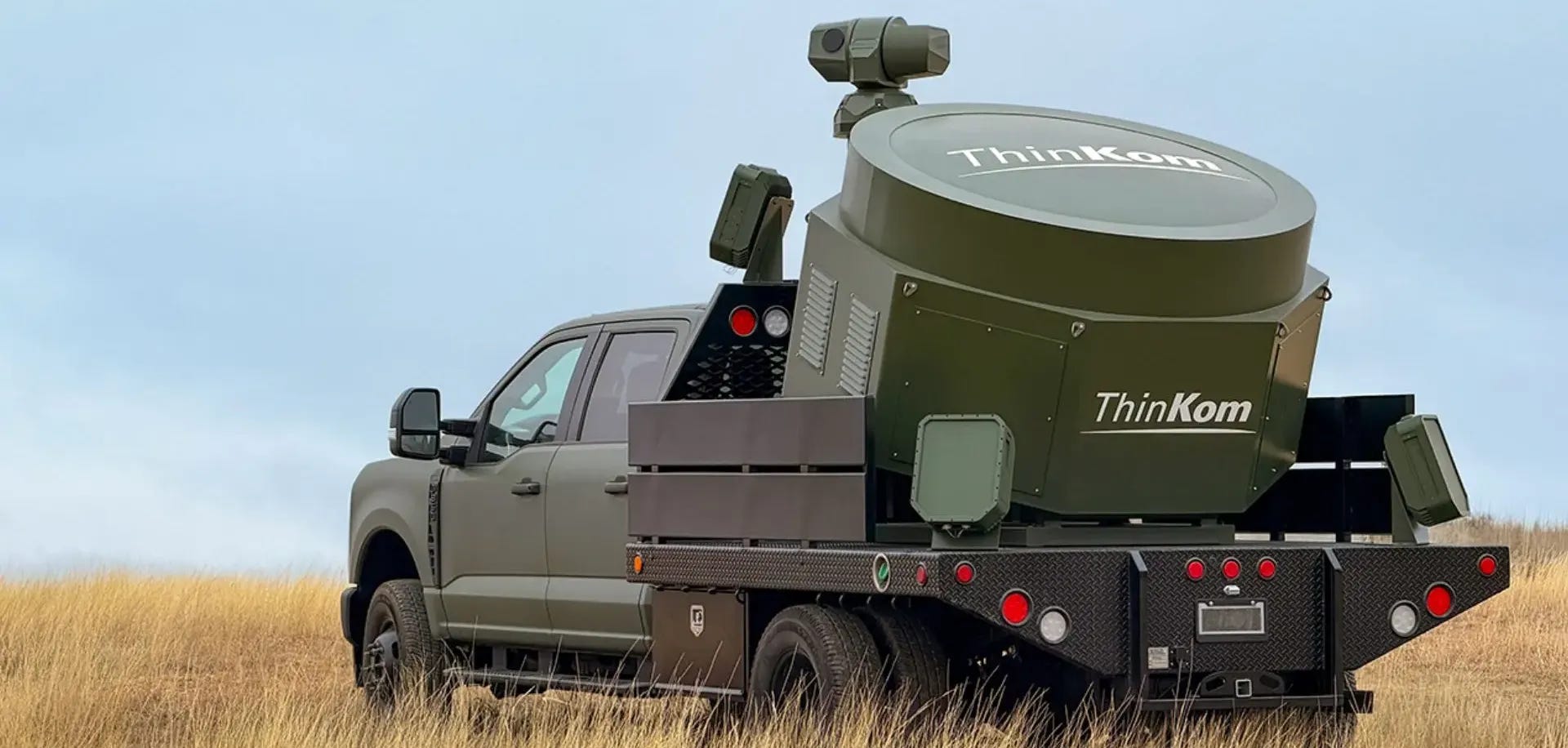
BLUF: The Army has awarded ThinKom Solutions a prototype contract worth up to $49M to develop and test a mobile high-power microwave system for countering drones.
The deal will fund testing of ThinKom’s Alecto system, which is built to target unmanned aircraft from a moving vehicle.
The first round of funding will pay for one of the four prototypes the Army wants, and field testing is set for 2027.
The firm will supply the Alecto system as a high-power microwave effector under the agreement. The system will be combined with sensors, fire-control gear, and a mobile platform chosen by the government.
The system is also designed for “fire-on-the-move” use. This means it can stay active while the vehicle is moving, which helps Army units respond to drone threats without having to stop.
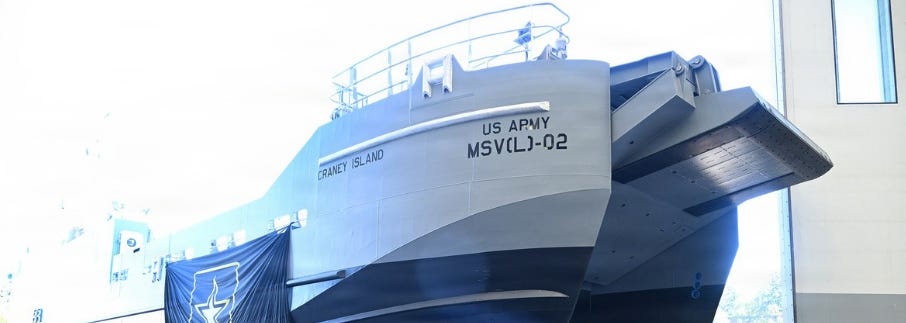
BLUF: The Army’s newest vessel, Maneuver Support Vessel (Light)-02 (MSV(L)-02), named Craney Island, was officially launched at an Aug. 11 ceremony held at Vigor Marine Fabrication, Vancouver, WA.
The event marked a major milestone in Army watercraft modernization.
Craney Island (MSV(L)-02) represents the Army’s first major watercraft acquisition in nearly three decades, delivering a generational leap in capability over its Vietnam-era predecessor, the Landing Craft Mechanized-8.
As a modernized, digital maneuver landing craft, the MSV(L) significantly enhances the speed and effectiveness of dynamic force repositioning.
Key design improvements include an increased payload capacity, superior speed and maneuverability, and a reduced draft that grants commanders unprecedented access to shallow-water littoral environments across the maritime domain.
The Army's strategy for the MSV(L) has from the inception centered on integrating mature commercial off-the-shelf subsystems into a new hull form, which takes advantage of marine industry design innovation and competition.
The Army plans to procure six production MSV(L)s.
BLUF: The Army is issuing a call to ramp up production of ground-launched rockets.
The Army sent out a request this week for manufacturing 133,014 Guided Multiple Launch Rocket System (GMLRS), rockets by 2034, according to the Army’s Sources Sought notice.
Contractors have until Sept. 1 to submit white papers on plans to meet that quota.
The timeline calls for churning out 19,002 rockets per year from 2028 to 2034, with the first actual deliveries starting in February 2030.
Current GMLRS manufacturer Lockheed Martin already announced last year that it is ramping up production capacity to 14,000 rockets annually.
The Army’s new plan would require a nearly 36% increase in capacity on top of that.
Other Army News:
Army network needs digital twin for training, testing, cybersecurity
Army cyber chief reveals AI task force building agents to ‘hunt’ in the DOD network
Army Awards Airbus $140M Contract for 12 UH-72B Lakota Helicopters

BLUF: The Navy awarded Raytheon a $22.9B contract to accelerate production of Tomahawk missiles.
By reducing procurement lead times, this contract directly supports the Department’s rapid capability fielding goals.
This award reflects the Department’s continued transformation of its acquisition approach to meet the demands of today’s security environment.
Under the strategic direction of PAE Munitions, led by Van Hendrey, the Navy is improving enterprise-level integration, strengthening partnerships with industry, and advancing a more agile approach to delivering weapons capabilities.
By providing industry with greater stability and predictability, this investment enables expanded workforce capacity, increased manufacturing throughput, and stronger supply chains.
“This landmark $22.9B investment accelerates the delivery of Tomahawk missiles to our warfighters at unprecedented speed. By working closely with industry to expand the capacity of our munitions industrial base, the Department is utilizing every available tool to meet the demands of current operations, guaranteeing our naval and joint forces have the lethal firepower they need to deter aggression and protect the homeland.” Hung Cao, Acting SECNAV
Related: US awards Raytheon $22.9B seven-year deal to boost Tomahawk output
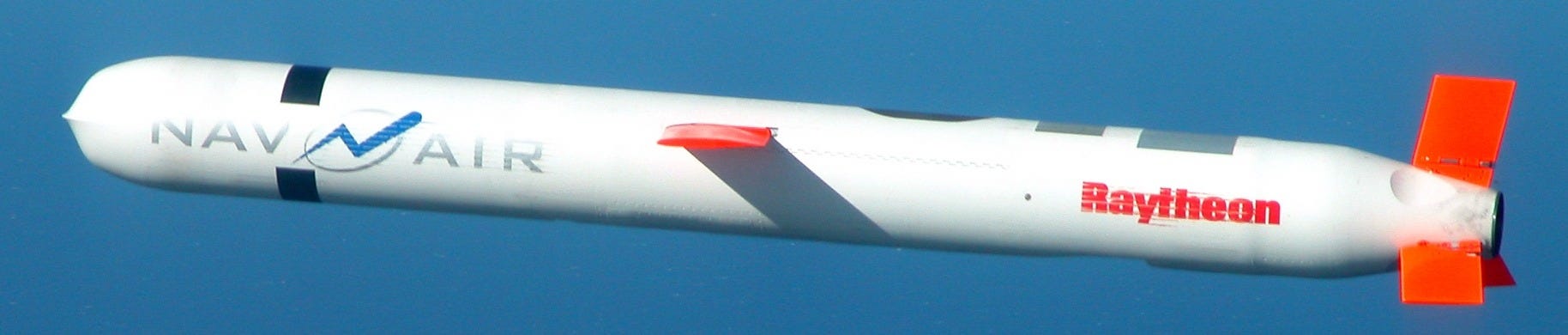
BLUF: In 1991, a Tomahawk was the opening shot of Desert Storm. Thirty five years later, it has not been retired and continues to prove irreplaceable.
The value of a weapon that can fly a thousand miles hugging the ground, change course, loiter if the target is not ready, and accept new coordinates mid-flight is impossible to overlook.
Add to that a modular design that allows it to be launched from destroyers, cruisers, and submarines, one that handles both conventional and nuclear warheads, and a system equally adept whether fixed to a ship or a submarine.
Even now, decades later, no other weapon in the American arsenal can offer all these capabilities. The Tomahawk remains a linchpin weapon to the extent no combatant commander would even think to plan a strike package without it.
With production rate standing at about 100 to 125 missiles per year, it will take around eight to ten years just to regain previous levels of strength.
Congress has recognized the problem and tried throwing money at it, but production rates have barely shifted. The reason is at once both simple and complicated: it is the production system itself that needs to change.
Every Tomahawk comprises over a thousand precision-machined parts. Each component is typically produced by a small, specialized manufacturer.
Often these shops are the only ones in the entire country to make that specific piece. Companies such as Re Manufacturing, Machina Labs, and Hadrian have begun demonstrating how greater automation, flexible precision-production capacity, and additive manufacturing could reduce some of these single-source dependencies, but such approaches have yet to be adopted across the industrial base at the scale required.
Hadrian’s use of automated manufacturing systems and accelerated technician training offers one indication of how the labor constraint might be addressed without waiting years for a new generation of traditionally trained machinists.
The broader shift towards software-defined and reconfigurable production, also reflected in Anduril’s Arsenal manufacturing model, suggests that defense manufacturing need not remain permanently tied to inflexible production lines and fragile supplier networks.
The Pentagon is now confronted by a basic reality. Weapons that cannot be replenished within a reasonable time frame are weapons with severely limited deterrent power. Even if those weapons are highly effective, when supply is limited, deterrence is impaired.
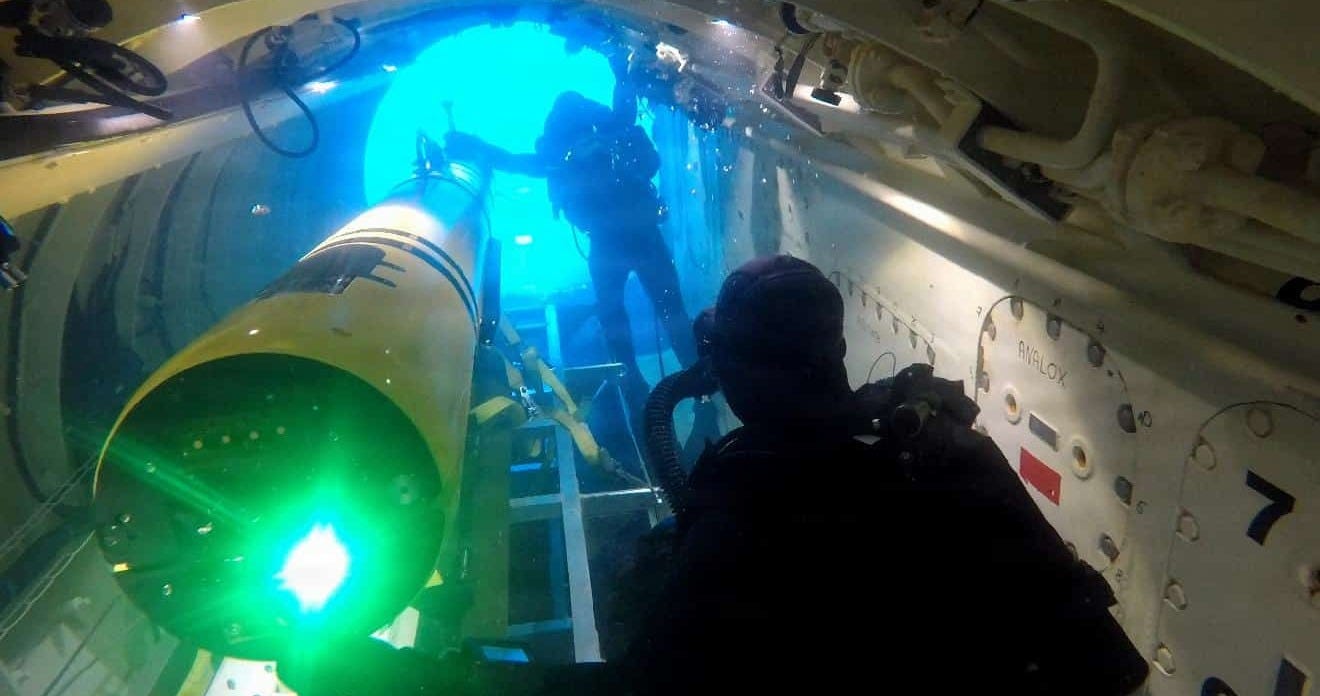
BLUF: The Navy’s Pacific-based submarine force is exploring a number of new mission sets for UUVs as they rapidly proliferate across the fleet, including new mission sets involving carrier-basing and underway submarine replenishments for contested environments.
Navy leaders discussed the value of the Navy’s attack submarine fleet as enablers for carrier operations, and discussed the role of UUVs in carrier operations where the uncrewed systems could serve as extensions of the strike group.
When integrated, UUVs could extend strike group organic reconnaissance, strike, minesweeping, and anti-submarine warfare capabilities.
They could be deployed by helicopters or by the carrier itself, and could extend as far as defending against torpedoes.
They discussed the possibility of using UUVs for underway submarine replenishment from carriers to submarines — a current challenge in the Navy especially in contested or denied environments.
“The operational environment in the Pacific continues to evolve with the rapid development of technological advancements in the undersea domain. The Pacific Submarine Force is heavily investing in unmanned capabilities to augment our manned submarines and preserve our undersea advantage across the full spectrum of submarine operations.” RADM Chris Cavanaugh, Commander, Submarine Force, Pacific Fleet
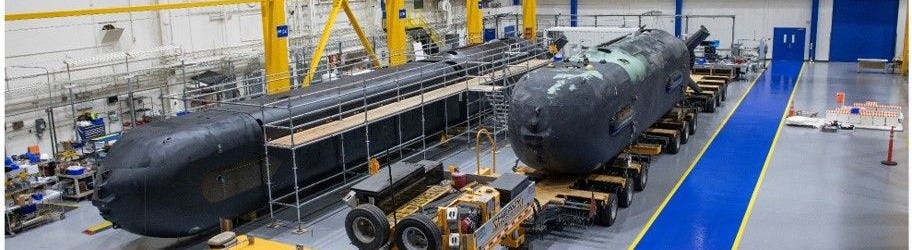
BLUF: Navy completed a 1,000 nautical mile transit with the service’s Orca XLUUV uncrewed submarine in July.
The Navy, working with teams from the PEO Unmanned Small Combatants (USC), completed the service’s first long-range mission with a Boeing and Huntington Ingalls-built Orca Extra Large Uncrewed Undersea Vehicle (XLUUV). The transit, which took the uncrewed submarine across the East Pacific
The XLUUV patrolled for over 1,000 nautical miles — a first in the program’s history as the Pentagon looks to rapidly ramp up uncrewed operations in the Pacific to supplement crewed aircraft, ships, missile launchers and submarines as major force multipliers.
Orca is among the Navy’s largest UUVs, capable of offensive and defensive missions identified in a Joint Urgent Operational Need tied to the Pacific theater.
Those missions include ISR operations, mine warfare, sea bed warfare, and expeditionary support
“The operational environment in the Pacific continues to evolve with the rapid development of technological advancements in the undersea domain. The Pacific Submarine Force is heavily investing in unmanned capabilities to augment our manned submarines and preserve our undersea advantage across the full spectrum of submarine operations.” RADM Chris Cavanaugh, Commander, Submarine Force, Pacific Fleet
BLUF: Director of submarine programs, VADM Rob Gaucher, accepts the Navy has made a “calculated risk” in waiving the post-shakedown availability of SSN 798
In doing so, the service risk compounding future maintenance, which could worsen shipyard backlogs further
At least 66 SSNs are required to fulfil the fast-attack capability but the Navy only have 53 boats available
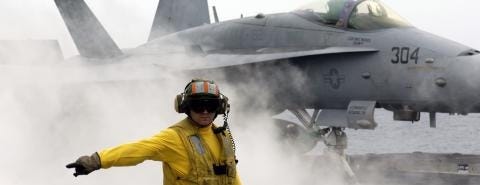
BLUF: Steam power was cutting-edge technology in the nineteenth century. It is the wrong choice for a modern navy.
President Donald Trump’s Aug. 13 executive order directing the US Navy to return to steam power for its catapults, the system used by carriers to launch fixed-wing aircraft, risks crippling fleet readiness — already at its lowest point in decades.
Redesigning the USS Doris Miller, already under construction, to replace its electromagnetic catapults with steam systems will exacerbate the readiness crisis.
The change is estimated to cost billions of dollars and delay the ship’s launch into the late 2030s.
Delayed carrier production will drop the fleet to 10 flattops next year, with the USS Nimitz retiring and the USS John F. Kennedy not ready to deploy.
The Navy adopted electromagnetic catapults in its new carriers as electric power has fewer moving parts, is more reliable, costs less and offers higher speeds compared with steam power.
The biggest benefit of the electromagnetic catapults are their lower cost and lighter personnel requirements.
The Ford’s crew is about 500 sailors smaller than its predecessors, largely because it is an all-electric ship outside of the engine room.
With hundreds fewer sailors and easier-to-maintain electrical equipment, the Ford costs the Navy ~$100M less per year to operate compared with older carriers.
That equals the price of almost 100 Tomahawk cruise missiles.
BLUF: CNO ADM Daryl Caudle recently put a stark number on the submarine problem. The U.S. is delivering submarines at a rate of about 1.2 per year when the minimum requirement is at least 2.3. The Navy does not deploy tons of submarine. It deploys complete units of combat power.
The Navy’s May 2026 shipbuilding plan calls for generational investment in shipbuilding and the maritime industrial base, including $124.9 billion in submarine construction across the FY2027–FY2031 plan.
The Navy is investing in shipyards, workforce development, suppliers, advanced manufacturing, automation, and distributed shipbuilding.
The strategic output is different: complete, combat-capable ships delivered to the fleet on a predictable cadence.
The Navy’s shipbuilding crisis is therefore not only an acquisition problem or an industrial-capacity problem.
Production systems do not move at the average speed of all their resources. They move at the rate of their limiting constraint. That principle is familiar in commercial manufacturing, nuclear operations, and other high-reliability enterprises, but it has strategic implications for naval shipbuilding.
Starting more work than the system can finish does not create capacity. It creates work in process: partially completed modules, queued inspections, material staged for unavailable trades, engineering packages awaiting disposition, and ships occupying scarce space longer than planned.
Its March 2026 acquisition restructuring directs portfolio leaders to manage production capacity and supply-chain risk while making data-driven tradeoffs across cost, schedule, and performance. That is a promising foundation. The next step is to make end-to-end throughput a dominant enterprise metric.
America should continue investing aggressively in its maritime industrial base. The U.S. needs more skilled tradespeople, stronger suppliers, modern facilities, advanced manufacturing, and sustained demand. But those investments should be organized around the logic of the production system rather than assumed to produce output automatically.

BLUF: The Navy has awarded Zone 5 Technologies a contract to build its combat-proven Rusty Dagger low-cost cruise missile for the U.S. Navy’s new CHAOS cruise missile program.
The award is the second contract signed under the relatively new CHAOS effort which seeks to deliver modular, surface-launched cruise missiles to U.S. and allied partners.
The latest award to Zone 5 represents a much bigger step in fielding combat-proven, capable cruise missiles for the U.S. and its allies — particularly in the Pacific.
Unlike RAACM-ER, Zone 5’s Rusty Dagger is a weapon already being battle-tested in highly contested Russian airspace, giving Zone 5 a distinct, measurable advantage over competitors as its real-world effects continue to materialize — even with the relatively small batches being delivered.
The Navy’s CHAOS program is one of many new efforts that stem from the Pentagon’s push towards low-cost, high-capacity strike weapons.
“As adversaries increasingly deploy advanced area denial systems, coalition and allied forces face significant challenges in maintaining credible, modern, and affordable anti-ship capabilities. CHAOS closes this capability gap, by delivering a highly capable, adaptable, and exportable maritime strike solution that overcomes present day obsolescence and supply chain challenges.” CAPT Sarah Abbott, PMX-201 program manager
BLUF: Shield AI, a specialist vying to provide the autonomy software for the Air Force’s autonomous Collaborative Combat Aircraft, has won government backing for its X-BAT drone—but not from USAF.
The $50M cash infusion comes from the Navy and the DIU, which see intriguing possibilities for a jet designed to take off and land vertically from a trailer.
The aircraft is powered by the same F-110 General Electric engine that powers an F-16. With an airframe smaller and lighter than the Viper, the engine can generate enough thrust for vertical takeoff and to land in a manner similar to SpaceX’s reusable rockets.
For the Navy, X-BAT could launch and return to surface combatants of all kinds, not just aircraft carriers. It would give the Navy more ways to deploy airpower.
Navy destroyers and amphibious ships already carry munitions and fuel, so they don’t have the logistical problems the Air Force would have in its ACE concept of operations.
The Air Force, meanwhile, is still sorting through the logistics and operational concepts for its CCA.
“If the Air Force was going to look into it, it would be … not necessarily eliminating the big, fixed bases that need a lot of defense but allow you to generate high-tempo operations, if you can protect them. But it would be to augment that by complicating an enemy’s targeting problem. It’s distributing your airpower and making it easier to survive and and stay active in future fights.” Gen Mike Holmes (Ret)
Other Navy News:
Lockheed Martin and Navy Demo AI-Powered Sub Hunter at RIMPAC
E-2D Advanced Hawkeye Block II Passes Critical Design Review as Navy Plans to Expand Fleet

RIP to Former SECAF James Roche. He was an early advocate of unmanned aircraft, air-space integration, expeditionary operations and joint networking. A visionary for our current times, he must have been pleased to see some positive movement in those areas before his passing.

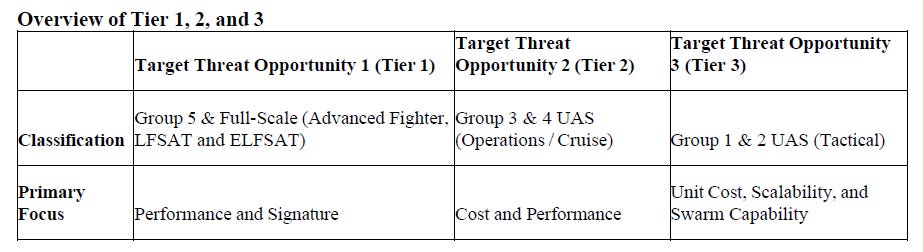
BLUF: The Air Force is looking for a new family of aerial targets that can replicate an extremely broad range of airborne threats, from small drones operating in swarms to stealth fighters, large UAS, strategic bombers, and airborne early warning aircraft.
The service wants these targets to be realistic enough to challenge modern sensors and weapons, but inexpensive and simple enough that they can be routinely risked, and even destroyed, during testing.
The RFI calls for industry proposals “including commercial, modified commercial, dual-use, and non-developmental solutions.”
For advanced fighter aircraft, the Air Force wants targets capable of “supersonic capabilities (up to and exceeding Mach 1.6 at 40,000 feet)” along with high-agility and high-G combat maneuvers.
The Air Force has been trying for years now to acquire new full-size target drones however, despite the launch of programs such as the 5th Generation Aerial Target (5GAT), progress in this regard has been extremely limited.
The Air Force is therefore effectively asking industry to find the sweet spot where high-fidelity threat representation and mass-produced affordability intersect.
Our Take: This is definitely the right way to explore tradespace although it would have been helpful to issue cost and production targets to inform this exercise since that will also be a big determinant in how this question is answered. For the higher end targets, there will be a cap on how inexpensive they can be with high-speed propulsion, stealthy coatings and likely very costly sensors.
Related Articles:
Air Force Wants New Family of Target Drones Ranging from Expendable to Sophisticated
Air Force plans Mach 1.6 target drones to test weapons against simulated enemy jets
BLUF: The Air Force recently tested prototypes for a portable ground station (called the Portable Command and Control Enclave, or C2E) for commanding and controlling semi-autonomous Collaborative Combat Aircraft.
Beyond fighter pilots, CCAs could be controlled from battle management aircraft like the E-7 Wedgetail - but the portable C2E effort is focused on the ground.
The prototypes being evaluated are specifically meant to be C2 systems that can be rapidly deployed and operated worldwide, even in austere environments.
After the command-and-control systems’ mobility and footprints were tested, the vendors carried out demonstrations to show how well their software operated.
Anduril has already touted the ability of its own system, the Menace-T, to control its version of the CCA.
The information collected from the Air Force’s Ohio demonstrations will help speed up the acquisition strategy for C2E and help shape the selection process going forward. A second C2E prototype phase will also soon begin.
Once the Air Force selects a C2E system, the service said, it will go to the Experimental Operations Unit currently testing CCAs to support agile combat employment operations.
“Getting prototypes into the hands of our operational and acquisitions wafighters for a swift, combined evaluation is a direct embodiment of acquisition transformation.” Col. Eric Reagan, Agile Development Office director
Our Take: This is real goodness. The Air Force has been slow to back ACE concepts with real equipment that is suited for the likely environments. This progress shows they may be taking some serious steps forward. We definitely agree with Col Reagan that this is how you do it - generate some prototypes, get operator feedback, then field an MVP that addresses a core need and iterate over time.
BLUF: The ceremony in which Lt. Col. Lyndon Bartlett assumed command of the EOU came a little more than a week after a groundbreaking exercise at Creech, in which the Air Force’s first CCAs practiced operating in simulated operational environments.
It marked the EOU’s second exercise with CCAs, following the first in April.
Anduril reps said EOU operators assigned tasks to CCAs from multiple locations, showing how disaggregated control of the drones could cut manpower requirements and allow Airmen to fly CCAs from austere bases.
Operational users oversaw daily mission autonomy flights of the prototype YFQ-44A for the first time, some days generating multiple sorties.
In the near future, controllers will be able to direct multiple CCAs at once which could mean using navigators or WSOs to control CCAs—but officials have noted that the CCA program faces “cultural headwinds” as it tries to change mindsets.
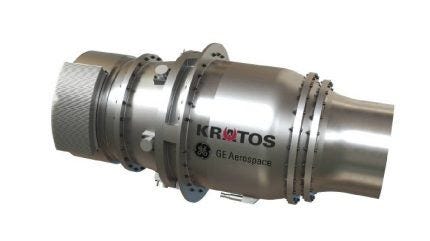
BLUF: The Air Force has awarded a contract to GE Aerospace and Kratos Defense & Security Solutions for the engineering, manufacturing, and development of the GEK800 engine as a second-source propulsion system for JASSM missiles.
The partners reported more than 50 successful ground engine starts during testing at their respective facilities.
It’s officially designated the F143-ZZ-100 and is an 800-lb thrust class turbofan.
BLUF: US-based NANO Nuclear Energy and Quadrant Nuclear Industries have signed an initial agreement to secure specialized nuclear fuel.
Under this arrangement, the companies will develop plans for the future supply of high-assay low-enriched uranium, known as HALEU.
The fuel will come from Quadrant’s planned facility at Idaho National Laboratory. This site aims to produce up to eighteen metric tons of enriched fuel each year.
The primary user of this fuel will be NANO Nuclear’s KRONOS micro modular reactor. Each unit produces between 10 and 45 megawatts of thermal energy.
The reactor also operates independently from regional power grids. This technical setup led to an earlier Phase I development with AFWERX.
Military planners are evaluating the design as a standalone power source for remote bases.

Check out this WSJ interview Gen Chance Salzman.
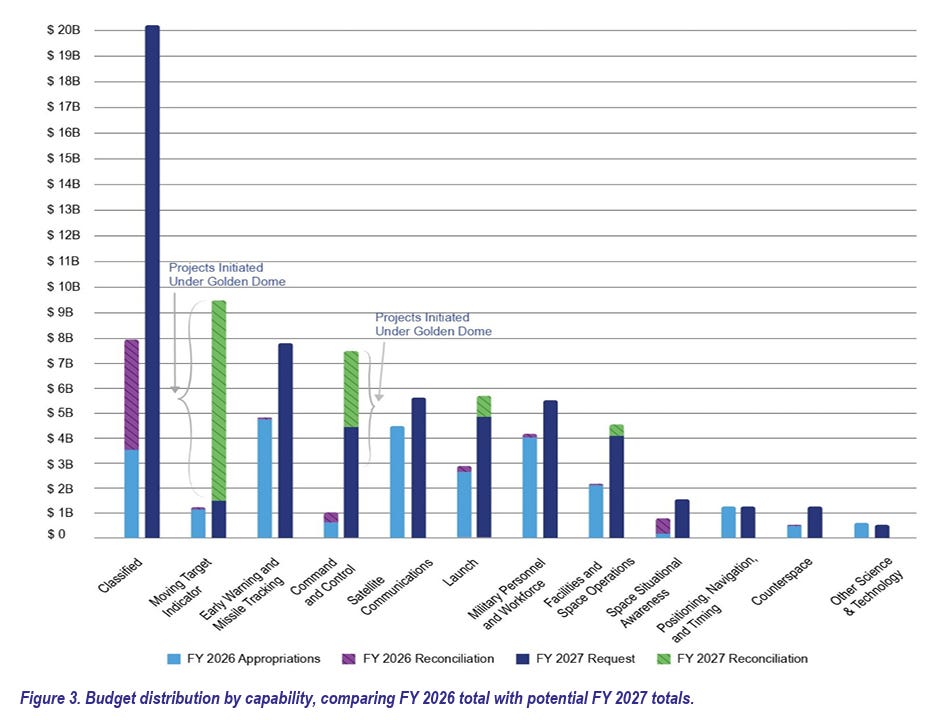
BLUF: A new analysis of the FY27 defense budget finds that the proposed surge in Space Force spending is concentrated in missions like moving-target tracking, missile warning, command and control and classified programs.
The proposed $71.3B Space Force budget if fully funded, would amount to a 120% increase over FY26 and the largest percentage increase for any military service since 1952.
The base Space Force request is $59.2B, with another $12.1B dependent on Congress approving a separate reconciliation package.
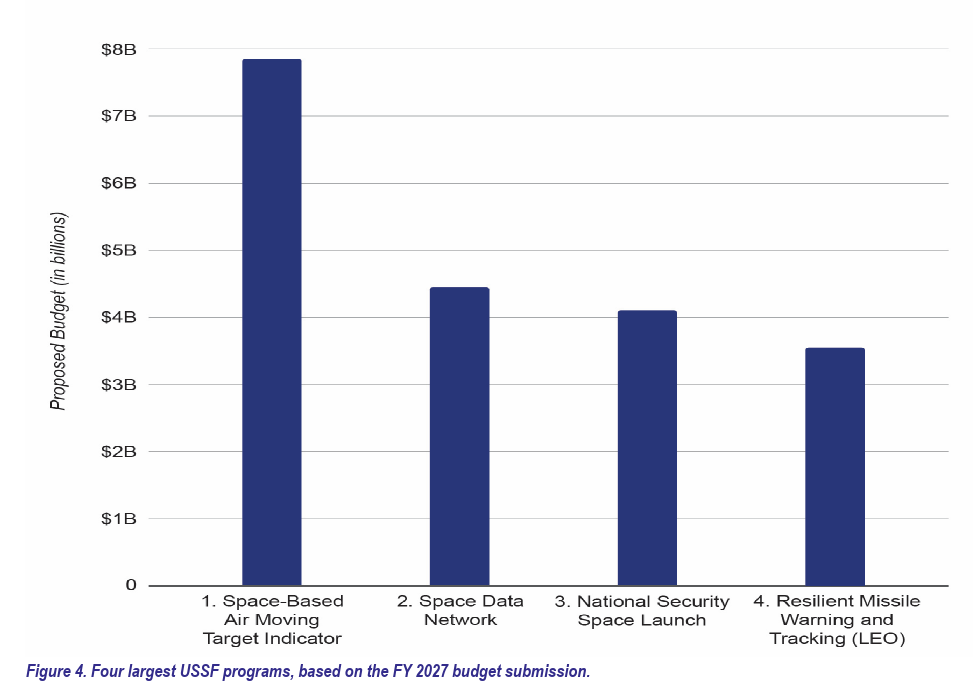
About 75% of the proposed Space Force increase is concentrated in classified activities, moving-target indication, missile warning and C2 programs.
The Space Data Network is the second-largest Space Force program in the request which is a proliferated low Earth orbit mesh network and ground infrastructure designed to move large volumes of military data with low latency.
BLUF: The Space Force launched its Space-Based Sensing & Targeting portfolio acquisition group earlier this year, which is the newest of eight groups focused on acquiring technology, representing a major change in the way that the military is approaching its procurement system and awarding contracts.
One of the sensing and targeting group’s initial contracts was a $4.16B award to SpaceX to accelerate the delivery of a space-based sensing layer designed to track and target airborne threats globally. It’s part of the development of a lower earth orbit mesh network that will be integrated into the military’s capabilities.
Over the next six to 12 months, the new hardware will be launched, even if it’s in a prototype phase. The plan is to take advantage of iterative development by delivering in smaller chunks that can be awarded contracts in segments.
Multiple companies will compete to provide sensor technology throughout.
“We don’t want to miss the moment. We want to capture the innovation and the new ideas and the newer capabilities that are available to leverage commercial production lines to minimize our nonrecurring engineering. It reduces risk for the Space Force. We have a warfighting imperative to deliver at speed and scale.
What I’m looking for ideally is to leverage something that works commercially so that we reduce that development risk on our end and get the economy of scale. Show us that the capability works. Prove it on orbit or in a testing environment, not on a pitch deck. That’s a compelling case for us to buy it,” Colonel Ryan Frazier, PAE for Space Based Sensing & Targeting
“We make sure that the program managers and the portfolio executives have the resources to develop strategies or award contracts – and we develop the workforce.” Lt. Gen. Philip A. Garrant, commander of Space Systems Command.
BLUF: Space is becoming an increasingly significant domain for national security and defense, and government organizations need to focus more resources on boosting launch operations.
SpaceX and the United Launch Alliance are the only two providers certified for National Security Space Launch missions, with Blue Origin in the process of certifying its New Glenn rocket.
One constraint is the integration of launch operations into the National Airspace System since the FAA has to manage the airspace during launches.
The Commercial Space Federation has been “actively encouraging” the FAA to include certain tools and technologies within its new air traffic control system and common automation platform.
“Right now, there aren’t enough launch providers, even though the space market has reached a point where it can enable more, and “we need them now.” Mike French, Space Policy Group founder and senior advisor at the Boston Consulting Group.
Doug Anderson and Steve Jordan Tomaszewski
BLUF: America’s space economy is scaling faster than its industrial base can support.
Commercial constellations are proliferating, national security architectures are more distributed and resilient and civil missions are growing more ambitious.
In 2025 alone, more than 3,700 objects were launched from the United States, nearly ten times the level seen in 2019.
Yet the supply chain supporting this growth was built for a different market, one defined by lower production volumes and more predictable demand.
For decades, the industry operated around highly specialized, bespoke systems produced in relatively limited quantities.
Today, the sector is transitioning toward industrial-scale production. Increasingly, the challenge is no longer whether companies can design advanced technologies.
It is whether they can reliably build and deliver them at the speed and scale the market now demands.
Manufacturers are already facing bottlenecks in specialized components including optical intersatellite links, propellant tanks and radiation-tolerant connectors. In some areas, the industry relies on as few as three major domestic suppliers.
Suppliers are relying more heavily on existing infrastructure rather than expanding capacity, extending lead times and reducing the ability to respond in a dynamic market.
Suppliers remain cautious about making long-term investments because procurement timelines and funding profiles remain difficult to predict.
Correcting this will require better coordination across the industrial base.
One opportunity would be to build on existing collaboration between industry, suppliers and government entities.
In the next 12 months, three priorities deserve focused attention:
establishing more consistent demand signaling so suppliers can invest with confidence
expanding testing and qualification capacity as a shared national asset rather than a program-by-program afterthought
modernizing compliance processes and regulations so that suppliers can grow the space industrial base.
BLUF: Space Force is evolving its hybrid space architecture (HSA) to ensure defensive readiness against advanced threats. Resilience of such a vital self-healing ecosystem is essential to sustaining the capabilities that will be delivered by this web of satellite assets. There are three key pillars to achieving it.
First is an interoperable terminal strategy.
Terminals to receive satellite communications (SATCOM) are often high-cost capital investments with operational lives that span decades.
The Space Force should not be expected to buy new equipment to accommodate a SATCOM provider’s proprietary products, or become vendor-locked to a particular service because of its terminals.
True resilience demands a terminal-agnostic strategy that can ensure interoperability when roaming across multiple orbits and spectrum frequencies.
Second is a digital environment that supports experimentation and informed decision-making.
From modeling concept of operations, to system design, validation and more, digital twin-based simulation will allow the Space Force to gain a deeper understanding of new systems capabilities before procurement commitments.
The result is faster adoption and time-to-benefit from assets once they are placed on orbit.
The third pillar is having the right contract mechanisms to make it all work.
The Space Force must be able to source capability on a timeline that meets the changing threat environment.
Sourcing the technologies needed to bolster defenses in this environment requires modifications to customary acquisition methods.
A greater challenge is the planning, programming, budgeting and execution (PPBE) process, which is predominantly driven by congressional budget cycles and oversight.
Our Take: We couldn’t agree more with this framework.
BLUF: The Space Force has announced awards to five companies, as part of a project to demonstrate that its emerging Space Data Network (SDN) will be able to establish connectivity to multiple commercial satellite networks.
The five winners are Amazon LEO for Government, Lockheed Martin, Northrop Grumman, Rocket Lab and York Space Systems.
With the exception of Amazon LEO, the companies are all under contracts with the Space Development Agency’s low Earth orbit Transport Layer for data relay.
SDN is the Space Force’s emerging satellite network-of-networks designed to provide low-latency, high-speed connectivity between US military sensors and shooters ― to support the Pentagon’s Golden Dome missile defense initiative.
SSC made clear these awards are designed as a two-step process.
The first step in the new effort will demonstrate ground-to-space and space-to-space data transport between systems provided by the various contractors, and interconnectivity with the SDN backbone.
The second step operationalizes these connections in orbit to field Space Exchange Point (SEP) satellites.
The core objective of these combined investments is to ensure future communication payloads can integrate seamlessly with competing spacecraft buses, eliminating the need for costly, custom redesigns.
BLUF: SpaceWERX, the Space Force’s innovation arm, selected 11 companies for a new round of public-private funding agreements aimed at moving space technologies from prototypes toward operational use.
The 11 agreements are expected to draw a combined $562.5M from government organizations and private investors.
SpaceWERX said about $245M is government funding; the balance includes anticipated private investment and other matching funds.
The companies are Agile Space Industries, Antares Nuclear, EO Solutions, Hydrosat, Kall Morris, Method Security, Muon Space, Scout Space, Sedaro, Star Catcher Industries and ThinkOrbital.
BLUF: The Space Force had anticipated decommissioning the three remaining Defense Meteorological Satellite Program spacecraft this year but will instead maintain them until at least 2028 as it transitions to a new replacement architecture.
The Space Force launched its first DMSP satellites in the 1960s, and the last three functioning spacecraft were sent up in 2003, 2006, and 2009—far outlasting their initial five-year service life estimate.
While there has been some degradation to the sensors and devices that control the satellites’ orbit and orientation—known as “attitude controls”—they’re still performing their mission as required.
The near-term plan is to split DMSP sensors across two programs: the Weather System Follow-on Microwave program, or WSF-M, and the Electro-Optical/Infrared Weather System, or EWS.
WSF-M satellites will identify and characterize tropical storms and high winds and measure snow soil and depth.
EWS satellites will carry electro-optical infrared sensors to provide imagery of cloud coverage and forecasts for military planners.
The first WSF-M satellite launched in April 2024 and the Space Force accepted it for initial operations a year later in 2025. Testing delays have pushed the next major milestone, full operational capability, from September 2025 to early 2027.
A Pentagon acquisition report notes that the slowdown is partially linked to resource constraints at the Air Force’s 557th Weather Wing, which supports the modeling platform that’s used to calibrate and validate systems like WSF.
A second WSF-M is slated to launch in early 2027 with the first EWS satellite scheduled to launch this year or next and the second in 2028.

BLUF: Firefly Aerospace’s Elytra is advancing a “satellite sweeper” capable of chasing and deorbiting aging spacecraft of different sizes across three orbital zones.
This is positioned as a cost-conscious answer to the Pentagon’s growing orbital debris problem, where defunct spacecraft and other objects can threaten critical space infrastructure.
The spacecraft can rendezvous with a target in orbit, inspect it, and then use its thrusters to push the spacecraft into Earth’s atmosphere, where it can burn up during reentry.
Its proprietary design allows Elytra to operate in low Earth orbit (LEO), medium Earth orbit (MEO), and geostationary orbit (GEO), giving it the reach to pursue different classes of spacecraft across a wide range of orbital environments.
The company said the spacecraft is highly maneuverable and carries substantial fuel reserves. Its payload capacity also supports a range of missions, including spacecraft delivery, deorbit services, communications, and lunar imaging.
Firefly is set to complete a preliminary design review for the US Defense Innovation Unit (DIU) and Space Development Agency to demonstrate that Elytra’s core technologies can perform as intended.
Separately, Firefly holds a DIU contract for a space domain awareness mission using Elytra, with launch planned no earlier than 2027.
Our Take: This is a big deal to be able to operate in multiple orbits. If executed affordably, this could be a gamechanger.
BLUF: The Space Force activated the 1st Electromagnetic Warfare Squadron earlier this month, a new unit with a few unique characteristics—it is manned mostly by former Air National Guardsmen.
The squadron will actually have personnel distributed across five locations, will operate both the new Meadowlands system and the Bounty Hunter weapon.
Other Space Force News:

BLUF: Gen. Michael Guetlein brought the Pentagon’s case for Golden Dome to North Dakota, headlining an event Aug. 20 hosted by two of the missile defense program’s strongest Senate advocates (Sen. John Hoeven and Kevin Cramer).
Cramer argues that existing U.S. missile defenses are too limited to address the range of threats now facing the homeland. He is also positioning North Dakota’s military infrastructure for a role in the Golden Dome architecture.
Cramer said he is trying to dispel what he sees as a misconception that Golden Dome is “all new stuff.” Much of the architecture involves connecting and expanding missile defense systems that already exist or are under development.
Guetlein offered an expansive account of the threats Golden Dome is being designed to counter, portraying the architecture to counter conventional ICBMs, larger drones, low-flying cruise missiles, maneuvering hypersonic weapons and fractional orbital bombardment systems.
Guetlein also provided new details about a recent integrated missile defense test which he said demonstrated that capabilities being purchased with initial funding would be effective against the threats the program is intended to counter.
Guetlein pushed back on criticism that Golden Dome has made little progress noting that the program office wasn’t established until July of 2025, meaning the effort has been up and running for only about 12 months.
Since Congress provided the initial $22.5 billion, roughly 90% has been obligated.
BLUF: Missile Defense Agency (MDA) is tapping X-Bow to develop and field a cheaper, more mass-producible alternative to the exquisite Patriots and THAAD interceptors.
The New Mexico-based solid rocket motor startup shared that it’s secured an $11M Phase II follow-on contract to develop and flight-test the X-Bow Low-Cost Interceptor (LCI) as part of the MDA’s RRSLT program.
Under the deal, X-Bow will power the LCI with its own SRM, which, for one, is their whole thing, and, for two, solves one of the primary component supply chain chokepoints in interceptor production.
The MDA’s LCI program seeks “enabling or revolutionary technologies” that “decrease the costs of kinetically intercepting ballistic, hypersonic, and cruise missile threats” to a sub-$750,000 price point.
BLUF: While Pentagon officials have revealed some details about the architecture behind the Golden Dome missile defense project, crafting an independent cost estimate for a largely classified program remains a challenge.
The Pentagon expects the program to cost $185B to build over the next 10 years but experts and government analysis have argued the bill will be much higher.
One of the first outside estimates, released last year by the American Enterprise Institute, projected costs ranging anywhere from $250B to $2.4T.
In May, the CBO pegged the program’s cost at $1.2T.
The space-based interceptor constellation would be the most expensive element of this architecture by far, costing $743B over 20 years, or 60% of the total cost.
CBO’s report also includes the cost of a satellite sensing layer—which it projects would require about $90B to develop, field, and maintain—as well as the systems needed to coordinate the broader architecture.
Golden Dome Director Gen. Michael Guetlein has pushed back on CBO’s estimates, saying they’re built on inaccurate assumptions about what his team is actually building.
Our Take: This is a classic dilemma for the cost estimating community which generally relies on legacy pricing to inform its estimates. With the proliferation of new vendors with novel approaches and a focus on affordably, we concur with Gen Guetlein that this is achievable for a much lower price tag than CBO.


BLUF: A novel program to integrate U.S. and Japanese space capabilities was “completed” last week when a Japanese navigation satellite carrying a U.S. Space Force payload launched into orbit.
The QZS-7 satellite will be operated by Japan and augment the GPS constellation in the Pacific region. Its U.S.-hosted payload will provide “near real-time data” on geosynchronous orbits above the Pacific.
This is the second USSF payload to be hosted on a satellite in Japan’s Quasi-Zenith Satellite System, following the first’s launch in February 2025.
Both hosted payloads will be operated by the Space Force’s Mission Delta 2, which is responsible for space domain awareness.
Japan is not the only U.S. ally to operate a satellite with an American military payload. Two satellites procured by Space Norway launched with USSF payloads for Arctic communications in August 2024.
Related Article: Space Force and Japan Complete QZSS Hosted-Payload Program with Launch of QZS-7
BLUF: Europe is increasing defense spending to boost its industrial base, investing in more sovereign capabilities to reduce reliance on other countries, particularly the U.S. Despite the shift, opportunities for U.S.-based defense contractors are still available, primarily in manufacturing and production capabilities.
While the concept of strategic autonomy is not new, the war in Ukraine has served as a wake-up call that has exposed Europe’s financial limitations and capability gaps.
In the U.S., the export of defense-related articles and services is controlled by ITAR, which can be a hindrance to foreign customers.
To spur the development of sovereign capabilities, EU adopted the Security Action for Europe, or SAFE, a new financial instrument designed to provide loans to member states to speed up defense readiness by allowing urgent and major investments in support of the European defense industry.
SAFE stipulates that components produced outside the European Union and Ukraine can constitute no more than 35% of the total cost of the end product.
However, SAFE also acknowledges that most EU defense products contain at least some third-country components.
The European defense market demands more investment, creating a huge opportunity for U.S. manufacturers.
BLUF: USV giant Saildrone announced that they’re officially expanding their presence in Europe with a new, larger Copenhagen office and production in the Netherlands, Norway, and Poland.
The USVs come in a few different flavors: The 23-foot Explorer, 33-foot Voyager, and 65-foot Surveyor. Earlier this year, they also unveiled a big ol’ 250-ton, engine-powered drone boat called Spectre, built with Lockheed Martin.
Four Voyagers also participated in NATO’s Task Force X experiment in the Gulf of Finland and western Baltic last summer essentially acting as the detection layer, cueing faster unmanned vessels to investigate contacts.
Related Article: Saildrone expands European footprint with production plans in 3 countries
BLUF: Chinese firm LandSpace achieved the country’s first successful recovery of a reusable space launch rocket booster on land. This follows China’s first-ever recovery of a reusable space launch rocket booster last month.
Reusable boosters can lower costs and increase the tempo of launches dramatically, which would be extremely beneficial for China’s already massively expanding military and national security space enterprise.
It could also help close the gap on commercial launch costs with the U.S.
Our Take: This is a dangerous development for the U.S. military. We’ve already known that China had adopted a SpaceX-type approach to development where they are willing to fly earlier to derisk and accelerate fielding timelines. Given the focus on their space program, we can expect that they will 10X this initial success and have the capacity to launch at faster rates than expected. The craziest part of this is that this innovation came from a state-owned enterprise (CASC).
BLUF: A report has reveals that China is exploring a new model of maritime defense in which contested islands in the South China Sea could be protected by networks of autonomous machines rather than relying primarily on human personnel.
The proposal was discussed in a paper published in July in Command Control & Simulation, a Chinese military-technology journal supervised by China Shipbuilding Industry Corporation.
Researchers envisage a coordinated system involving aerial drones, uncrewed vessels operating on the sea surface and underwater vehicles. Together, these platforms would form a multi-layered defensive network around islands and reefs.
The idea represents a shift from conventional island defense, where soldiers and manned ships perform most surveillance and response tasks.
Instead, the system would use numerous relatively inexpensive machines that could monitor different parts of the surrounding maritime environment.
Aerial drones could provide broad surveillance from above, while surface and underwater platforms could watch approaches that are difficult to monitor continuously from land.
Artificial intelligence could then help process information from these different platforms and identify potential threats.
Our Take: This is currently a research proposal but one to watch given its viability and alignment with other PLA efforts.

Reimagining the Defense Innovation Ecosystem | Jacob Glassman
NDIA Emerging Tech Horizons
Ukraine’s Drone War Erased the Front Line | Sam Bendett
Drone Wars Podcast
How Integrate Took Risk to Win a Space Force Contract | John Conafay
Crossing the Valley
Why would the Navy go back to STEAM CATAPULTS?
Sandboxx

SmallSat Conference
Aug 23-26 • Salt Lake City, UT
DIB Accelerator 2026
ASW(IBP) • Aug 25-27 • Philadelphia, PA
Space Warfighting Forum
NDIA • Aug 25-27 • Colorado Springs, CO
Prodacity
Rise8 • Aug 25-27 • Nashville, TN
Intelligence and National Security Summit
AFCEA • Aug 26-27 • Bethesda, MD
GOVCON Accelerator Summit
DLF • Sep 1-2 • Reston, VA
Emerging Technologies for Defense
NDIA ETI • Sep 9-10 • Washington DC
Creative Disruptors by the Lakes
CDF • Sept 18-19 • Minnesota
Air • Space • and Cyber Conference
AFA • Sep 14-16 • National Harbor, MD
Unmanned Maritime Systems Tech
SAE Media • Sep 14-16 • Arlington, VA
Undersea Warfare Conference
NDIA • Sep 21-23 • Groton, CT
UAV Technology
SAE Media • Sep 22 • London UK
Comments
Nothing yet. Say the first thing.
Sign in to join the conversation.