
Let’s be honest.
You’ve probably put in the work. You’ve read the filings, followed the news, listened to the calls, and still watched your returns lag.
You don’t want more information. You want better results.
That’s what I do here at DeepValue Capital.
From the start of 2024 through July 2026, my portfolio is up 300.29%. The S&P 500 is up 57.05%.
Those results came from concentrating in overlooked corners of the market where prices are beaten down and a lot of bad news is already reflected.
I specialize in turnarounds.
This article covers a framework I developed to understand potential turnarounds within apparel brands and retailers.
Nike, Lululemon, VF Corp, Adidas, Puma, and Under Armour are all sitting in multi-year drawdowns.
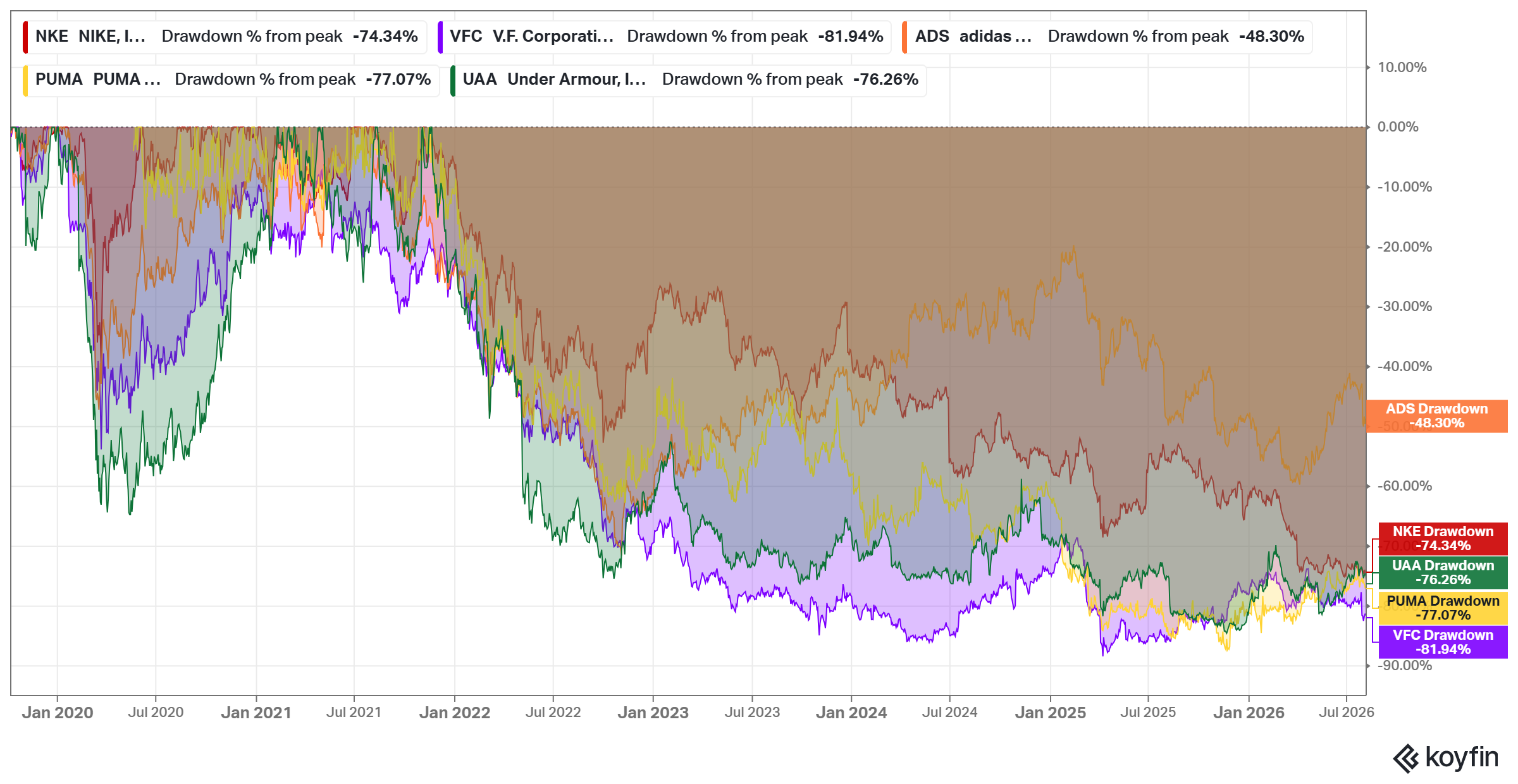
This is usually when I start getting interested in a company but I have historically stayed away from apparel companies because it felt like needing to predict fashion trends. Let me tell you, I am not the one to try and predict that.
Despite that concern I decided it was time to actually spend time learning what it takes to turn companies like this around.
This article is the result of all that work.
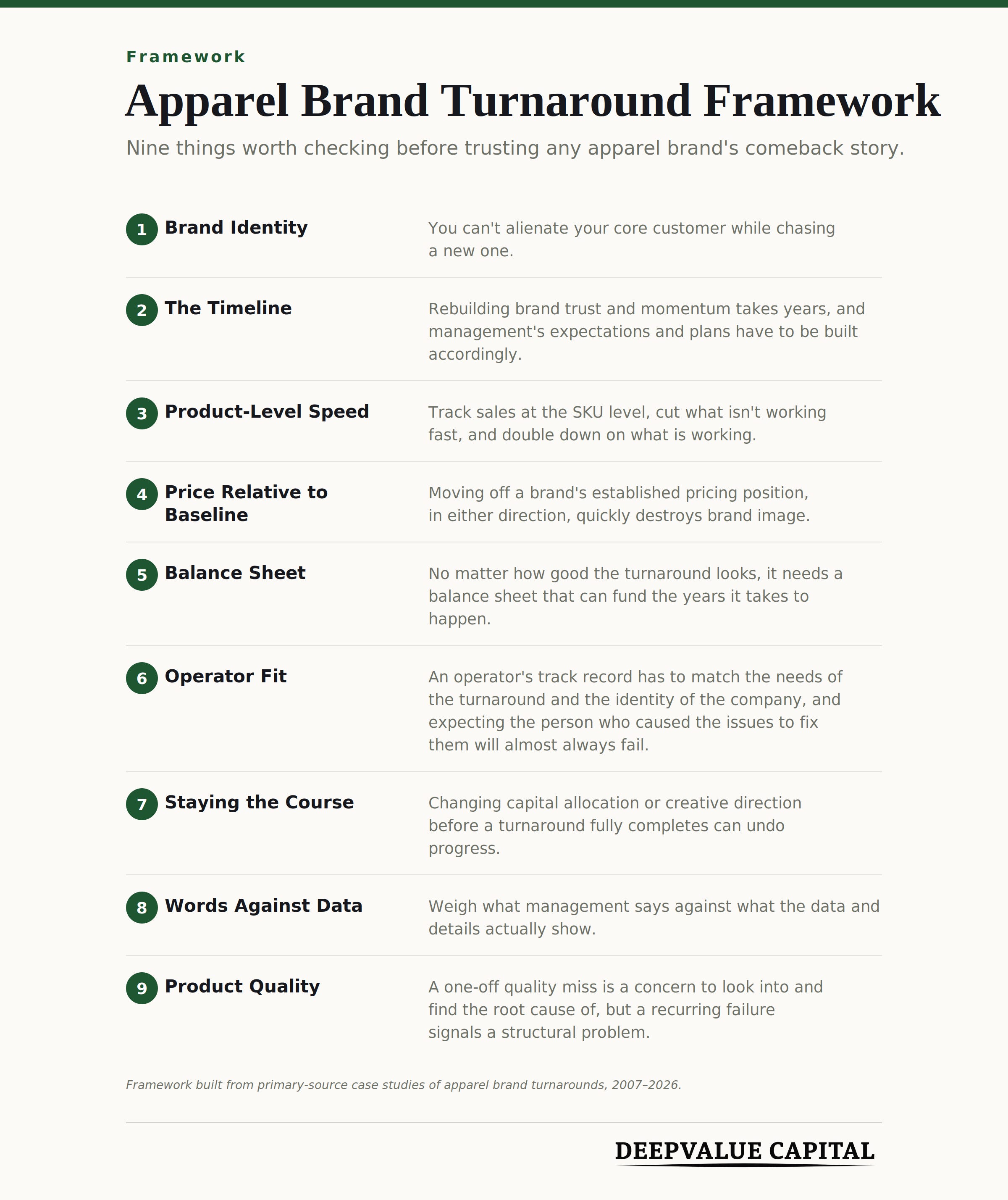
What you see below is the framework I compiled after reading about many successful and failed turnarounds over the last 20 years.
I end by applying all the lessons to 3 turnaround attempts happening today.
VF Corp
Nike
Lululemon
Before we start though let me be clear, this framework is designed to help you decide which companies have a more credible chance to turnaround than others. It will not make decisions for you, tell you as what price to buy, or replace actually doing the full research.
If you want to know how I do full deep research, compare opportunities, and actually invest you can go to the article here.
Let’s go all the way back to 1996, a year that turned out to be a peak revenue period for the company. Over the 15 years that followed though revenue would fall ~30%.
It is after that decline where the story picks up. Specifically in September of 2011 when new CEO Chip Bergh was appointed.
He came into the company and took his time. He went on what he called a listening tour, talking to employees and executives asking questions like,
“What are three things we should not change? What are three things we absolutely must change? What’s one thing you’re afraid I may do?”
While on that listening tour, he got a clear picture of what the company’s culture had turned into. That lesson came when he sat down a bunch of employees to ask them a question.
In that meeting he asked them if they thought the company was doing well, 80% of them raised their hands. Keep in mind this was after sales had declined 30% over a 15 year period, clearly not a company doing very well.
He says that was the moment he realized how ingrained complacency had become in the company.
“I was shocked. A lack of urgency, of financial discipline, and of data discipline permeated the culture.”
He took his time on that listening tour. It was only after it was over that he put out a plan to refocus the company around their core. At that time that core was Dockers and jeans, those two products were about 80% of their profits.
Quickly after he took over and put that plan in place, profitability improved. For the full year 2011, cash flow from operating activities was at its lowest level since 2005, essentially break-even, just $1.8M. The next year, he was able to generate over $500M in operating cash flow by rightsizing.
That focus meant cutting out what wasn’t working and doubling down on what was. In 2012 they cut inventory by about 15%. As you saw cash inflected quickly.
“Primarily reflecting our lower purchases and the lower cost of inventory, and our lower operating expenses.”
Before Chip came in operating income had been declining since 2007. From 2012 to 2013 it jumped about 40% and stayed there.
He didn’t try to change who Levi’s was. He focused on who they were and what they were good at.
The “Live in Levi’s” campaign came a little later in 2014 from a consumer visit to Bangalore. What I love about that campaign was its inviting language. It invited everyone in and people self selected for the product and what it stood for instead of telling people if they belonged or not.
It was after this campaign had time to take hold that revenue inflected up. Women’s, which had been a key area of extension, grew from about 20% of the business to north of 40%. DTC went from 20% to almost 50%.
By FY2019, revenue reached ~$5.8B, up 28% from the 2015 trough with women’s posting 16 straight quarters of growth by then. He ran that plan for a long time and really built a brand image.
Levi’s has some clear lessons that helped build my framework.
Brand Identity: They did not try and reinvent who they were and what the brand represents.
Timeline: They measured the turnaround in years taking time to understand what the issues really were before taking action.
Staying the Course: They didn’t derail progress by changing strategies after things started improving.
Around the same time as the Levi’s story, a very different company was having a very different turnaround outcome.
In November 2011, J.C. Penney brought in new CEO Ron Johnson fresh off his role at Apple. There he was SVP of Retail and was credited with creating the Apple Store concept.
When he came into J.C. Penney, he found a company heavily reliant on its core customer. Middle-aged women coming in looking for a sale. He came up with a plan he called “Fair and Square”. That meant cutting all the discounting and coupons, with the goal of improving margins, and redesigning the stores to feel more modern to entice younger customers. That meant redoing the logo, partnering with celebrities, and trying to make the store a more fun modern place to shop.
In that release Johnson said he felt like all the discounts made the company look “desperate.” He went further saying,
“Coupons were a drug…”
He went about changing that, and quickly. Just 3 months after being appointed, in February 1, 2012, the new pricing took effect.
It blew up in his face.
The core customer was middle-aged women looking for deals, and he actively destroyed exactly what they were looking for. At the same time he was spending trying to chase someone who had already decided J.C. Penney was old and out-of-date.
Even as the numbers collapsed, Johnson kept saying the plan was working.
“Customers love the new jcp they discover in our stores… we are confident in our vision to become America’s favorite store.”
The numbers told a very clear and very different story.
Q1 FY2012 comps fell 18.9%. Q2 fell 21.7%. Q4 fell 31.7%, a quarter that alone carried a $552M net loss. Full year comps were down 25.2%, with a net loss of $985M for the year.
CFO Ken Hannah later admitted that cutting core apparel brands from the assortment was as he said a,
“huge, huge miss.”
The balance sheet hadn’t been the problem coming in. In 2011, the company had $1.5B in cash and a manageable debt load, real time to work with. It just didn’t get the chance to use it. By February 2014, about two years after the pricing rollout, total debt had ballooned to $4.9B.
He was fired April 8, 2013, about 17 months after he started.
J.C. Penney has some clear lessons of what not to do that helped solidify my framework.
Brand Identity: This was one of the clearest cases I studied where management alienated the customer coming in by changing who they fundamentally served redesigning stores and their logo.
Price Relative to Baseline: A core part of the alienation was the elimination of the coupons customers had come to rely on. They did not come to pay full price but find deals.
Timeline: Within just month management made drastic massive changes.
Operator Fit: When you look back to when he was hired it is obvious experience at Apple wouldn’t transfer. The specific thing Apple was good at premium branding is on the opposite side of the value/price spectrum J.C. Penny is on.
Words Against Data: Finally he kept telling investors the plan was working while comps and revenue said the opposite. This one was particularly obvious but an important callout still.
Burberry is a very old company, founded by a 21 year old, Thomas Burberry, in 1856. They’re the inventors of the breathable waterproof fabric, gabardine, that was later used in the iconic trench coat for soldiers during World War I.
Fast forward from their founding all the way to the early 2000s, and the luxury brand was expanding into all kinds of different lines, dog raincoats, baseball caps, and their trench coats, with creative control spread across 23 licensees worldwide operating independently.
All that decentralization was leading the brand to become less cohesive. They were expanding into lower value products, and were becoming one of the most duped brands in the world.
By 2005, it was estimated that 99% of their iconic check-patterned products out there were counterfeit. Those issues were starting to show up in the numbers coming into 2006.
Revenue growth had been decelerating for three years, and operating cash flow had been declining for two. It wasn’t a crisis by any means yet but there were clear signs of issues coming.
That’s where Angela Ahrendts comes in, joining in January 2006 and taking the CEO title that July.
At her first strategic planning meeting, she noticed something telling about her executives.
“They’d flown in to classic British weather, gray and damp, but not one was wearing a Burberry trench coat. If our top people weren’t buying our products, how could we expect customers to pay full price for them?”
She called that a clear sign of the challenges they faced.
“We had 23 licensees around the world. We were selling dog cover-ups and leashes… something for everybody, but not much of it exclusive or compelling.”
“In luxury, ubiquity will kill you.”
For her first 6 months she traveled around the world getting a sense of what Burberry was like globally. She had this to say.
In Hong Kong, I was introduced to a design director and her team, who proudly showed me the line they were creating for that market: polo shirts and woven shirts and everything with the famous Burberry check, but not a single coat.
Then we went to America, where I was introduced to another design director and design team. This team was creating outerwear, but at half the price point of that in the UK. Furthermore, the coats were being manufactured in New Jersey. So we were making classic Burberry raincoats that said “Made in the U.S.A.” I later learned that we had outerwear licensees in Italy and Germany making trench coats that were even cheaper than those in the United States.
After all that touring it was clear to her they needed to centralize final creative control under their creative director, Christopher Bailey. Under one voice with final say instead of two dozen plus they could create a much better brand image that makes the product experience cohesive no matter where you are shopping globally.
Part of the issue too was brand dilution coming from noncore cheaper products that were often the target of dups. She cut 35 product categories and as important re-anchored the whole company around what had been their most iconic product since it became famous in World War I, the trench coat.
“The trench coat must remain our most exciting, most iconic product. It guides all our decisions.”
Once that was stabilized, she went all in on digital advertising and live-streaming runways, one of the first companies to do that.
In 2009, that took the form of “Art of the Trench,” a platform built entirely around the one product she’d re-anchored the company on, letting real customers post their own photos wearing it.
It invited people to think of the brand in a way that fit them, to self-select and aspire to it. Facebook followers passed a million within a year, and e-commerce grew 50%. That allowed them to extend to a new audience without trying to recreate a whole new brand image.
Under her leadership from 2006 to 2014 revenue grew from £850M to £2.5B, and the company’s stock market value more than tripled. She turned what was heading toward stagnation coming into 2006 into continued strong growth, delivering well above market returns for as long as she was there.
While a slight difference from a pure turnaround there was still obvious lessons to be learned here.
Brand Identity: They refocused on their most iconic product and identity as a luxury brand.
Product Level Speed: The brand was being cheapened both by dupes and products outside of their core. Because of the data they were able to cut out the non-core weight.
Staying the Course: Management stuck with it leaning on that expanded reach to solidify the companies position without deviating.
I am sure you know of the ugly clog company everyone can’t seem to get enough of that was dubbed “aesthetically atrocious” around the same period they were growing over 100% YoY.
They went through a boom in the early 2000s, with revenue growing from nothing to $1.2B by 2014. By that peak though, they were facing some real issues. Operating income peaked in 2012, fell over 50% in 2013, and then turned negative into 2014.
A story reported that “by 2013, then-Chief Executive John McCarvel's strategy used the clog only as bait: The shoes were relegated to the back of stores, so that shoppers would see Crocs' other products first.”
They had overexpanded into products that were not their core with costs ballooning along with it. This is where I pick up the story.
John McCarvel retired as CEO in April 2014, and Andrew Rees, the company’s President, stepped in as interim CEO. That July, under Rees, the company announced a plan to refocus by removing non-core products, cutting costs, and reducing store count.
“Ribatt wants to remind people that Crocs was founded on bright colors, whimsy, and comfort.”
Gregg Ribatt then took over as CEO in January 2015, with Rees continuing on as President. Greg continued with that plan Rees laid out. Operating income bottomed out that year at -$72M, but started recovering from there. By 2017, Ribatt could point to the results.
“We’ve reduced SKUs brought to market from over 2,000 to approximately 1,000.”
“Our innovation and newness will be most heavily concentrated on core clogs, and sandals, flips and slides.”
Because they had expanded so aggressively into products that didn’t fit the brand, they were able to cut SG&A, store counts, and right-size the business pretty aggressively. Store count went from 558 down to 447, a 20% reduction in 2017 alone.
In February 2017, the board moved Ribatt out of the CEO role effective that June, and Rees took over again. That April, they refocused their marketing around that clog and their identity of fun and whimsy that appealed to younger consumers. They leaned into individuality and customization of their core product instead of trying to reinvent something new.
They had some whacky partnerships that created really unforgettable looks for good or bad.
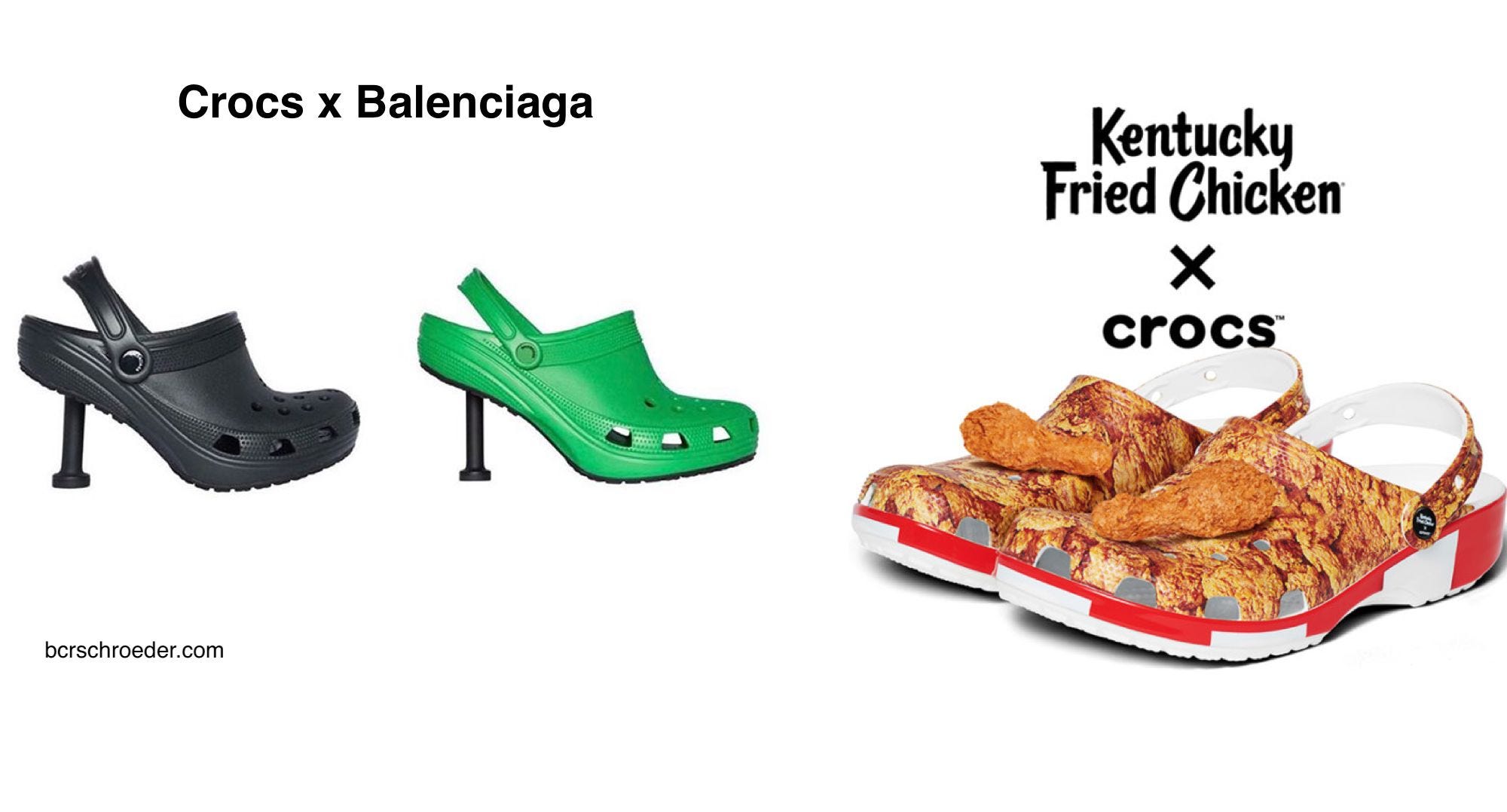
It worked.
Operating income turned positive that year, at $17M.
“A big shift in our marketing strategy last year was to shift 100% of our marketing spend to digital.”
By Q4 of 2018 Americas DTC comps were up 21.2% on the seventh straight quarter of growth.
Crocs is a very different story than Burberry but has some great takeaways.
Brand Identity: Crocs refocused on who they were at their core and leaned into it instead of trying to reinvent themselves.
Product Level Speed: They had the data on what was selling and what wasn’t and acted quickly on it.
Balance Sheet: They had a net cash position when the turnaround efforts started. That gave them years of runway to be patient vs rushing to a quick fix.
Under Armour was founded in 1996 by Kevin Plank. Their story was an incredible one starting from nothing and eventually reaching the 2nd largest fitness brand in the US.
The have been struggling for a long time though, with my story picking up back in 2013. Until then Under Armour had been a very focused apparel company. That December they acquired a fitness app, MapMyFitness, for $150M.
They were riding on growth still though so no real issues out of the gate but it set the foundation.
Later in 2015 they announced they would be buying Endomondo and MyFitnessPal for a combined cost of $560M.
At this point they had invested over $700M into what was not a core focus of the company. That same year Plank announced their “get big fast” plan to hit $7.5B in revenue by 2018 which would mean a 25% topline CAGR.
Into that September investor day they had a ton of momentum including Stephen Curry extending his contract through 2024, revenue growth of almost 29%, and a stock up over 400% in the last 2 years.
So what did they do? They decided to change the focus of the company.
“By leveraging its Connected Fitness network, Under Armour is positioning itself to evolve from a company focused on changing the way athletes dress to one focused on changing the way athletes live.”
As we all know apparel companies are best known for great electronic device and tech innovation.
They tried to become something new and all that investment and change in focus would quickly show up in their numbers.
2016 revenue grew 21.75%. That year they announced expanded into Khols, a store known for heavy promotions and by the end of the year they were seeing “significant promotional activities” even before the Khol’s partnership went live early the next year. Operating income only grew 2% that year.
During Q4 of that year Plank was still out in the report saying,
“The strength of our Brand, an unparalleled connection with our consumers and the continuation of investments in our fastest growing businesses -- footwear, international and direct-to-consumer -- give us great confidence in our ability to navigate the current retail environment, execute against our long-term growth strategy and create value to our shareholders.”
Revenue growth had fallen to ~12% YoY vs the target 25% per year needed to hit their 2018 target. Things would get worse.
2017 revenue grew just 3.13% and apart from post Covid bump they have never exceeded 5% annual growth since this year. To make it worse operating income crashed 93% that year as they started what would become a pattern of “restructuring”.
Under Armour was chasing new constantly, new products, new sources of growth, new partnerships, new business lines. And it destroyed their culture, brand and profits.
They tried to become an lifestyle performance fitness device company all at once. Their history was just creating performance apparel for athletes. This unfocused expansion diluted the brand clearly seen in large scale discounting we still get today.
The killer that never allow them to turnaround from my perspective is that Plank has never been able to let go. He “stepped down” in 2020 but retained control of the board and essentially the company in a way that never allowed someone to come inject newness into the brand and culture.
Under Armour has some critical lessons for the framework.
Brand Identity: Under Armour clearly tried to become something they were not and it’s clear that it never resonated with their customers.
Timeline: They frequently tried to make big, bold, aggressive bets layered on top of each other, never giving the company time to digest and stabilize.
Product Level Speed: I didn’t discuss this one much but in my research I saw very little discussion of SKUs or specific products or lines that were working.
Price Relative to Baseline: Under Armour had previously been a mid-tier full-price brand in the sports category. As they lost their focus and stopped resonating with customers, they expanded into stores that more heavily discount. They clearly started to lose value in the eyes of customers and discounting became heavier over time.
Operator Fit: Plank clearly had the background to run UAA, he founded the company. But when things started to go wrong, you can’t expect the same person that caused the issues to suddenly change. Most of the time that does not work.
Words Against Data: Management was still out confident they could meet targets even when revenue growth had fallen to less than 50% of needed.
Coach was founded in 1941 by six leather artisans. My story picks up much later than that in 2014. By this point the brand was already struggling.
Aggressive expansion and heavy discounting had diluted what had been “accessible luxury”. Customers stopped seeing them as luxury and went to competitors like Michael Kors and Kate Spade.
2014 revenue fell 5.3%, North America sales fell 10.9%, and comparable store sales in the region down 15%. With a lot of fixed lease expenses operating income fell even further down ~21%.
Victor Luis, who had been with Coach for 7 years in senior positions, became CEO in January 2014 and laid out his plan about 6 months later calling it Coach’s “third chapter.”
“Our strategic agenda from my start as ceo was about transforming the brand and its image in the mind of the consumer,”
He wanted to reestablish premium pricing and did so by cutting back on wholesale and introducing new higher priced lines. To cement a new refreshed image they started new marketing campaigns, created new leathers and materials, and modernized store designs.
This wasn’t all though. He also laid out a plan to close 20% of full service North American stores. And bring in house Coach trained staff to stores instead of general department store employee’s.
When asked about the timing of the turnaround Victor said, he wouldn't know when until he sees it, but traffic will be the harbinger of change.
Then when asked about the next quarter expectations he said,
“It's not about September. It's not about the next "It" bag that we're launching, or the next "It" collection. It's about, at the end of the day, how we evolve the brand over this journey that we are on. Coach is an iconic brand, grounded in authenticity and heritage, with a proven history of successful reinvention. We are confident we're taking the appropriate strategic actions, knowing that this is a multi-year journey that ensures both brand vibrancy and healthy, long-term growth. “
His strategy would start paying off as sales and profits stopped plunging in 2016, then operating profits started turning in 2017 up 41% YoY with sales showing improvement up ~2.2%.
The turnaround was showing great signs of working
Unfortunately for Coach though, we skipped over the part where they were no longer the only focus. In 2015 Coach bought Stuart Weitzman for $574M then in 2017 Kate Spade for $2.4B.
In 2017 as they became a conglomerate of brands they changed the name of the company from Coach to Tapestry (TPR) which is what they still trade under today.
Both of those acquisitions would dilute focus and hurt profitability. Kate Spade still struggles to generate operating profits today while Coach continues to get better. Stuart Weitzman was sold off in 2025 for $120M… just 21% of what they bought it for a decade earlier.
It took Coach’s stock 13 years to get above their 2012 peak. Even looking 12 years after that peak they were still down 50% yet Coach was actually more profitable by that point than anytime in history.
Coach follows a different path than most examples laid out here but there are some crucial lessons.
Staying the Course: Had Coach not made any of these acquisitions, I have no doubt that the turnaround of that brand would have happened more quickly. They would have had more creative resources allocated there and more focus on creating an efficient company. Management was unable to stick to that and went out and bought two very difficult companies that even today still drag Coach down overall.
These turnarounds, successful or failed, throughout history have some fantastic lessons but I wanted to take some time to discuss how I think about apply them in practice.
First not every rule lives on the same level of importance. The two that stand out as absolutely necessary are balance sheet and product quality. If either of these two is broken, then a company will need to pull off a miracle to turn things around.
The logic is pretty straightforward.
If people are purchasing a product and it’s immediately falling apart or just doesn’t serve the function they need it to, they’re not going to be coming back. I look for a major product launch with documented issues, a disclosed increase in defect or return rates, or the company directly addressing quality issues. Specifically this is not scattered reviews, which run negative across virtually every brand regardless of actual quality.
Next if the company doesn’t have a balance sheet to survive years of stabilization then they’re going to be forced to move products quickly through discounting and cheapening the brand. They also won’t have capital to invest in improvements or refreshing their image.
If a company is missing either of these I don’t have high hopes for a turnaround and will be avoiding the name.
Below those come everything else which I look at over the last 24 months.
In all the examples I talk most about brand identity. Brands are built over many years and if a company tries to reinvent who they’re serving and the image of what their brand fundamentally represents, it’s not that different from trying to start a new company.
Trying that when you’ve got all the costs of an old company is going to make things incredibly difficult.
Timeline was another common thread. I usually saw that when an operator comes in quickly and tries to change a major part of the company without taking the time to test, understand the business, and find out what a customer wants and needs. Those are the situations where they can get ousted so fast they never have a chance to see their project work and/or they hurt the company more than help it. Brands take time to change, apparel takes time to make, global logistics are complicated. A CEO needs to take their time and shift things in increments.
Everything else:
Product-Level Speed
Price Relative to Baseline
Operator Fit
Staying the Course
Words Against Data
These are important points and should be tracked on an individual company level. No individual yellow flags flat out kill an idea but multiple or any clear issues here are not good signs.
On product-level speed, is management talking specifics? Are they discussing specific SKUs over recent weeks that are working or are they talking about the brand in general terms only? You want to see granularly specific discussion AND actions being taken on that data.
Their price relative to baseline was more common than I expected. Premium companies trying to expand too fast and being forced into discounting can destroy the image of the brand. Heavy discounting brands like JCPenney are going to have an incredibly difficult time moving to only full-price product.
Their customers are there searching for a deal and they’re not going to like it when they don’t find what they’re looking for. They’re going to stop coming after some time.
On operator fit, obviously you want someone with relevant experience to be able to turn that company around but I think this one applies a little bit more loosely than you would guess. You want someone who has relevant operation experience and has lived on the same side of the cost curve.
If you’ve got someone who’s been working at Louis Vuitton, they’re probably going to come in and struggle a little bit to run a company like Old Navy, and vice versa.
The second side of this coin is understanding that if a CEO was running the company as it deteriorated, they are going to struggle to reinvent themselves and a company.
Stay the course, we saw that with Coach. They were able to implement a lot of good that we talked about, sticking close to their brand identity, thinking over a long period of time, cutting what wasn’t working, and innovating while staying true to who they were delivering high-quality products.
But, when you’ve got someone who tries to add something new on top that is fundamentally different than their core it can throw a wrench in that whole plan.
Words against data speaks mainly to catching operators with either a history of overpromising and under delivering or those saying all the words you want to hear but never actually seeing the results.
When they talk about multi-year timelines are they actions actually matching up or are they trying to shift the business to something new very quickly. If they discuss cutting promotions is it actually happening. ETC
If you can use all of these benchmarks to analyze a potential apparel turnaround over 3-5 years I think they give a great picture of if it is likely to happen.
This framework does NOT tell you if a company is a buy at current prices, but simply lets you gauge the quality of their turnaround story.
Now that you have an idea of how to apply these tests I wanted to walk through three companies attempting turnarounds right now.
VF Corp (VFC)
Nike (NKE)
Lululemon (LULU)
Here are the results of that initial research.
On a first pass I send AI with a standard prompt to do deep research to determine if a name is worth looking into, and what to focus on if they are. This is only a first pass to determine if I want to spend time on the name. It is not a substitute for doing full deep research yourself.
P.S. if you want the prompt I used that took me 4 hours of tweaking just comment below a retail/apparel turnaround you think is interesting and why.
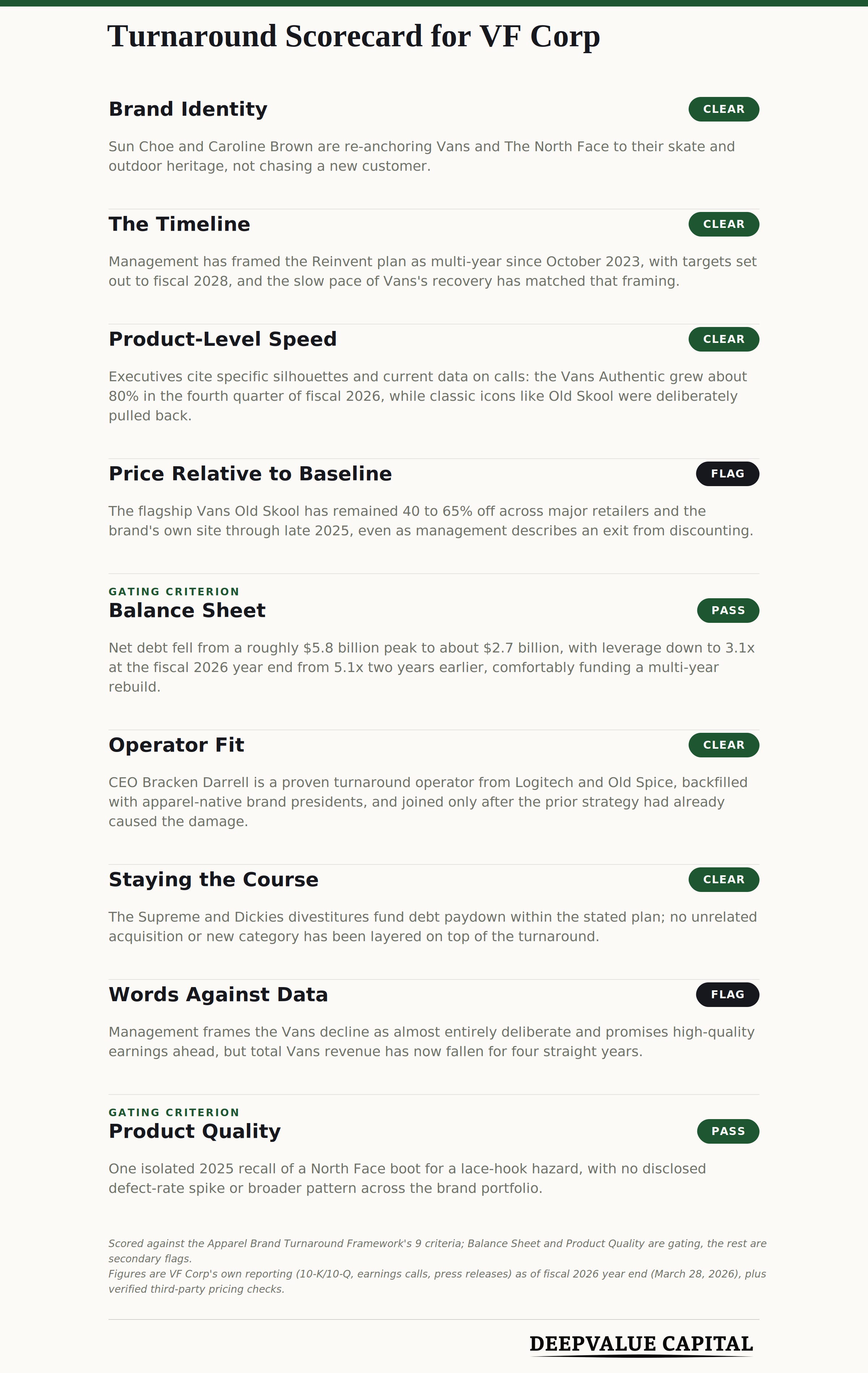
Below I run Nike and Lululemon through that same nine-criteria framework. One of them outright fails one of the two gating criteria.
Which one, and what name will I be focusing on next is below.
Comments
Nothing yet. Say the first thing.
Sign in to join the conversation.