
The study of Middle Paleolithic technology has underwent a profound transformation over the past three decades. Long treated as a static assemblage dominated by repetitive flake reduction strategies, the material culture of Homo neanderthalensis is now recognized as a highly dynamic, multi-component technological system. While lithic knapping remains the most archaeologically visible aspect of hominin behavior, stone tools rarely functioned as standalone implements. Instead, they were frequently integrated into complex, multi-material composite systems—tools composed of stone bits, organic shafts, and specialized binding agents.
Among these components, the emergence of organic adhesives marks a fundamental threshold in Pleistocene pyrotechnology. Unlike naturally occurring plant gums, animal glues, or unmodified tree resins, birch bark pitch (Betula tar) is a synthetic material. It does not exist in nature. It can only be produced through the destructive distillation (pyrolysis) of birch bark within a strictly regulated thermal window, typically between 250 and 400 degrees Celsius, under conditions that exclude atmospheric oxygen. Exposure to open flames causes bark to rapidly degrade into volatile gases and ash; conversely, insufficient thermal energy fails to liberate the heavy pentacyclic triterpenes required to form a tar distillate.
In this article, I examine the structural, chemical, and operational evidence for Middle Paleolithic pitch distillation. Moving beyond simplistic binaries of primitive versus modern, our analysis focuses on the raw thermodynamic constraints, molecular signatures, and procedural sequences (chaînes opératoires) required to produce pitch. I argue that the physical specimens recovered from sites such as Campitello Quarry (Italy), Königsaue (Germany), and the Zandmotor (Netherlands) demonstrate that Neanderthals managed complex material state changes, controlled sub-surface thermal environments, and possessed multi-tiered task management capabilities as early as Marine Isotope Stage 7 (over 200,000 years ago).
The survival of organic adhesives from the Middle Pleistocene is governed by exceptionally narrow taphonomic windows. Organic compounds readily undergo aerobic biodegradation, thermal oxidation, and mechanical weathering. Consequently, the surviving record of Middle Paleolithic pitch is localized to waterlogged lacustrine sediments, acidic peat bogs, and protective marine silts across Western and Central Europe.
The site of Campitello, located in the upper Valdarno basin, provides the oldest securely dated evidence of hominin adhesive manufacture. The cultural horizon, designated Layer A3, comprises fine-grained lacustrine silts and clays deposited during an interglacial lacustrine highstand. Electron Spin Resonance (ESR) dating of associated Stephanorhinus hemitoechus (steppe rhinoceros) molars, paired with regional palynological correlations, assigns Layer A3 to Marine Isotope Stage 7 (MIS 7), establishing a minimum age of 200,000 to 220,000 years BP. The low-energy depositional environment preserved two retouched flint flakes (including Specimen CMP-F1) found in close spatial proximity to a partial skeleton of Palaeoloxodon antiquus.
Exposed during open-cast lignite mining in the Aschersleben basin, Königsaue represents a benchmark locality for Paleolithic organic preservation. The site consists of a sequences of limnic gyttja, moss peat, and fluvial sands. Pitch artifacts were recovered from two distinct, well-stratified horizons:
Horizon Königsaue B: Stratigraphically correlated with the early Weichselian glacial sequence (Marine Isotope Stage 5a/5b), with Infrared Stimulated Luminescence (IRSL) sediment ages exceeding 80,000 years BP.
Horizon Königsaue A: Situated higher in the sequence, dated via IRSL to between 50,000 and 55,000 years BP, and yielding infinite radiocarbon ages (greater than 48,000 radiocarbon years BP). The anaerobic, acidic hydro-chemistry of the peat bed preserved macro-scale pitch masses (Specimens KSA 117/57:1 and KSA 117/57:2) with intact surface morphology.
The Zandmotor discovery highlights the potential of submerged Pleistocene landscapes. Artifacts were recovered from marine sands dredged from the North Sea floor (Doggerland basin) and deposited along the Dutch coast for coastal defense. Geological and biostratigraphic constraints place the source sediments within the Middle Paleolithic Weichselian land surfaces, dated to Marine Isotope Stage 3 (approximately 40,000 to 60,000 years BP). Specimen ZM-13728—a small retouched flint flake—retained a localized micro-mass of black adhesive along its proximal retouched platform, shielded from abrasion by fine-grained anaerobic sea-floor silts prior to suction recovery.
Distinguishing synthetic birch bark pitch from natural environmental resins (such as pine rosin or spruce balsam), bitumen, or modern chemical contaminants requires high-resolution organic geochemistry. The primary diagnostic workflow relies on solvent extraction paired with gas-phase chromatography and mass spectrometry.
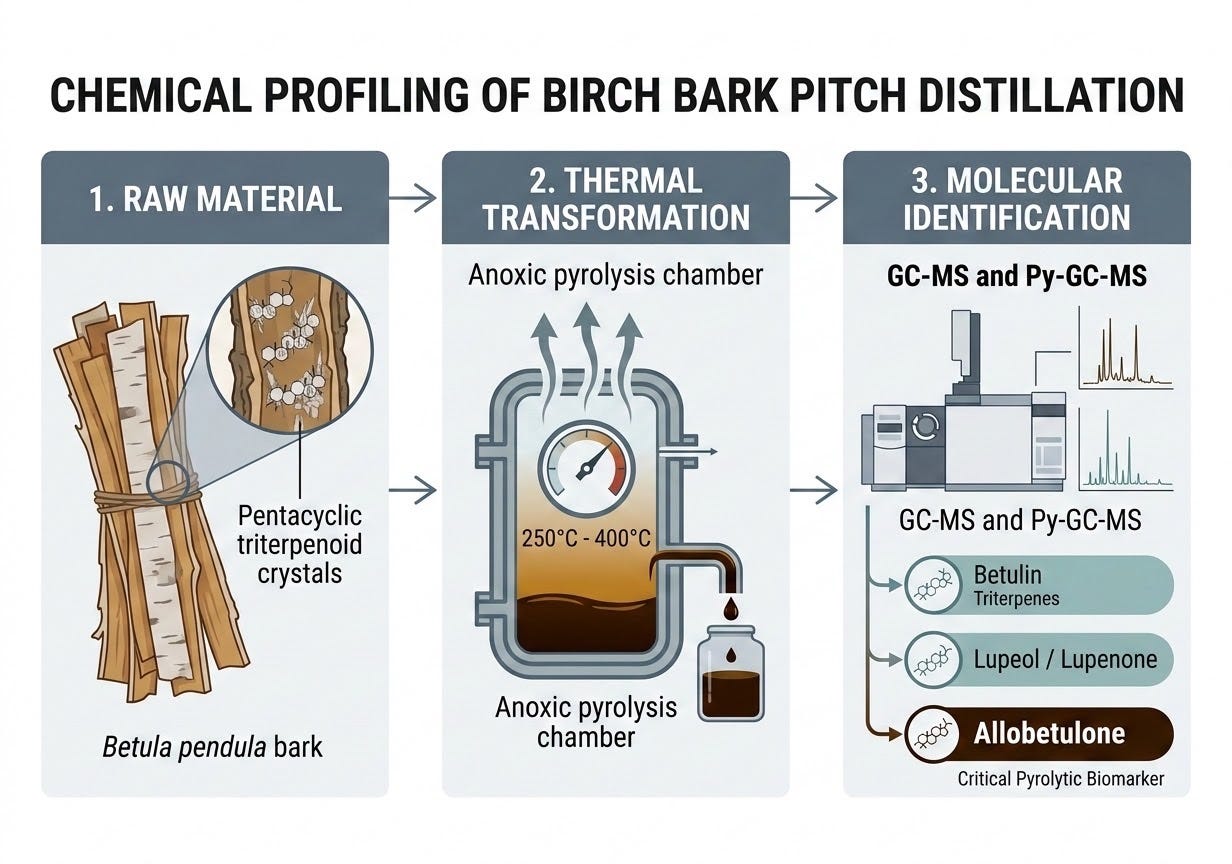
The outer bark of Betula species (most commonly Betula pendula and Betula pubescens) contains high concentrations of pentacyclic lupane-type triterpenoid crystals. The primary component is betulin (which can make up 20 to 30 percent of the dry weight of outer bark), accompanied by secondary compounds including lupeol, lupenone, and betulinic acid.
When subjected to thermal energy in the absence of oxygen, these triterpenoids undergo specific chemical alterations:
Primary Thermal Degradation: At temperatures exceeding 250 degrees Celsius, betulin begins to lose hydroxyl groups. This dehydroxylation transforms intact triterpenes into secondary derivatives such as lup-20(29)-en-3-one and lupeol.
Diagnostic Pyrolytic Biomarkers: When pyrolysis occurs between 300 and 380 degrees Celsius, specific structural rearrangements produce compounds that are completely absent in unheated birch bark. The most vital of these is allobetulone (along with lupa-2,20(29)-dien-28-ol and 1,4-epoxy-lupan-3-one). Identifying allobetulone via GC-MS fragmentation patterns (specifically analyzing key ion fragments at m/z 440, 425, and 383) provides conclusive proof that a sample was subjected to intentional thermal processing, eliminating the possibility of unheated raw bark contamination.
Screening for Non-Betula Resins: Samples are simultaneously screened for diterpenoid diterpenes (such as abietic acid and dehydroabietic acid), which identify coniferous resins (Pinus or Picea), and hopane biomarkers, which signal mineral bitumen.
To evaluate the operational requirements of pitch extraction, experimental researchers (Kozowyk et al., 2017; Schmidt et al., 2019) have logged temperature profiles and tar yields across several experimental setups:
Subterranean Two-Pot System: A bark-filled vessel is placed inside a sealed pit, covered with an anaerobic clay seal, and heated from above by a wood fire. Thermocouple arrays show that this method maintains a remarkably stable thermal gradient (300 to 350 degrees Celsius) for over 90 minutes, yielding up to 5.0 grams of refined tar per 100 grams of dry bark.
Mound/Pit Distillation: Tightly rolled bark strips are buried in a small earth pit, covered with ash and dry soil, and ignited at the upper margin. Internal oxygen concentrations drop below 2 percent as volatile gases expand, creating an anoxic condensation chamber within the pit base. Yields range from 0.8 to 1.5 grams per 100 grams of bark.
Open-Air Pebble Condensation: Bark strips are burned in an open hearth directly above cold, smooth stones. Tar vapors condense briefly on the unburned lower rock surfaces before burning off. Yields are extremely low (less than 0.2 grams per trial), and temperature control requires constant manual manipulation to prevent the tar from igniting.
Unlock deeper insights into human evolution with full access to rigorous, multidisciplinary site breakdowns, technical data analyses, and critical evaluations of ancient hominin cognition. By upgrading to a paid subscription, you directly support independent, primary-source science journalism while unlocking exclusive deep-dives that challenge the dogmas of deep history. Join our community of researchers and enthusiasts to read the rest of this investigation and explore the full archive.
Thanks for reading The Deep History Refuge! This post is public so feel free to share it.
Comments
Nothing yet. Say the first thing.
Sign in to join the conversation.