A reader recently sent me a message asking:
"How are you able to publish blog posts and raw notes so fast? What's your setup like, and are you using some background automation or API?"
It's a great question. When people see someone posting quick notes and blog posts regularly, they usually think there's some complex CMS or API running in the background.
The truth is, I don't use any web dashboards or complex APIs. I just have a simple setup with terminal scripts, a few VS Code extensions, and small background automations that remove all friction.
Here's how my setup works and why it's so fast.
1. Two types of content: Blog vs Raw notes
One of the biggest reasons people take so long to publish is mental friction. If every post needs to be a 2,000-word polished essay, you overthink and end up publishing nothing.
To solve this, I split my content into two types:
- Blog posts under
/blog/: Longer, detailed guides and essays, like my post on setting up OMP - Raw notes under
/raw/: Short technical notes, quick fixes, links, or random thoughts
Having a separate section for raw notes changed everything for me. I don't worry about perfect structure or length. If I learn a quick trick or fix a bug, I just drop it in a note and publish immediately.
By the way, I was inspired by Simon Willison's blog a lot, when I migrated my blog from WordPress to 11ty last year.
2. Terminal shortcuts over web dashboards
I don't log into WordPress, Ghost, or any admin panel or CMS to write. Everything lives in plain Markdown files on my computer.
Instead of opening a folder, creating a file, and manually adding dates and tags, I wrote a few small Node.js scripts.
When I want to write a new note, I just open my terminal and run:
pnpm raw my-quick-noteOr for a blog post:
pnpm blog my-new-postThis single command:
- Creates the Markdown file in the right folder
- Fills in the date, title, and initial tags automatically
- Opens the file directly in VS Code
It takes less than a second to get from an idea to a ready-to-type Markdown file.
3. VS Code extensions that speed up writing
I write and edit everything inside VS Code. To keep the writing process smooth and fast, I rely on a few simple extensions as well:
- LTeX+ (grammar/spell checking using LanguageTool): Great for basic spelling and grammar checks while typing.
- Markdown All in One: Makes writing Markdown much faster with simple keyboard shortcuts, like
Cmd+Bfor bold,Cmd+Ifor italics, auto-formatting lists, and quick heading shortcuts. - Markdown Table: Takes the headache out of creating and formatting Markdown tables so everything stays neatly aligned automatically.
4. Automation doing the heavy lifting
Once I finish writing, I don't want to spend time optimizing images, making social preview cards, or running multiple Git commands.
I built a simple command pnpm ready that runs automatically before publishing:
- Image optimization: It automatically resizes and optimizes all new images so the page loads fast.
- OG preview images: It generates custom social share cards automatically. I also wrote about how I built custom OG images earlier.
- Asset sync: It uploads images to Cloudflare R2 so they load fast, and the site repository stays lightweight.
And to push the post live, I run just one command:
pnpm raw:pushThis runs the checks, optimizes images, uploads them to R2, commits the changes, and pushes to GitHub. Netlify picks it up and deploys the site live in around 30 seconds.
5. The 2-minute workflow
Here's what publishing a quick note looks like from start to finish:
- Open terminal and run
pnpm raw <title> - Write the note in VS Code
- Run
pnpm raw:push
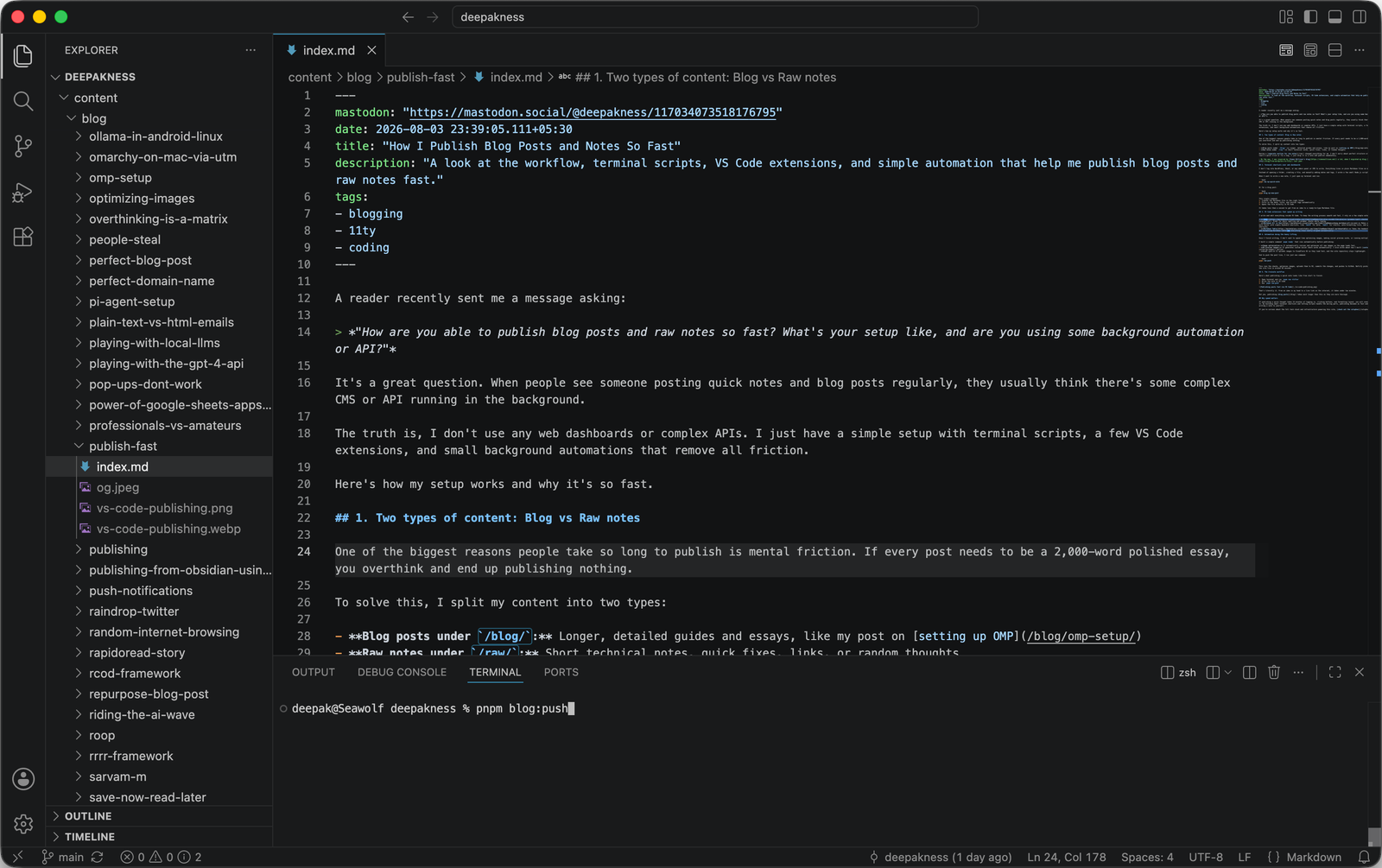
That's literally it. From an idea in my head to a live link on the internet, it takes under two minutes.
But yes, publishing blog posts takes much longer than this as they are more thorough.
Why speed matters
If publishing a quick thought takes 15 minutes of logging in, clicking buttons, and formatting layout, you will eventually stop doing it. By building small terminal shortcuts and letting scripts handle the boring parts, publishing becomes as fast and natural as writing a note to yourself.
If you're curious about the full tech stack and infrastructure powering this site, check out the colophon.
Comments
Nothing yet. Say the first thing.
Sign in to join the conversation.