
At 10 PM tonight, if you are in a well-lit room or reading on a bright screen, your body is receiving a signal that overrides 200 million years of evolution. The blue light entering your eyes is suppressing melatonin and confusing the biological clock in every cell. Your liver still thinks it is noon. Your immune cells are waiting for a shift that keeps getting postponed. Your mind, meanwhile, is preoccupied with finishing one more thing before bed.
This is the most common and least diagnosed disorder of modern life. Researchers call it circadian desynchrony. The remedy is older than any clock invented to tell time.
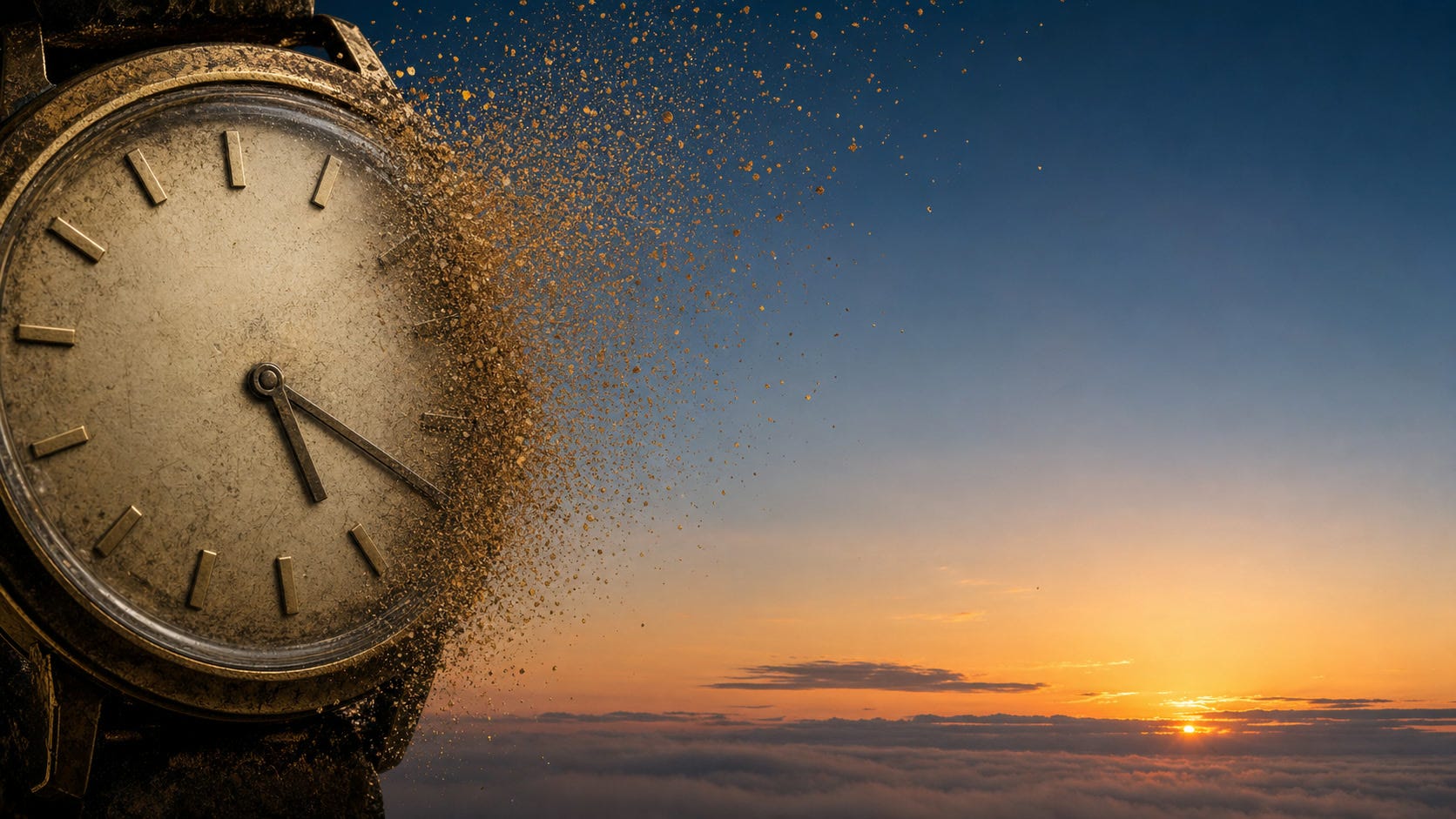
The clock inside every cell
The 2017 Nobel Prize in Physiology or Medicine went to Jeffrey Hall, Michael Rosbash, and Michael Young for discovering the molecular machinery that governs circadian (daily) rhythms (NobelPrize.org, 2017). Their work confirmed something remarkable. Almost every cell in your body contains its own 24-hour clock, built from a small handful of genes.
A 2014 study of circadian gene expression found that roughly 43 percent of all protein-coding genes rise and fall on a daily rhythm in at least one organ (Zhang et al., PNAS, 2014). Nearly half your genome is doing something different at 2 PM than at 2 AM.
Ayurveda’s daily routine, or dinacharya, addresses the same thing from the inside. It is a map of when the body and mind naturally want to work, rest, digest, and open to insight. You already know these rhythms. Through various signals like late-morning hunger, afternoon restlessness , and feeling heaviness around nine in the evening. Each of these signals is your awareness meeting your biology in real time.
Eating in time
For a century, the big question in nutrition has been about what to eat, but a subtler question has gained traction: When is the best time to eat?
In 2012, Dr. Satchidananda Panda’s lab at the Salk Institute fed two groups of mice the same high-fat diet. One group ate whenever it wanted. The other ate only within an eight-hour window. Same calories, same food. After eighteen weeks, the free-feeding mice were obese and showing signs of fatty liver. The time-restricted mice were healthy (Hatori et al., Cell Metabolism, 2012). Human studies since then have shown similar benefits for blood sugar, blood pressure, and inflammation (Chaix et al., 2019).
The Ayurvedic guidance is simple. Eat your largest meal between 11 AM and 1 PM, when digestion is strongest. Finish eating by 7 PM so the body can rest and repair through the night. Biology now explains why this works., but the felt sense of what was right has always been there for anyone who paid attention to how a heavy late dinner sits, for example, compared with an early, lighter one.
The night repair window
When you fall asleep, growth hormone rises. In the deep, slow-wave sleep of the first half of the night, the brain opens a network of channels called the glymphatic system and washes out metabolic waste, including proteins linked to Alzheimer’s disease (Nature Communications, 2020). Natural killer cells, one of the immune system’s front-line defenses against cancer and viruses, reach their peak activity in the middle of the night (Journal of Immunology, 2012). DNA repair steps up. Your body’s overnight cleaning and maintenance runs on a schedule.
If you are still at your laptop at 11 PM, your body cannot fully do the work it was designed to do at that hour. When you go to bed early and wake naturally at dawn, you can feel the difference. There is a clarity in the morning that no supplement reproduces. That clarity is your own biology at work, and your awareness is the place where you get to feel it and choose to work with it.
The hour before dawn
Ayurveda has always singled out the hour before dawn as the most transparent time of day, when the mind is quiet and the world is quiet with it. Endocrinology now describes the same window in its own language. Within 30 to 45 minutes of natural waking, cortisol rises by roughly 50 percent, in what researchers call the Cortisol Awakening Response (Oxford Endocrine Reviews, 2025). This surge sharpens attention, wakes up metabolism, and primes the brain to learn.
The traditional prescription for this hour in Eastern thought was meditation. The modern reflex is to reach for the phone. You can silently sit in the early morning with the rising cortisol level, and it becomes fuel for insight. Focus instead on a news feed, and elevated cortisol becomes background anxiety for the next twelve hours. The chemistry does not decide which state you will experience. You do.
The circadian alignment audit
For one week, notice four things without trying to change anything yet.
1. The clock time of your first meal.
2. The clock time of your largest meal.
3. The clock time of your last meal.
4. The clock time you actually fall asleep.
Then compare, gently and without judgment, to the Ayurvedic pattern. Largest meal between 11 AM and 1 PM. Last meal before 7 PM. Asleep by 10 PM.
Most people find real misalignment in one or two of the four. Pick the easiest single change and make only that one the next week. Then notice what shifts. Sleep depth. Morning clarity. Afternoon energy. Don’t approach this as trying to follow rules. See it as listening to your body and choosing to move with it.
Rhythm as medicine
Every clock in your body is ticking, every enzyme and hormone rising and falling on its own tide, whether you are noticing or not. The ancient Ayurvedic daily routine is simply an invitation to bring your choices into agreement with a rhythm that has never stopped playing.
This is the heart of qualia medicine. These rhythms are not happening to a machine you happen to live inside. They are qualities of your own awareness. When you eat at midday because it feels right, when you go to bed at 10 PM because you respond to the pull toward stillness, or when you meet the dawn with quiet attention instead of a screen, you are recognizing inner intelligence and choosing to move with it.
In short, rhythm is medicine you can practice from the inside, one meal, one sunset, one dawn at a time.
In the next article we turn to sound and the striking evidence that a single meditation practice can change the expression of more than 2,000 genes in one session.
Namaste,
Deepak
Awakening in the Final Chapter is available for pre-order now and publishes September 8. Reserve your copy today so it arrives the moment it’s released.
Comments
Nothing yet. Say the first thing.
Sign in to join the conversation.