
New review just dropped!:
“Working with Bethel taught me that budgeting does not have to feel restricting. In fact, its’s freeing! We built a budget that covers the essentials and sets aside money each month for life’s pleasures, like eating out with friends or taking a car home after a night out. Through working with Bethel, I realized that spending on these “non-essentials” is now so much more pleasurable because that I know there’s a plan in place. Awareness is relaxing!” - Chloe
“Awareness is relaxing!” Thanks, Chloe! If you’d like to finally make sense of your personal finances in a lasting way, it would be my pleasure to work with you. I’m running a sale on a truncated version of my program, The Good Bones Edit, until the end of this month. Set up a free, 30-minute intro session and mention “Deconstructing Money” to learn more.
Abundance.
I think I’ve heard at least ten different characterizations of this word.
I’ve mostly heard it used in a positive way. That having an abundance mindset—or the belief that there will always be enough—allows you to imagine your way into situations that can lead to more opportunities. That it can lead to less stress because you aren’t fixated on what you don’t have and what you can’t do.
I’ve most often heard the word come up by artist types who’d rather not feel restricted by their numbers. Who’d like to know that, if they wanted to, they could cover the costs of whatever good or service they desired and trust that everything will work out in the end.
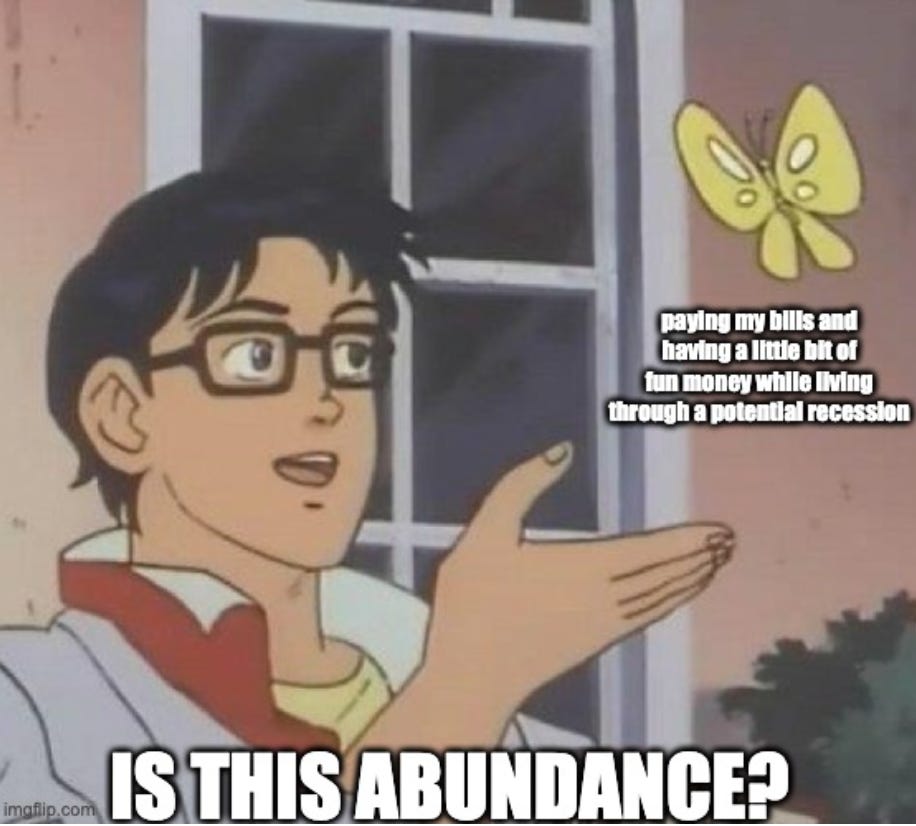
But recently I heard a mentor and therapist use it differently.
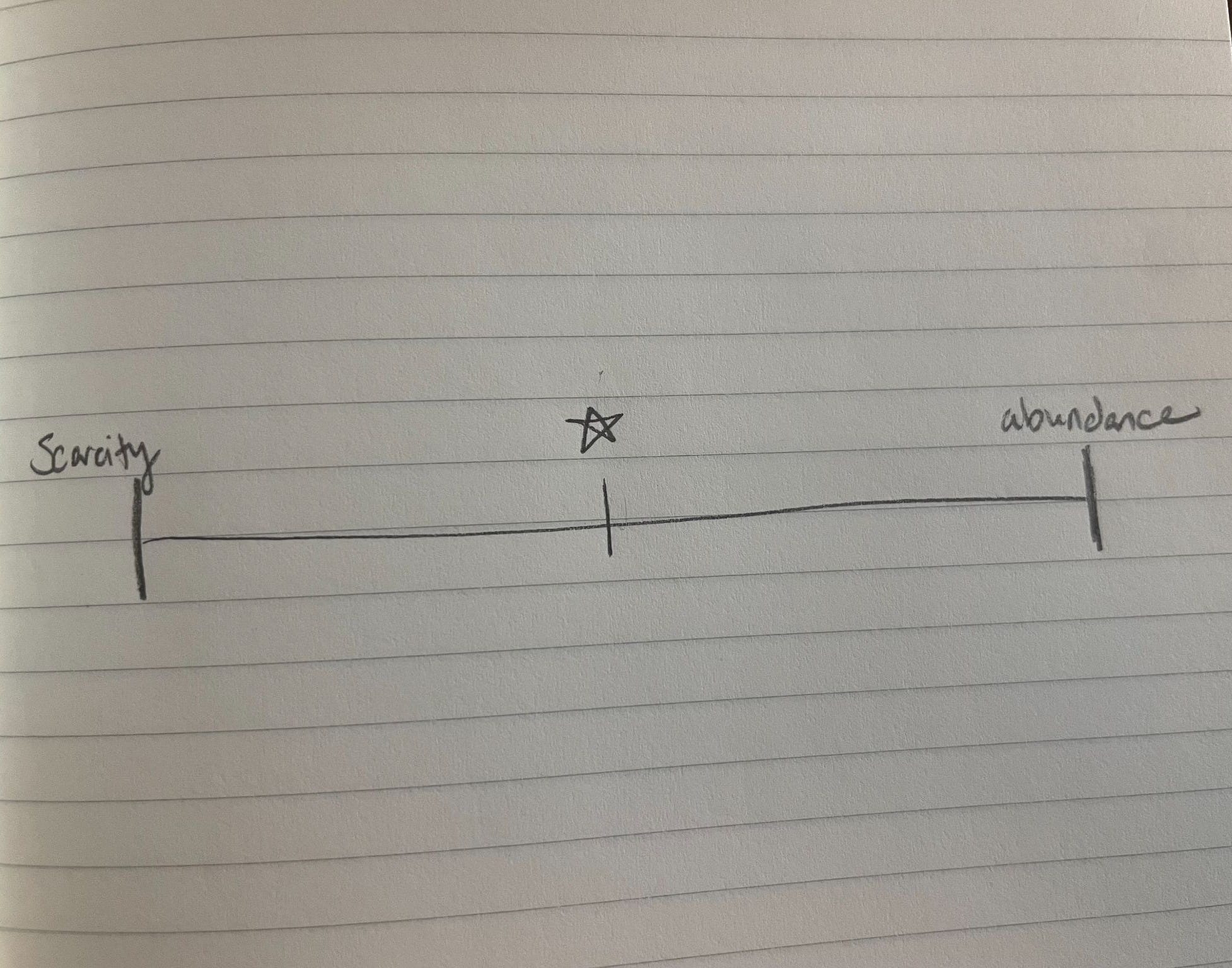
She put scarcity and abundance as opposites on a spectrum.
If having a scarcity mindset means focusing too much on what you lack and belt-tightening out of fear, then an abundance mindset means imagining your financial resources are limitless, which, unless you’re a billion or trillionaire and your money compounds faster than you can spend it, they’re not.
She argued that we shouldn’t strive to have an abundance mindset lest it lead us into a state of delusion (and debt). She argued that instead we should aim to land in the middle of that spectrum.
Even more recently I stumbled on yet another characterization of abundance that both appeals to me but also confounds me. It comes from “Conscious Money” by Patricia Aburdene:
“Abundance thinking…rests in the inner knowledge that there is always enough, no matter how much money you have or don’t have. Because what you really need comes from your Being. This unique store of treasure is always at your disposal because it lies within…When you grasp this meaning of abundance, that the true source of money lies within each of us, you recognize that money is energy and sometimes intangible. So, inner resources, which are potentially as real as money, might appear invisible, too. If what you are looking for is only dollar bills already in your wallet or sizable financial sums in your online banking statement, you may miss seeing the great possibilities right before your eyes. Abundance thinking unlocks the ability to recognize resources and money opportunities that otherwise lie unseen, as I learned from observing my stepdaughter, Nana Naisbitt.” (27)
Aburdene goes on to describe her stepdaughter’s method for funding her three kids’ education. Her stepdaughter enjoyed a high income in Chicago which could’ve easily supported tuition for all three of her kids. But she fell in love with Telluride, Colorado and decided that it would be a great place to raise them. She left her job and got one at a local non-profit that paid much less. They downgraded their lifestyle but enjoyed their access to nature and proximity to family. Her kids got after-school jobs and worked in the summer. When it came time to apply for colleges, she didn’t have the money to cover the costs. So she threw herself into researching scholarships, deferments, the works. All of that effort resulted in finding $475,000 in scholarships for her children.
“I don’t think my practical, resourceful stepdaughter considered herself an abundance type, yet that is exactly what she was because she never doubted that there was enough money available to send her kids to great colleges, and she pursued it…When you think there is enough, your thoughts reflect an inner wisdom that agrees that there is indeed enough.” (29)1
All of that’s wonderful. Believe there’s enough, even if the numbers aren’t reflecting that reality yet, pursue that belief, et voilà.
Now here’s where she loses me.
“Abundance thinking can be an excellent antidote to greed. One of the motivating forces behind greed is the inability to experience having enough. A need cannot be met unless the person who experienced it is able to feel satisfaction. For complex psychological reasons, some people fail to recognize that a need has been fulfilled and that they are free to feel a new and perhaps more satisfying need. The ill-fated urge to seek more and more, even though there is already plenty, leads to financial carelessness, from accumulating credit card debt to investing in real estate bubbles.”
Now, couldn’t the belief that there will always be enough before those funds are realized be the very thing that leads people into credit card debt and unwise investments? Couldn’t new needs that are discovered after meeting old needs have expensive price tags?
I read recently that some people are going into debt by giving to mutual aid. Maybe this means that they aren’t imagining that their contributions to the world are “enough” but couldn’t the belief that “there will always be enough to give” (abundance) lead them to the same end?
I’m not against abundance thinking outright. I think it’s wise to imagine ways that financial problems can be solved that don’t yet exist, believing in our inner resources and pouring our energy into worthwhile pursuits. But I don’t know that relying on our own assessment of what we need allows us to avoid feeling abundance to the point of excess. I think abundance thinking coupled with a grounded check-in with reality—and acknowledgment of current limitations—is a healthier way forward.
I’m feeling more and more partial to aiming to fall in the middle of the spectrum.
What are your thoughts on abundance? Let me know in the comments or shoot me a DM.
Shifting Your Money Mindset From Scarcity to Abundance - Money with Katie
“One trick to changing your mindset about money is to practice abundance. It sounds counterintuitive, but it doesn’t mean spending every penny you have or pretending your annual salary has doubled. Instead, practicing abundance means freeing yourself of worries of scarcity. Here are three ways to practice abundance:
Give your time freely. If someone you know needs help, offer assistance without any worry about it negatively impacting your own needs or commitments.
Share your possessions freely. Give your stash of baby gear that you are saving for a potential future child away to people who can use it today. Loan your second car to a friend who can’t afford to get hers fixed.
Don’t worry about future needs. This doesn’t mean not preparing for retirement or not planning who’s going to pick the kids up from swimming tomorrow. It means that those problems you imagine in the future—the ones that could or could not happen, like losing your great job or urgent and expensive home repairs—shouldn’t weigh heavily in your thoughts today. Do your best with the information at hand and the things that have actually happened or are on this week’s calendar. If that “what if” scenario does happen, you can deal with it then. Don’t bother worrying about it now.”
-Do Less: A minimalist guide to a simplified, organized, and happy life - Rachel Jonat
The Cost of Leisure - Why my French friends are always surprised in the U.S. - Pamela Clapp, With Love From Paris
“At the tax office we see mostly older folks. I’ve mostly believed that the “great wealth transfer” and the “silver tsunami” are trends that economists see but don’t play out in real life. This is being proved to me over and over. I see a lot of struggling seniors but I also see people with so much wealth that their dividends alone are far more than they will spend. They are afraid of letting go, of the money, the house, etc. The wealth brings no joy and they are the ones who complain most bitterly about taxes because the money is theirs and they don’t want to surrender one bit of it. Most of the happiest seniors I meet are in assisted living and are located near family. They have their complaints but mostly they feel cared for. The other happy seniors I meet are still on their own but have a job or volunteer gig that brings them purpose. They have had massive losses and sorrows but they are resilient and like to make jokes and tell stories. They take the taxes in stride. The lesson here for me, even though I am a shy introvert, is connection. It is our safety net and our life raft. Valuing money more than people is against nature and it creates a loneliness nothing can fill.” - Deirdre Woollard
Aburdene, Patricia. Conscious Money: Living, Creating, and Investing with Your Values for a Sustainable New Prosperity. Atria Books/Beyond Words, 2012.
Comments
Nothing yet. Say the first thing.
Sign in to join the conversation.