
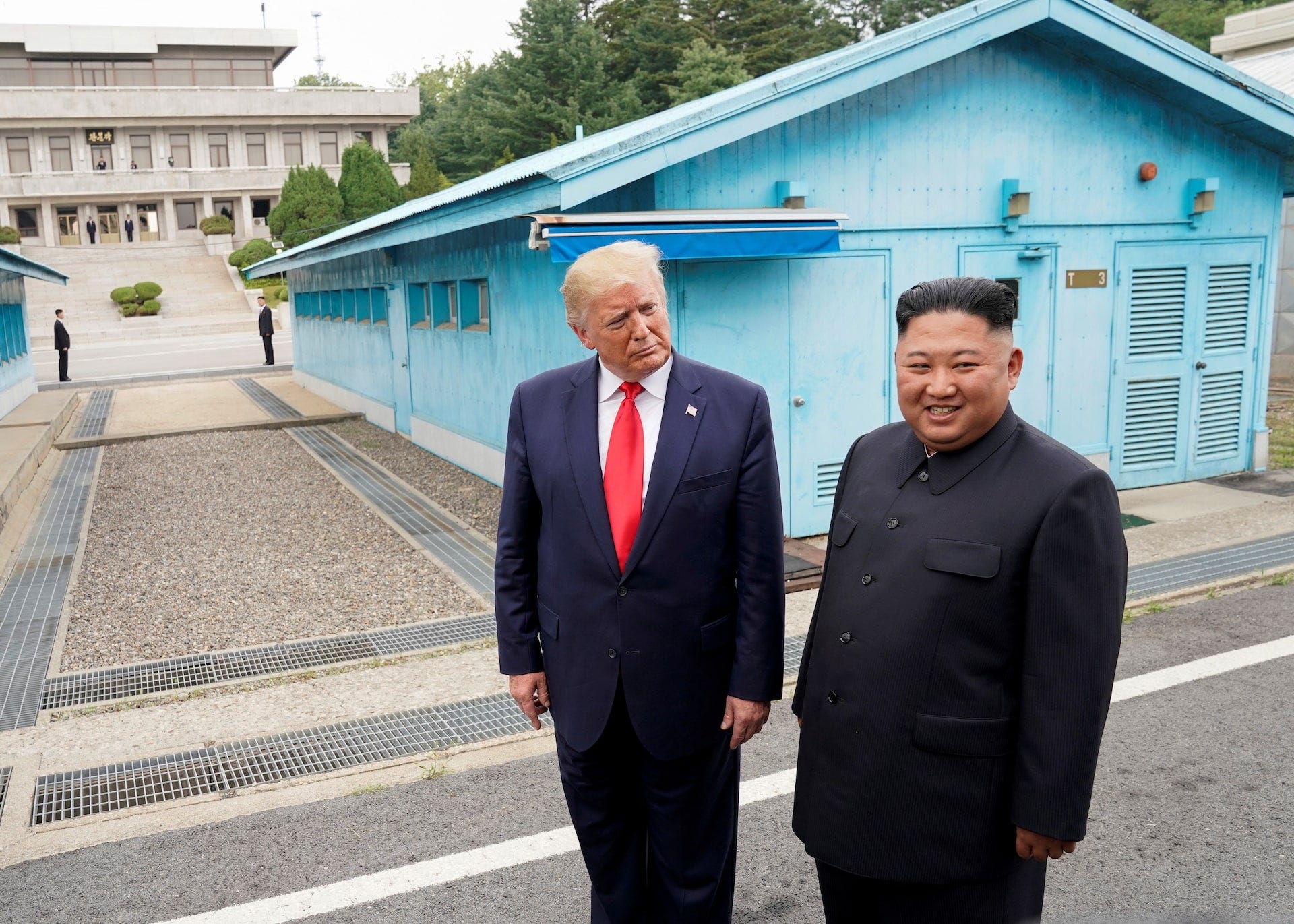
With the war in Iran still ongoing and after almost two years of various foreign policy craziness of the current U.S. administration, the bar for what can shock people has gone up quite significantly. After all, you can get numb even to things that would, not that long ago, dominate the headlines for months on end. But even so, two things from the past few weeks have still managed to do it, mostly because they both just lack any obvious logic or rationality.
First, there was an abrupt cancellation of a traditional U.S.-South Korean military exercise by Donald Trump, who called it “inappropriate and hostile” towards North Korea - a pretty unprecedented concession by a U.S. president - followed by a demand for South Korea to pay $10 billion a year to America for protection. And second, a collapse of trade talks with Canada, after the U.S. came up with last-minute requests that Canada’s Prime Minister Carney called unacceptable demands on Canada’s sovereignty. Including, among others, a demand to control what deals Canada is allowed to sign with other countries in the future.
In both instances, there was the usual outrage - but this time, more than outrage, there was a lot of confusion, mostly centered on one question: why would anyone do that?
Why would you damage relationships with your key regional ally of the past 70 years to court a country that considers you its arch-enemy and clearly refuses to change anything about that? After all, shortly after Trump cancelled the exercise, North Korea announced that it changes absolutely nothing and launched 10 short-range ballistic missiles toward the sea.
And why would you torch an objectively good deal that already forced Canada to give you way more than they wanted to - but that they couldn’t really refuse - by stretching your demands ad absurdum and requesting what amounts to a complete subjugation? After all, the real winner here is Mark Carney - who not only got the chance to refuse a bad deal without looking confrontational, but also looks like a national hero and received wide political and popular support from nearly everyone in Canada.
Neither of these was a win for the United States. On the contrary, they were both pretty clear short-term and long-term losses and, more importantly, they were completely avoidable, even by just doing nothing at all. And so the question still stands: why would anyone do that?
Well, in the conventional way that most presidents, experts and, until recently, most regular people in the West used to see the world, having allies meant that you were in a mutually beneficial partnership. You help them and they help you because both sides believe that it makes them stronger. And you sign trade deals for the same reason - because both sides benefit from them. It’s never fully equal: one side always benefits more, one side always has more leverage, and one side can even take advantage of the other. But at the end of the day, you know that you benefit from your alliances, and that in order for them to work long-term, the other side has to benefit from them as well.
But in Trump’s view, allies are not really partners; they are more like subjects of a medieval feudal lord. They are not your equals by any stretch of the imagination, and so you don’t really have to treat them that way. It’s a one-sided relationship where you (as America) get to ask for their money, loyalty, political support and deference. And you get to do that because you have leverage over them - economic in the case of Canada, or security leverage in the case of South Korea and Europe - not because you need to give anything back. Unlike with allies, there is no limit how much you can demand from your subjects - and if they don’t give you everything you want, it’s quite natural to use 100% of the leverage you have to get it anyway.
That’s why Trump is always prone to asking for more, why he seems so strangely hostile toward loyal allies, and why he seems completely unfazed by the damage he’s causing to those alliances. Because while from the conventional perspective, pressuring allies beyond a limit of what’s considered acceptable damages your alliances, from Trump’s perspective, not using your leverage means you are wasting it. If they need America, why shouldn’t America demand more? Why shouldn’t it demand everything?
And that’s why, in this worldview, when your allies don’t comply, it triggers an escalation. Because if an ally is effectively a subordinate, then disagreement isn’t normal alliance politics - it’s interpreted as ingratitude, freeloading and disobedience. That’s why a good, normal trade deal with Canada isn’t enough - because if you have what you see as absolute leverage, there is very little limit to what you think you can extract from your subjects.
And what about your enemies? Why don’t you treat North Korea in the same way?
Well, because enemies are different. North Korea isn’t under the U.S. security or economic umbrella. Kim has his own base of power - nuclear weapons, and zero dependence on the U.S. - and so Trump can’t treat him like a subordinate, because he has very little leverage over him. That’s why, if this is how you view the world, you end up courting your enemies - whether North Korea or Russia - even as they keep working against you, while threatening your allies. Because unlike your enemies, allies are people you don’t have to win over, so you can treat them however you want.
Even better, what your enemies can offer - and what your allies cannot - is the theoretical possibility of a spectacular deal that no previous president was able to achieve. Whether it’s North Korea or Russia, Trump believes he can turn an adversary into a negotiating partner and claim a historic personal achievement.
And even though there might be a good reason why this has never really happened before - and judging by the reaction of all the traditional U.S. adversaries Trump is making overtures to, it might not happen this time either - he seems enchanted with this possibility.
And the obvious final question here is whether this strategy will work out - whether this worldview is grounded in the reality of how states act in the real world and whether it will make America stronger, as intended.
Well, the answer is that it most certainly will not. Here’s why.
The problem with Trump’s logic is that it assumes that America’s leverage is almost absolute - that it’s so big that no matter how extractive the United States becomes, there’s nothing its allies (or subjects) can do about it. But that’s not the case.
Even though it may seem hard to believe, even allies have agency - at the end of the day, they will choose what they see as the best way forward for them. If Canada, South Korea, Europe and other allies conclude that being allied with America comes with more costs than benefits, they will start to look for other solutions.
In Asia, they will likely seek to hedge and improve relations with China. China is already as economically important to them as the United States, if not more, and it has considerable influence over North Korea. And especially as U.S. security protection becomes increasingly unreliable, closer ties with China will start to look like the most rational option. Canada is in a different situation, but it, too, is already trying to build a closer partnership with China to reduce its economic dependence on the United States.
On the other hand, Trump’s courting of Kim Jong Un, Vladimir Putin and other long-standing U.S. adversaries will almost certainly fail to deliver the spectacular deals he’s chasing.
There is no historic bargain that all previous presidents failed to achieve just sitting there waiting to be seized. It hasn’t happened before because there is simply too much distrust and hostility, and not enough shared interests. Kim and Putin don’t want to be won over, they want what they’ve always wanted, and a friendlier American president doesn’t change that. So the concessions Trump offers to get them to the table - cancelling exercises with Seoul, easing the pressure on Moscow - buy him nothing, because there was never a deal to be had.
Which leaves America with the worst of both outcomes. It extracts from its allies until they conclude the relationship costs more than it’s worth and begin looking elsewhere, and it gives concessions to its adversaries to win deals that never arrive.
The logic that treats friends as subjects to be squeezed and enemies as prizes to be won ends up doing the reverse of what it intends: it pays the countries that work against America and drives away the ones that stood with it. The result is a United States with just as many enemies as before - and far fewer friends.
Thanks for reading Decoding Geopolitics! This post is public so feel free to share it.
No posts
Comments
Nothing yet. Say the first thing.
Sign in to join the conversation.