

For more than a year, Democrats have led on the generic ballot question, which asks poll respondents which party’s candidate they plan to vote for in their local U.S. House race. Though the size of the Democrats’ lead has fluctuated, recent polls have found them with a clearer advantage. In Decision Desk HQ’s polling average, Democrats now lead by about 6 percentage points, 47%-41%.
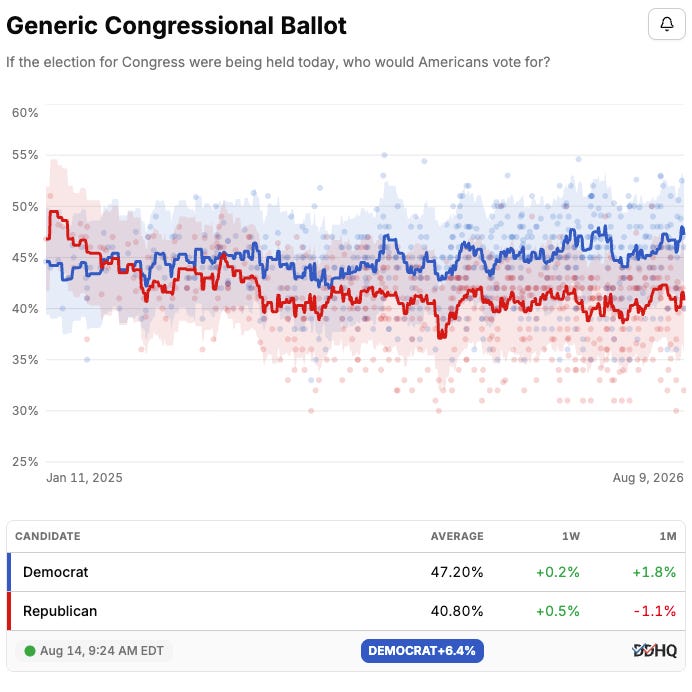
This lead marks an improvement for Democrats, whose edge had ebbed to only around 4 points in July. But since the conflict with Iran heated up again and the price of gas rose, the Democrats’ have tended to have a larger advantage in surveys testing 2026 preferences. It’s no surprise that military operations against Iran and rising gas prices have hurt the president’s party at a time when concerns about the cost of living and disapproval of President Trump’s handling of the economy are high. Not coincidentally, Democrats held a 7-point or so lead in May when gas prices last peaked.
The extent of the Democrats’ edge in the electoral environment will have repercussions for the 2026 midterms. In Decision Desk HQ’s election forecast, the probability that a party wins control of the House and/or Senate is tied to the generic ballot. The chart below presents how the average affects those chances.
If Democrats only held around a 2.5-point edge on the generic ballot, the forecast would view the battle for House control to be just about a pure toss-up, with Republicans as heavier favorites to keep the Senate. But now that the Democrats’ edge is 6 points, that puts the party closer to the 7.5-point advantage associated with the Senate being a pure toss-up. In that scenario, the House is much more likely to flip to the Democrats.
Overall probabilities of control and average seat counts:
Change in forecasted control probabilities over time:
Probability of joint control outcomes in Congress
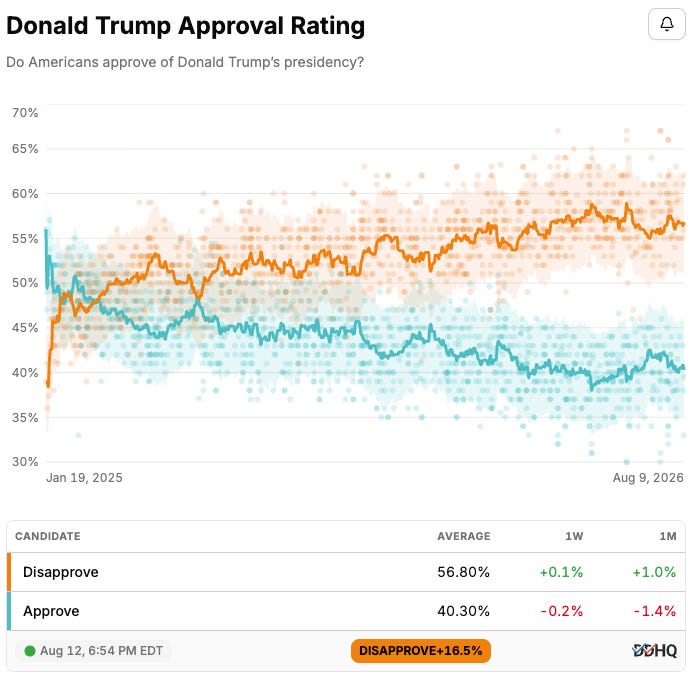
President Donald Trump’s standing remains roughly in the same vicinity as it has been more months now. In Decision Desk HQ’s polling average, his job approval rating is at 40% while his disapproval stands at 57%.
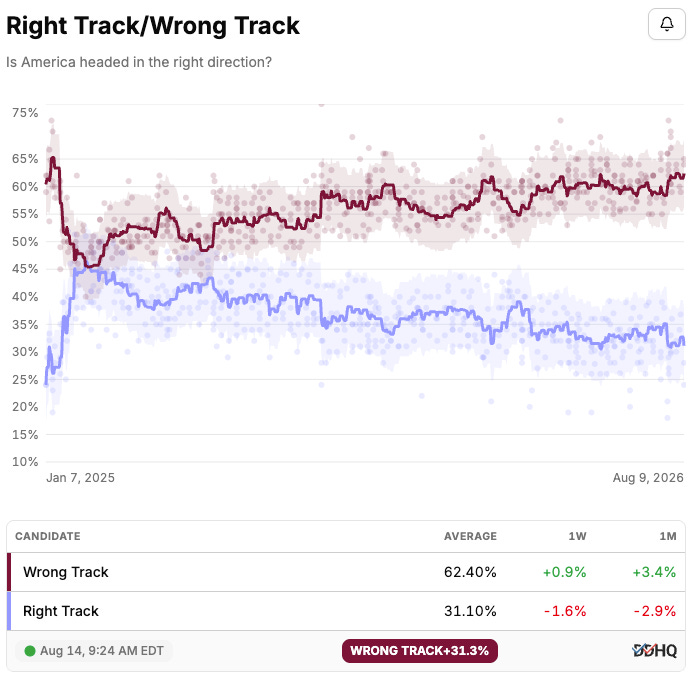
Americans continue to hold strongly negative views about the direction of the country. In Decision Desk HQ’s average, 62% say the nation is on the wrong track, while only about 31% say it’s on the right track. The right track mark is right around low point for Trump’s second term.
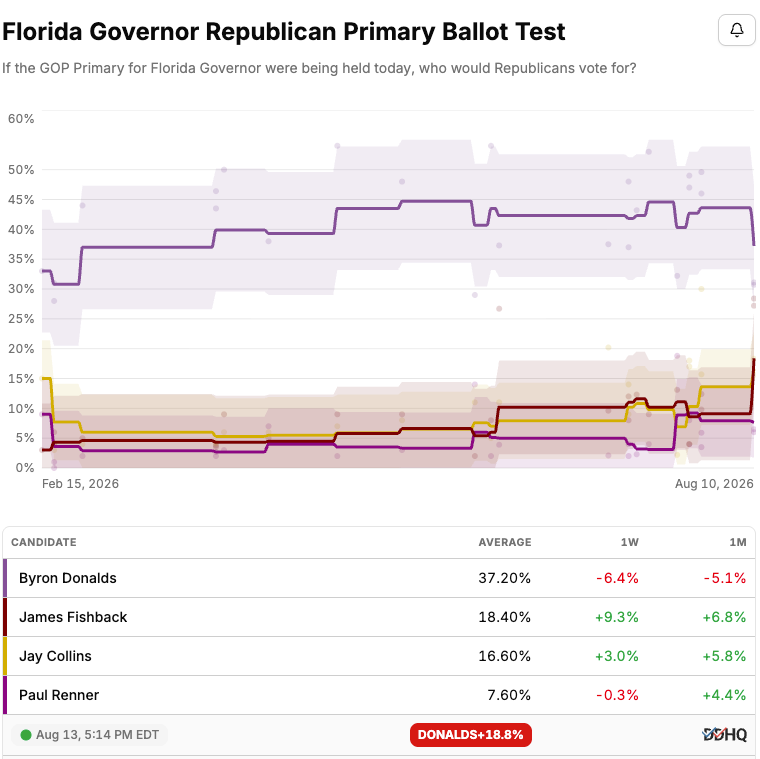
Republican Rep. Byron Donalds has President Trump’s endorsement and is favored to win the GOP nomination for governor in Florida. However, he still has to win the Aug. 18 Republican primary. In Decision Desk HQ’s average, Donalds leads the GOP field with 37%, though his advantage has decreased recently. Conservative activist and businessman James Fishback sits in second with 18%, with Lt. Gov. Jay Collins (17%) polling just behind him. Former state House Speaker Paul Renner is well back in fourth with 8%. The polls strongly disagree about how competitive this race is, making the outcome somewhat more unpredictable.
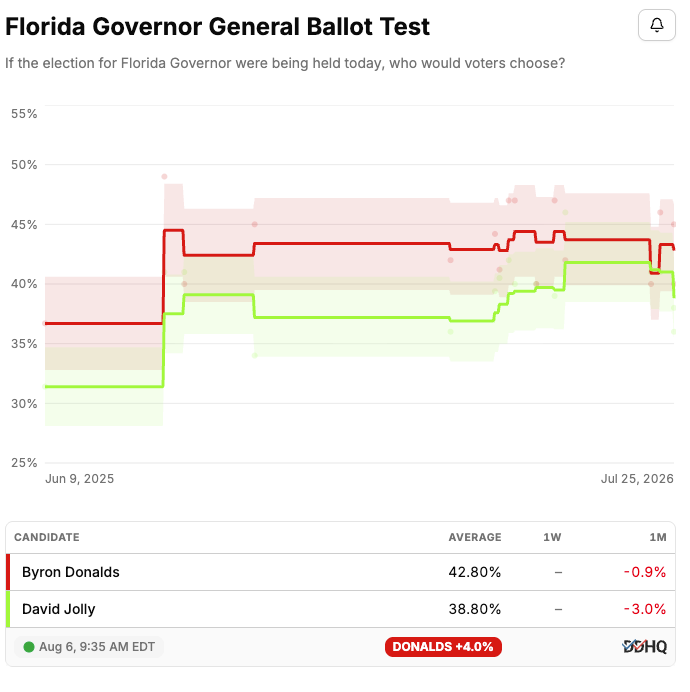
The likeliest general election matchup in Florida’s gubernatorial contest pairs Donalds against former Rep. David Jolly, a Republican-turned-Democrat. But the polling for this probable matchup remains closer than the numbers in the Sunshine State’s Senate race. In Decision Desk HQ’s polling average of the potential Donalds-Jolly matchup, Donalds leads by 4 points, 43%-39%.
By comparison, Florida’s special election for U.S. Senate does not look quite as competitive. Appointed Republican Sen. Ashley Moody is seeking to complete now-Secretary of State Marco Rubio’s term. She appears likely to face Democrat Alex Vindman, a former Army lieutenant colonel who was part of the National Security Council. Vindman came to national prominence in 2019 when he testified in Trump’s first impeachment trial. In Decision Desk HQ’s polling average, Moody holds a 47%-40% advantage.
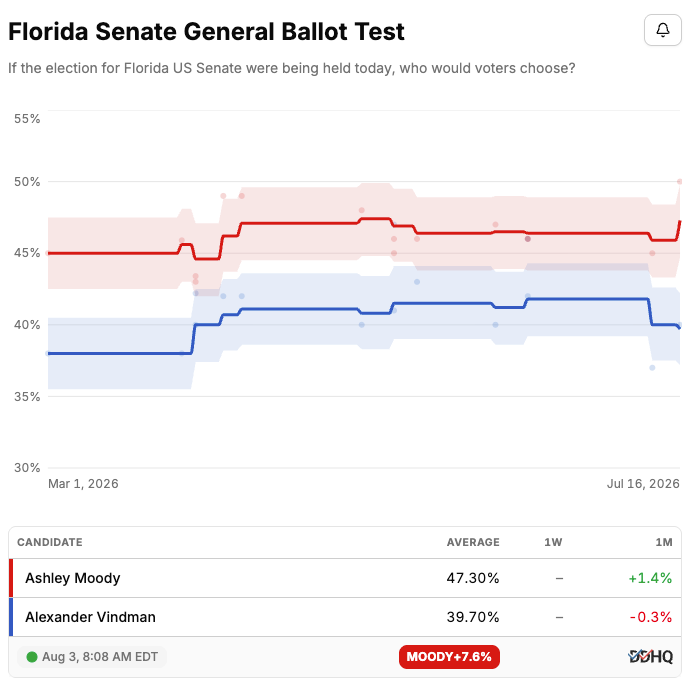
In 2024, Florida had around the same presidential margin (Trump +13) as Alaska, Iowa, and Texas (all Trump +13 to +14). Yet our forecast does not view it as similarly competitive: Whereas the other three states are hosting close contests, the GOP is currently about a 4 in 5 favorite to win Florida’s special election.
Democrats must win the open Senate seat in North Carolina, where Republican Sen. Thom Tillis is retiring. Yet early general election polling is favorable for Democrats. In Decision Desk HQ’s average, former Gov. Roy Cooper, the Democratic nominee, leads former Republican National Committee chair Michael Whatley by about 10 points, 51%-41%.
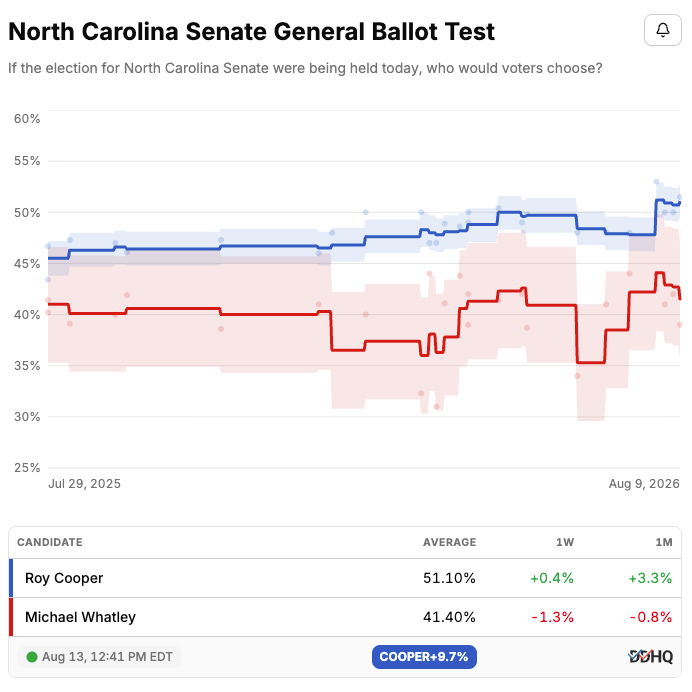
In our forecast, North Carolina is clearly the Democrats’ best pick-up opportunity. Right now, Cooper has better than a 3 in 4 chance of winning. That is no sure thing, but it does make it the friendliest-looking Republican-held seat for Democrats.
In Ohio’s special election for Senate, appointed Republican Sen. Jon Husted faces former Sen. Sherrod Brown, the Democratic nominee. Recent polling has given Brown a larger-than-expected edge in the red-leaning state. In Decision Desk HQ’s average, Brown now leads about 50%-44%. Brown’s record of running at least somewhat ahead of the Democratic baseline in Ohio gives him a real chance of flipping this seat.
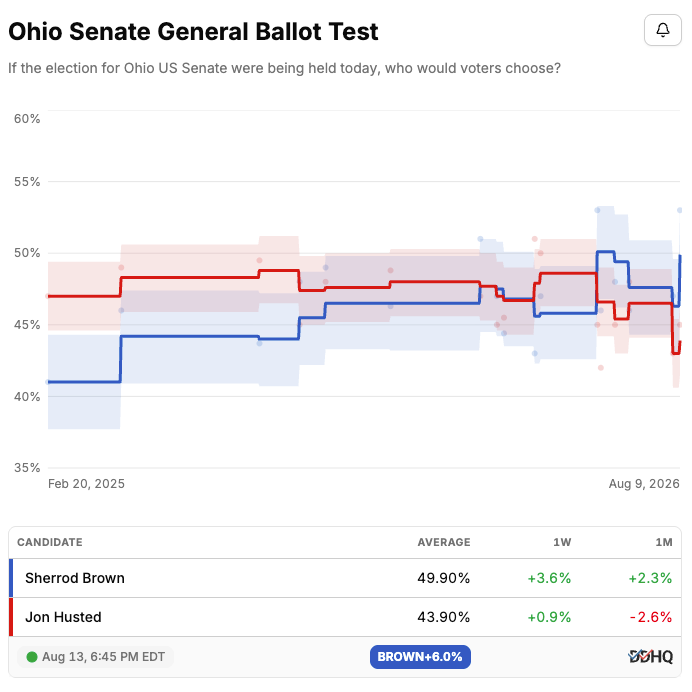
This is also a pivotal seat for the Senate arithmetic. Husted currently has only a little better than 1 in 2 shot of winning in November, making this a toss-up race in our forecast. Ohio is the least red (Trump +11) of the red-leaning seats that Democrats have to compete in for a chance at a majority.
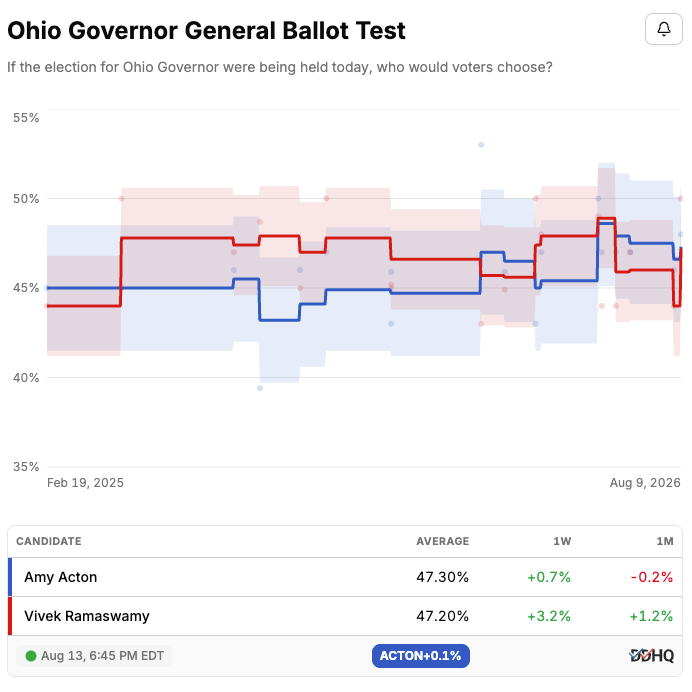
In Ohio’s race for governor, Republican Vivek Ramaswamy, a 2024 presidential candidate, faces Democrat Amy Acton, the state’s former health director during the COVID-19 pandemic. In Decision Desk HQ’s average, Acton and Ramaswamy are effectively tied 47%-47%.
In Texas, Democrats are hoping to win the U.S. Senate contest, which would be their first statewide victory there since 1994. In Decision Desk HQ’s average of the Texas race, Democratic state Rep. James Talarico narrowly leads Republican Attorney General Ken Paxton 48%-46%.
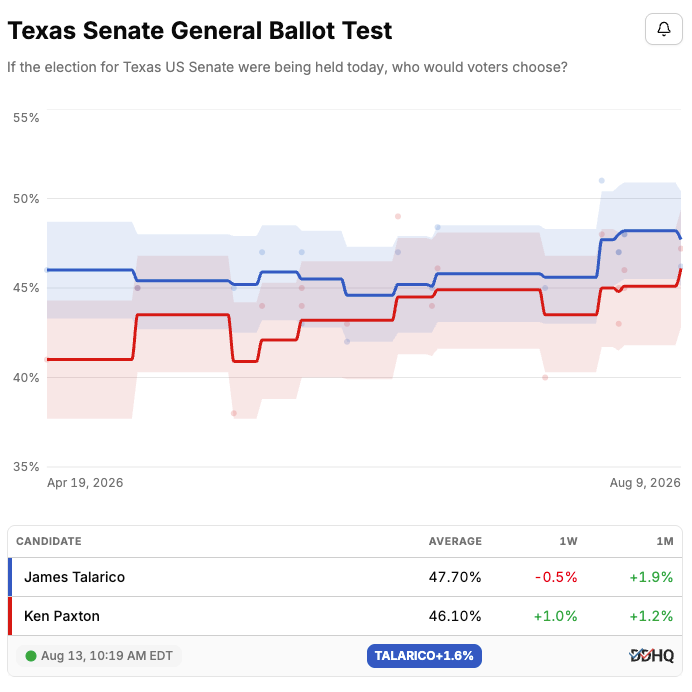
Talarico’s small lead has helped make Texas a toss-up race in Decision Desk HQ’s forecast. The Democratic nominee has given his party a real shot at flipping this seat, which they may need to capture the Senate majority.
To see all Decision Desk HQ polling averages, click here.
To see Decision Desk HQ’s 2026 election forecast, click here.
Our team carefully reviews and averages these polls using a straightforward methodology, ensuring that our polling averages reflect a balanced and up-to-date snapshot of public opinion. Within each average you can find a specific point in time to compare how things have changed or view any poll included within that average.
Read about Decision Desk HQ’s polling average methodology here.
Read about Decision Desk HQ’s 2026 forecast methodology here.
Enjoyed this post? Please share it!
Comments
Nothing yet. Say the first thing.
Sign in to join the conversation.