
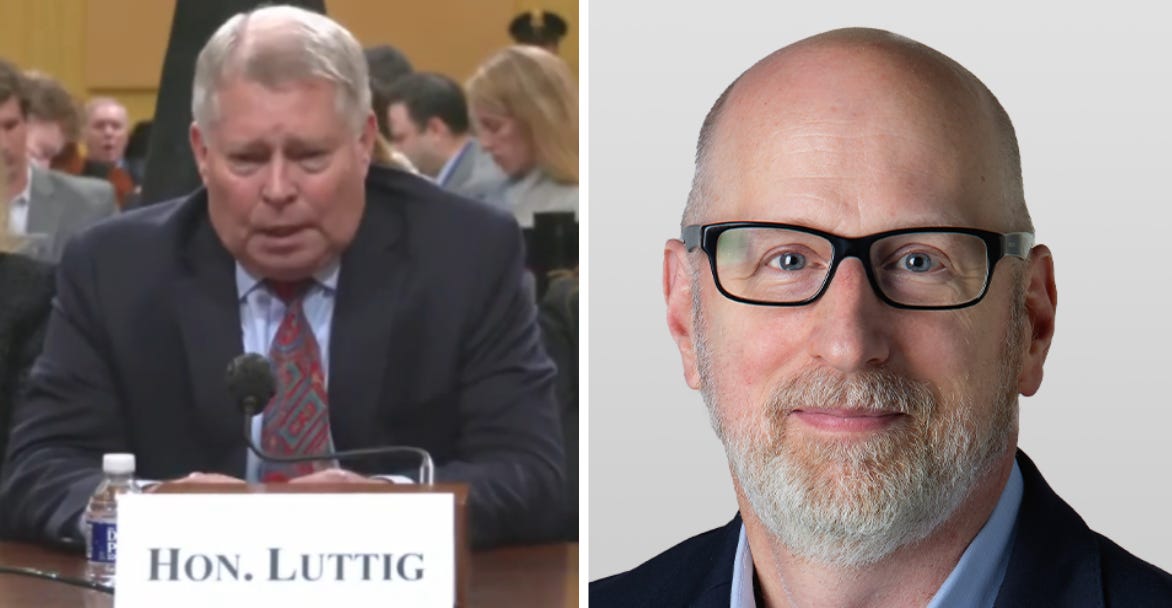
How would you feel were the political party that controls the House of Representatives to refuse to seat members-elect of the other major party, and in doing so retain for itself majority control of the House? How would you respond were you to learn that, months before, once-prominent leaders of the political movement associated with that majority party warned that the party might do exactly this?
Most importantly, how do you respond right now upon learning of such warnings from Michael Luttig and David French?
Retired Judge J. Michael Luttig was a leading light of the conservative legal movement. He clerked for Judge (later Justice) Antonin Scalia and for Justice Warren Burger, served as an associate in the Office of White House Counsel for President Ronald Reagan, served in the Justice Department of President George H.W. Bush and later received from President Bush appointment to a federal judgeship. He also was on President George W. Bush’s short list for nomination to the Supreme Court. In the runup to January 6, Judge Luttig answered Vice President Pence’s call for advice in the face of pressure from the White House that Pence agree to reject certification of Joe Biden’s victory in the 2020 presidential election. Judge Luttig persuaded Vice President Pence that it would be unconstitutional and wrong for him to take that action.
In an August 16 Substack essay (“The Final Battle for America’s Democracy”) as well as in a media appearance that he referenced in the essay, Luttig warned that “Mike Johnson and the Republican House [would] refuse to seat the newly-elected Democrat Majority to the 120th Congress.” Luttig linked and referred to other pieces that explained this danger, including ones in The Atlantic and on the website of the Center for American Progress. Of special significance is another piece that Luttig shared, David French’s July 23 essay “This Is What’s Keeping Me Up at Night.”
Similar to Luttig, David French has had a long and distinguished career in the conservative legal movement and as well in the world of conservative political commentary. He has served as a senior counsel for the American Center for Law and Justice (ACLJ) and the Alliance Defending Freedom (ADF), as president of the Foundation for Individual Rights and Expression (FIRE), as a staff writer for National Review and senior fellow at the National Review Institute, and as a senior editor at The Dispatch and a permanent guest contributor to the Dispatch’s legal podcast Advisory Opinions.
Below, excerpted from his July essay, is how French explained what is keeping him (and Luttig) up at night. Note that in his first-paragraph mention of Mike Pence, French refers to the then-vice president’s resistance to pressure from then-President Trump and his allies that on January 6 he disregard his ceremonial responsibility to certify Joe Biden’s 2020 presidential election victory and instead declare Trump the winner. We will return to this point.
I’m worried that a largely forgotten constitutional provision (combined with a relatively vague federal statute) provides House Republicans a legal loophole to abuse — with no one clearly ready (or willing) to assume Pence’s role as the guarantor of American democracy.
Article I, Section 5 of the Constitution says that “Each house shall be the judge of the elections, returns and qualifications of its own members.” In plain English this means that the House and Senate make their own decisions regarding who belongs in each chamber of Congress, and those decisions are not reviewable by any other branch of government, including the courts.
Or, as the Supreme Court put it in a 1972 case called Roudebush v. Hartke, “Which candidate is entitled to be seated in the Senate is, to be sure, a nonjusticiable political question.”
The actual process for contesting an election to the House is governed by the Federal Contested Elections Act of 1969, a law that revised and updated previous legal procedures governing contested House elections. The law is detailed about process but largely silent about substance. The actual grounds for overturning an election are left to the discretion of the House (the Senate is governed by different rules).
The law gives a losing candidate, which it calls the “contestant,” 30 days after the certification of the election by state election officials to file a challenge with the House. The challenge is then referred to the Committee on House Administration, which investigates the contestant’s claims.
The contestant is supposed to bear the burden of proving that the election result should be reversed. But the matter is ultimately decided by a simple majority of the House, and the House can refuse to seat any member while the contestant’s challenge is pending.
The refusal to seat a member ought to happen only under exceptional circumstances, but those circumstances are up to the House, not the courts.
In fact, as a congressional explainer outlines, even apart from the Federal Contested Elections Act, “a member-elect may challenge the right of another to be sworn in, usually when the House convenes for a new Congress.”
This means that even if Democrats win a House majority after all the votes are counted this fall, one or more defeated Republican candidates could try to persuade the lame-duck Republican majority not to permit their Democratic opponents to take office while the challenge is pending.
Election authority Ned Foley, in a piece that he published the same day as and in response to French’s (“Another reminder: the House is not a continuing body”), clarified an error in the final French paragraph above. At noon January 3, 2027, the term for all members of the House – including that of Speaker Mike Johnson – will expire. At that point, there will be no currently serving members of the House, only members-elect, some of whose victories may be subject to the Federal Contested Elections Act procedures that French described. It is these members-elect, not yet sworn into office themselves, who on January 3 will elect a new Speaker and, upon taking their own oaths of office (and barring a numerical tie), establish a provisional partisan majority.
So technically, it would not be a lame-duck Republican majority of the current House that would prevent Democratic members from taking their seats. Below is how Foley explained what might happen:
Consequently, the House organizes itself and elects a Speaker based on the less-than-full membership. But once the House is organized with a majority party on this basis, there is no guarantee that the rest of the seats will be filled fairly. That’s the situation in which a party can abuse power to keep itself in power. It’s not the lame-duck members of the current House; it’s the seated majority of the incomplete new House.
The point remains that, in a replay of the aftermath of the 2020 presidential election, this fall we may see a flurry of bogus disputes of Democratic electoral victories – mini “Big Lies” – across numerous states. Under the Federal Contested Elections Act, Republicans holding even a sliver of a majority among uncontested House seats in the new Congress may arbitrarily decide those disputed contests in favor of the Republican candidate and thereby on a fraudulent basis confirm and expand their partisan majority rather than yield the Speakership and committee gavels to a rightful Democratic majority.
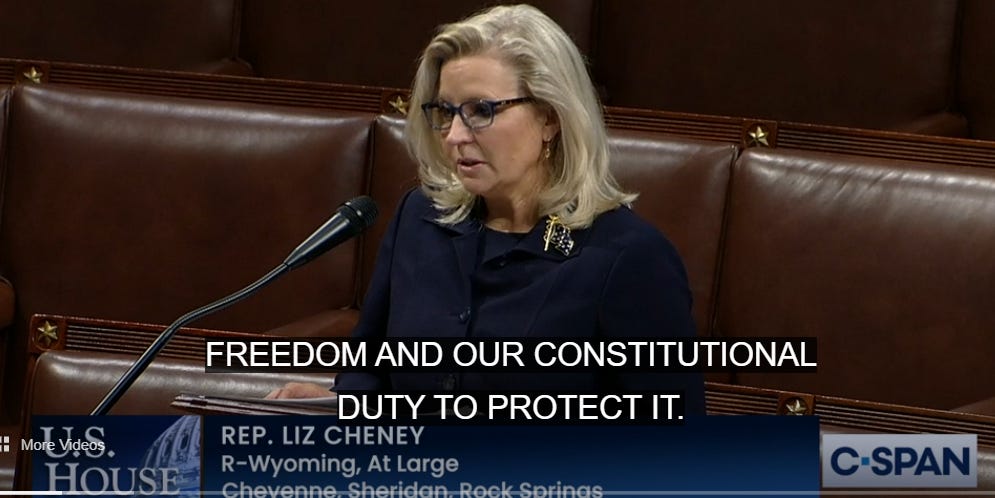
The January 6 Committee released its final report in December 2022. The Committee’s Republican co-chair, Liz Cheney, had been chair of the House Republican Conference until May 2021, when her Republican colleagues removed her from leadership for having spoken the truth about the former president’s plots to overturn the 2020 election. Below is a passage from the speech she delivered on the eve of her removal (scroll to the bottom of this post to read it and/or watch it here):
Today, we face a threat America has never seen before. A former president who provoked a violent attack on this Capitol in an effort to steal the election has resumed his aggressive efforts to convince Americans that the election was stolen from him. He risks inciting further violence. Millions of Americans have been misled by the former president. They have heard only his words but not the truth. As he continues to undermine our democratic process, sowing seeds of doubt about whether democracy really works at all.
I am a conservative Republican and the most conservative of conservative principles is reverence for the rule of law. The Electoral College has voted. More than 60 state and federal courts, including multiple judges the former president appointed, have rejected his claims. The Trump Department of Justice investigated the former president’s claim of widespread fraud and found no evidence to support them.
The election is over. That is the rule of law. That is our Constitutional process. Those who refuse to accept the rulings of our courts are at war with the Constitution. Our duty is clear. Every one of us who has sworn the oath must act to prevent the unraveling of our democracy. This is not about policy. This is not about partisanship. This is about our duty as Americans.
Remaining silent and ignoring the lie emboldens the liar. I will not participate in that. I will not sit back and watch in silence while others lead our party down a path that abandons the rule of law and joins the former president’s crusade to undermine our democracy.
Over the course of the ensuing five-plus years, the former, now restored, president and his allies have relentlessly a) propagated the same big lie about the 2020 election, b) commuted the sentences of the Proud Boys and Oath Keepers who engaged in seditious conspiracy in connection with January 6, vacated their convictions, and pardoned all of the other people convicted for their participation in the January 6 riots, and c) persecuted the public servants in the Department of Justice and the FBI who did their duty in investigating and prosecuting those crimes (for further documentation of this and additional materials as of this past January, see here, here and here).
More to the point, the president and allies inside and outside of Congress and in government at every level more broadly have spread lies about the security of our current elections in an obvious bid to justify some form of interference in the midterm elections. In a commentary that the libertarian Cato Institute published this past July 17 (“Trump Big Lie Isn’t about 2020”), Ilya Somin (holder of an endowed chair at Cato, a frequent contributor to the conservative Federalist Society, and a professor at the Antonin Scalia School of Law at George Mason University) offered an explanation that matches the first of the 15 predicted election subversion tactics that the Center for American Progress presented in the report that Judge Luttig referenced: “Tactic 1: Casting doubt on election integrity via disinformation to justify nationalizing elections.”
Below is the opening paragraph of Somin’s essay, which referenced a speech that the president delivered in the evening of July 16:
In a speech Thursday night, President Trump claimed there have been serious breaches of election security and repeated his assertions that the 2020 election was compromised. As in the past, these remarks are utterly indefensible. And they are likely part of an illegal effort to federalize control over the upcoming midterm elections, so as to tilt the results in his party’s favor. Hopefully, America’s courts and federal system will continue to stymie him.
Somin proceeded to debunk a few of the president’s false and nonsensical claims about election security before continuing with the following paragraph (emphasis added):
These claims are intended to bolster Trump’s long-standing assertions that the 2020 election was somehow “stolen” from him. Overwhelming evidence shows the contrary. In 2020–21, Trump and his political allies filed 64 court cases challenging the results in six key swing states. As detailed in “Lost, Not Stolen,” a review of these cases conducted by prominent Republican lawyers, election law specialists, and former federal judges, none of these decisions found significant evidence of voter fraud.
The bolding in the final quoted sentence above reinforces a theme of this essay: decency and sense are not confined to any single political party or tendency. Neither are its opposites, indecency and nonsense. Many members (and recent members) of the Republican party and self-identified conservatives – individuals named in this essay notably among them – have stood against and called out efforts of this president and his partisan allies to undermine democracy in America. It is the duty of every engaged citizen of any political leaning (or none at all) to likewise approach our politics with clear eyes and in an independent and fair-minded way. It is vital that we stand up for our democracy.
The paragraph below from Liz Cheney’s forward to the January 6 Committee report quotes an esteemed conservative commentator:
The late Charles Krauthammer wrote, “The lesson of our history is that the task of merely maintaining strong and sturdy the structures of a constitutional order is unending, the continuing and ceaseless work of every generation.” This task is unending because democracy can be fragile and our institutions do not defend themselves.
Consider carefully: How would you feel? What would you do? What are you doing?
No posts
Comments
Nothing yet. Say the first thing.
Sign in to join the conversation.