
Articles I found interesting. Doesn’t mean I agree with their takes.
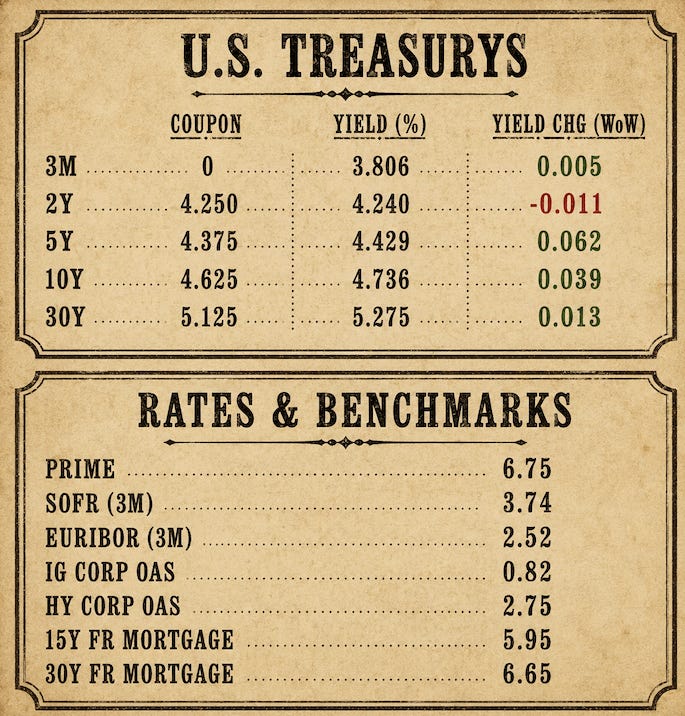
Treasury may raise bond buybacks above $4B per operation after 30-year yields hit 5.3%, near a 20-year high. The move briefly pushed yields down, but half the drop was later reversed (Reuters)
Bond traders are hedging the risk of Fed rate cuts in 2027 as U.S. economic data weakens. September hike odds have fallen sharply, while traders buy options that benefit from future cuts (Bloomberg)
The AI debt binge is crowding out Treasuries as hyperscalers flood the market with bonds. Treasuries may need to pay higher yields, with big tech borrowing ~$200B, or 25% of Treasury net issuance (Bloomberg)
Apollo’s famous short of First Brands’ debt was based on realizing that its cash flow and P&L didn’t add up. FB also overstated receivables borrowing in one instance by 180,000% of the amount it was entitled to (Financial Times)
Private-credit BDC fundraising fell 82% to $2B in Q2, while investors sought a record $23B in redemptions. Direct lending is shrinking as managers diversify into IG data centers and other private-credit strategies (Bloomberg)
Carlyle is shifting back to Washington under CEO Harvey Schwartz, focusing on government-linked investments. Its DC roots are an edge as defense, infrastructure and supply-chain spending grow (Semafor)
Mark Walter built Guggenheim by moving insurers into private assets, but now faces a federal probe over $20B of undisclosed affiliate investments. Walter is selling sports assets and raising billions to shore up the insurers (Financial Times)
UK insurers are targeting $1.35T of defined-benefit pension liabilities from pension plans, as higher rates pushed plans into surplus. 40% of retirement assets are in private markets, with one-third in private credit (WSJ)
HPS and Oaktree seized MBS Group after its debt default. Lower TV spending and shrinking streaming seasons (from 22 to 10 episodes) hit the film-equipment supplier; creditors converted $100Ms of debt to equity and injected $40M (Financial Times)
CD&R’s aggressive Multi-Color restructuring has damaged its reputation as a creditor-friendly sponsor. Lenders to its other portcos are now organizing into cooperation groups and pushing for tighter protections (WSJ)
Erebor Bank, founded by Palmer Luckey and backed by Peter Thiel, aims to replace SVB but risks repeating its concentration on tech clients. Its tech, defense, crypto and AI focus could amplify losses in a downturn (Bloomberg)
Europe’s banks are pushing the EU to ease Basel rules as U.S. deregulation what puts them at a competitive disadvantage. The changes could unlock hundreds of billions of euros in capital and liquidity (Bloomberg)
Bond investors are wary of $70B of off-balance-sheet AI liabilities as Nvidia, Broadcom and Meta backstop AI debt. Rating agencies warn these guarantees could become costly in a downturn (Bloomberg)
SRT issuance reached $18B in H1 2026 and is on track for a sixth straight annual record. Manulife CQS is raising about $1B for its fourth SRT fund, targeting a ~13% IRR after the prior fund returned over 11% (Bloomberg)
European direct-lending volume rose to €9.8B from €8.5B in the prior three months. Software loans widened to E+525-550 from E+475 six months ago. €4.8B of direct loans were refied into BSLs, the 2nd-highest level (PitchBook)
Canadian institutions hold C$500B ($360B) of private credit, mostly in the US; pensions and insurers hold most of it. Private credit is 15% of Canadian corporate credit, vs. 75%+ from banks and debt markets (Bloomberg)
India’s private credit market is expanding into mid-market financing, with $10m-$60m deals reaching 61% of deal value as borrowers seek alternatives to banks. Domestic funds account for 74% of deal value (Economic Times)
Emerging Markets inflation-linked bonds are up 11.1% in 2026, vs. 1.6% for local bonds. The $886B market is benefiting from sticky inflation and stronger currencies, with Brazil and Mexico over half (Bloomberg)
Anthropic is increasing its revolver from $2.5B to $10B as it prepares for an IPO. Bookrunners are expected to provide $1.25B each, followed by $1B and $750M from other participating banks (Bloomberg)
Alphabet raised A$5.5B ($3.89B) in Australian debt, becoming the first AI hyperscaler to tap the market. The bonds run 3, 5, 10 and 20 years, with a 6.9% coupon on the 20-year bond and A$18B+ in bids (Reuters)
KKR-owned Internet Brands plans to issue bonds to refinance syndicated debt, with RBC already sounding out major lenders. Its loans have recovered to near par as business improves after an AI-driven selloff (Bloomberg)
Ripple Prime raised $275m via a private placement of senior unsecured notes at an 8.25% coupon, rated BBB by KBRA. Proceeds will fund growth and working capital (FM)
Blackstone’s BCRED raised $750m of 5-year notes vs. a $500m target, at a 2.05% spread, 25bps tighter than initial talk. Blue Owl Tech Finance raised $400m vs. a $200m target, at a 2.50% spread vs. 2.65% on its existing bonds (Bloomberg)
Franklin Templeton closed its first Collateralized Fund Obligation (CFO), raising $1.5B for exposure to private equity secondaries, continuation vehicles and US middle-market direct lending (Yahoo Finance)
Thoma Bravo-backed Sophos is seeking to refi $2B+ of loans with leveraged-loan investors after private credit passed, likely offering higher coupons, amort. and tighter covenants. Thoma rebuffed requests for fresh equity (Bloomberg)
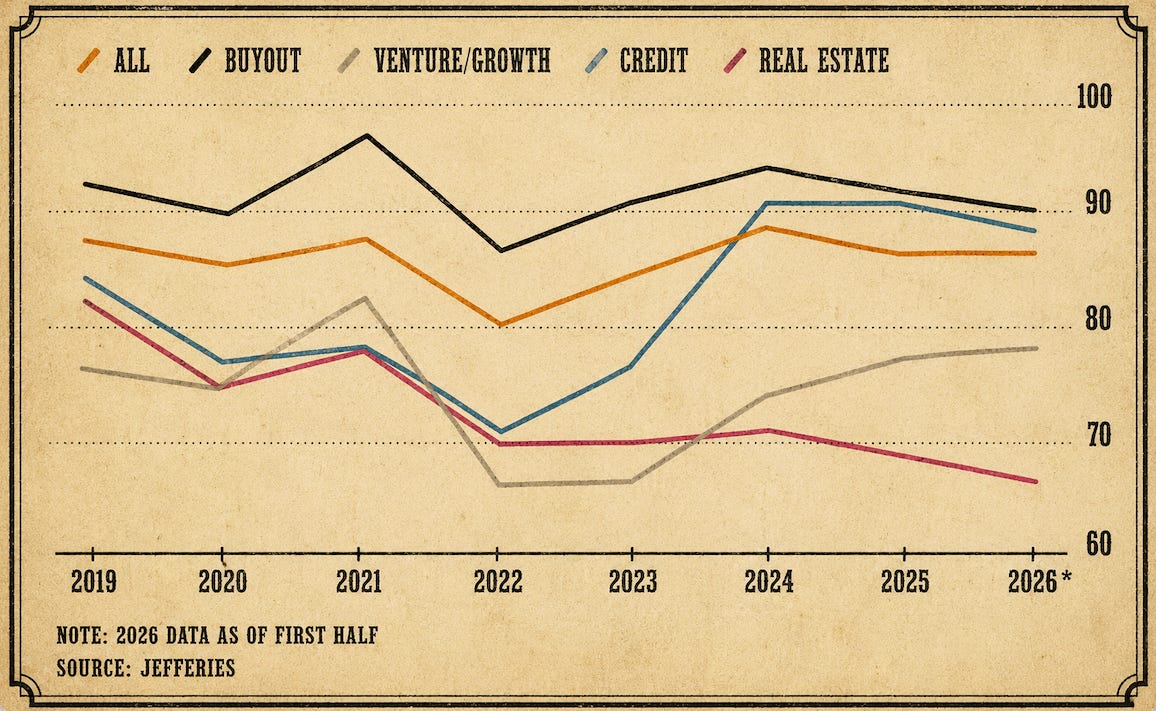
The secondary market for private fund stakes has seen wider discounts in recent years, with the U.S.-Iran war and concerns over AI’s impact on software and other companies contributing to the increase.
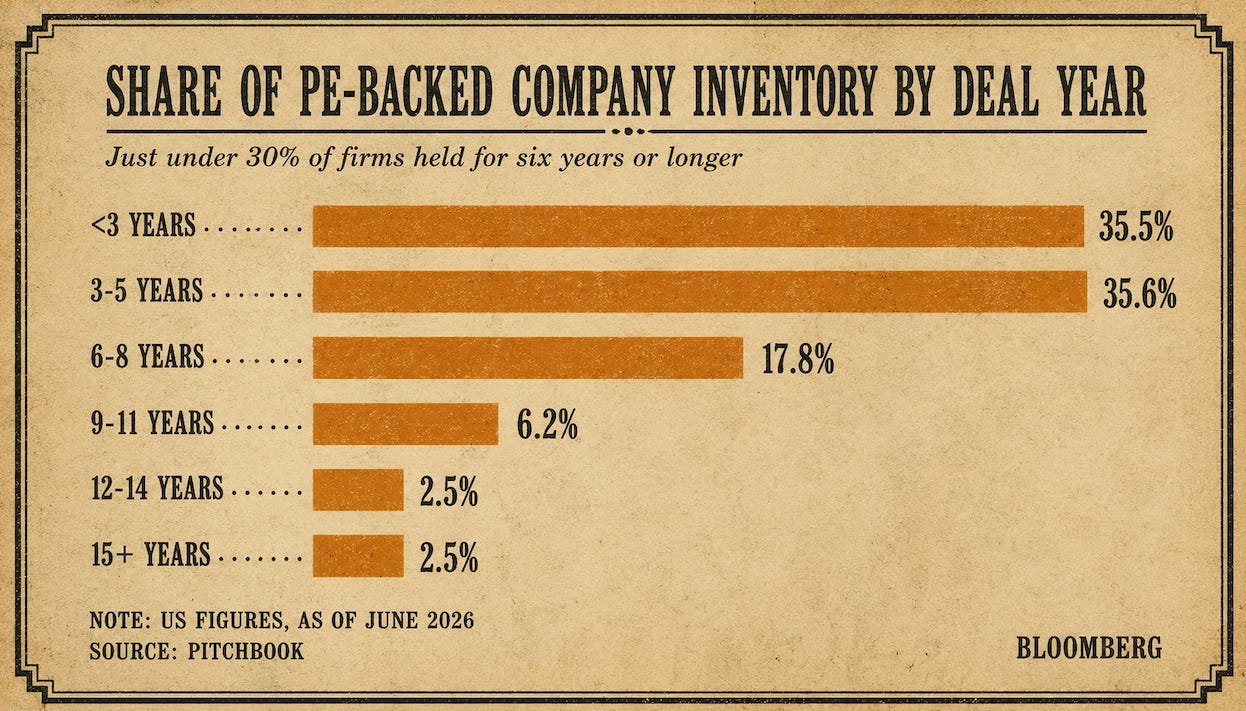
Of the 13,509 PE-backed companies in US sponsor portfolios as of June 30, some 3,332 have been held for five or more years and have not completed a deal of any kind since the end of 2021.
Bloomberg is offering 60% off its annual subscription ($180 vs $399) LINK
If you’re not a subscriber and the article is behind a paywall, search for the article title online. It’s often reprinted on Yahoo Finance for free.
WSJ Online is offering 65% off its annual subscription ($4 per week vs $11) LINK
The Financial Times is offering a 4-week trial for $1 (total, not per week), but make sure to cancel before it renews to avoid paying $75/month LINK
These are NOT sponsored links, just money-saving tips.
Comments
Nothing yet. Say the first thing.
Sign in to join the conversation.