
In Round #56:
VC’s DPI history
Radiant World’s creditors pull facilities
BlackRock TCP’s CV sale to Pantheon
BDC’s defy expectations
European maturity wall is moving
9fin’s covenant report
Notable dals
Bulletin board (New discounts and Four investment opportunties)
Disclaimer: there are 4,400+ of us here discussing private credit and leveraged loans, which is not a big world. At some point, I will probably throw punches at your company. I am blunt and sarcastic and, as friends like to remind me, too mouthy to live to an old age, so my take likely won’t please you. But don’t worry, next week it will be someone else in the spotlight and you will quietly nod along in satisfaction.
Also, none of this is investment advice.
Does anybody know Kyle Stanford from PitchBook? I don’t, but I came across his report on U.S. VC returns over the past decade and I’d like to meet the guy. I typically don’t care much about VC, but the intro he posted about the report (below) intrigued me enough to read the whole thing for fun:
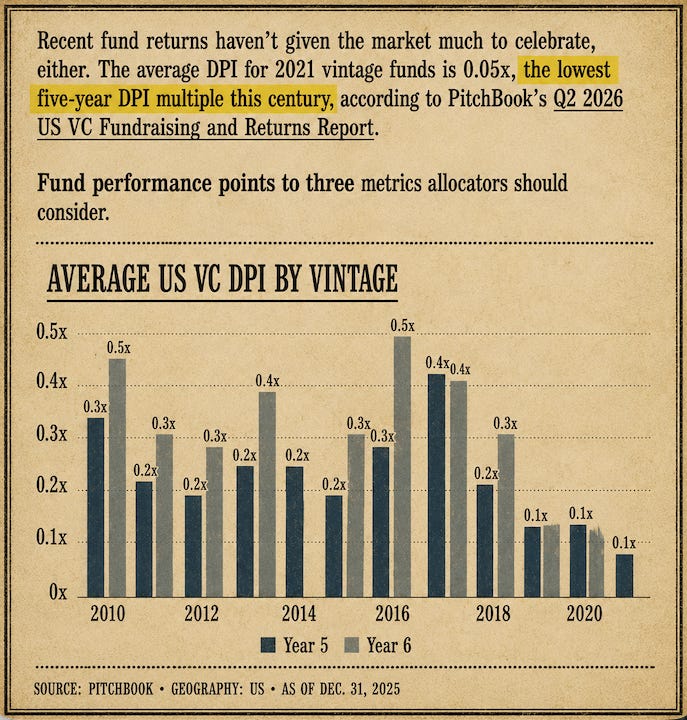
“…the lowest five-year DPI multiple this CENTURY.” What a choice of words!!! I mean, with intros this violent, he might need to borrow my disclaimer above, you know? Although, he should have gone full savage and called it “the lowest this millennium,” which would have been just as accurate.
I don’t care if you’re not interested in VC returns. That intro alone makes you want to check out the report!

Well, there seems to be a new “First Brands” brewing in the media: Radiant World. The two have a few things in common: both grew too quickly, both are being accused of fabricating invoices, their founders have virtually no online presence, and Jefferies’ Point Bonita hedge fund was among their lenders.

Most people haven't heard of Radiant World, but if you happen to run a steel mill, you definitely know the company as a major iron ore trader. Not a hedge fund-type trader, but the type of trader that buys iron ore from Brazilian or Australian mines and resells it to Chinese steel mills, while also taking care of the logistics to ensure it is delivered on time.
Radiant World was founded in India in 2003 by 23-year-old Pinkesh Nahar. India was already one of the world’s major iron ore producers and exporters, so it was a natural place to start an iron ore trading business. The company gradually expanded before entering China in 2008, and that’s when things really took off, as it hit the jackpot riding China’s rapid industrialization and the resulting surge in demand for steel and iron ore. By then, it had also established relationships with mining giants like Vale, Rio Tinto, and BHP Group.
Most metals trading is dominated by Glencore and Trafigura, but iron ore was a relatively niche business that wasn’t worth building out as a separate operation for these powerhouses. That gave Radiant World a natural niche. By 2012, Glencore and Trafigura were already using Radiant to round out their own offerings without having to build a dedicated iron ore trading business.
Nahar, who has kept a very low profile and is barely mentioned online, has been anything but conservative when it comes to growing the firm. By 2014, Radiant was trading about 7 million tons of iron ore a year. A decade later, that had grown 10x to 70 million tons. The company’s latest reported figures show annual revenue of roughly $12B. One interesting thing about Radiant is that, unlike most trading houses, which primarily act as intermediaries connecting buyers and sellers and typically hedge the commodities they trade, Radiant would occasionally make outright bullish bets by buying iron ore and holding it unhedged for a period of time, betting on price appreciation. And historically, those bets seem to have worked pretty well.
The trading business of Radiant World is sizable and, unsurprisingly, very well-banked, with significant credit exposures across a number of financial institutions. Commodity traders like Radiant typically rely on banks not only for traditional corporate loans, but also for trade finance facilities tied directly to their underlying transactions. In Radiant’s case, trade invoices and shipping receipts were used as collateral for its financing lines. If you are wondering just how well banked Radiant was, below is the list of financial institutions that worked with the company as of 2025.
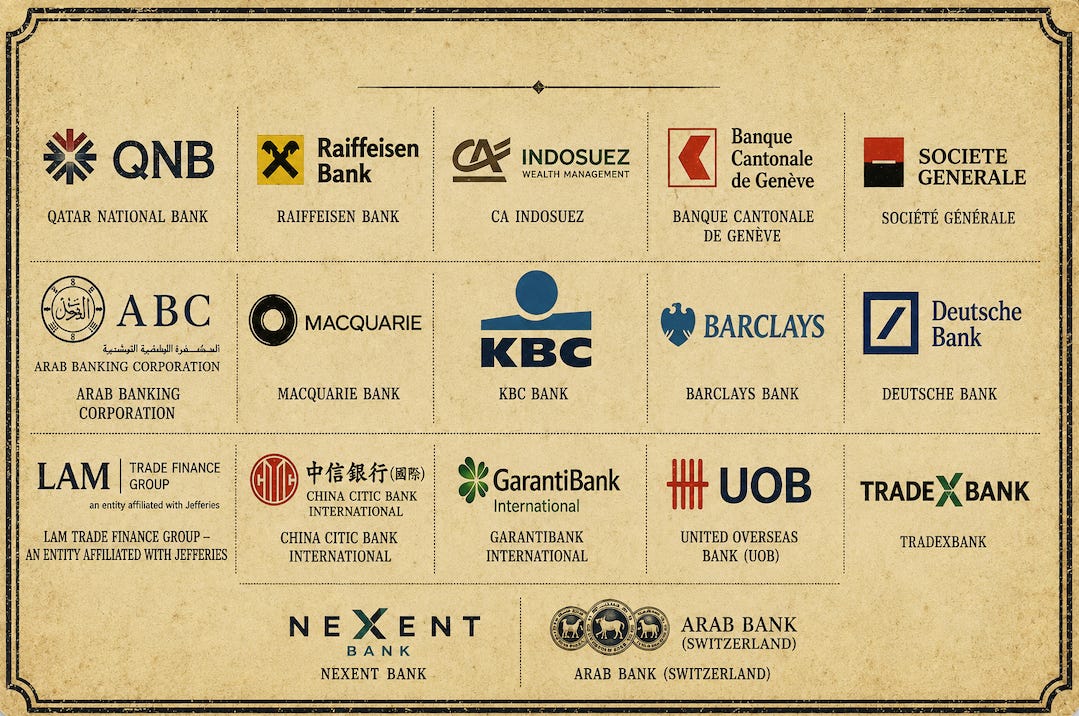
That’s especially important given the latest developments at the company. A couple of weeks ago, Bloomberg reported that Cargill, Glencore, Rio Tinto and Vitol had stopped trading with Radiant. Glencore’s exposure to Radiant may be as high as $500m-$800m, making its decision to stop trading with the company particularly significant. Bloomberg reported that the companies had discovered Radiant was providing banks with falsified invoices and other documents related to iron ore trades. Since then, it has been revealed that Arab Bank, one of the company’s key financiers, has stopped issuing letters of credit. ICBC has suspended repo financing, while Société Générale has reduced its exposure. Deutsche Bank and KBC have also frozen some of Radiant’s assets in Singapore. Meanwhile, Intesa Sanpaolo and Jefferies’ Point Bonita fund are reviewing their exposures, which are estimated at $200m-$300m each.
The thing that bothers me most about these credit frauds (or alleged frauds, as of now) is not that they occur, because no one can completely prevent fraud from happening. It’s that significant red flags are typically missed:
Two of the world’s biggest commodity trade financiers, Cooperatieve Rabobank UA and ING Groep NV, stopped financing Radiant World several years ago amid concerns about certain documents involved in some of its trades.
Look, you’ve done your due diligence, and it turned out that major banks had already exited the relationship because they were concerned about potential fraud. Yet you still proceeded with the deal. This was clearly surfaced during diligence, but some smart nose on the origination team convinced everyone that there had been a misunderstanding and that the documents weren’t actually fabricated. Well, you could have fired the person on the spot for pushing a dumb deal, except you also signed off on it under pressure from other members of the committee. What can I say? Hopefully, it’s a misunderstanding this time as well. Otherwise, the whole team should be kicked out, you know?
Even more interesting, though, is the following point Bloomberg made about Radiant in a report last year:
The trading house’s [Radiant’s] scale means that any change in its fortunes could be felt throughout the iron ore market — a commodity whose role as the key ingredient of steel makes it crucial to the global economy and the key driver of profits for the world’s largest mining companies

In last week’s letter, I wrote the following:
What if the private credit crowd borrowed a page from the Tbilisi airport’s currency exchanges, except instead of rotating the winners, they rotated the losers? They could start separate funds whose sole purpose was to refinance the really bad deals. Let’s call those funds, idk, BlackRockTCPs (…sorry… just couldn’t help myself), and rotate which one refinances the bad loans each quarter? I mean, who cares about performance, collect your fees, repackage the loans into some sort of CLO or AMAPS or whatever, and voilà, the maturity wall is gone!
The following day, the Wall Street Journal published a piece discussing how BlackRock TCP, which has been in the news for all the wrong reasons, is transferring nearly half of its loans, including the collateral underlying its CLO, into a separate continuation vehicle and selling a majority stake in that Frankenstein of a vehicle to Pantheon.
I mean, I’m not saying I predicted the whole thing, but boy, isn’t this hilarious? Now, if you’ve read the WSJ piece, you are probably wondering what’s actually going on here, and I don’t blame you. The article throws a bunch of numbers at you as if everything is simple and perfectly logical. It absolutely isn’t.
To try to understand it, you have to go back to the source: the SEC filings and the company’s earnings call presentation. And even then, it feels a bit like reconciling adjusted EBITDA on a compliance certificate with the numbers in the audit (if you know, you know).
May 2026
BlackRock TCP bundled 70 of its loans with a total value of $535m, into a CLO. It initially sold the A1, A2, and B tranches to outside investors, followed later by the C tranche, raising approximately $406m in total (remember this figure). It retained the D and LLC Int. tranches, representing the subordinated and equity interests, on its balance sheet for a total of approximately $130m. The $406m of proceeds were used, among other things, to repay outstanding bank credit lines with Citi and ING.
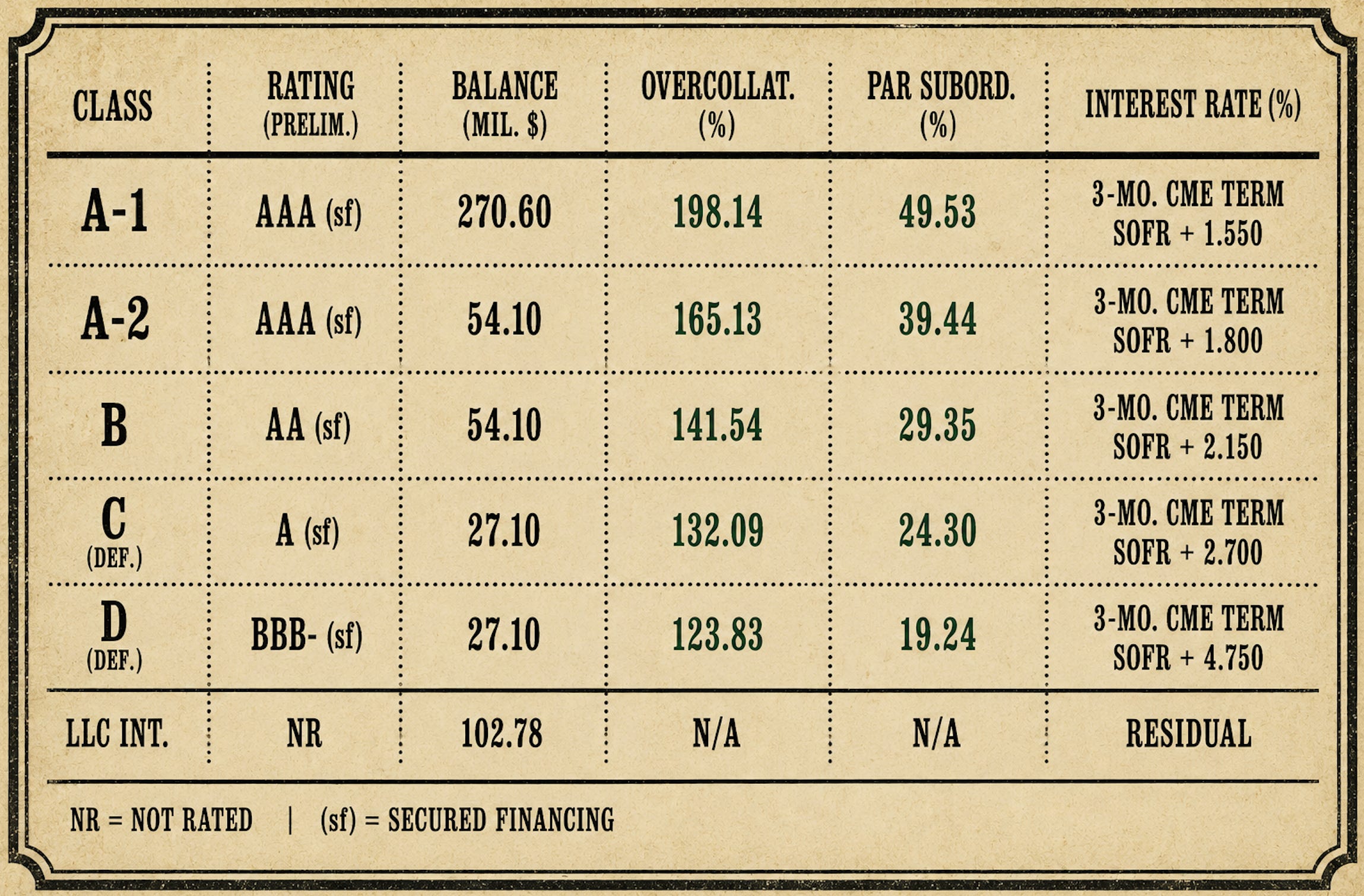
None of this information is discussed in the article or in BlackRock TCP’s recent SEC filings. It is simply useful background for understanding which CLO the article is referring to.
August 2026
Now, onto the actual transaction that was announced. As reported by the WSJ:
Under the Aug. 4 deal, BlackRock TCP is transferring roughly two-thirds of 78 middle-market loan investments into a new continuation vehicle and Pantheon will purchase a 95% interest in it. The Santa Monica, Calif.-based BDC expects to receive gross proceeds of about $152 million from the deal and will retain the remaining 5% interest in the continuation vehicle.
Frankly, this is all you need to know, because getting deeper into the details opens up a rabbit hole that is impossible to make sense of. Basically, BlackRock created a new CV, moved 78 loans into it, including the 70 loans serving as collateral for the CLO plus several more, and transferred the $406m of CLO obligations along with them (among other liabilities), reducing and cleaning up the balance sheet. It then sold 95% of the CV to Pantheon for $152m.
When all is said and done, including the upcoming major loan paydown from one of its portfolio companies (Domo), the leverage ratio will drop to 0.3x from 1.38x before the transaction.
If you really want to see how the transaction looks on the financials, see below. But don’t try to reconcile it, and certainly don’t contact management for further details either, as they just got hit with another shareholder lawsuit, essentially accusing the company of mismanagement that led to a 2/3 decline in its stock price.
You know how some things are too good to be true to the point where you just want to pass on them, because surely there’s a catch? Bloomberg’s article titled “Private Credit Funds Avert Worst Fears and Rebound From Lows” gave me exactly that feeling, cuz, you know, they are not supposed to be saying this.
The piece is a collection of bullet points on a bunch of public BDCs’ Q2 earnings calls, and begins with the following:
In the eye of the private credit storm, outlooks called for the $1.8 trillion market to either bring about the next financial crisis or for the pressure to quickly peter out. Nearly half a year later, it seems the truth lies somewhere in the middle.
Publicly traded BDCs have been reporting their second-quarter results in recent days, providing the clearest state-of-play yet for the industry. That’s because unlike their non-traded peers, which are mired in a multibillion-dollar backlog of redemption requests, these vehicles have set pools of money, putting the focus squarely on their loan valuations and portfolio credit quality.
The article elaborates that, based on Q2 calls, these BDCs are focused on trimming underperforming loans, working out non-accruals, and reducing leverage. They are also avoiding dividend cuts, which the market tends to view negatively. In other words, lenders are doing exactly what they are supposed to do: dealing with problem loans and de-risking, and apparently that caught the media off guard. Well, too bad.
The market reacted swiftly to what it perceived as positive developments, and BDCs have rallied over the past week or two, although they remain below their pre-SaaSpocalypse levels (Feb. 2026) and, in some cases, even below pre-First Brands levels (Sept. 2025). I’m a bit worried, though, that if Q3 results are similarly less negative than expected, some people’s worldviews might start melting down, which would be concerning.
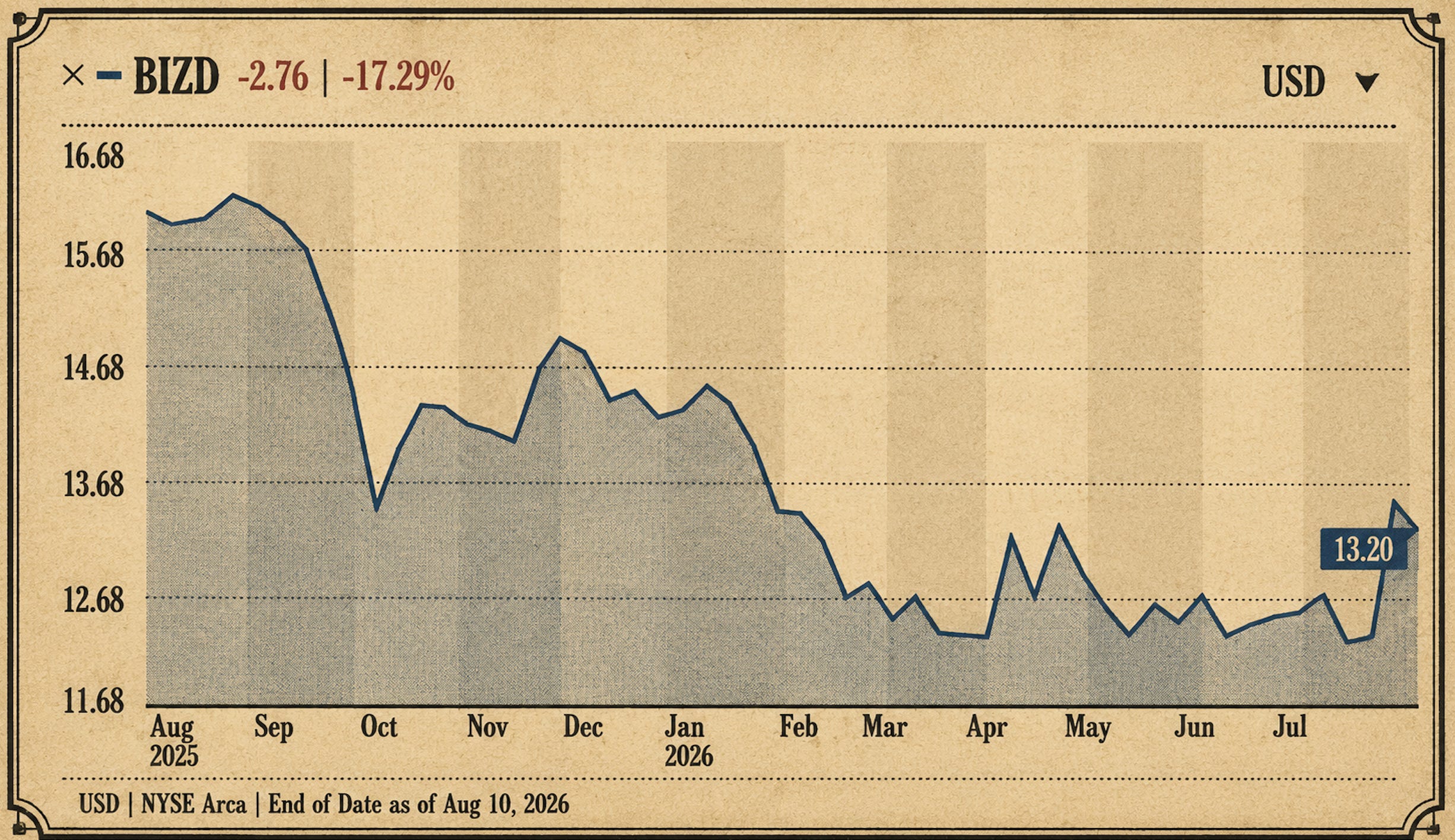
And frankly, there were some negative developments at certain BDCs: Ares’ non-accruals grew by 15% to $708m (2.4% of total loans); Blackstone marked down its NAV to the lowest level since 2020; and senior executives at BlackRock and Goldman stepped down, which is rarely a good sign. But the negatives were clearly less severe than the market had feared, particularly at the beaten-down BlackRock and Blue Owl BDCs, which helps explain the rally.
We’ll see what Q3 brings…
A few months ago, in Round #39, I wrote that concerns around the 2028 maturity wall of leveraged and private loans were overblown. As with previous maturity walls, I expected it to get smoothed out as we approach 2028, with the only wildcard being software loans. And even there, I suggested that the issue was not so much the fundamentals, but the uncertainty around them, which would take some time to figure out.
Well, it looks like Europe very much agrees, as discussed in PitchBook’s article, “Europe tackles 2028 loan maturity wall faster than expected, but software lags.” And, of course, I’m going to discuss it!
The following paragraph and chart are basically summarize the piece:
Despite several big-ticket buyout deals, refinancing and extensions led supply in European loans this year, making up 67% of total volumes of €110.6 billion excluding repricings. The pace accelerated in the second half, which has whittled away at the European loan maturity wall. This debt was identified as a potential threat to the market at the start of the year, with a chunk of borrowers’ financing needs dating from the height of the QE-fuelled LBO boom in 2021.
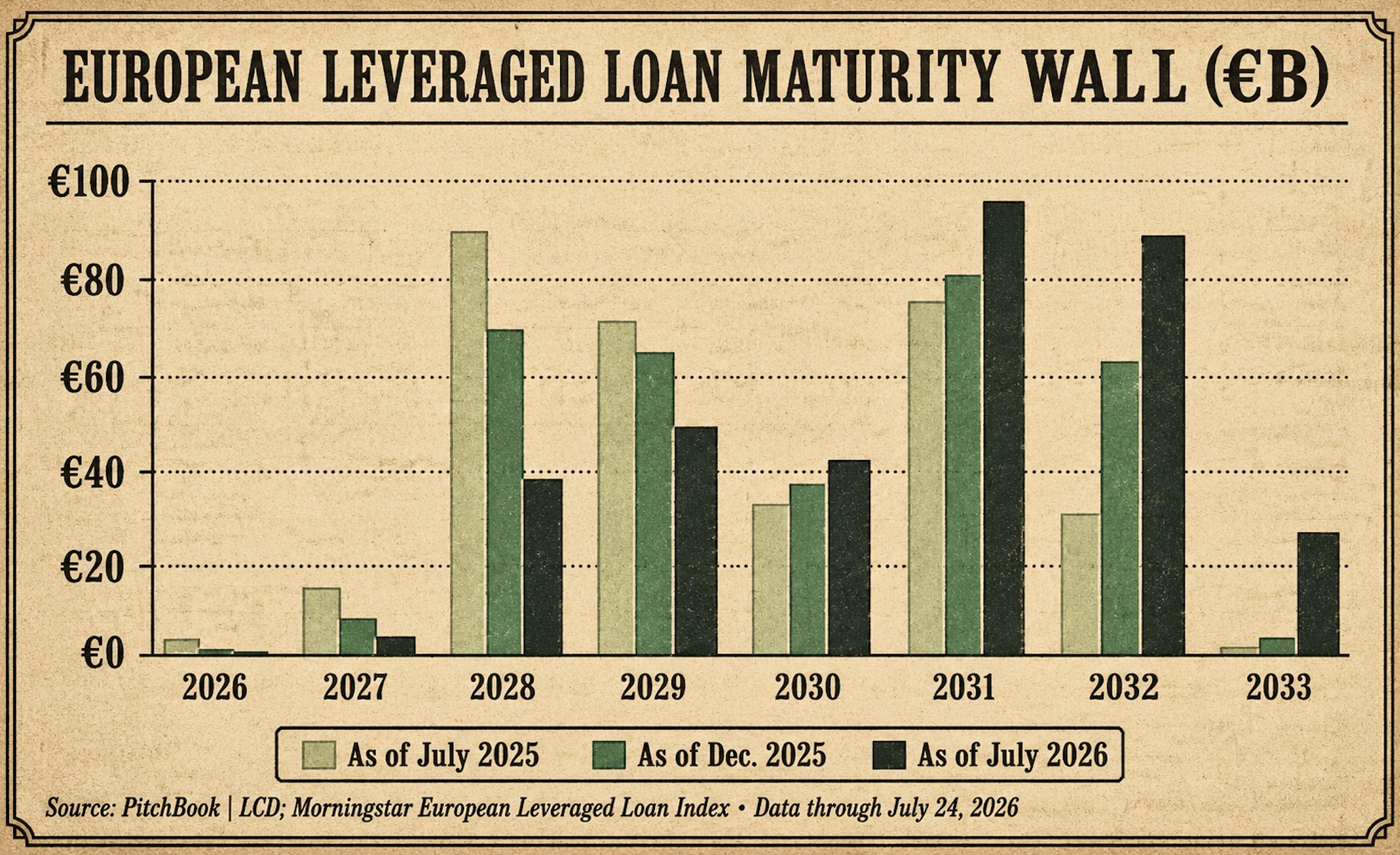
I think the chart tells the story quite well, as the value of loans maturing in 2028 has shrunk considerably since December 2025. Obviously, we can’t simply extrapolate this refinancing trend into the future, because it is only logical that the cleanest, strongest loans were the ones that got extended first. The piece acknowledges as much:
The next block of work to extend the 2028 need may also prove tougher than the first part of the year. “What is left? There is usually a reason if something is not already addressed,” said one manager. “Probably leverage is a bit higher than it should be, or the sector could be stuck in a long downturn cycle that has yet to recover,” they added.
That said, the pressure to refinance or face loan acceleration (the demand to repay the loan) will force sponsors to either put in more equity or bring in junior lenders to bridge the gap between the amount of equity they are willing to contribute and the amount of debt senior lenders are willing to extend. Everyone in the capital structure is incentivized to refinance, or at least extend the maturity, so you are not betting only on the companies themselves, but also on the incentives of each player in the capital structure. And I wouldn’t bet against the latter.
Now, the piece covers leveraged loans, specifically European ones. However, it suggests that in certain situations, private credit refinanced some of these loans, meaning the competition between BSL and private credit is another variable that could help facilitate the refinancing process.
Lastly, the piece is about European loans, while it was US loans that have made most of the noise so far. That said, I view the European situation as a guide to what we should expect in the US, especially given how much deeper and more competitive the US capital markets are.
So, if you were to ask me, we are getting closer to something like the following:

9fin recently published its US Covenant Trends Report 1H26, covering leveraged loans and high-yield bonds. The report is worth checking out, but below are a few tidbits on leveraged loans (skipping HY altogether).
First, the Margin Ratchet, which is a fancy way of saying “leverage-based pricing grid” (which in itself is a fancy way of saying that if leverage is 5x, the price is S+5.00%; if it is 4.5x, the price is S+4.75%, etc.):
Margin ratchets appear in 40% of sponsored deals and 21% of non-sponsored deals. This stands in contrast to the European market, where margin ratchets appear in almost every deal.
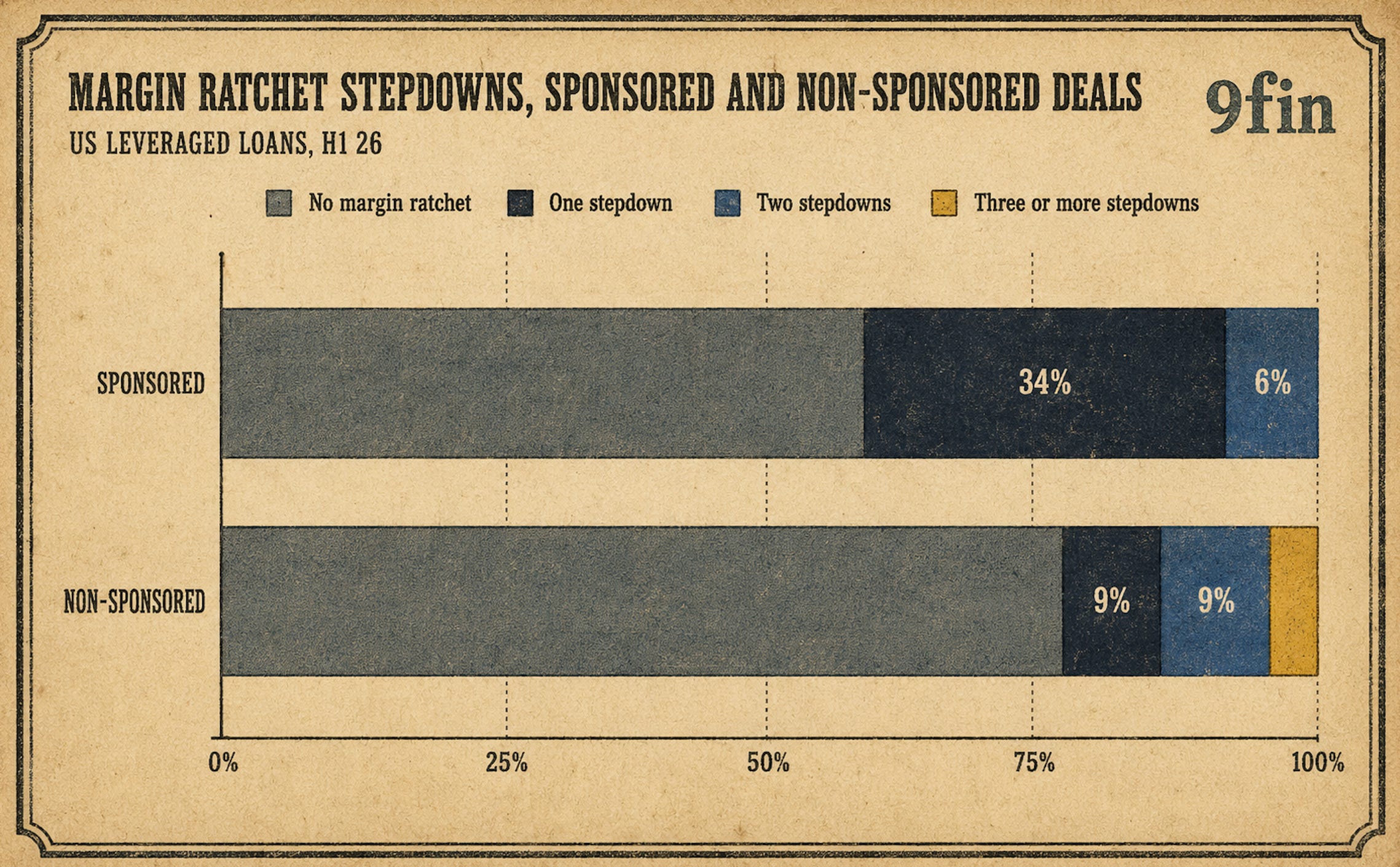
I’m a bit surprised that ratchets are on almost every European deal, as I’ve been under the impression that European deals are more lender-friendly and, generally speaking, ratchets favor the borrower. From a Finance 101 perspective, the riskier the asset, the more premium the investor should demand, and vice versa. So, when the loan deleverages over time and there is less time to maturity, surely the loan has de-risked, and technically, lower pricing is justified. But as a lender, I don’t care about Finance 101. I want the highest pricing I can get, and I want it to stay through maturity. As a borrower, especially a sponsor-backed one, you don’t really care about my sentiments toward the pricing I want because they conflict with your deep desire to have the lowest price possible.
That’s how we find a compromise: we start closer to where I want pricing to be (still lower than I wished) and gradually get to where you want it to be (still higher than you wished), with the reduction contingent on deleveraging.
Anyway, seems like in Europe they skip the negotiation and start with: “OK, it will be a grid.” Meanwhile, US deals seem to follow my logic, although it’s a bit surprising to see that some non-sponsored deals got three step-downs. Perhaps they opened at a high enough spread to allow for it, or these were large, competitive deals where lenders had less negotiating leverage.
Second, EBITDA adjustment caps, which limit how much those “one-time expenses,” “pro forma adjustments,” and other fancy EBITDA add-backs can increase reported EBITDA. That’s important not only for leverage and fixed-charge coverage ratios, but also because many “baskets” are sized based on EBITDA.
The proportion of deals with uncapped EBITDA adjustments has dropped across the board:
A third of sponsored deals have uncapped EBITDA adjustments, down from 53% in H2 25
15% of non-sponsored deals have uncapped EBITDA adjustments, down from 27% in H2 25
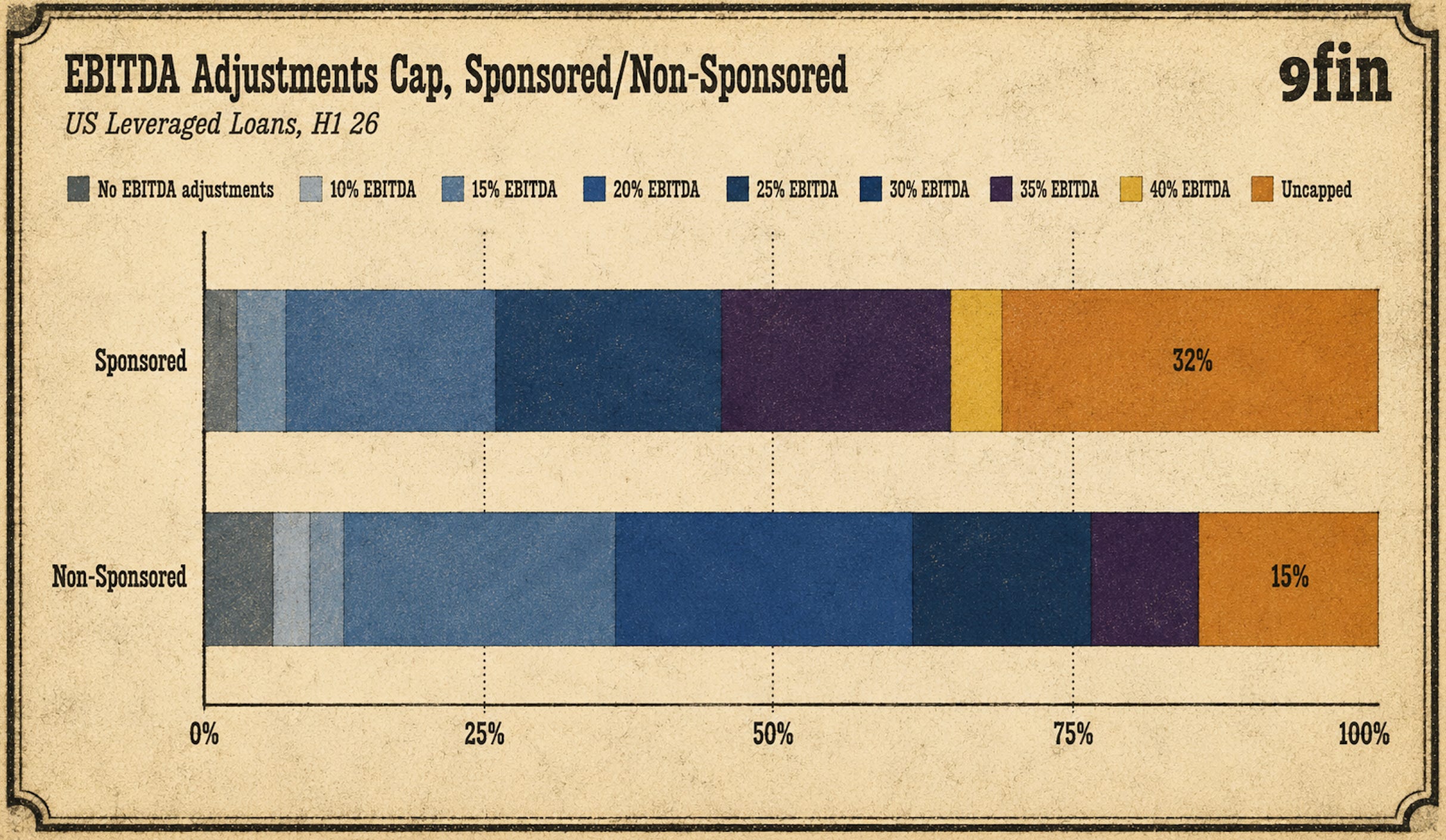
It’s nice to see uncapped adjustments down to 32%, although anyone who has seen the kinds of add-backs that typically make it into the calculation and what adjusted EBITDA does to your ability to analyze a company’s true cash flow would tell you that 32% is still 32% too many. And forget uncapped adjustments. Even a 30% adjustment, which seems to be somewhere in the middle of the chart, can work some serious magic on covenants.
Think of a fixed charge coverage ratio (FCCR), whose purpose is to ensure that the business generates enough cash to cover its fixed expenses. Obviously, the worst you can allow is an FCCR of 1.0x, which means the borrower is just breaking even. But being the prudent lender you are, you set the covenant above 1.0x, say at 1.25x.
Now, if the borrower’s fixed charges are $8 and adjusted EBITDA is $10, it’s in compliance right at that 1.25x level (10 / 8 = 1.25x). But if that EBITDA includes 30% of adjustments ($3), suddenly your true cash generation is only $7, which doesn’t cover the $8 of fixed charges. That borrower better have a solid cash pile on the balance sheet to cover the shortfall, and those adjustments better truly be “one-time,” with all pro forma synergies fully realized now (riiiiiight), so the expenses are covered in the next reporting period.
Lastly, the report includes a number of other changes to credit agreements, including LME blockers, reporting requirements, and a bunch of baskets that are too technical and confusing to get into here. Baskets are weird animals in general and can be surprisingly annoying to negotiate. It’s hard to conceptualize why an obscurely worded basket sized at 40% of EBITDA could be materially more dangerous than a 30% one, so they often end up being driven more by precedent deals with a particular sponsor than by any strong conviction one way or another. They often serve as negotiating currency: you give the sponsor the basket size they are asking for in exchange for getting what you need somewhere else. Of course, when the deal blows up, you suddenly understand exactly why that basket mattered, and why 30% instead of 40% could have made all the difference in the world.
So, perhaps read this 9fin report…

KIÉR LIÓR – Providing outsourced private and leveraged loan underwriting and portfolio management to institutional investors, family offices, and direct lenders.
www.KierLior.com
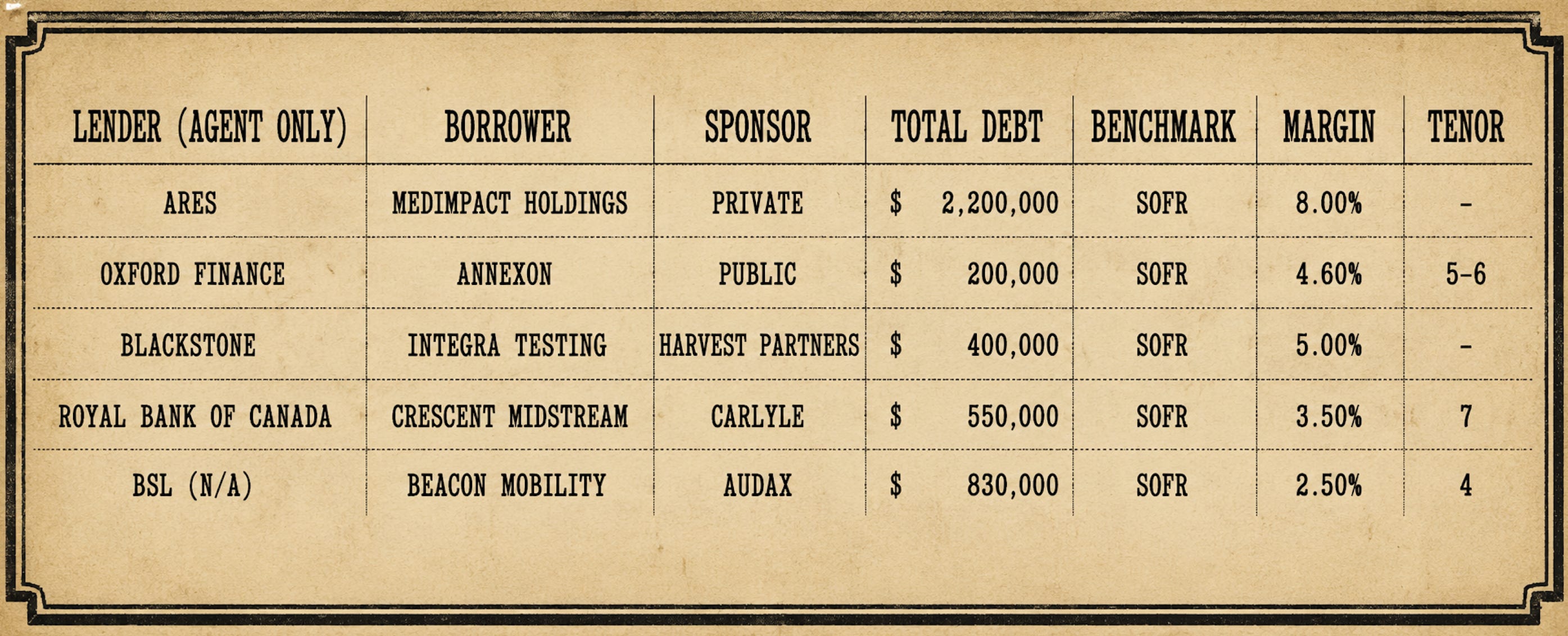
Download below: the full Excel file covering deals completed in 3Q26 (plus the prior three quarters).
CLICK to Download 3Q26 Details
Four debt/equity requests: $35m, $12m, $9m, and $7m (LINK)
Empirasign, a provider of secondary market trading data for structured products, covering ABS, MBS, CMBS, CLOs with BWIC history dating back to 2010. They also carry real time market data for IG/HY bonds as well as secondary loans. DEBT SERIOUS readers get a 1-month completely FREE trial. Click the LINK and select DEBT SERIOUS during registration
Bloomberg is offering 60% off its annual subscription ($180 vs $399). If you are in Business, Bloomberg is a MUST, with no real close alternative LINK
WSJ Online is offering 65% off its annual subscription ($4 per week vs $11) LINK
The Financial Times is offering a 4-week trial for $1 (total, not per week), but make sure to cancel before it renews to avoid paying $75/month LINK
Shortcut.AI, an AI tool for Excel that lets you build models by simply typing requests (similar to ChatGPT). It is free to use up to a certain number of tasks per day (LINK). If you hit your limit before finishing your project, simply upgrade to the Pro plan ($20/month) and enter promo code DEBTSERIOUS (all capital letters) to get 50% off
LoanEdge, a BDC research tool that lets you look into BDC loan compositions, individual loans, which BDCs own a specific loan, and more, is kindly providing DEBT SERIOUS readers with a free 3‑month trial (the regular price is ~$3k per year, and it’s higher for institutions). Here is a LINK to the tool. Send an email to Sadaf Khan at sadaf@theloanedge.com and let her know you are from the DEBT SERIOUS community
As a reminder, I don’t personally benefit from either of these offers. I am just saving you money.
Lastly, our community is over 4,400 strong and includes a broad cross-section of mid- to senior-level professionals across private credit, private equity, LPs, and debt advisory. Please use the Bulletin Board at the end of each weekly letter to share events, discounts, or deals that benefit the community. I will continue to feature these opportunities and personally connect interested parties at no cost.
Aznaur.Midov@KierLior.com
Comments
Nothing yet. Say the first thing.
Sign in to join the conversation.