
In Round #55:
From Georgia with love
How private credit became the dominant story in the media
Looking into how PE socializes risk through insurers
Q2 update on private equity and direct lending
Notable deals
Bulletin Board: includes new FREE access to EMPIRASIGN (a structured credit dataset) and FOUR live deals
Disclaimer: there are 4,400+ of us here discussing private credit and leveraged loans, which is not a big world. At some point, I will probably throw punches at your company. I am blunt and sarcastic and, as friends like to remind me, too mouthy to live to an old age, so my take likely won’t please you. But don’t worry, next week it will be someone else in the spotlight and you will quietly nod along in satisfaction.
Also, none of this is investment advice.
Ok, I told you in the last letter that I’m in Tbilisi (country of Georgia), but I didn’t share the story of currency exchange, because there was already enough about Georgia in that letter.
So, as you arrive at the airport, you are greeted by a dozen currency exchange windows where you can get the local currency, the lari. I was looking at the exchange rates, and they all seemed identical to the penny, so I figured it didn’t really matter which window I used. But then I noticed a couple of windows offering significantly better rates (see below).
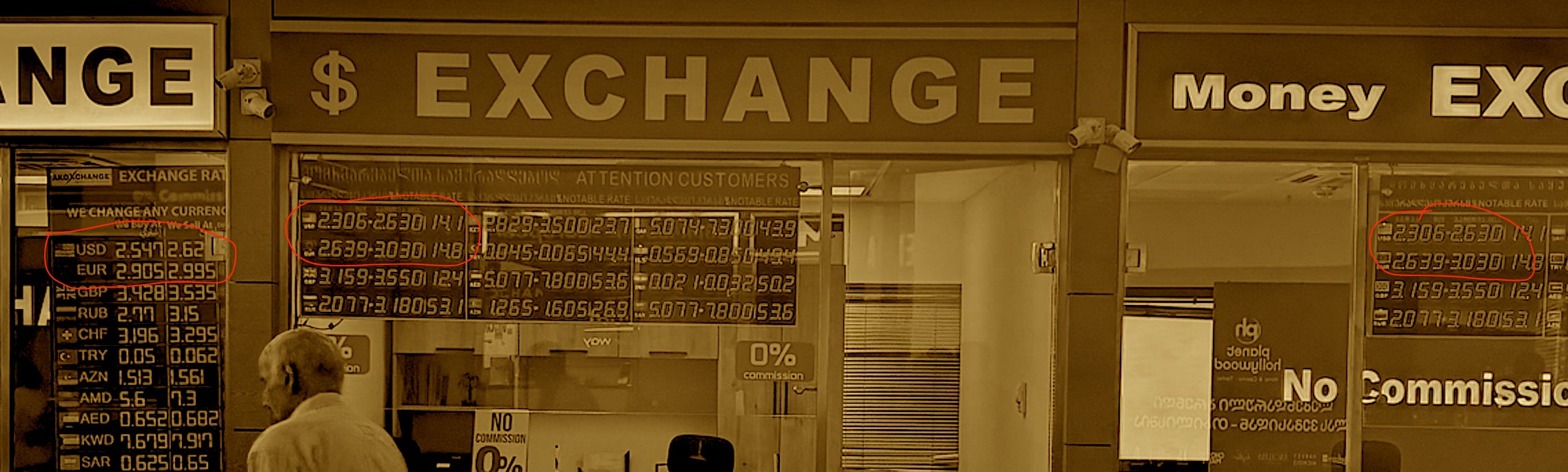
That made no sense, because they offer the most commoditized service possible, exchanging one type of currency for another. Plus, they are located right next to one another, so you can compare all their rates without even moving from where you are standing. As I was approaching the window with the better rate, I was genuinely puzzled about why anyone would be such a sucker as to exchange their money at the other windows.
Before exchanging any money, I confirmed with the teller that they were, in fact, exchanging currency and not offering some sort of transfer or another service that could explain the rate difference, because at that point I was truly bamboozled. She confirmed that it was just a regular currency exchange, so of course I had to follow up by asking why anyone would exchange money at the window to the right. Before she could answer, the guy standing behind me jumped in: “Because they rotate. Today it is this window with favorable exchange rates, tomorrow it is the one on the right.” The teller laughed and denied it, but it was the kind of laugh that pretty much confirmed the guy was right!
It was actually funny to me, because once he said it, it seemed like the most logical explanation possible, yet somehow it was the one thing I hadn’t considered! I mean, I thought of differences in transaction volume, potential marketing tricks the other windows might be using, and basically everything I’ve learned over the years about competitive tactics, except for the most obvious explanation: a dozen players had simply fixed their prices for the benefit of two others, and were rotating throughout the day/week!
Where is Lina Khan when you need her?!
Anyway, that got me thinking. You know how people keep bringing up the maturity wall coming in 2028 and wondering who is going to refinance all those loans? What if the private credit crowd borrowed a page from the Tbilisi airport’s currency exchanges, except instead of rotating the winners, they rotated the losers? They could start separate funds whose sole purpose was to refinance the really bad deals. Let’s call those funds, idk, BlackRockTCPs (…sorry… just couldn’t help myself), and rotate which one refinances the bad loans each quarter? I mean, who cares about performance, collect your fees, repackage the loans into some sort of CLO or AMAPS or whatever, and voilà, the maturity wall is gone!
Ok, since the maturity wall issue was just fixed, moving on to the next problem…
And the next problem is trying to make sense of how we got here with private credit and an observation I haven’t seen discussed much.
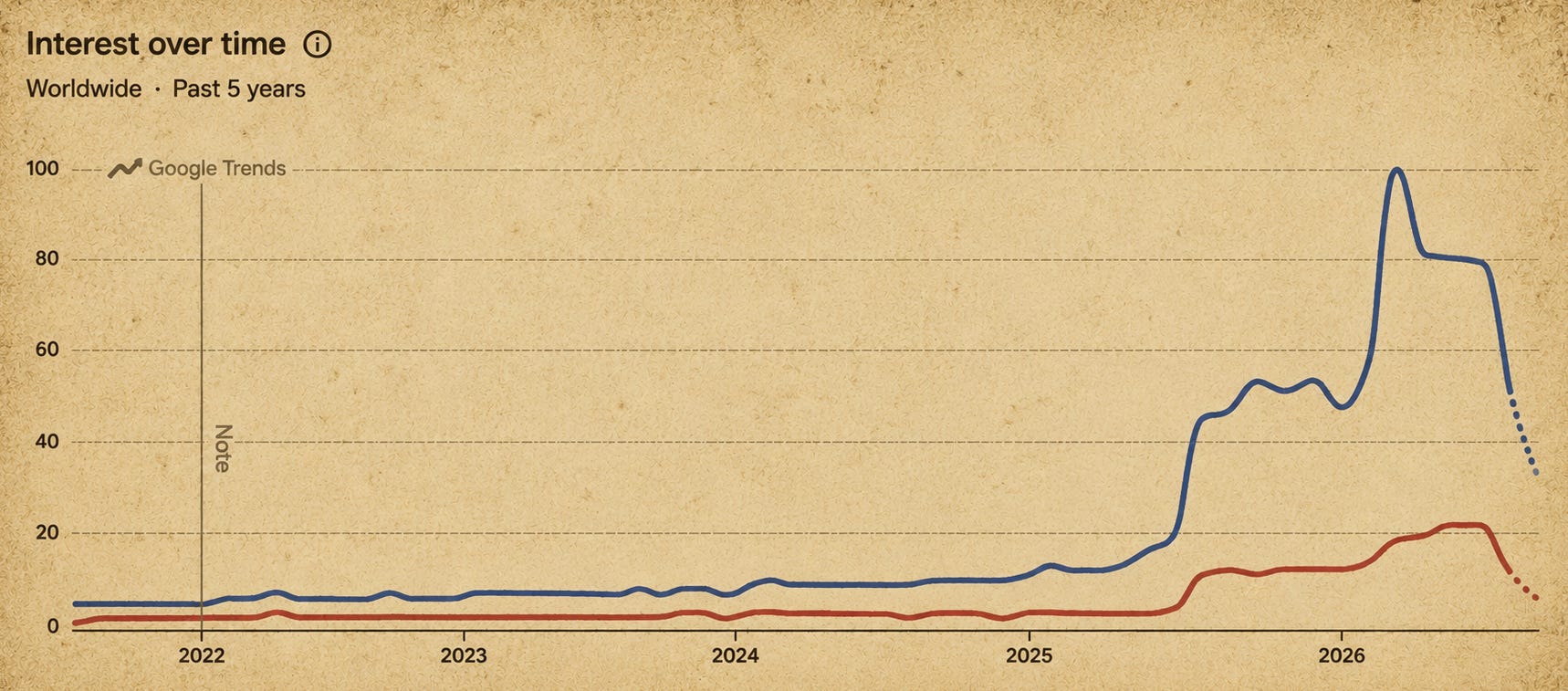
When I started DEBT SERIOUS a year ago, before all the hysteria about the space, the media was still at a crossroads over whether to call the space “Private Credit” or “Private Debt” (even though there are technically differences that we don’t care about). The chart below shows search results for “Private Credit” (blue line) and “Private Debt” (red line) over the past five years. As you can see, sometime around the middle of last year, there was a sudden move to “Private Credit,” and the term has been a click magnet ever since. Interestingly, both terms appear to have peaked in March of this year and have been declining ever since, so maybe we will finally stop hearing about them.
We all know the story that private credit exploded after the 2008 financial crisis, when new regulations made certain types of lending more expensive for banks, particularly to leveraged middle-market companies, and funds stepped in to fill the void. Something like that… no one really explains the exact regulatory details or what requirements actually changed.
Obviously, if we are talking about funds stepping in and doing the lending that banks used to do, we are really talking about the Direct Lending part of private credit, even though we kept calling the whole thing private credit. The reason I am specifying that is because private credit has turned into a pretty large umbrella of strategies, as we’ve noted before, and you can see them in the chart below (ignore the percentages, which are from a survey about LPs’ allocation focus).
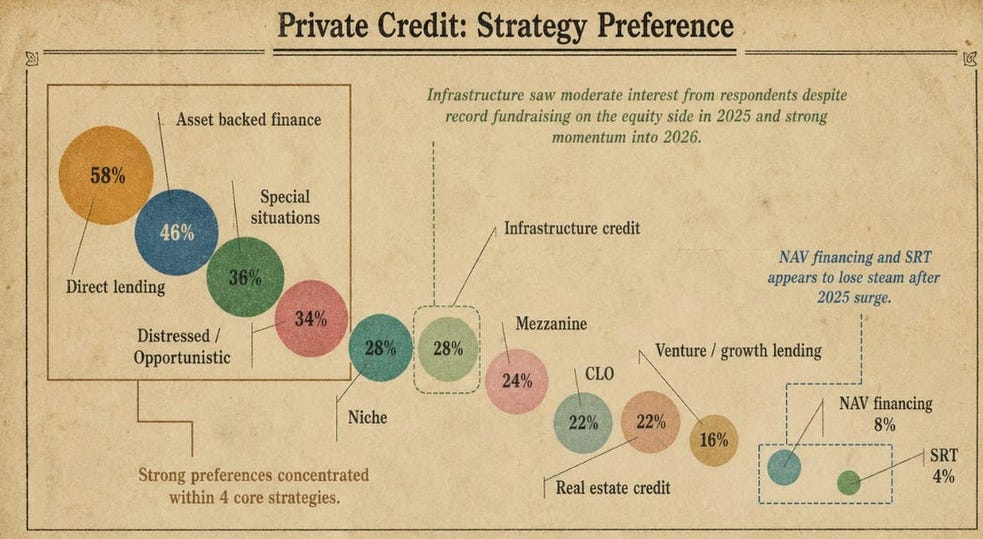
Bear with me, but keep this chart in mind. So, if you were in banking or direct lending at the end of 2024, you’d hear a fair amount of frustration about intensifying competition, loosening covenants, and compressing pricing. Newspapers, meanwhile, were primarily discussing M&A in the space, covering some basic facts about private credit, and publishing the occasional skeptical take, as the industry was still quite mysterious.
Then, around April/May 2025, you started seeing an increasing number of bearish takes on the space (see the FT headlines below), which somewhat coincided with tariffs, I guess. This is not a knock on the Financial Times, which just happens to have all of these articles in one place. That said, I do believe the FT was a major contributor to the hysteria that was about to kick in and has continued ever since.
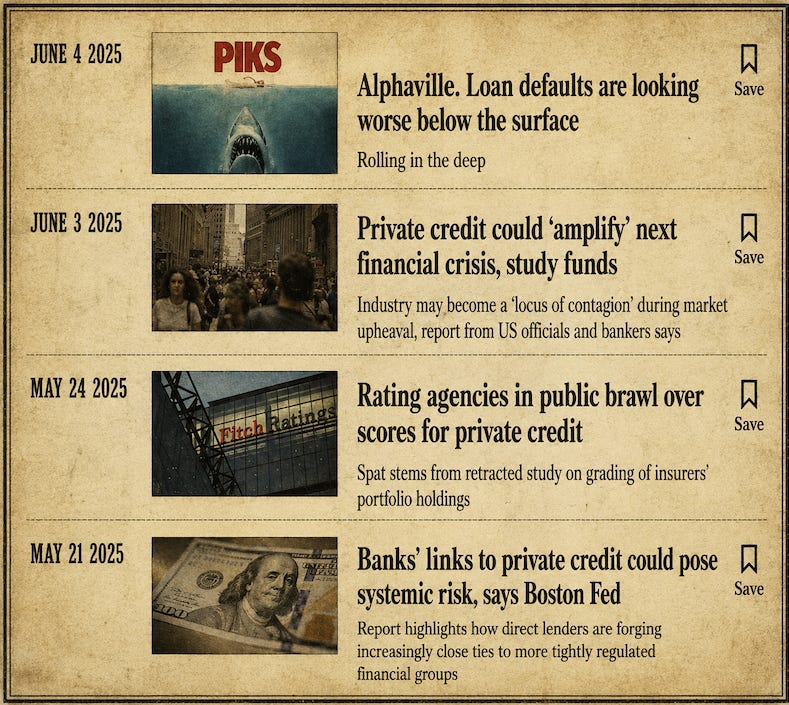
The triggering events were the back-to-back blowups of Tricolor and First Brands. That’s when private credit became the center of attention, and when I believe the media realized how many clicks it could generate. If you recall, those deals were actually frauds, and even though we’ve had a few more similar frauds since then (across hundreds of thousands of loans), Tricolor and First Brands became the “I told you so” examples of what private credit would bring, cited by a bunch of pundits from the credit world (often biased because of competitive dynamics), including Dimon with his “cockroaches” comment, which certainly didn’t help.
With headlines getting more dramatic over the following months, non-traded BDCs started experiencing redemption requests above their typical 5% quarterly repurchase limits. The financial media began covering this heavily because they had to keep using the magic words “Private Credit,” which generated clicks. Remember when Blue Owl received redemption requests equal to 17% of shares in its BDC at the beginning of this year and met them in full? The media covered it extensively. They also started tracking how redemption requests increased each quarter for certain other BDCs, even though they either remained below 5% or were fully met by the funds. This was apparently important enough to track, and given the number of funds out there, you could generate an endless stream of articles and clicks.
Then came SaaSpocalypse in February, and we learned how exposed private credit was to those loans. A new wave of articles about the exposure of each fund, the hidden exposure of each fund, and what people thought about the exposure and hidden exposure of each fund kept popping up.
Then came more redemptions, now above 5%, that were gated. The media started covering each gated fund, turning gating into something inherently inappropriate. They conveniently forgot that just a couple of months earlier, the same funds received no credit for going beyond their requirements and meeting redemptions in full.
Recently, we’ve started seeing another angle of the private credit story: insurance. And this one is becoming increasingly relevant. So, there seems to be no end in sight to this private credit debacle.
And now, let me explain why I brought back all these memories. The private credit hysteria started with Tricolor and First Brands, right? But the irony is that Tricolor had absolutely nothing to do with private credit. First Brands had very little to do with private credit: it had about $10B-$12B of debt, of which roughly $1.2B was provided by hedge funds through supply-chain finance, with the balance largely made up of BSLs and bank loans. Remember that chart above? Supply-chain finance is more of a Niche strategy, although some may consider it a subcategory of Asset-Based Finance (ABF).
Why does it matter? Because by calling Tricolor’s bank debt and First Brands’ niche finance exposure “private credit,” the media helped cause a run on BDCs, which represent a Direct Lending strategy that had nothing to do with either Tricolor or First Brands.
SaaSpocalypse was definitely a solid reason to worry about direct lending, which is why BDCs continue to struggle. That’s fair.
But now, the discussion has shifted to private credit in insurance companies. The issue is that, when it comes to private credit, life insurers primarily invest in asset-backed finance (like consumer or auto loans, etc.), strategies like NAV or SRT, infrastructure debt, and direct lending, which is typically investment grade (whereas BDCs do direct lending for non-investment-grade borrowers). There are obviously BSL CLOs and private CLOs, and the latter contain a non-investment-grade direct lending component, but insurers typically invest in the rated senior tranches of those instruments.
The point is that all the noise about problems in private credit started with reporters ignoring crucial nuances and lumping loosely related strategies into one category, “Private Credit,” even though those strategies aren’t even correlated. That eventually turned the situation into something of a self-fulfilling prophecy, stigmatizing the entire private credit umbrella in the process.
Let me use a simple analogy to bring the absurdity of the situation home. Imagine that a few Volkswagen Golfs experienced brake problems that resulted in injuries. Newspapers started running stories about German cars causing injuries. Then they interviewed salespeople from Toyota and Ford, who explained that German cars have strange braking systems and said they weren’t surprised by the accidents, as they’d been warning about those systems for years. The stories gained traction, and suddenly people started selling their Mercedes’ and BMWs because reporters glossed over the rather important nuance that the problems involved Volkswagens, specifically Golfs, and actually just a handful from, say, the 2021 vintage.
Now, that doesn’t mean the Volkswagen brake problems should be dismissed. Maybe there is a broader issue with a particular model or model year that warrants a recall. But surely that doesn’t mean every German car has a brake problem and is dangerous to drive.

Speaking of insurance! A couple of weeks ago, a paper called Private Credit’s State Backstop: How Private Equity Socializes Risk Through Insurers, started making rounds, with certain excerpts circulating online.
I went into the paper fully prepared to lose my temper within the first few paragraphs, expecting the usual story about how private credit is very risky, how it experiences stress (everything I discussed in the prior piece), and how insurance companies should never invest in it or the world will come to an end. Turns out I was wrong. It was anything but that, and the paper was actually quite interesting.
There are several key themes in the paper, which I’m going to oversimplify, of course: (i) PE firms have been acquiring life insurance companies in part as a tool to maximize their own fees, not necessarily to improve insurance operations; (ii) these life insurance companies tend to shift allocations away from traditionally conservative, liquid investments and toward illiquid, hard-to-value private credit assets, potentially adding risk; (iii) the unique way insurance companies are liquidated could ultimately leave taxpayers on the hook for insolvent insurers; and (iv) the authors propose regulatory reforms aimed at reducing the risk of insurer failures and avoiding taxpayer bailouts.
Let’s go through each theme briefly.
The first theme, the acquisition of life insurers by PE firms, is pretty self-explanatory. It is no secret that alts like Apollo or KKR have acquired insurers and gradually converted them into machines that generate quasi-perpetual capital. Unlike traditional drawdown funds that last 8-10 years, where LPs may choose not to reinvest the proceeds into a new fund upon maturity, especially if the fund underperforms, insurers’ capital is sticky, which also means recurring fee generation.
Besides the fees, though, the paper discusses other benefits a PE firm can get from owning an insurer. For example, it can sell assets from one of its funds to the insurer’s balance sheet on terms favorable to the PE firm. It uses the following statistics:
Recent empirical evidence suggests that PE-owned insurers buy identical assets at higher prices when the seller is an affiliate [PE]. By comparing purchases of the same structured security on the same day, [a study] shows that PE- owned insurers pay 7bps more when buying from affiliates, and 40bps more when the transaction involves privately-placed securities.
Essentially, assets that are sold to third parties for $99.00 are sold by affiliates to insurers for $99.07 (structured securities) and $99.40 (privately-placed securities). Amortize the difference over a 3-5 year tenor, and the premium gets fairly small. I’m sure if you were to confront management, they’d say that $99.40 is a fair price, that they were comfortable paying it because they know how diligent the affiliate is, etc. The issue is different, though. If these types of self-dealing transactions are part of the ordinary course of business, how do we know distressed assets aren’t also being sold to insurers at inflated prices? The paper uses a recent Blue Owl transaction as an example, where it sold assets near par to its affiliated insurer, Kuvare. That raised some eyebrows because Blue Owl’s public BDC was trading at a significant discount to NAV at the time, suggesting the market didn’t trust the marks.
A separate point is that PE-owned insurers can cede liabilities to captive reinsurers (discussed in Round #43), which can provide tax benefits and result in lower capital requirements for the insurer. In other words, the insurer can operate with more leverage.
The second theme is closely related to the first, and in fact is part of the initial point in the paper itself. I am separating it for convenience. PE-owned insurers have been shifting their allocations away from traditional liquid investments and toward more opaque private credit assets. Private credit provides higher yields, but it is also illiquid and harder to value. That means less certainty around the price at which you can exit a position when you actually need to, which adds risk.
The paper uses some statistics showing that PE-owned insurers allocate significantly more to private credit than independent insurers, and argues that further increases in those allocations reduce the margin for error and, consequently, increase risk.
In 2024, 49.5% of new PE-owned insurers’ investment was in privately-placed instruments, compared to just 13.9% for independent insurers…
…The exact extent to which the rise of private credit on insurer balance sheets raises insolvency risk is contestable, but trendlines point towards greater hazard. The most optimistic study, using a relatively narrow definition of private credit, finds that greater private credit exposure has not been historically associated with higher estimated insolvency risk. We note that, as private credit continues to sharply rise each year to new historical highs of insurer ownership, projections based on historical data will be contending with economic environments that insurers have never actually experienced.
Despite my rant about the media’s misunderstanding of private credit, I can’t disagree with this take. More importantly (for me!), the paper doesn’t obsess over the potential collapse of private credit (it actually does a good job of distinguishing between direct lending and ABS), so it is more of a “look, we are fine for now, but this is concerning, and if the trend continues, it could blow up in our faces” take.
The third theme is the most important one, and is something I didn’t know about. So, what happens when one of these insurance companies blows up? Much like banks, insurers don’t go through a traditional bankruptcy process. Instead, they end up in receivership. With banks, the priority is protecting depositors; with insurers, it’s protecting policyholders. Unlike banks, where the FDIC is a federal agency that takes over a failed bank and works out its obligations, insurance doesn’t have a federal FDIC-equivalent receiver; it is primarily regulated and resolved at the state level, as the industry is regulated state by state.
Another big difference is that every bank pays premiums to the FDIC (into the Deposit Insurance Fund), and when one of them blows up, those funds are used to cover the infamous $250k per depositor. Insurance doesn’t have an equivalent pre-funded pool. Instead, when an insurance company blows up and ends up in receivership run by its state regulator, other insurance companies (its competitors) that operate in the same line of business (auto, life, etc.) are assessed a predetermined amount to make sure policyholders get covered up to $300k. Crazy, right? You put your competitor out of business and then have to bail out its policyholders!
But that’s not the main part. The main part is that the vast majority of states then provide tax credits to the insurers that bailed out their failed competitor, and over the next 5-10 years, they can recoup most or all of their contributions. Well, if those contributions are ultimately offset by tax credits, the bailout is effectively being funded by taxpayers.
This is the main point of the paper, and where it gets its title, “How PE Socializes Risk.” The argument is that PE firms buy life insurance companies, get access to permanent capital on which they charge fees, allocate that capital to higher-yielding and potentially riskier investments, and if the insurer blows up, the PE firm isn’t the one required to fund the bailout. Instead, taxpayers can ultimately end up on the hook.
The fourth theme is about the authors’ proposed reforms. They don’t recommend banning PE acquisitions of insurers or reducing their allocations to private credit, which is where I thought the paper was going. Instead, they suggest fairly logical (but surely unpopular among PE-owned insurers) reforms: (i) a surcharge for balance sheet opacity; (ii) recourse to PE owners and holding companies; (iii) charging insurers premiums to create a Deposit Insurance Fund-like pool that would be used to pay policyholders when an insurer fails; and (iv) ending the tax credits discussed above. They propose several other reforms and go into much more detail on why each is important, but this is the high-level summary.
P.S. I agree with the authors on many points, and I also have concerns about PE-owned life insurance companies. In fact, just a few days before they published the paper, I posted the following note on Substack:

Yes, in my humble opinion, Apollo and KKR are Systemically Important Financial Institutions (SIFIs), because if their insurance arms blow up, it would feel like a Lehman moment (I said “feel,” not that it would be on the same scale). But I don’t think they are necessarily where the problems will start. As I’ve noted many times in the past, the media and pundits are overly focused on the strongest players, who, ironically, have the most experience and resources and are in the best position to pick the healthiest deals. I think the bigger risk is the second-tier players trying to emulate the Apollo/KKR model without the same experience, resources, or access to the best deals, and instead financing the stuff the big guys passed on.
I’m also less concerned about insurers’ exposure to private credit and more concerned about their leverage. Insurers are levered around 20:1 on a consolidated basis (including holdcos, reinsurers, etc.), but their operating entities are often levered 50:1, if not higher, as we discussed in this interview with Tom Gober. If you are 50x levered and we hit a prolonged recession, you better make sure the holdco has enough liquidity on hand to bail you out.
Weirdly enough, if we get some major short-term market dislocation where liquid assets suddenly show significant unrealized losses, those private holdings, with their slower repricing, might actually buy these insurers some time, at least on paper. Of course, the values will be fake, but as long as the market stabilizes before they need to start liquidating assets, the lag in repricing might actually provide a temporary buffer. That’s just my hypothesis, though.
PitchBook published its mid-year report on PE, which conveniently includes a couple of slides on direct lending (cuz, you know, someone needs to provide the debt). There are a number of interesting slides, but I will cover a few.
The first one covers Q2 PE activity based on deal volume ($$$) and deal count.
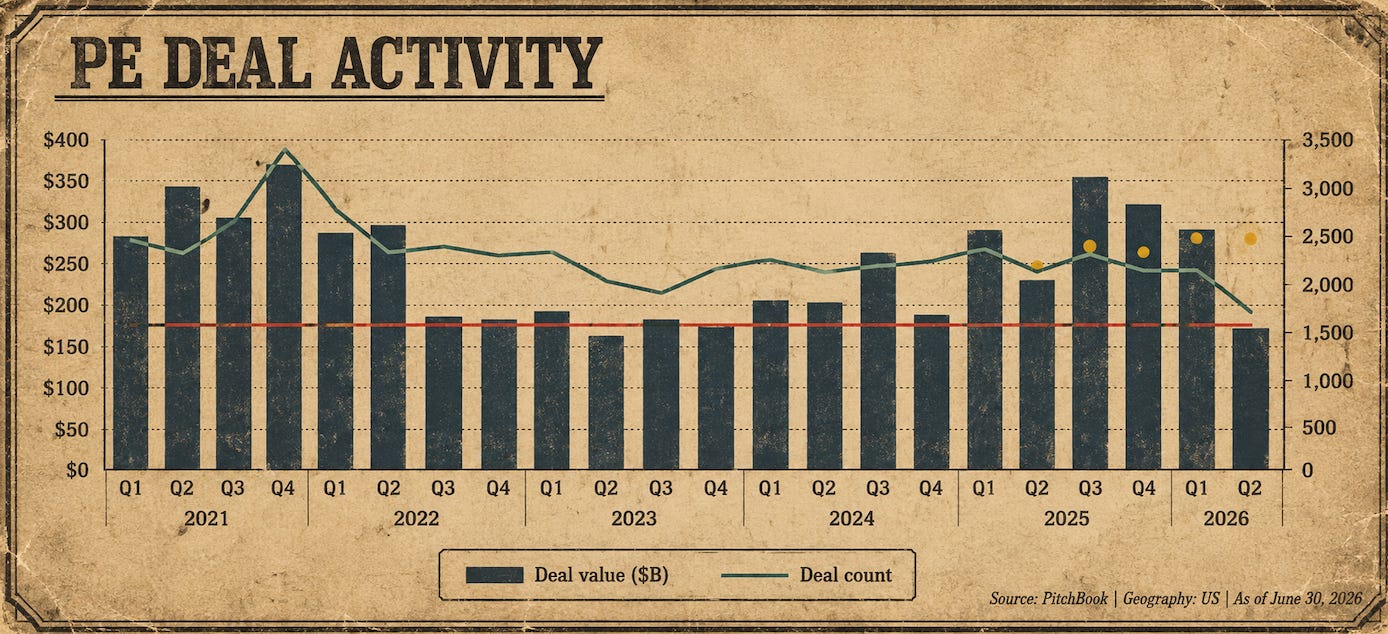
This doesn’t look particularly good, with both deal value and deal count down significantly over the past few quarters. One small silver lining is that average deal size appears to be coming down (the line is getting closer to the bars), which, in my book, is more important than sheer value.
I’m not sure why value is the metric that gets quoted in the press so often. $200B of transaction value that includes five $20B acquisitions isn’t necessarily healthier than 400 deals at $500m each. What we really need is for the lower middle market to start transacting and work through the backlog, not just a handful of healthy upper-market deals boosting the headline numbers.
Direct lending typically correlates with PE, so you could have predicted how it looked. Both value (or volume as they chose to say here) and deal count are down.
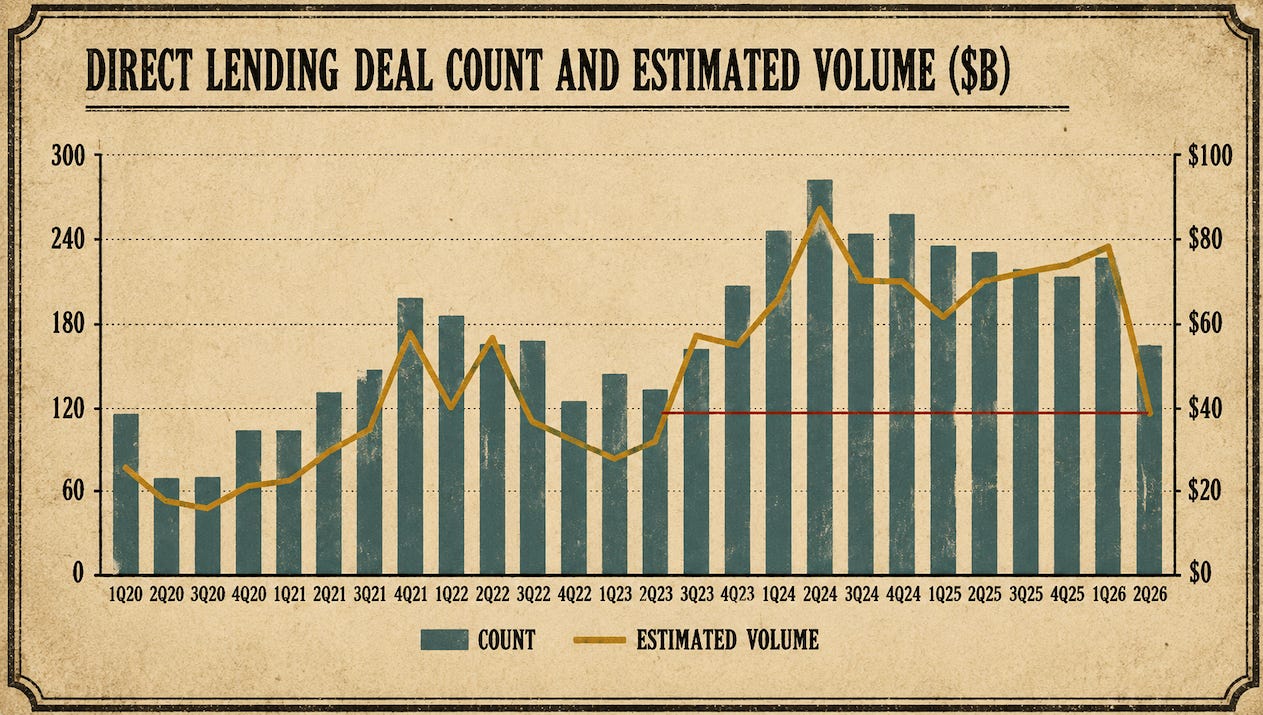
I don't know why they thought it was a good idea to switch the presentation (unlike the prior chart, deal count is now bars, not the line), but luckily there's no need to read too much into the chart: basically, we are back to 2023 value and transaction count.
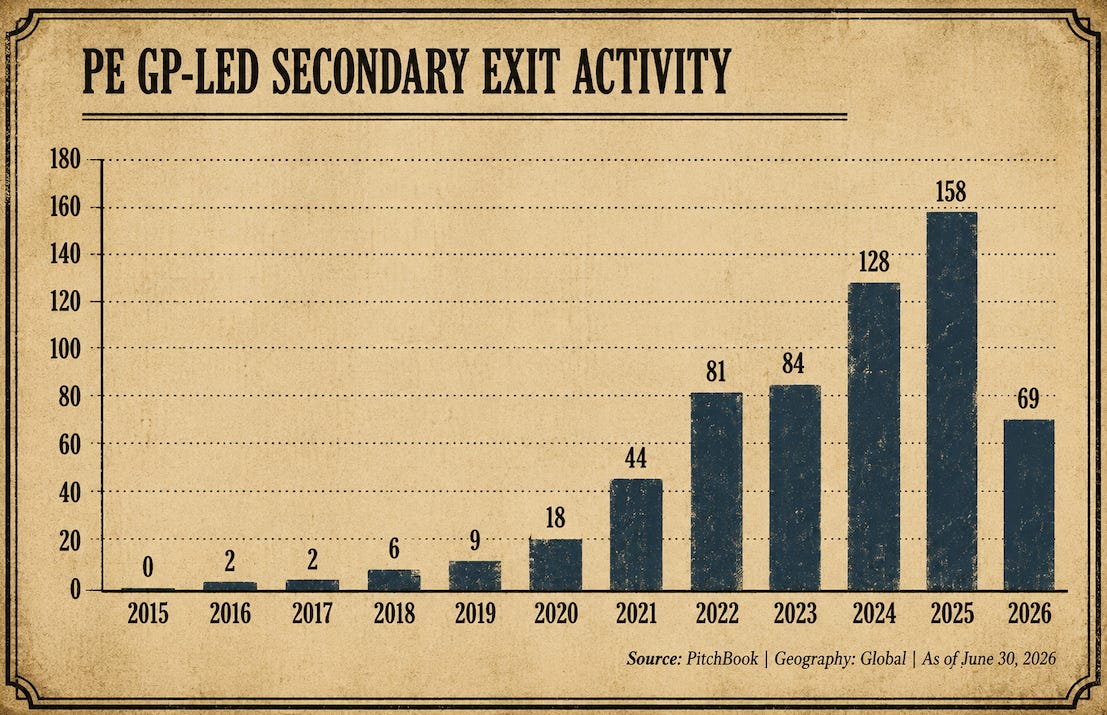
The last chart shows the number of exits through secondaries. Given all the discussion about the lack of liquidity and exits, along with the numerous articles about the growth in secondaries, I fully expected 2026 to be a record year for exits through this route.
So far, though, it looks like exits will come in below 2025 and roughly in line with 2024, which I find very strange. Well, it is what it is, I guess.
Overall, a nice little report. Not too many words, plenty of charts, and perfect for when you need a break from actual work but still want something work-related on your screen while daydreaming about the weekend.
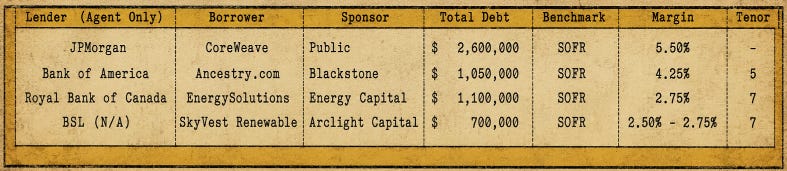
Download below: the full Excel file covering deals completed in 3Q26 (plus the prior three quarters).
CLICK to Download 3Q26 Details
Four debt/equity requests: $35m, $12m, $9m, and $7m (LINK)
NEW: Empirasign – the true leading provider of secondary market trading data for structured products, covering ABS, MBS, CMBS, CLOs with BWIC history dating back to 2010. They also carry realtime market data for IG/HY bonds as well as secondary loans. Used across desks at every major dealer, hedgefund and asset managers, Empirasign offers the most complete data and correct data set for credit practioners, and DEBT SERIOUS readers get a 1-month completely FREE trial. Click the LINK and select DEBT SERIOUS during registration
WSJ Online is offering 65% off its annual subscription ($4 per week vs $11) LINK.
Bloomberg is offering 60% off its annual subscription ($180 vs $399). If you are in Business, Bloomberg is a MUST, with no real close alternative (LINK).
Shortcut.AI, an AI tool for Excel that lets you build models by simply typing requests (similar to ChatGPT). It is free to use up to a certain number of tasks per day (LINK). If you hit your limit before finishing your project, simply upgrade to the Pro plan ($20/month) and enter promo code DEBTSERIOUS (all capital letters) to get 50% off.
LoanEdge, a BDC research tool that lets you look into BDC loan compositions, individual loans, which BDCs own a specific loan, and more, is kindly providing DEBT SERIOUS readers with a free 3‑month trial (the regular price is ~$3k per year, and it’s higher for institutions). Here is a LINK to the tool. Send an email to Sadaf Khan at sadaf@theloanedge.com and let her know you are from the DEBT SERIOUS community.
As a reminder, I don’t personally benefit from either of these offers. I am just saving you money.
Lastly, our community is over 4,400 strong and includes a broad cross-section of mid- to senior-level professionals across private credit, private equity, LPs, and debt advisory. Please use the Bulletin Board at the end of each weekly letter to share events, discounts, or deals that benefit the community. I will continue to feature these opportunities and personally connect interested parties at no cost.
Aznaur.Midov@KierLior.com
Comments
Nothing yet. Say the first thing.
Sign in to join the conversation.