
In Round #54:
Why Georgia’s GDP has doubled
Kevin Warsh and the leveraged basis trade
Wells Fargo’s quarterly direct lending report
Eagle Point on software loans and CLO equity investing
Notable deals
Bulletin board
Disclaimer: there are 4,400+ of us here discussing private credit and leveraged loans, which is not a big world. At some point, I will probably throw punches at your company. I am blunt and sarcastic and, as friends like to remind me, too mouthy to live to an old age, so my take likely won’t please you. But don’t worry, next week it will be someone else in the spotlight and you will quietly nod along in satisfaction.
Also, none of this is investment advice.
P.S. There’s a new energy deal posted this week (see the Bulletin Board).
So, where was I? Ok, yesterday, the National Bank of Georgia (Georgia the country, not Georgia the state) kept its interest rate unchanged at 8.25%, despite inflation running significantly above its 3% target at 5.8%. The NBG is expected to keep rates unchanged for now, with inflation beginning to decline in the second half of 2026 and returning to its 3% target over the medium term. Who cares, right? Well, I do, because I’m currently visiting Tbilisi and have already gone through the “Wait a minute, what’s going on?” phase a couple of times.
The first time was when I boarded my Amsterdam-Tbilisi flight, fully expecting 95% of the passengers to be Georgians. Instead, it seemed like 95% were Westerners traveling to Tbilisi. This wasn’t a connecting flight, either, so Tbilisi was clearly their final destination.
The second time was when I decided to look into the country’s economy and came across the 10-year GDP chart below. I’m not an economist, but seeing GDP more than double in 5 years, after a fairly ordinary growth rate in the previous 5 years, blew my mind.
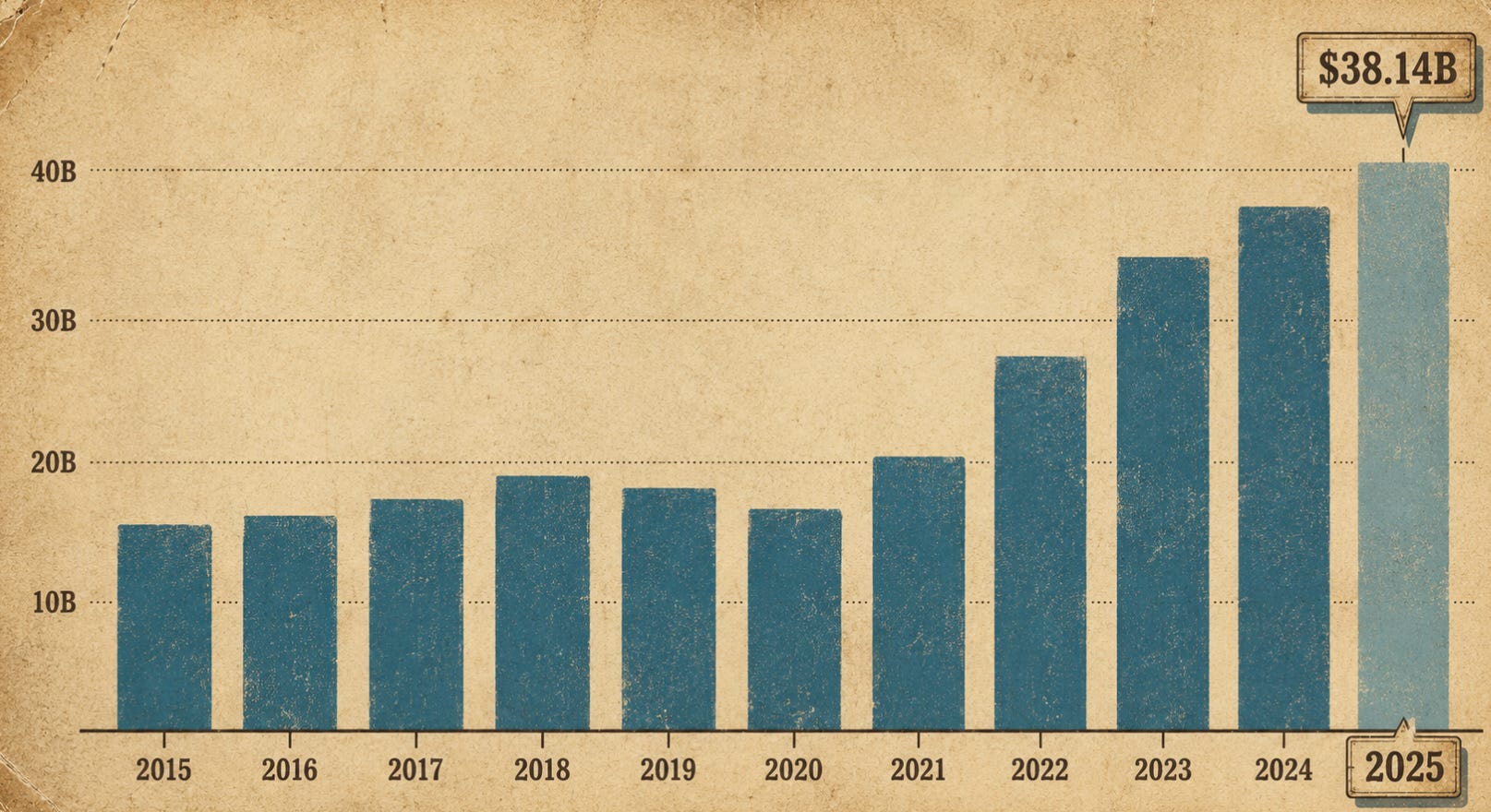
Well, I then looked at where the country is located, remembered the major conflict involving its much larger neighbors, and figured the two were probably connected. It was somewhat counterintuitive, though, because I thought security concerns would hurt the region, not help it. I was wrong. It turns out Georgia’s post-2021 economic boom was fueled in part by a recovery in tourism, but mostly by a surge in immigration, financial inflows, and transit trade following the Russia-Ukraine conflict.
The tourism part is easy to explain: mountains, great food and wine, and low prices. That said, the tourism recovery was driven by the end of COVID, not the conflict, obviously. The immigration part is pretty straightforward too. A significant influx of Russian, Ukrainian, and Belarusian immigrants escaping the conflict increased demand for goods and services, but with the population growing by only about 200,000 people over five years to 3.9 million, it clearly wasn’t enough to explain GDP more than doubling.
Financial inflows were a much bigger contributor. Because of sanctions and broader security concerns, entire businesses relocated from Russia, Ukraine, and Belarus to Georgia. They brought capital, created jobs, increased demand for the Georgian currency (the lari), boosted exports of goods and services, increased demand for loans, generated higher tax revenues, and everything else you learned in Economics 101.
Then there was transit trade. As the Russia-Ukraine conflict made some of the traditional trade routes between Europe and Asia much harder to use, more goods started flowing through Georgia instead, turning it into one of the region’s main transit hubs.
What’s also quite interesting is that Georgia wasn’t the only country to benefit from the conflict. Several neighboring former Soviet republics did as well, especially the smaller economies, where it takes much less to move the GDP needle. Below are the main beneficiaries (I also included cumulative inflation, since it contributes to nominal GDP growth).
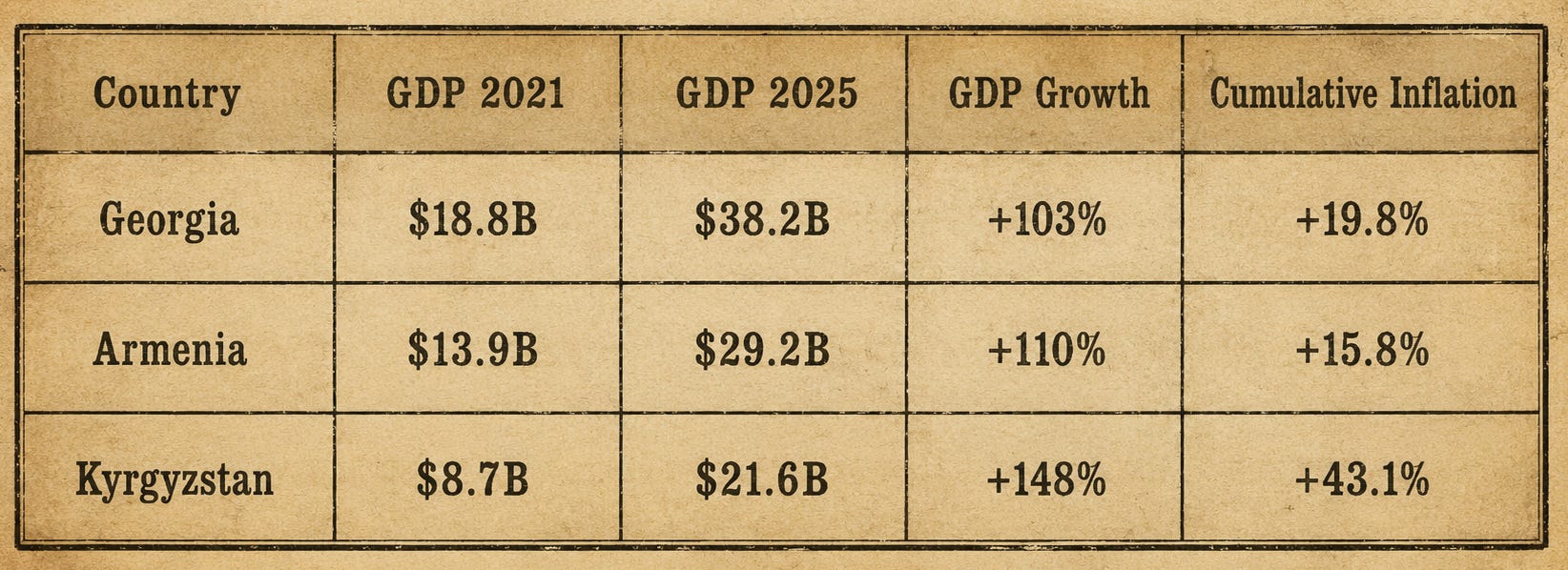
So, is there a private credit opportunity? Not yet. Some of the largest U.S. private credit funds have more AUM than the entire GDP of these countries, although slapping “Armenia Fund I” on a pitch deck is certainly more memorable than launching yet another lower-middle-market direct lending fund. So why should you care? Well, IDK, these countries have mountains, great food and wine, and low prices, so the next time you’re planning a European vacation, skip Paris and come to Tbilisi…

This post was definitely not sponsored by the Ministry of Tourism of Georgia… although it probably should have been.
Back on home turf, since we touched on interest rates earlier. The Fed kept rates unchanged at 3.50%-3.75%. The Financial Times had an interesting piece last week on Kevin Warsh’s shift from transparent forward guidance to taking a much more tight-lipped approach. As the Financial Times puts it, Warsh said:
“Financial market prices are probably the most important source of information to guide central bankers,” he [Warsh] said at his inaugural press conference last month. “But when all the financial markets are doing is reflecting back what we’ve said, then we’re taking the most important source of information and we’re being blind to it.”
I like how Ajay Rajadhyaksha, global chair of research at Barclays, laid out his take on the shift
Forward guidance has turned markets into a mirror. The Fed watches markets; markets watch the Fed. And no one’s actually watching the economy.
It’s hard to argue with that logic, as it sounds bulletproof. The problem is that a significant number of market participants (including myself) haven’t operated under Greenspan and his ambiguity policy. So, there is a pretty good chance this perfectly sound libertarian-ish view turns into another example of “be careful what you wish for.” Because we recall what happened to many crypto bros in 2022 who wanted independence from the financial system but as soon as their altcoins blew up, asked for a bailout and regulation.
And there are other things to worry about besides just the Fed’s new communication approach. The article points out that the ownership of the Treasury market has changed quite a bit. Historically, U.S. Treasurys were primarily held by patient, long-term investors, such as insurance companies and pension funds. Hedge funds have always been active in the market, but their Treasury holdings have grown dramatically in recent years. They now own about $2.5T of Treasurys (for reference, China holds around $660B). Even more interesting, their Treasury exposure has doubled over the past two years, growing much faster than the Treasury market itself.
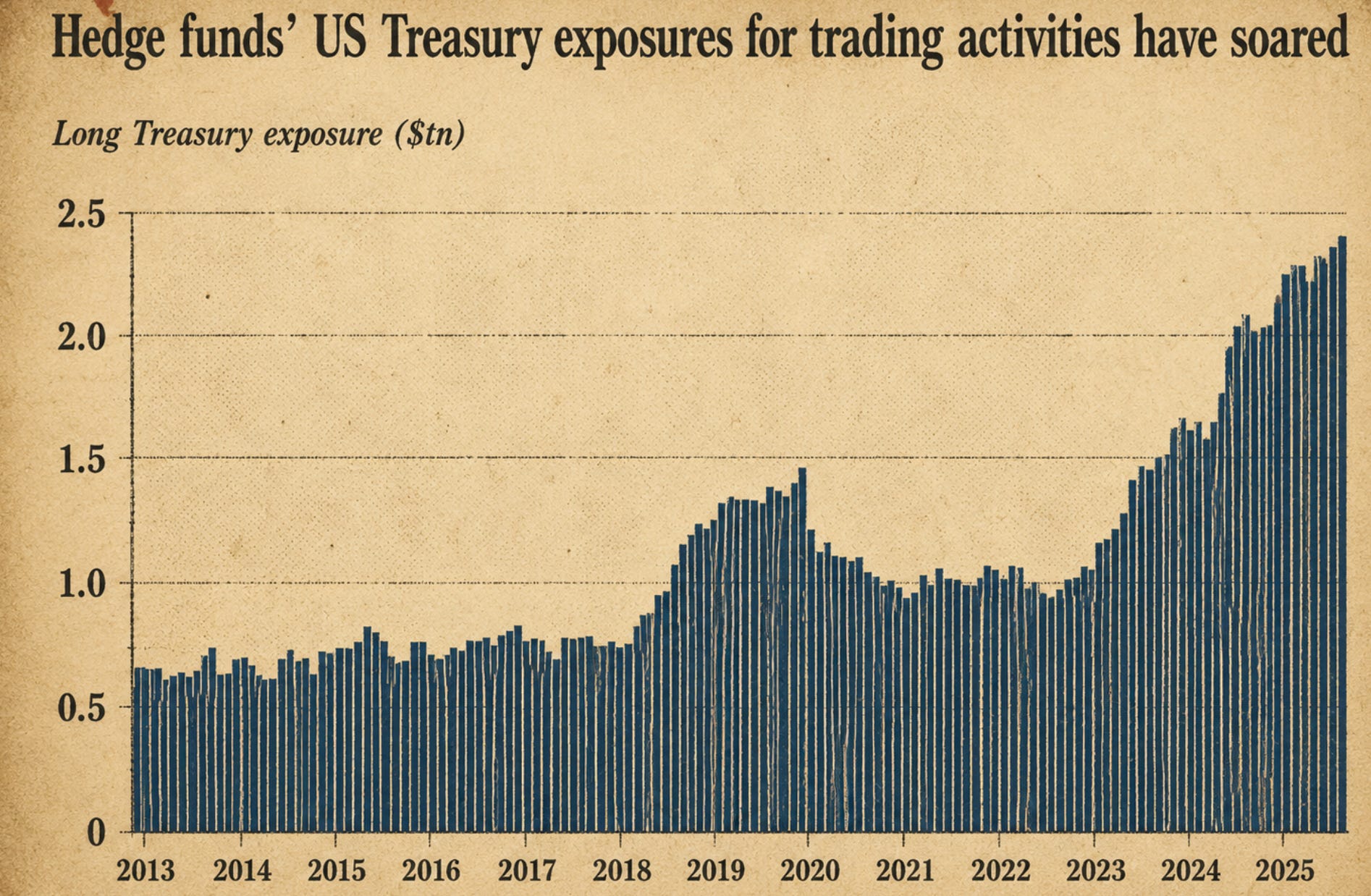
The concern is that many of these funds are running leveraged basis trades (discussed below). If those trades start going against them, hedge funds could be forced to unwind their positions, creating a liquidity crunch in what’s supposed to be the most liquid market in the world.
I’m gonna be honest, I have no idea what the repercussions of that would be. That’s more of a question for economists and the liquid credit crowd. But, at least optically, the chart above doesn’t look good. The buildup in these positions has been incredibly steep (at least to my liking).
Also, if you have no idea what a basis trade is, don’t worry. Until a few days ago, neither did I. I got tired of reading about it without actually understanding how it worked, but never cared enough to dig into the mechanics. Well, until I started writing this letter. I can now proudly say I’m about 5% less clueless than I was before.
Basis Trade
This might have been the most confusing concept I tried to wrap my head around, mostly because different sources explain it differently. At its core, the trade is actually pretty simple: you buy, say, a 10Y Treasury (go long) and short 10Y Treasury futures. Then you come across futures quotes that look like this, and suddenly you start wondering whether you understood any of it correctly:
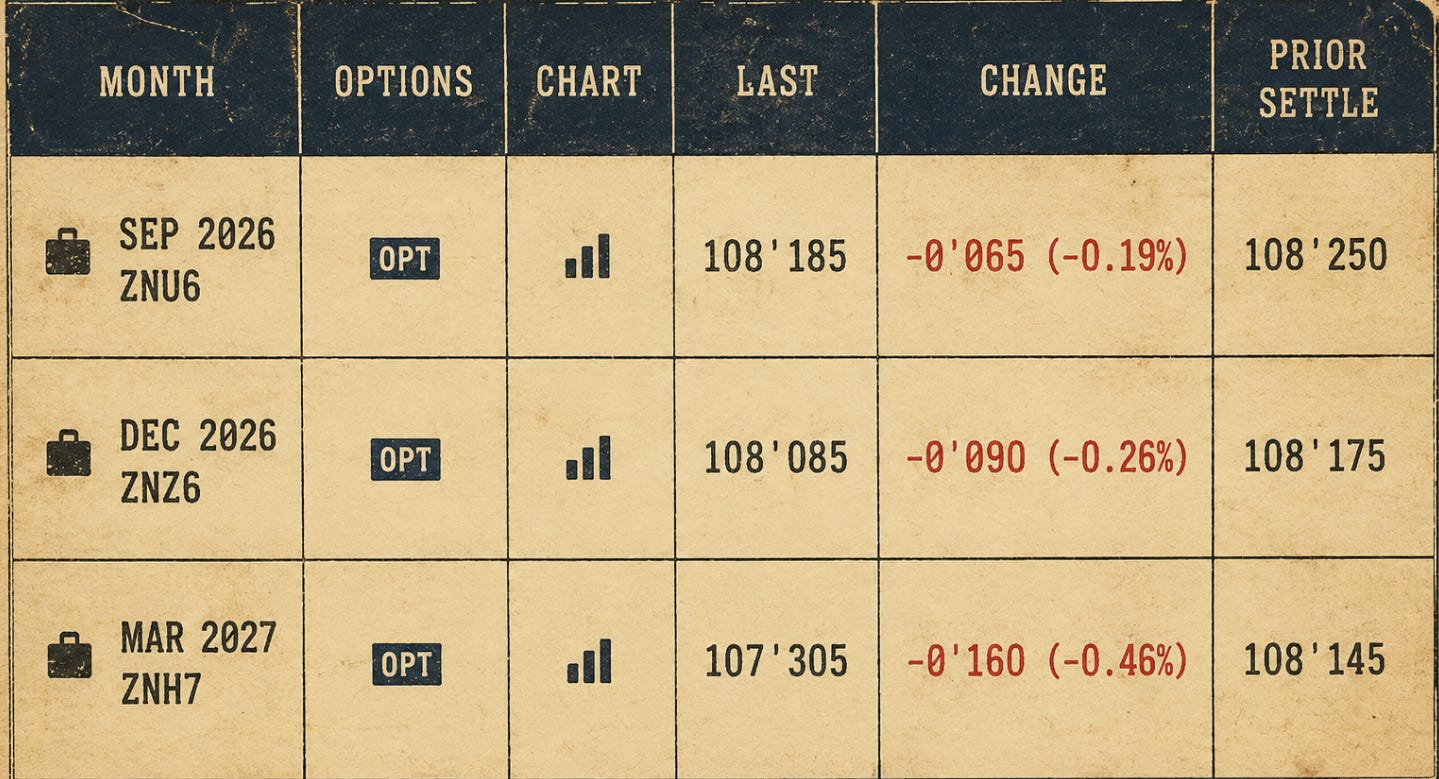
So, with the 10Y Treasury priced at, say, $98.50, the futures quote of $108.125 sounds like way too rich of a spread. Well, two things:
Those 108s are not the prices of 10Y Treasurys, but rather the quoted prices for the Treasury futures contract. To convert that quote into the price of the Treasury that can actually be delivered into the contract, I need to multiply it by something called the Conversion Factor, then account for accrued interest and a few other adjustments. For simplicity, let’s ignore those other adjustments and just multiply 108 by the first conversion factor of 0.9127 (which may or may not be the cheapest-to-deliver bond…long story). That gives us $98.74, which makes the comparison to the Treasury’s $98.50 price a lot more intuitive.

That said, relative value is what ultimately matters. We are not betting on a specific price target for the 10Y Treasury, but rather focusing on the spread between our long and short positions. Since we initiated the trade with a spread of -$0.24 ($98.50 minus $98.74), the position becomes profitable as that spread narrows.

Leveraged Basis Trade
Now, that $0.24 spread is before accrued interest and a few other adjustments, so the actual profit opportunity is even smaller (say, it is $0.05). How do hedge funds make money on such tiny spreads? Leverage.
Specifically, repo. And you remember how repo works, right? Suppose a hedge fund wants to buy $100m of 10Y Treasuries from a dealer, say Goldman Sachs. It doesn’t have $100m sitting in its bank account. Instead, before the trade settles, it arranges repo financing with JPMorgan. JPMorgan agrees to lend the hedge fund $99m, with the Treasuries serving as collateral for the loan. When the trade settles, Goldman Sachs delivers the Treasuries, JPMorgan wires $99m to Goldman Sachs on the hedge fund’s behalf, and the hedge fund contributes the remaining $1m. The hedge fund now owns $100m of Treasuries, despite only putting up $1m of its own capital.
On the other side, the hedge fund enters into $100m of Treasury futures. Unlike buying Treasurys, it doesn’t need an additional $100m to do so. Instead, the futures exchange requires the hedge fund to post only a small amount of collateral, typically only a small fraction of the contract’s value. By posting just a few million dollars of margin, the hedge fund can establish a $100m short futures position.
So, with only a few million dollars of its own capital, the hedge fund has effectively created a $100m long position in Treasuries and a matching $100m short position in Treasury futures.
The Concern
With all that background, let’s go back to the Financial Times piece and see why Warsh chose to frame his comments around hedge funds’ Treasury exposure. The article continued:
An interest-rate surprise from the Warsh Fed might not only unsettle Treasury yields but set off a vicious circle of margin calls — when a sudden price movement in assets bought with borrowed money requires an injection of capital — and fire sales by hedge funds that could create a dash for cash.
Torsten Sløk, chief economist at Apollo, the private equity giant, says that there is more chance of such a scenario — which he labels a “leverage unwind” — because of the Fed’s change of stance. He adds: “It is indeed the case that when you have less forward guidance, things can happen all of a sudden.
I don’t think I can add much more color to that paragraph.
Time Out
So, a few months ago, you spoke to your boss about your compensation. You thought you were underpaid, but when the dust settled, your pay barely moved. Well, that’s because you probably didn’t realize just how underpaid you were and ended up asking for too little. Like, if you’re a Director at a private credit fund, your base salary alone can range anywhere from $215k to $300k… and don’t even look at the bonus. See? You’d know that if you used BuysideHub, where I shamelessly stole the data below.
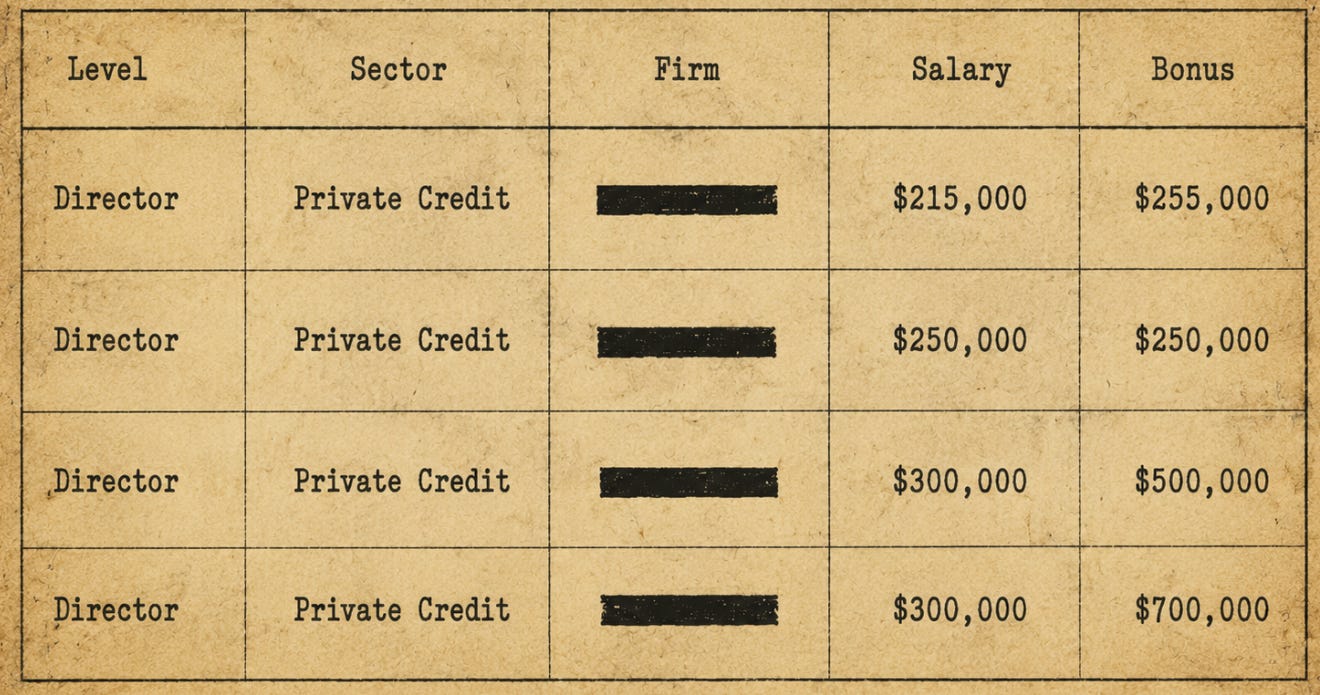
Anyway, below is the word from BuysideHub, which happen to be the sponsor of this Round.

Buyside Hub is a compensation analytics platform heavily used by Private Credit and Leveraged Finance professionals.
It is the one-stop shop for a detailed compensation breakdown for Buyside Credit professionals.
And it’s 100% free for those who join and contribute to the platform. You can join 15,000+ other Buyside Hub community members here:
Wells Fargo CIB’s Q2 report on direct lending is out (download below), laying out the key themes and trends. Historically, volatile markets tend to slow down loan origination but lead to higher-quality loans. These dynamics reinforce each other, as lenders become more selective and, when they do extend credit, demand stronger terms. The Q2 results were largely in line with what you’d expect, although it’s worth putting some numbers behind the trend.
Total origination fell QoQ to its lowest level since Q3’23, which isn’t exactly surprising. We covered this in Round #52, where Reuters noted that the slowdown in deal activity came just as direct lending funds were raising record amounts of capital. Those two trends rarely coexist for long. Eventually, managers have to deploy that capital, and that usually means competition for deals increases and underwriting standards begin to loosen.
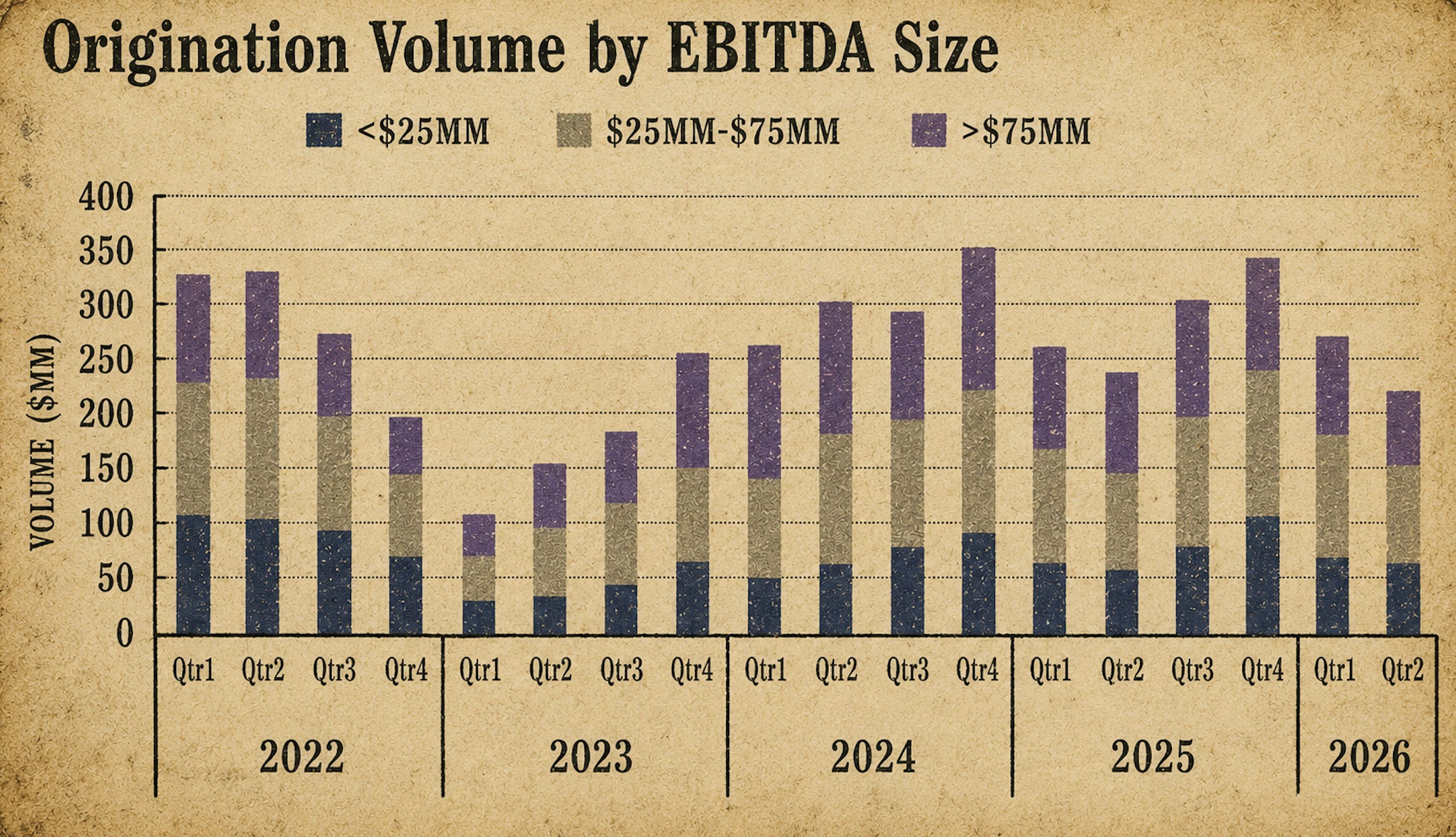
Oddly enough, that might not be such a bad thing. Private equity dealmaking has already been slow, and if lenders stay this picky, it’s hard to see transaction volumes picking up anytime soon. A little more competition among lenders could be exactly what the market needs to get deals moving again, even if it comes with a bit more flexibility on terms.
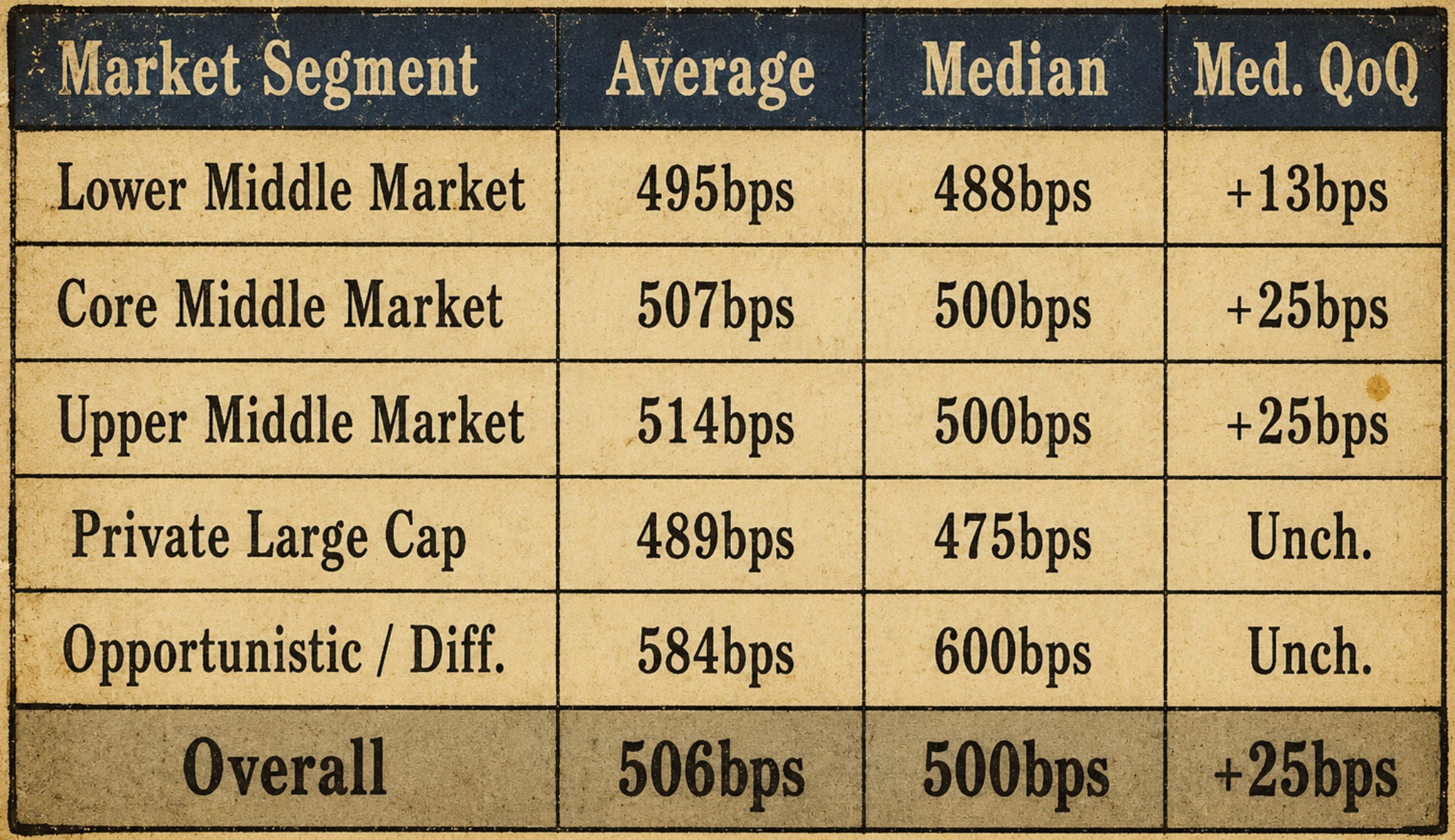
Pricing improved across three of the five market segments (below), while Large Cap and Opportunistic Credit stayed flat QoQ. Interestingly, last quarter it was the exact opposite, with Large Cap and Opportunistic spreads tightening by 25 bps and 12 bps, respectively. So, over the past two quarters, we’ve basically had a perfect catch-up.
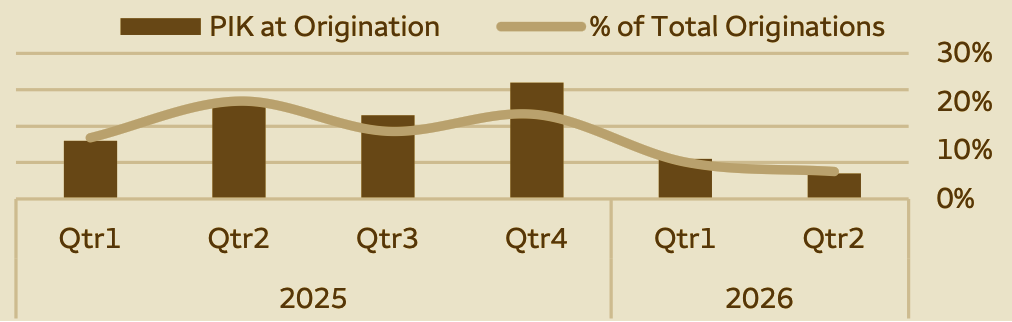
On stronger terms, Wells’ report shows that both average senior net leverage and interest coverage on new loans improved by 0.2x, to 4.4x and 2.6x, respectively. Media-beloved “good PIK” also fell to its lowest level in the past two years.
Lastly, let’s talk about the maturity wall. On its own, the chart below pretty much matches what the media has been saying: the 2028-2029 cohorts are shaping up to be the fun ones to deal with. But as I’ve written before, I’m less pessimistic about refinancings than most. Historically, these maturity walls have a way of smoothing themselves out as borrowers refinance ahead of schedule.
Software loans are definitely the wildcard because of how much uncertainty AI has created around the sector. Even so, if you compare the Q1 and Q2 charts, you’ll notice that the 2026 and 2027 cohorts have already started to shrink, suggesting at least some borrowers are refinancing early (see the chart).
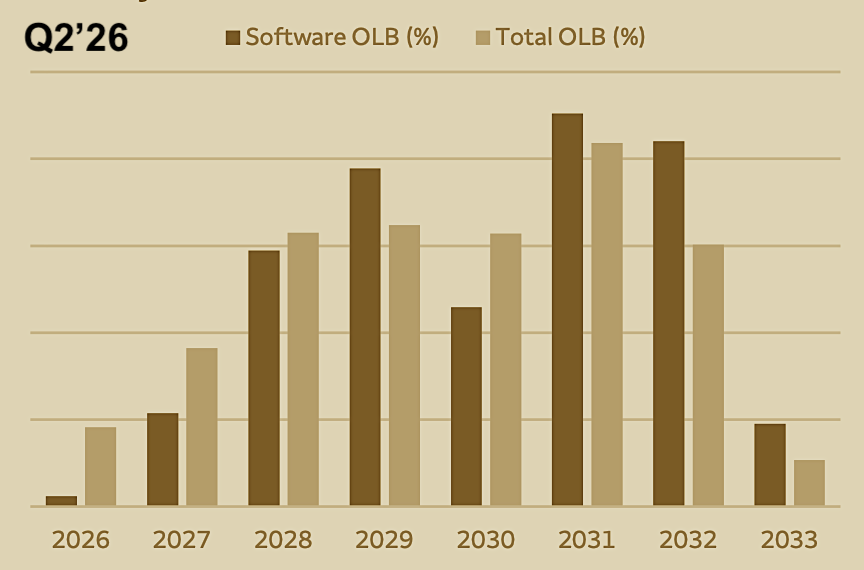
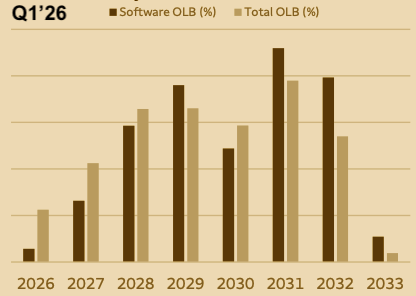
Ironically, I actually think the 2026 and 2027 cohorts are the tougher ones. Those loans will need to be refinanced before we have a much clearer view of what AI will actually do to the software industry, which makes the early refinancing activity even more encouraging. Of course, it’s probably the stronger credits extending first. The real question is whether that trend eventually trickles down to the rest of the market.
One other thing that caught my eye is the increase in 2033 maturities. That’s probably driven mostly by new issuance, with some contribution from refinancings of the 2026-2027 vintages, although I’d guess those are still the minority.
To be honest, I’m surprised lenders are still comfortable writing 7-year loans to software companies. If AI has taught us anything, it’s how quickly technology can change. Personally, I’d argue that even the traditional 5-year term is too long for software businesses. ChatGPT has been around for just 3.5 years, yet it has already forced the entire software industry to rethink its future. If you asked me, 3-year loans should probably become the new standard for the sector (and I’m in the camp that AI’s impact on software has been overblown).
The problem is that no lender can do that on their own. Push for a 3-year maturity, and the sponsor will simply find someone else willing to write a 5-year deal, and you probably won’t get another call from them. At the same time, lenders obviously can’t coordinate on shorter maturities without raising antitrust concerns, or at the very least triggering backlash from the private equity crowd. So the only realistic path is to slowly shift the narrative by talking about it on podcasts, writing about it on social media, and bringing it up in interviews until everyone accepts that 3-year loans should become the new standard for software companies.
I guess I just fired the first shot.
Download Wells Fargo Q2 Report
The Credit Edge podcast is one I listen to quite often, and every now and then they put out a good episode. I enjoyed their recent conversation with Tom Majewski of Eagle Point Capital, a firm best known for investing in CLO equity. A few interesting tidbits below:
On AI’s impact on the software industry
AI disruption is real, but the market may be getting ahead of itself. Like Amazon transformed retail without destroying it, AI will reshape software over time, with mission-critical applications likely proving far more resilient than lower-value tools. There will be an impact, likely more severe than many expect, but it will come later because the implementation of innovation takes time.
On software loans
Most loans are refinanced well before their contractual maturity, so borrowers often have another opportunity to refinance before facing a true maturity event. Companies can also move between the syndicated and private credit markets depending on their circumstances, giving them multiple refinancing options. Companies with revenue and EBITDA may continue accessing the capital markets despite deteriorating performance. There will eventually be a day of reckoning, but time is a lender’s friend, as borrowers can refinance from SOFR +300bps to +600bps or even 800bps, because paying higher spreads is preferable to losing all their equity.
On rising CLO default fears
There are always outliers. Even in the CLO 1.0 era, 96% of CLOs delivered positive equity returns, with median IRRs well above marketed base cases. Historically, the biggest risk to CLO equity hasn’t been defaults but spread compression. In 2025, Nomura estimated CLO equity returned -15%, driven less by credit losses than by loans repricing tighter (e.g., 375 bps to 325 bps), reducing asset income. Managers can offset some of this by refinancing and resetting CLO liabilities, but liability spreads tightened far less than asset spreads, causing net interest margins to compress despite proactive management. Ironically, bull markets and loan repricing have historically hurt CLO equity more than defaults. Even a hypothetical 10% default rate over the next 12 months may be less damaging than severe spread compression, depending on where loans trade.
On CLO equity returns this year
Banks reported non-trivially negative 1H CLO equity returns, driven more by credit volatility than spread compression. Most of the spread compression appears to have played out, issuance has become more disciplined, and third-party equity participation is expected to increase in 2H after a 2025 market dominated by manager-sponsored deals. While loan price declines weighed on CLO equity valuations, realized credit losses have remained limited despite restructurings and modifications. Secondary CLO equity and existing portfolios currently offer more attractive opportunities than new issue CLOs.
On private credit loan marks
Private credit valuation opacity remains frustrating, particularly when loans are held at 100 for multiple quarters and then suddenly marked at 30. While differences such as 98 versus 95 across BDCs are reasonable for Level 2/3 assets, marks of 60 versus 100 on the same loan should not happen. At the same time, revenue across many portfolio companies continues to grow, EBITDA is generally flat to growing, and 10%-30% revenue declines remain isolated rather than widespread. Even so, most BDCs continue to trade at discounts to book value, reflecting market expectations of future credit losses that are viewed as overpriced.
Overall, it’s worth a listen.
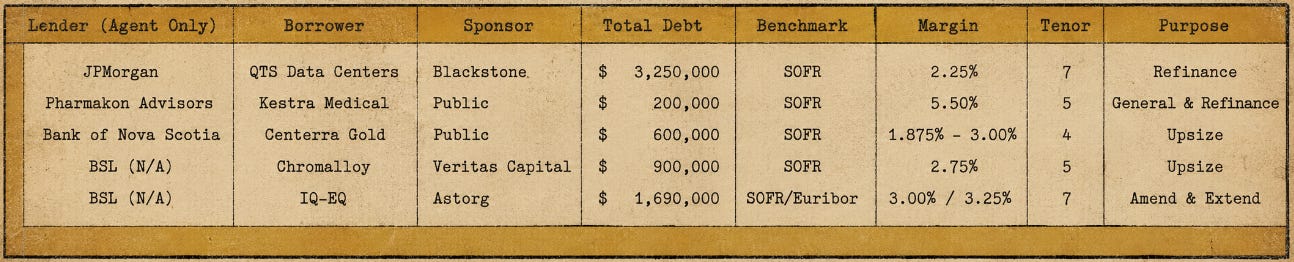
Download below: the complete Excel file covering deals completed in 3Q26 (plus the prior three quarters).
CLICK to Download 3Q26 Details

KIÉR LIÓR – Providing outsourced private and leveraged loan underwriting and portfolio management to institutional investors, family offices, and direct lenders.
www.KierLior.com
Four debt/equity requests: $35m, $12m, $9m, and $7m (LINK)
WSJ Online is offering 65% off its annual subscription ($4 per week vs $11) LINK.
Bloomberg is offering 60% off its annual subscription ($180 vs $399). If you are in Business, Bloomberg is a MUST, with no real close alternative (LINK).
Shortcut.AI, an AI tool for Excel that lets you build models by simply typing requests (similar to ChatGPT). It is free to use up to a certain number of tasks per day (LINK). If you hit your limit before finishing your project, simply upgrade to the Pro plan ($20/month) and enter promo code DEBTSERIOUS (all capital letters) to get 50% off.
LoanEdge, a BDC research tool that lets you look into BDC loan compositions, individual loans, which BDCs own a specific loan, and more, is kindly providing DEBT SERIOUS readers with a free 3‑month trial (the regular price is ~$3k per year, and it’s higher for institutions). Here is a LINK to the tool. Send an email to Sadaf Khan at sadaf@theloanedge.com and let her know you are from the DEBT SERIOUS community.
As a reminder, I don’t personally benefit from either of these offers. I am just saving you money.
Lastly, our community is over 4,400 strong and includes a broad cross-section of mid- to senior-level professionals across private credit, private equity, LPs, and debt advisory. Please use the Bulletin Board at the end of each weekly letter to share events, discounts, or deals that benefit the community. I will continue to feature these opportunities and personally connect interested parties at no cost.
Aznaur.Midov@KierLior.com
Comments
Nothing yet. Say the first thing.
Sign in to join the conversation.