
In Round #53:
DEBT SERIOUS: One Year Later
Goldman Sachs pitches LPs to buy back their own capital call lines
Cox Capital’s tender offer for Apollo, Ares, and HPS BDCs
Notable Deals
Bulletin Board (including THREE new deals)
Disclaimer: There are 4,300 + of us here discussing private credit and leveraged loans, which is not a big world. At some point, I will probably throw punches at your company. I am blunt and sarcastic and, as friends like to remind me, too mouthy to live to an old age, so my take likely won’t please you. But don’t worry, next week it will be someone else in the spotlight and you will quietly nod along in satisfaction.
Also, none of this is investment advice.
P.S. If you lend / invest in Latin America, don’t miss the Bulletin Board. There are three Energy deals posted this week.

This week marks the first anniversary of DEBT SERIOUS. That’s right, I’ve been ranting about private credit and leveraged loans for a year now. And the community of people who voluntarily put themselves in the position of listening to those rants has grown to 4.3k subscribers and ~500 followers (followers are basically just shy subscribers). There are almost 100 of you debtageeks who even decided it was worth paying for my free newsletter, which is really flattering (and I, of course, appreciate it, and am working on something for you, as promised).
Perhaps the most fascinating thing is how diverse this community is, from students to senior executives in alts... including people from firms I've thrown punches at, so kudos for being good sports and not sending me angry emails or unsubscribing.
Jokes aside, I just wanted to thank you all for letting these letters into your inbox, helping make the newsletter one of the largest in the private credit/LevFin space, and pushing the podcast into the top 2-3% of business podcasts globally.
Now that my LinkedIn-style humblebrag is over, I’d like to ask you to make this a two-way conversation: send me an email with a few words about yourself (aznaur.midov@kierlior.com), add me on LinkedIn, forward the newsletter to your junior staff so they can nerd out, or to your bosses... so they can do what the big guns I mentioned two paragraphs ago are already doing.
Also, start using the Bulletin Board. It’s a free resource to downsell exposure (if you’re a lender), raise debt (if you’re a debt advisor or in PE, idk), announce a tender offer for a BDC (hey, you never know), or post anything else you think the community could benefit from.

Alright, one more thing: this letter is shorter than usual because I’m traveling, but I didn’t want to break the weekly ritual.
If you are not intrigued by the article titled Goldman Pitches Investors on Loans to Their Own Private Funds, I am not sure you are a human. Goldman’s new pitch fascinates me and, to be honest, mildly confuses me as well. Here is what Bloomberg says:
Goldman Sachs’ fund-finance team is pitching a trade that would allow large investors to buy back so-called capital call lines to their own funds. The bank would free up balance sheet capacity and keep some of the extra spread as part of the transaction, while limited partners would receive interest on capital that would otherwise be sitting idle.
I still remember the first time I learned about capital call lines (aka subscription lines) and then proceeded to ask my senior about 50 “Wait, but why?“ questions. For those who don’t know, most mid- to large-cap PE funds have one (well, GPs for that matter, but let’s stick to PE). It’s a revolving credit facility that the fund typically draws on when it makes an investment. In other words, the “equity” piece is initially funded by debt.
The primary reason is simple: convenience. Buying a company is a chaotic process with dozens of moving pieces. The last thing anyone wants is to add another one by coordinating capital calls with 50 different LPs while trying to get a deal across the finish line.
Without a subscription line, the instructions would sound something like this: "Reach out to all 50 LPs. Ask them to be ready to wire their pro rata share for an investment we're about to make, even though the purchase price is still tentative and likely won't be finalized until 3-7 days before closing. So, tell them to earmark roughly X, but expect it to change. If they send too much, we'll wire the difference back. Oh, and make sure all 50 wires hit our account no later than the day before closing. Go."
Alternatively, they can just tell Goldman, with whom they already have a subscription line in place, that the acquisition is coming a few days before the transaction closes and receive one wire for the entire amount needed. After the transaction closes and the chaos subsides, they can reach out to the LPs and request the funds. The difference is that LPs know exactly how much they need to wire, and the PE fund can collect those funds gradually, as not all LPs send their money at the same time. Once all the capital has been received, the line is repaid.
Two things before going back to the article:
These subscription lines are underwritten based on the credit quality of the LPs because, ultimately, the LPs are the ones on the hook. If the PE fund doesn’t repay the line, the LPs are still required to wire their share of the committed capital. That’s why these are considered very safe loans and typically yield around SOFR + 150-200 bps.
These lines are not repaid right after closing. They are typically outstanding for up to 6 months or even longer. PE funds are not in a rush to repay them because doing so helps boost their IRR by delaying when LP capital is called. Since IRR starts accruing only once LPs have wired their capital, delaying those capital calls artificially inflates reported IRRs.
With that background, here is what seems to be happening. Goldman basically told LPs: “Look, you guys fully guarantee these lines, but you do not even get paid for it. Why not earn some spread?” And this sounds like a no-brainer pitch.
If you think about it, as it stands today, LPs are indirectly lending money to PE funds at 0% (since they guarantee the facility), which makes it seem like they are doing it simply to boost PE funds’ IRRs, which is pretty strange. Under Goldman’s proposal, they can at least get paid for doing it, so people like me do not write pieces like this one.
Here is how I think it would work. Say a PE fund (”Bhoma Travo”) needs $50m. Bhoma still calls Goldman, with whom it has the facility in place, and Goldman funds $50m for the acquisition. Goldman then calls Bhoma’s LP (PamPERS), who agreed to participate in this new arrangement discussed in Bloomberg. The deal is that PamPERS will wire Goldman, say, 90% (just guessing) of the $50m ($45m), with Goldman keeping the remaining $5m, which I assume it would need to retain as the agent. PamPERS is now earning 5.50% (SOFR of 3.70% + 1.80%).
When Bhoma finally decides to repay the loan, it would reach out to PamPERS, asking it to fund its $50m commitment, because on Bhoma’s books, that transaction between Goldman and PamPERS didn’t happen. Then PamPERS, Bhoma, and Goldman hop on a call, and Goldman says: “Hey, Bhoma, don’t worry about it, we will work with PamPERS directly. PamPERS, you already sent us $45m, so just send us the remaining $5m.” All agree. PamPERS sends Goldman $5m, makes a few book entries in its accounting system, and that’s it. Everyone is happy. BTW, Bhoma was most likely aware of the transaction, so they didn’t go, “Wait, what are you two talking about?”
This is just my take, and I’m sure the transaction will be structured with more nuances, but directionally it should be correct.
There is one clarification in the piece:
This trade is meant for large investors who have committed capital through separately managed accounts where they are the sole investor in the fund, the people said. Groups of limited partners, working in coordination with fund managers, could also participate, they added.
The point is that Goldman wants to deal with only one PamPERS, or a few, because dealing with 50 would be a nightmare.

Reuters ran a piece titled Private credit roundup - Discounts show the cost of getting out, which worked as intended, and I clicked. The article is basically a collection of loose facts tied together by their proximity to BDCs, but it was the second paragraph that I was most curious about:
Pressure in private markets is showing up in an uncomfortable place: the gap between what funds say their assets are worth and what investors may have to accept to get out now.
Cox Capital Partners this week launched tender offers for shares in non-traded business development companies run by Apollo, Ares, and HPS, offering to buy them at discounts of 15% to 30% to their May-end net asset values.
Those of you following the BDC developments will recognize Cox Capital’s name because, a few months ago, they teamed up with Saba Capital and launched a tender offer for three of Blue Owl’s BDCs at 20-35% discounts to NAV. To my surprise, despite Blue Owl being featured in virtually every negative private credit headline, less than 1% of shares were tendered.
So, Cox is back, but this time it’s targeting BDCs managed by the largest alts, which also happen to have received the largest redemption requests this quarter. Cox’s press release provides the clearest summary of the tender offer and the rationale behind it:
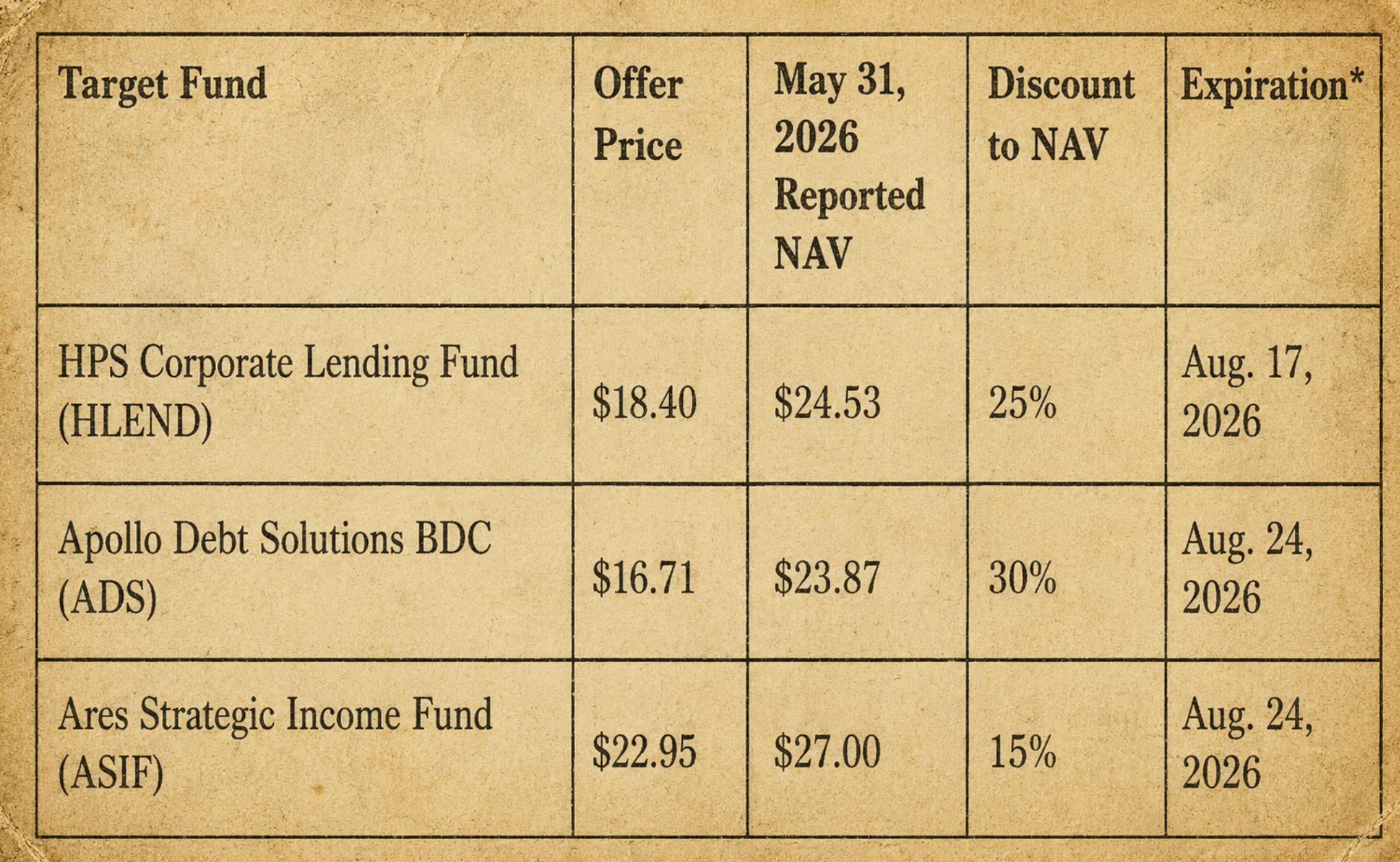
“Comparable traded BDCs trade at meaningful discounts to net asset value. We priced each offer on three things — portfolio quality, the liquidity characteristics, and those observable traded-market discounts — not on a negative view of these funds,” said John Cox, CEO and CIO of Cox Capital. “Repurchase demand ran well ahead of issuer program capacity again last quarter, and we believe the industry needs a standing utility for the unfilled remainder. For a holder seeking full liquidity, the practical arithmetic is a blended exit: shares accepted by an issuer program are repurchased at or near net asset value, remaining shares can be sold to us.”
There are a few things to note in the above:
First, Cox makes a very clever case to investors, basically saying, “be realistic: if you need money quickly, get some prorated at par and tender some to us.” On a blended basis, that’s not a bad outcome. Look at Ares, for example, where they are offering to buy shares at a 15% discount to NAV, which basically means that if, for every share you redeem at par, you tender one share at a 15% discount, you receive 92.5% of your money on a blended basis. Not perfect, but for those who need funds quickly, that might be attractive.
Second, they don’t bash the funds directly. In fact, Cox clarifies that this is not a negative view on the funds themselves. That’s likely true, although the fact that they offer different discounts to different funds may offend some managers (I don’t think Cox cares, though). They do note that they based the offer on portfolio quality, liquidity, and comps. The last two are straightforward, but the first is probably harder to figure out because there is no public information about the borrowers’ financial health.
Third, the assigned discounts are somewhat surprising. Apollo, which is often regarded as one of the leaders in the private credit space, is being offered the highest discount, which kind of stinks for them if they happen to see the table (well, they obviously don’t care, but it’s still optically annoying).
What’s also important, and not immediately intuitive, is what those discounts actually mean. I’ve seen people online throwing around their estimated values for the loans in these BDCs, saying they’re worth 60-70 cents on the dollar, without realizing how scary those numbers would be in reality. That would basically imply wiped-out equity across virtually all deals, which would affect not only the funds, but even your 401(k) because of the shock such a situation would send through the markets, reminding us that, in a panic, all assets become correlated.
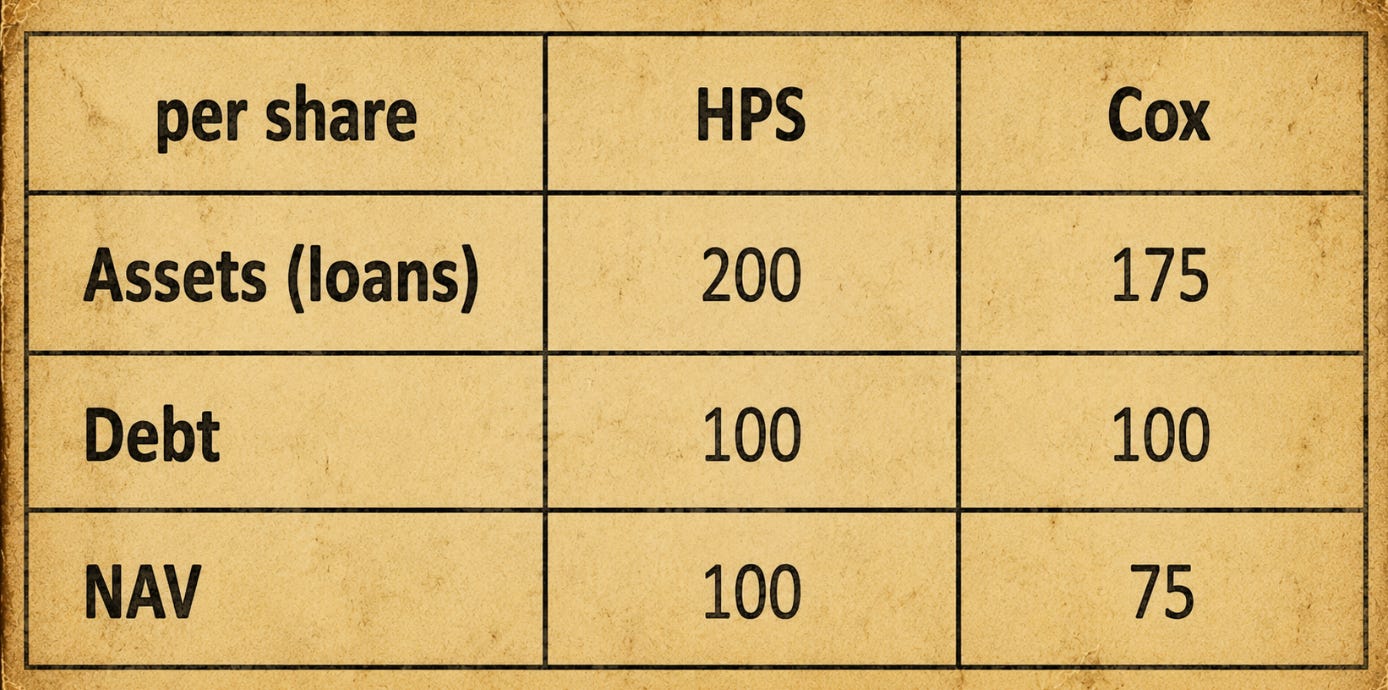
The reason, in my view, is that people are just used to hearing that BDCs trade at, say, 0.7x NAV, and they intuitively assign the same discount to the underlying loans. They forget that BDCs are typically levered roughly 1:1 ($1 of debt for every $1 of equity, where equity is BDC NAV). So a 0.7x NAV valuation doesn't mean a 30% discount to the assets; it's 15%, because leverage amplifies the effects of asset changes on NAV.
I’m going to over-explain this because, in my opinion, these dynamics are at the heart of Cox’s investment thesis. Let’s use made-up numbers, but tie them to Cox’s tender offer for HPS shares at a 25% discount to NAV.
In the chart below, HPS used $100 of equity (NAV), levered it 1:1 by borrowing $100, and originated $200 of loans, which it currently carries at par. Well, Cox is likely skeptical that those loans are worth par, but they don’t know their exact values, so they use the redemption panic to offer to buy the shares at a 25% discount to NAV, or $75. Because the debt amount is unambiguous, Cox is implicitly valuing the loan portfolio at $175 ($100 of debt + $75 of equity). So, divide $175 (Cox’s valuation) by $200 (HPS’ valuation), and you get 87.5%, which implies only a 12.5% discount (not 25%). Make sense, right?
Let’s say 100 thousand shares were tendered at $75 each, for a total of $7.5m. The best part of this strategy, at least the way I see it, is what comes next. Cox is not going to be an activist, trying to remove management and hire KIÉR LIÓR (my shameless plug) to manage those loans. When the redemption window opens, they will request to redeem all 100k shares they acquired. Well, they will be gated, and only 30% of their redemption request will be granted, so they will redeem 30k shares at $100 each, earning a 33% return ($25 gain on a $75 purchase price). Multiply the 33% quarterly return by 4 to annualize it, and you get an ~132% IRR (don’t nitpick). The following quarter they will do the same thing, be gated again, but redeem another pro rata portion of their shares. The IRR will be lower, however, since you only multiply the return by 2 to annualize it, as two quarters have passed. They’ll keep repeating the process until all of the shares are redeemed.
But that’s not all. HPS BDC also pays a 9% dividend, or $9 for every $100 of NAV. Cox will receive the same $9, but its cost basis is $75, so its dividend yield is 12%. That’s right, Cox will be gradually redeeming HPS shares at NAV, earning a juicy IRR while also collecting a 12% yield on the shares that haven’t been redeemed yet. By the way, that 132% IRR above is understated because it doesn’t include the dividend. So yeah, Cox will do just fine.
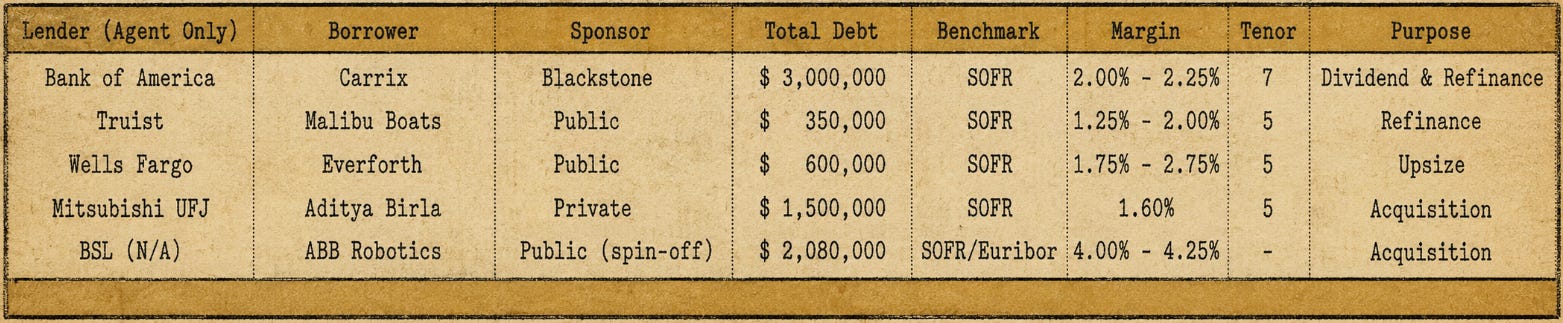
Download below: the complete Excel file covering deals completed in 3Q26 (plus the prior three quarters).
CLICK to Download 3Q26 Details

KIÉR LIÓR – Providing outsourced private and leveraged loan underwriting and portfolio management to institutional investors, family offices, and direct lenders.
www.KierLior.com
Three LATAM debt/equity requests: $35m, $12m, and $9m (LINK)
WSJ Online is offering 65% off its subscribers ($4 per week vs $11) LINK.
Bloomberg is offering 60% off its annual subscription ($180 vs $399). If you are in Business, Bloomberg is a MUST, with no real close alternative (LINK).
Shortcut.AI, an AI tool for Excel that lets you build models by simply typing requests (similar to ChatGPT). It is free to use up to a certain number of tasks per day (LINK). If you hit your limit before finishing your project, simply upgrade to the Pro plan ($20/month) and enter promo code DEBTSERIOUS (all capital letters) to get 50% off.
LoanEdge, a BDC research tool that lets you look into BDC loan compositions, individual loans, which BDCs own a specific loan, and more, is kindly providing DEBT SERIOUS readers with a free 3‑month trial (the regular price is ~$3k per year, and it’s higher for institutions). Here is a LINK to the tool. Send an email to Sadaf Khan at sadaf@theloanedge.com and let her know you are from the DEBT SERIOUS community.
As a reminder, I don’t personally benefit from either of these offers. I am just saving you money.
Lastly, our community is over 4,300 strong and includes a broad cross-section of mid- to senior-level professionals across private credit, private equity, investment banking, LPs, law, and other related fields. Please use the Bulletin Board at the end of each weekly letter to share events, discounts, or deals that benefit the community. I will continue to feature these opportunities and personally connect interested parties at no cost.
Aznaur.Midov@KierLior.com
Comments
Nothing yet. Say the first thing.
Sign in to join the conversation.