
In Round #52:
PitchBook's forecast for the size and composition of private credit in 2030
Is liquid credit's criticism of private credit justified?
HSBC cuts exposure to risky private credit funds
Interpreting KBRA's statistics on recurring revenue loans and ARR ABS
Direct lending raises more but deploys less
Notable deals
Bulletin board
Disclaimer: there are 4,300+ of us here discussing private credit and leveraged loans, which is not a big world. At some point, I will probably throw punches at your company. I am blunt and sarcastic and, as friends like to remind me, too mouthy to live to an old age, so my take likely won’t please you. But don’t worry, next week it will be someone else in the spotlight and you will quietly nod along in satisfaction.
Also, none of this is investment advice.
PitchBook just published a forecast for private market growth through 2030, covering various assets from PE to RE, and of course, private credit. There isn't a lot to discuss, but I like the charts they provided, as they remind us where private credit stands and where it is going.
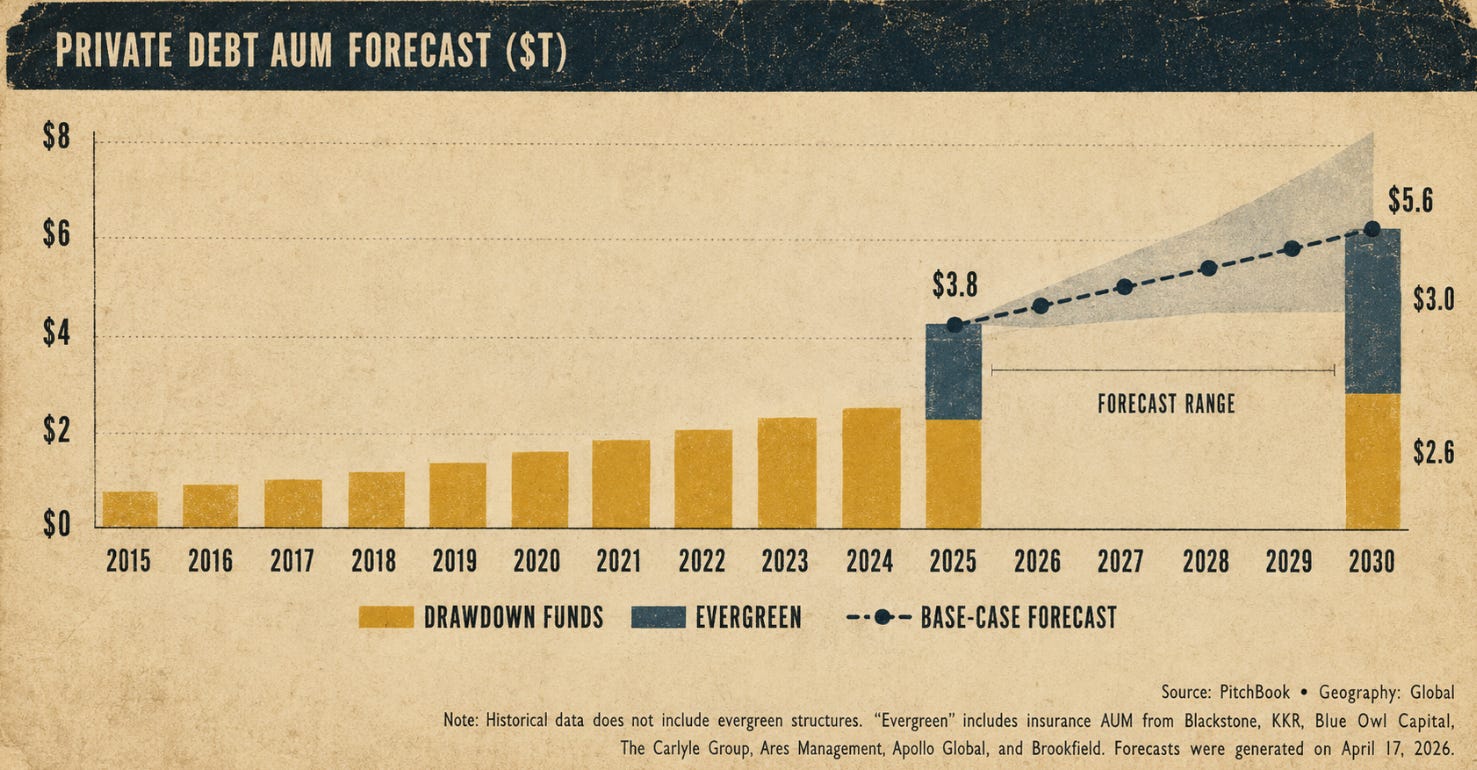
We are at $3.8T today and projected to hit $5.6T by 2030, which means I'll have something to write about for the foreseeable future. Now, that $3.8T is a rather elusive number because you'll see different outlets cite different figures, with Bloomberg, for example, insisting it is $1.8T. Part of the discrepancy is that many outlets keep using outdated numbers, and part of it is that the definition of private credit has been evolving.
PitchBook has also provided a breakdown of private credit by strategy, which is very helpful.
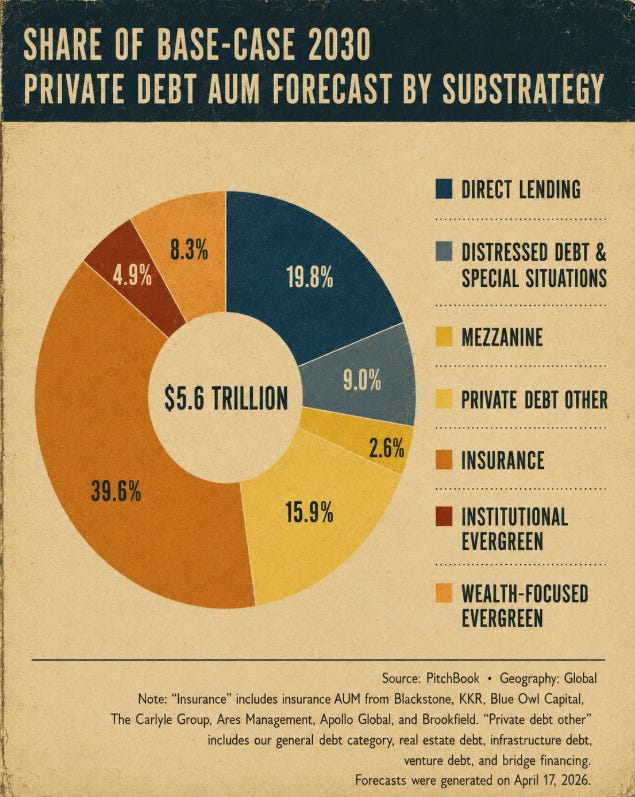
Assuming the current breakdown of private credit is directionally similar to what it will look like in 2030, most of the noise around private credit comes from the 8.3% allocated to wealth-focused evergreen funds (redemptions). That 8.3%, together with the 20% allocated to direct lending and 2.5% to mezzanine, are also where the other major headache associated with private credit sits: software loans.
So, when we hear that 20% of BDC loans are software loans, I guess that's 20% of 31%, or about 6% of total private credit. Let's round that up to 10% for conservatism, since other strategies have software exposure as well. Hey, maybe this PC thing isn't a systemic risk after all!

Readers know that I’m often critical of the media’s coverage of private credit, which is largely driven by fearmongering and clickbait. The media doesn’t make up facts, but it often presents them without context, making situations appear far more dramatic than they actually are. If you read the financial press and base your views solely on what you read, you will almost certainly come to the conclusion that private credit is in trouble.
But there is another group that has been vocal about private credit troubles, and they carry far more credibility than the media: public credit investors, or liquid credit investors, if you prefer that term. Whether they speak on a conference panel, appear on a podcast, or post on social media, their words carry more weight because they are experts in a closely related field. After all, credit is credit, so they know what they are talking about, right? And they do, but they, too, miss important nuances.
It is worth addressing the elephant in the room. For years, particularly during the low interest rate era, institutional investors increased their allocations to private credit in pursuit of higher yields, often at the expense of traditional public fixed income. Several years later, a different dynamic is emerging. I've read about it a few times, but since I'm not in the allocation game, I'll let BlackRock do the talking:
We also believe private credit is increasingly being considered by investors in the context of their broader fixed income allocations. As a result, we see scope for the fluidity of investor allocations between public fixed income and private credit to increase over time.
Show me the incentive and I’ll show you the outcome, right? Well, show me the asset class that's taking capital that was historically allocated to mine, and I'll show you the asset class I despise.
The criticism is the same: misleading marks, misleading default numbers, and misleading performance figures that are largely the result of the prior two issues. Basically, in their view, private credit generates all those fees by making up its numbers, which I'm sure is infuriating to the liquid credit crowd. Again, they have a point, but there are also nuances that explain many of these dynamics. Let's review.
Misleading Marks: Even people within private credit would acknowledge there is some truth to this criticism. They would tell you that marks are often too sticky and are not adjusted as quickly or as much as they should be. But there is a big leap between saying, "Yeah, I think, based on recent performance, this loan should probably be marked a few points lower," and claiming that private credit loans are "marked to myth," as critics often do.
The liquid credit crowd is used to marking portfolios to market continuously, with valuations fluctuating based on macro factors and market sentiment, not just changes in the underlying borrower. To them, keeping a loan at the same value for several consecutive quarters is a foreign concept.
Well, to private credit, constant marking has been a foreign concept. Until recently, when some funds started moving to daily NAVs, few actually thought it was a problem. When a private credit origination team presents a deal to the investment committee, everyone assumes the loan will stay on the books until maturity. As a result, the discussion centers on the fundamentals: whether the borrower is strong enough to support the debt, whether the loan structure is sound and includes the right covenants to bring everyone back to the table if performance deteriorates, and whether the pricing adequately compensates for the risk. Those value fluctuations are somewhat of an afterthought.
Well, I guess they are important if we're talking about fees, specifically fees that BDCs charge based on NAV. But the fee discussion is less relevant for traditional drawdown funds, where the manager is compensated based on committed or deployed capital. Since BDCs represent only a small portion of the private credit market, I'm setting aside the discussion of fees tied to fluctuating NAVs and focusing instead on the ultimate value of the loans at maturity, and why fluctuations along the way are not top of mind. Hopefully, we're clear here.
Misleading Default Numbers: This point has two separate arguments: (i) private credit lenders often prevent formal defaults by amending loans ahead of projected stress; and (ii) PIK structures can mask the true extent of underlying defaults or distress. Frankly, both arguments are technically true, and they do prevent the occurrence of formal defaults. But the motivation behind them matters. In lending, these are often routine loan management tools rather than evidence of anything shady.
Let’s start with the amendment point. The borrower knows it is going to miss a leverage covenant, so it notifies the sponsor. The sponsor reaches out to the lender saying, “Hey, can we hop on a call?” which is usually a cue for, “I’m about to ask for something.” These situations rarely come out of the blue. Based on the borrower’s performance, everyone was expecting the call. The conversation typically goes something like this:
PE: (after some small talk) Look, don’t want to take up too much of your time, but as you know, things are taking longer than expected. Some synergies haven’t materialized, but it’s a timing issue. [Fill in the blank] took longer than expected. We’ve worked closely with management and are very confident we’ll get there, so we need some covenant relief. Here’s our updated model and the revised covenants we’re proposing.
PC: Cool, let us discuss internally and revert.
Obviously, this is a cordial conversation, not a one-sided monologue.
The lender then discusses the deal internally, tightens the cushions on the proposed covenants, and at a minimum charges amendment fees. Depending on the severity of the situation, the lender may also require an equity injection, a partial loan paydown, or outright refuse the request, instead waiting for an actual default, which gives lenders significantly more leverage to demand more substantial changes to the deal structure.
You need to put yourself in the shoes of a lender. More often than not, these covenant breaches are not severe, and even after the reset, you’ll still catch any further deterioration if the borrower’s performance continues to weaken. You are also compensated for providing that relief. And as I said, depending on the severity of the situation, the lender may decide it needs more than just amendment fees, or respond, “We don’t think we can do it, so take us out” (well, you wouldn't actually say that, but rather overstructure the deal and demand so much that the sponsor would simply refinance you). In fact, anyone who has ever sat in the lender’s seat has gone through the exercise of recalculating the covenants, carefully comparing the definitions in the credit agreement against the borrower’s compliance certificate to confirm that the borrower remains within the required limits. If not, the lender comes back to the negotiating table with a completely different counterproposal.
The tone of the conversation will change dramatically from that point on, of course, but at no point are lenders trying to avoid a formal default simply to keep it out of S&P's or Fitch's statistics. As noted, a formal default actually gives them significant leverage in the negotiation.
And this is nothing new. It’s exactly how banks have managed borrower relationships since the beginning: have the conversation before the default and determine whether, and on what terms, the borrower should be supported. That's why lending has long been called a relationship business.
Are there exceptions? Of course. But that's not what we're discussing here.
PIK Masking the Default: Sometimes, the borrower is burning significantly more cash than projected and needs additional liquidity, in which case the sponsor would propose to upsize the loan to provide liquidity to the business, or alternatively, PIK some or all of the interest, with an upsize typically being the preferred option (because the cash is fungible and can be deployed outside of debt service). Again, for lenders, this is simply another tool to stabilize the borrower, not some conspiratorial way of avoiding defaults, which, as we just established, few people outside of Fitch, S&P, and perhaps distressed debt funds actually care about.
You have the same scenario of reviewing the model and determining, based on the assumptions, whether the proposed PIK period would bridge the company to positive cash flow and a recovery from the situation it found itself in.
Generally speaking, this is not how the public credit crowd operates, including high-yield managers (let alone investment-grade investors). They have no relationship with the borrower or the sponsor, so everything is very transactional. As such, the idea of working something out or coming up with different structures, such as PIK, is foreign to them. If the price of the bond is moving in the wrong direction, they check the fundamentals, and if the company appears to be heading toward a default, they are out. Heck, they are often out long before there is even a realistic possibility of default, because as soon as default becomes probable, the bond price will reflect it. There are exceptions, of course, where a small group of bondholders works things out with the issuer, but those cases are relatively rare. Which is why public credit is allergic to all this "working things out with the sponsor" and view it as some sort of conspiracy, or simply another way to kick the can down the road.
That's not a crazy idea, though. But again, you have to think like a lender. The sponsor reached out ahead of a default. They have a plan. You agreed to a PIK, but always in exchange for something else, such as fees, an equity infusion, or tighter documentation. If you can get the sponsor to put in more cash and start executing on a plan, which may ultimately involve selling the company, that's almost always the preferred route. Every other alternative, such as an LME, bankruptcy, or having the keys thrown back to you, tends to suck. So, that so-called "bad PIK" is often the better alternative to whatever would have come next.
Diagnosis of the Problem
I think the disconnect lies in how difficult it is to consistently outperform in public credit, where your performance is measured against the market every minute, and the moment you stop outperforming, investors start fleeing. Meanwhile, they look at the private credit crowd, which seems to raise seemingly unlimited capital, mark its own NAVs, and generate all these fees. At least that's my read of the situation. But I think the topic deserves a bit more discussion because the other side is rarely as easy as it looks.
Start with portfolio building. If you are in public credit and just closed, say, a $100m fund, you can wake up tomorrow morning, open your Bloomberg Terminal, and deploy the entire fund within a couple of days. You can choose from hundreds of bond issuers and screen them by rating, industry, yield, you name it. You can also exit any position at any time, with or without a reason. Industry outlook worsened? Out. Competition is catching up? Out. The CFO got a stupid haircut? Out.
Now think about private credit. You raised a $100m fund (too small, but whatever), and now you have to deploy it deal by deal. You start calling on sponsors, but they are well-banked, with multiple go-to lenders they already work with. So you’ve been wining and dining them for months, making the case for why they should give you a shot, all to no avail. One day, you finally get the call you’ve been waiting for. But they are not bringing you into a brand-new deal. Those go to lenders with whom they already have established relationships, because the sponsor needs certainty that the acquisition will close on time and without surprises
Instead, they ask you to refinance an existing deal. Remember those deals lenders overstructure to the point that the sponsor wants to refinance them altogether? Congratulations, that's what you are about to get: a hairy, poorly performing deal that their lending partners don't really want anymore.
But you still need to find a way to make it work. You need to structure the loan in a way that protects your downside while also showing the sponsor you are someone they can work with (PIK upfront?). That’s how you earn your way into becoming one of their go-to lenders, so the next time they have a clean, competitive financing, your phone rings too.
You finally closed the deal, but now you are married to it for 5-7 years. You can only get out at maturity or at a refinancing if the company gets acquired (assuming a change of control triggers repayment). If the company starts underperforming the new, sandbagged projections you underwrote to, you will get to know the other side of the sponsor: how supportive they are of the borrower during distress, and whether there is another new lender, that has been wining and dining them for months, and is willing to refinance you out of the deal. You never know how that will turn out, and you certainly would love the option to just go to your Bloomberg Terminal and get out of that deal, even at a loss.
P.S. Yes, private credit does things differently, and from the outside, some of those practices might look shady, but they aren’t. They’re simply standard tools used to achieve financing objectives. It's like seeing a group of cars speeding and bumping into each other. You turn to your friend and say, "Gee, these guys are completely reckless. They're speeding, cutting each other off. We should call the police." Your friend replies, "Well, we're at the racetrack watching NASCAR. That's exactly what these guys are supposed to be doing."

This one from the Financial Times is interesting: HSBC pulls back from riskier private credit lending:
Europe’s biggest lender told clients in recent weeks that it would not renew their facilities after deciding to stop lending to private credit funds that did not provide sufficient returns to justify the risk, according to three people familiar with the matter. Instead, HSBC will focus on lending to less risky private credit funds, the people added.
On one hand, this supports a point I've made before: if private credit cracks, it won't be the Apollos and Blackstones of the world you need to worry about, but the second-tier firms lending to less stable borrowers.
Well, but then FT continues:
Britain’s two largest banks reconsidered their risk appetite in the wake of the blow-up of the bridging lender Market Financial Solutions, which stung both banks. MFS collapsed in February amid fraud allegations owing more than £2bn to some of the world’s biggest banks and private credit firms. Barclays provisioned £228mn to cover losses from its loans to MFS, while HSBC took a $400mn charge because of its lending to Apollo’s asset-backed lending unit Atlas SP, which had lent to MFS.
I covered the MFS fiasco in Round #38, and based on the discussion in the UK, some strong actions by local banks were expected. To be clear, MFS was not a private credit fund. It was a specialty lender that collapsed due to fraud, and a number of its creditors lost money.
Barclays had provided MFS with a warehouse facility and ended up losing money. HSBC wasn’t involved in the MFS situation, but apparently still managed to lose money through its back leverage to Apollo’s Atlas.
The irony is that when HSBC says it’s cutting exposure to risky private credit, I highly doubt it’s referring to Atlas, the very platform through which it actually lost money. It’s far more likely talking about some smaller, lesser-known funds you’ve never heard of. That’s just my speculation, of course, but I can’t imagine HSBC picking up the phone and telling Atlas/Apollo it's cutting their credit line. If it does, I'd do just about anything to be a fly on the wall for that conversation.
KBRA just published its Q1’26 Recurring Revenue Loan Metrics Dashboard, covering those notorious ARR software loans. The dashboard is based on weighted-average statistics from 102 ARR loans and 23 KBRA-rated recurring revenue ABS (I'll come back to those). The release feels a bit late for Q1, and the publication only includes a bullet-point summary (need to be a client to access the full report). Still, it's worth a look because it provides one of the first snapshots of the market roughly two months after the SaaSpocalypse. That's probably too early for the full impact to show up in the data, but it should give us an early read on where things stand.
Let's go through a couple of points:
On an aggregate portfolio basis, annual recurring revenue (ARR) for the dashboard population is $177.6 million, down 0.9% quarter-over-quarter (QoQ) and 0.7% year-over-year (YoY), but remains above the historical average of $175.1 million.
Right out of the gate, the decline in ARR growth is bad news. These companies have historically been valued at a multiple of ARR, with higher growth leading to higher multiples. When ARR growth slows, the multiple compresses. When it turns negative, the multiple can collapse. Before the SaaSpocalypse, companies growing ARR at 20%-30% with strong retention could trade at 7-10x ARR. If growth slows, the multiple might fall to, say, 4-6x. Once ARR starts contracting, valuations can fall much further.
That said, the average ARR in this portfolio is $175m, which provides a strong floor. Out of tens of thousands of SaaS companies globally, only about 200-300 reach that scale. Companies that large have historically been very desirable, and many of them went public around those ARR levels. Even with flat ARR, they should hold their value much better than smaller lower-middle market software companies, which can trade at, or even below, 1x ARR once revenue starts contracting.
Without going too far down the rabbit hole, there is also a good chance these companies already generate solid EBITDA because they are no longer growing as fast. Maybe not the 30%-40% margins they could theoretically achieve, but perhaps 20% ($35m EBITDA), if not more. If that’s the case, investors will gradually start valuing them based on EBITDA rather than ARR, which should help support valuations. That said, I don’t think this is simply a shift from top-line growth to EBITDA generation. Last year’s report showed 31% YoY ARR growth, and a drop this big in just one year is simply too much.
The debt-to-ARR ratio increased 2.5% QoQ to 1.7x but is down 5.1% YoY. The average loan-to-value ratio decreased 11 basis points (bps) QoQ but increased 260 bps YoY to 29.7%.
First, on leverage. At 1.7x, leverage in private credit is actually very low. I’d have thought the leverage would be closer to 2x-2.25x on average, so that’s good news. Perhaps the reason is the composition of the portfolio, which might include not just pure SaaS companies, but also so-called tech-enabled businesses that still generate recurring revenue and provide software, but where people, rather than the software itself, provide most of the value.
Just to make the point clear, think of a cybersecurity software company where you simply install the software. The gross margins could be 80%-85% because, outside of hosting costs and something called customer success (let’s not get into it), there isn’t much else. Now, think of a cybersecurity company that also has software, but where the main value is a team of people dedicated to managing your cybersecurity full time. Because of labor costs, their gross margins will be 40%-50%, and they usually get lower valuations and, therefore, lenders provide lower leverage.
That's just my speculation, though, since 1.7x ARR is more in line with historical bank lending than private credit (banks typically lent 1-1.5x ARR, occasionally up to 1.75x).
Second, on LTV of 29.7%. Let’s do math, ok? So, assume a company has $100m of ARR and carries $170m of debt (1.7x ARR). A 29.7% LTV implies an EV of about $570m, or 5.7x ARR... for a company with a declining top line and what many see as an existential threat from AI (whether that's real or not)... come on, folks, what are we doing here?
To be fair, if you do the same math using the numbers from the last report, which showed 31% ARR growth, 1.8x ARR leverage, and a 27.1% LTV, the implied value is $660m, or 6.6x ARR, so there has been solid compression. But I am still skeptical about the current valuation multiple, and I am willing to bet almost anything that you won’t exit these companies with negative growth at that multiple. Now, I don’t think they are underwater, but perhaps an LTV of 50%-60% sounds a bit more realistic today? Maybe the Q2 numbers will tell a different story. We'll see.
23 KBRA-rated recurring revenue ABS
Ok, I told you we will get back to this. Look, I’ve spent the better part of my career in the ARR lending world, and I’ve never seen these things. Apparently, there is such an instrument as recurring revenue loan ABS (RRL ABS), which is simply a bunch of ARR loans chopped into tranches, rated, and sold to investors. Well, there is a word for such a thing, a CLO, right? Although there is limited information about the structure of this instrument, I found out that there are a couple of differences between CLOs and RRL ABS.
While a CLO collateralizes either a portfolio of BSL loans or private credit loans (for private credit CLOs), RRL ABS is concentrated in ARR and tech loans, which tend to have higher yields than traditional direct lending loans, but also may include some BSL and/or middle market loans.
Unlike a CLO, where interest and principal payments are based on a waterfall, going first to senior tranches and then the remainder to junior tranches, in RRL ABS everything is pro rata. However, there is typically a ~5% default threshold, which upon breaching turns the payment structure into a traditional CLO-like structure: senior tranches get paid first, then junior.
If you want to see a real-life example, below is the structure of Vista-sponsored RRL ABS. You can dig into the docs HERE, if you are really bored.
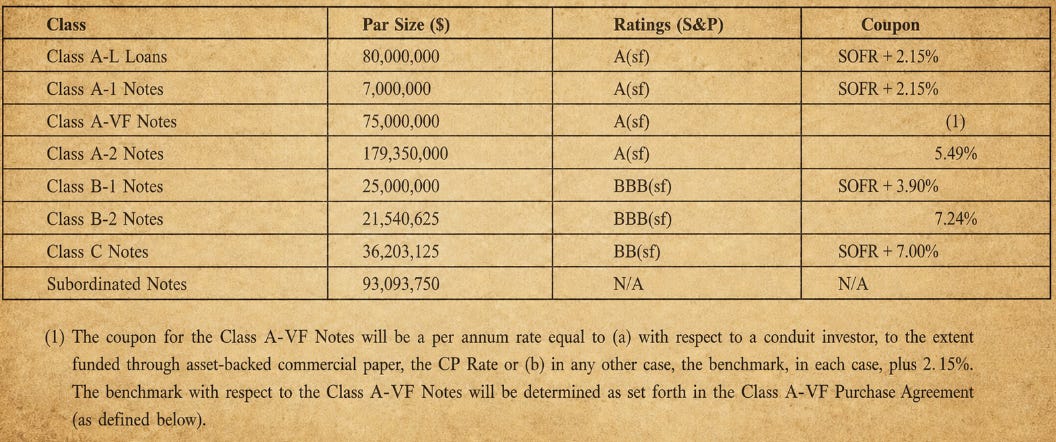
And if you've worked on one of these yourself, reach out. I'd love to hear more about how they're structured.
Here is a piece from Reuters: US direct-lending activity falls even as private credit firms raise more cash, which goes against how the media should be operating. Instead of breaking the article into two, one for the majority pessimistic crowd (US direct-lending activity falls) and one for the 20-30 optimists (Private credit firms raise more cash), they decided to combine both into one article and upset everyone. No wonder their stock is down more than 50% since the private credit turmoil began last year, while every other news outlet is printing money by selling "the next financial crisis" stories about Tricolor, BDC redemptions, and SaaS lending. Gotta change it!
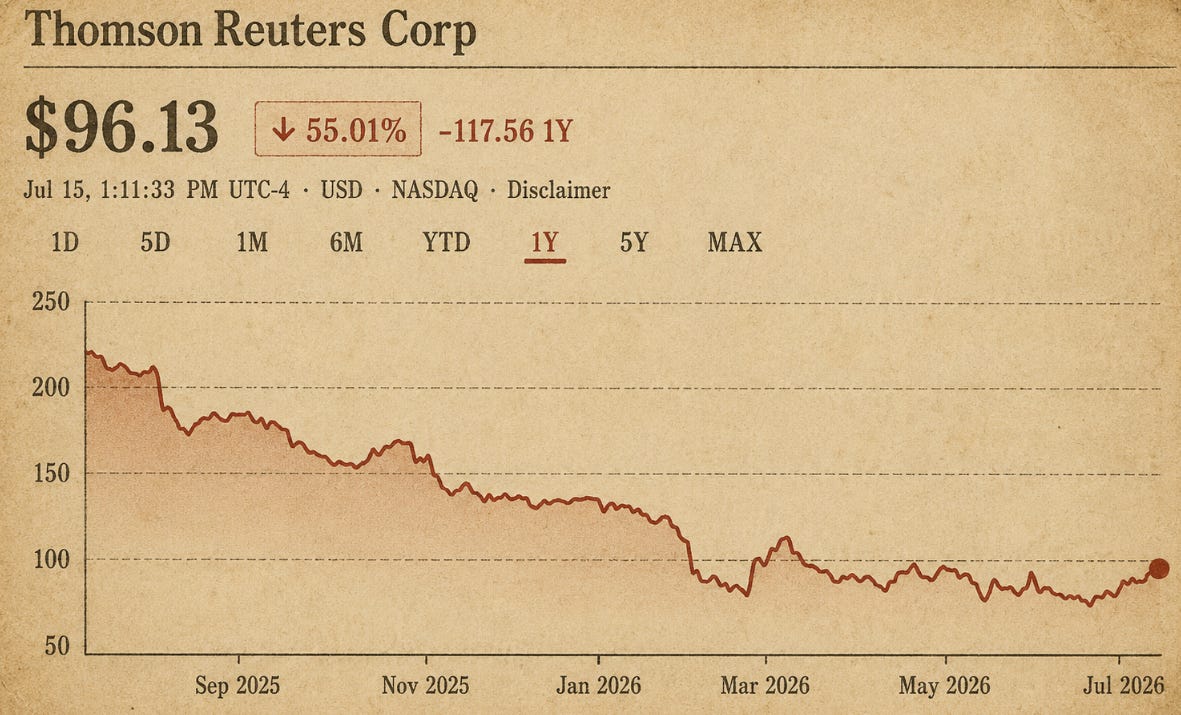
Anyway, back to the article. It opens with some pretty interesting statistics:
North America-focused closed-end direct-lending funds raised $16.25 billion in the quarter, up from $1.3 billion in the first quarter, according to Preqin data, the highest in two years.
…and it continues with an equally interesting statistic pointing in the less encouraging direction, and then even shows us the chart with the combined data:
U.S. direct-lending volume, a measure of loans made directly by private-credit funds to companies, fell about 55% quarter-on-quarter to $33.59 billion in the second quarter from $74.67 billion in the first, the lowest level since the second quarter of 2023, according to PitchBook/LCD data. The deal count declined to 154 from 217.
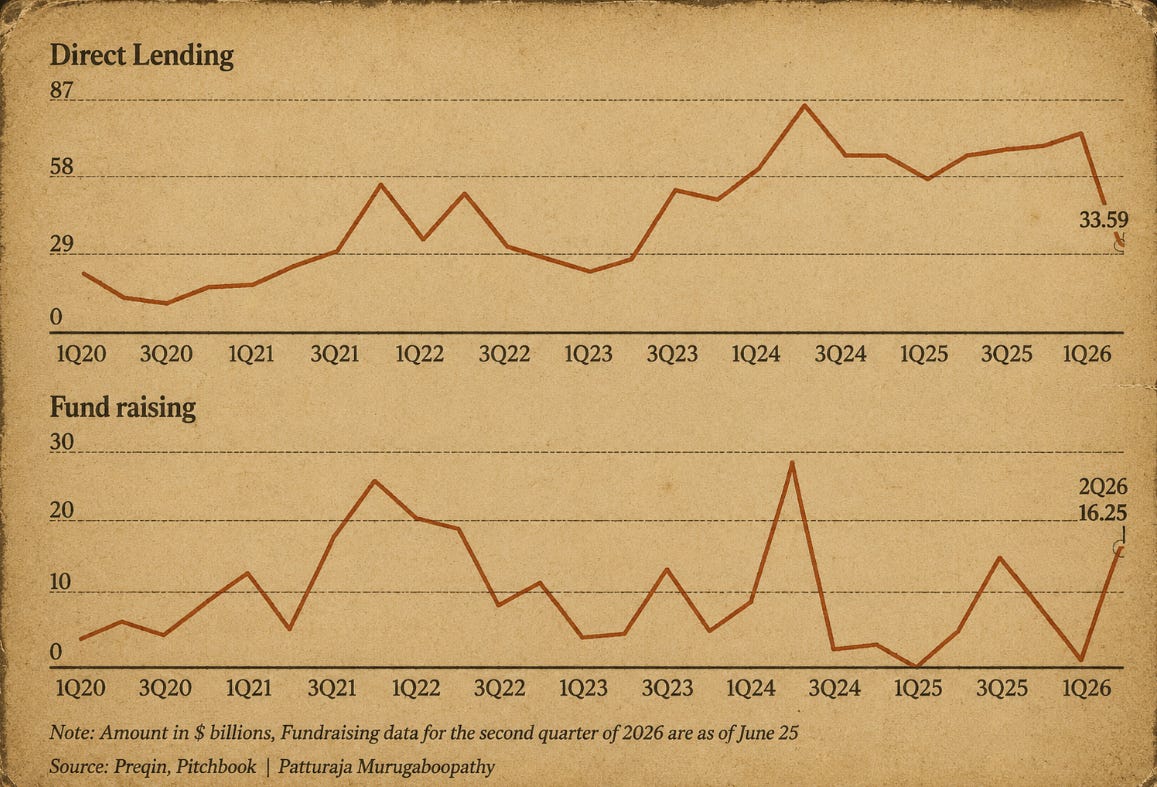
The immediate reaction is that such a drastic QoQ decline in direct lending is bad news. It coincides with a 56% QoQ decline in PE activity, with the two showing an almost perfect correlation. What's probably even more concerning, though, is that excess capital and a scarcity of opportunities to deploy it rarely lead to good outcomes. We won't know whether that's the case this time for another 3-4 years, once today's capital has been deployed and we can evaluate the performance of this loan cohort.
On the other hand, I do see a silver lining. Excess capital in direct lending at least guarantees that, when and if PE activity accelerates, there will be enough capital to finance those transactions and build on that momentum. In addition, if you recall the chart from the first piece in the letter, Mezzanine and Special Situations funds represent 11.5% of the market combined, and I believe they will play a very important role over the next 2-3 years by bridging the gap between what PE firms are willing to pay for a company and what direct lenders are willing to provide. Mezz and Special Sits, with their junior debt and more creative capital solutions, might be the missing layer of capital needed to get the PE flywheel spinning again.
If you are raising a Mezz or Special Sits fund and plan to use the paragraph above in your LP deck, I expect a fee. Thx.
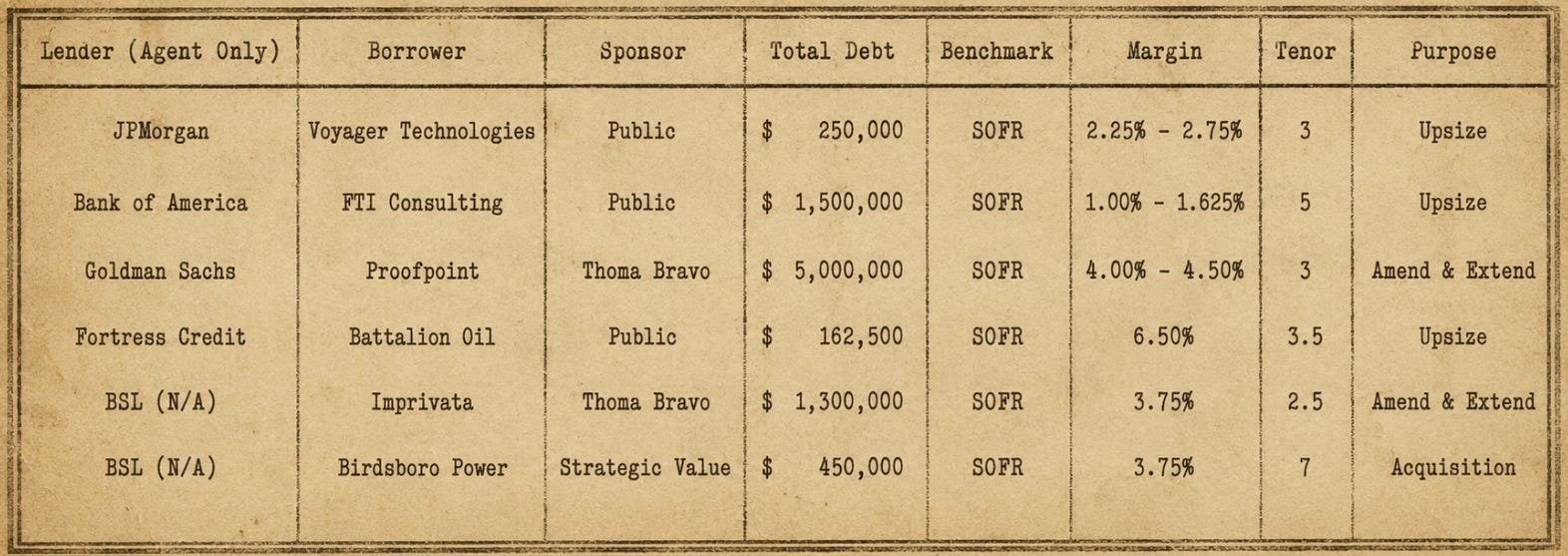
Download below: the complete Excel file covering deals completed in 3Q26 (plus the prior three quarters).
CLICK to Download 3Q26 Details

KIÉR LIÓR – Providing outsourced private and leveraged loan underwriting and portfolio management to institutional investors, family offices, and direct lenders.
www.KierLior.com
WSJ Online is offering 65% off its subscribers ($4 per week vs $11) LINK.
Bloomberg is offering 60% off its annual subscription ($180 vs $399). If you are in Business, Bloomberg is a MUST, with no real close alternative (LINK).
Shortcut.AI, an AI tool for Excel that lets you build models by simply typing requests (similar to ChatGPT). It is free to use up to a certain number of tasks per day (LINK). If you hit your limit before finishing your project, simply upgrade to the Pro plan ($20/month) and enter promo code DEBTSERIOUS (all capital letters) to get 50% off.
LoanEdge, a BDC research tool that lets you look into BDC loan compositions, individual loans, which BDCs own a specific loan, and more, is kindly providing DEBT SERIOUS readers with a free 3‑month trial (the regular price is ~$3k per year, and it’s higher for institutions). Here is a LINK to the tool. Send an email to Sadaf Khan at sadaf@theloanedge.com and let her know you are from the DEBT SERIOUS community.
As a reminder, I don’t personally benefit from either of these offers. I am just saving you money.
Lastly, our community is over 4,300 strong and includes a broad cross-section of mid- to senior-level professionals across private credit, private equity, LPs, and debt advisory. Please use the Bulletin Board at the end of each weekly letter to share events, discounts, or deals that benefit the community. I will continue to feature these opportunities and personally connect interested parties at no cost.
Aznaur.Midov@KierLior.com
Comments
Nothing yet. Say the first thing.
Sign in to join the conversation.