
You have all you need to drink tea in the Tang, though you had better bring some fine rice paper and brushes to commemorate the occasion with a poem or sketch.
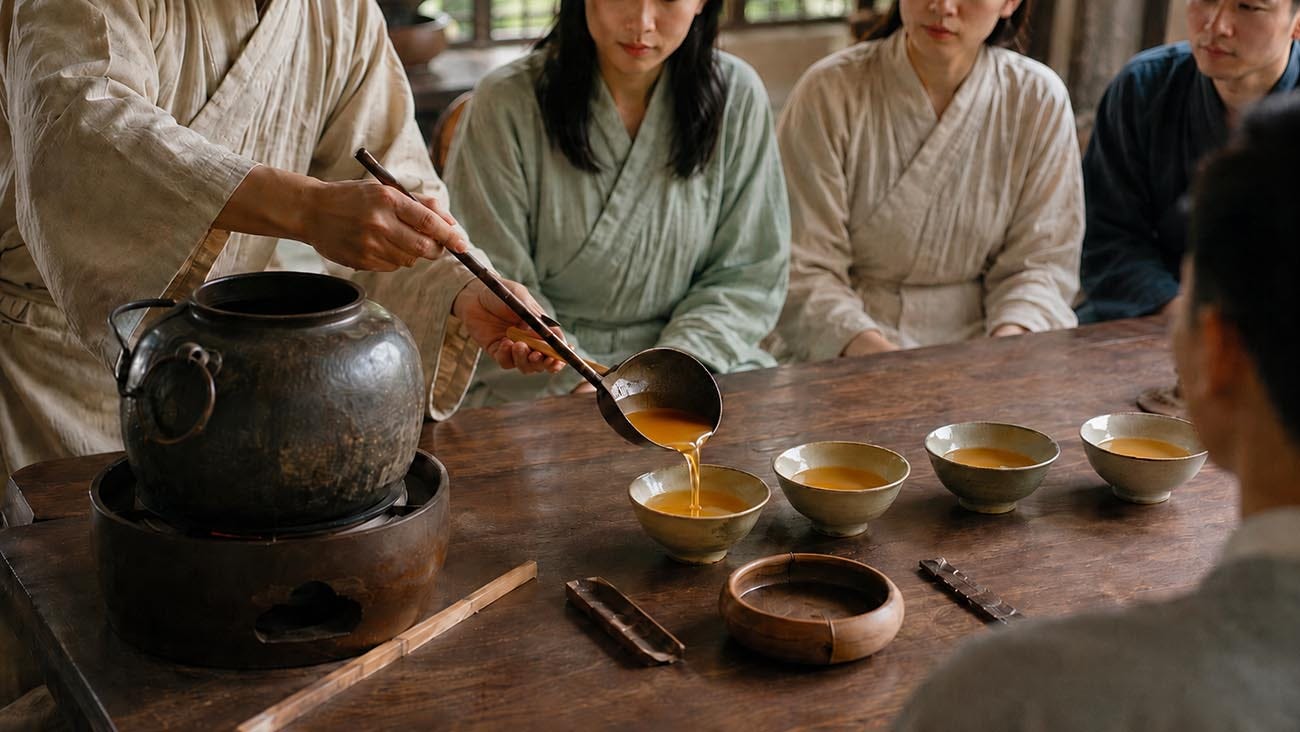
Before Lu Yu, ‘tea’ was a breakfast broth, full of vegetables and spices. The ‘tea saint’ left the Chan monastery where he grew up, joining an opera troupe in order to travel Jiangnan to try as much tea as he could. He’d grown used to brewing tea for the monks, tasting steamed green tea from nearby mountains and the compressed black teas from the gorges of western Hubei.
Tea had already spread from river-basins along the Tea-Horse merchant’s road, and common people were now consuming it regularly. Lu Yu walked south, picking tea leaves, staying in farmers houses and studying tea-types, comparing, qualifying and writing. He ventured to famous springs, trying the quality of water.
Along his journey, he befriends monks, literati and officials, developing a large circle of supporters; his Tea Classic was long anticipated even before it was finished. His patrons arranged for his book to be copied, merchants purchased copies in order to promote their wares, and he made an ‘illustrated guide’, copied onto white silk, to hang on the walls of taverns and in public squares, to make his tea classic available to everyone.
The literati soon spread tea culture. Parcels of tea, carefully wrapped and bound with red silk, became a common gift of friendship.
Buddhists and Daoists adopted tea as a meditation aid. Drinking tea cleared the mind, dispelled heat, and helped ascetics during periods of fasting. Lu Yu himself, despite growing up in a Buddhist monastery, was deeply aligned with Daoism. He lived in seclusion like a Daoist hermit and emphasized Daoist ideas of frugality and tranquility in his writings. The tea stove he designed, to boil water for tea-making, was designed on the hexagrams of the Yi Jing 易經, using the trigrams kan (representing water), li (fire) and xun (wind) to structure the stove.1
How do we know about Tang tea culture?
We can find all we need to know about tea in the Tang from poetry and paintings.
All of the items mentioned in the introductory paragraphs are from tea poems.
Ju mu 橘木 is a tree which grows in south-east asia. It’s usually translated as “wood orange”, “tangerine”, and “bengal quince” - in truth it smells like an orange, but has a hard, woody skin like a quince. Probably it is the hard wood-like skin which makes it perfect for tea boxes, and tea-grinders.
Lu Yu, who wrote the first ever book about tea, the Cha Jing 茶經 or Tea Classic, recommended that the best wood for tea boxes and grinders was the 橘木 , wood-orange or quince.
Text within this block will maintain its original spacing when published
 茶,                                                  tea
香叶,嫩芽。                                  laurel leaf, tender shoots
慕诗客,爱僧家.                              admired by the poets, loved by monks
碾雕白玉,罗织红纱.                      carved by white jade, gauze woven with red muslin
铫煎黄蕊色,碗转曲尘花。            sauteed in a pan, till the stamens are yellow,
                                                             the bowl swirls with dust flowers
In this pagoda poem by Yuan Zhen 元稹, writer, minister, and friend of Bai Juyi, the ‘white jade’ is the pestle which pounds the tealeaves, and dust flowers are the foam produced on the top. Sha 纱 is a thinly woven silk, like gauze or muslin.
The process of pounding tea leaves then whisking the liquid to form foam, or ‘dust flowers’ on top, is similiar to the way matcha is made in the modern day. Tea was introduced to Japan via China in the Tang dynasty, and became popular in the Song after a Buddhist monk brought the matcha method of making tea from China to Japan.
Text within this block will maintain its original spacing when published
常聞玉泉山.   I’ve always heard of Jade Spring Mountain
山洞多乳窟.    it’s mountain caves full of stalactites
茗生此中石.    tealeaves sprout amongst the stone
玉泉流不歇.    the Jade Spring flows without resting
Our spectacular poet Li Bai was one of the first to describe the process of preparing tea in verse. The water at the Jade Spring is soft and full of nutrients, if you clap your hands the water rises up, forming bubbles like strings of pearls. The hydro-acoustics are formed from cracks in the stone.
Nowadays we might buy bottled spring water to make a tasty brew.
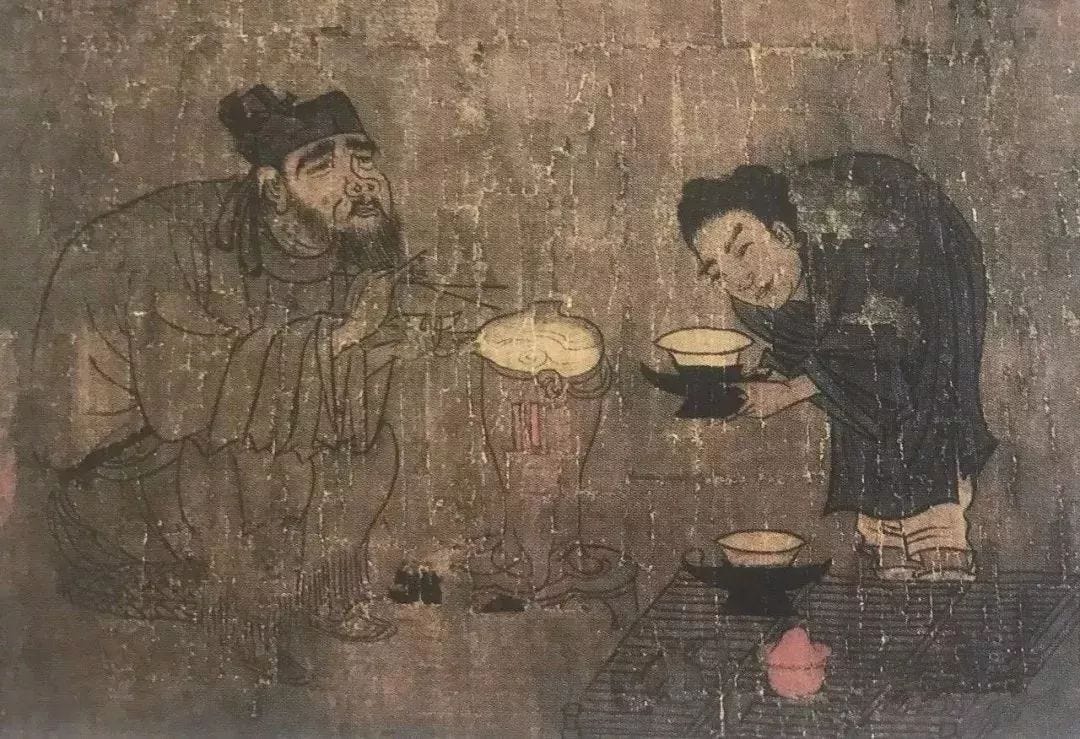
The tea stove, tea utensils and celadon cups appear in this work by Yan Yiben, a Prime Minister and Master painter from the early Tang.
Text within this block will maintain its original spacing when published
九秋风露越窑开,夺得千峰翠色来
late autumn wind exposes the Yue kiln
seizing jade-green verdancy of ten thousand peaks
Lu Guiming’s 秘色越器, 2Secret Colour of Yue Ware describes the soft glow of celadon, named a ‘secret colour’, as the kilns were only for use of high officials, keeping the technology secret from others.
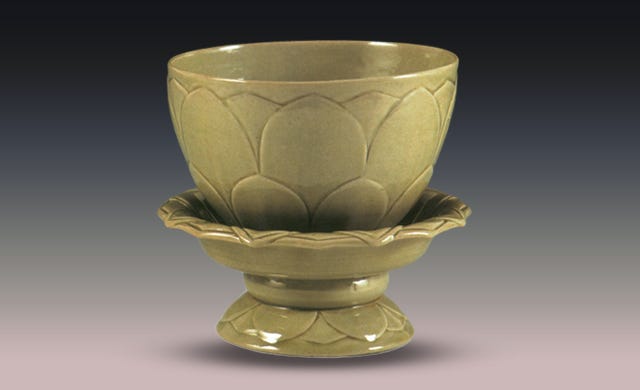
Tea spread to more regions, production of tea increased, and specific types of teas quickly became famous. Poets and painters popularized tea drinking, literati gatherings made it a cultural phenomenon, and Daoists and Buddhists emphassed harmony, moderation, and detachment, emphasizing self-cultivation through tea-drinking. Tea ware and tea utensils grew in production and quality.
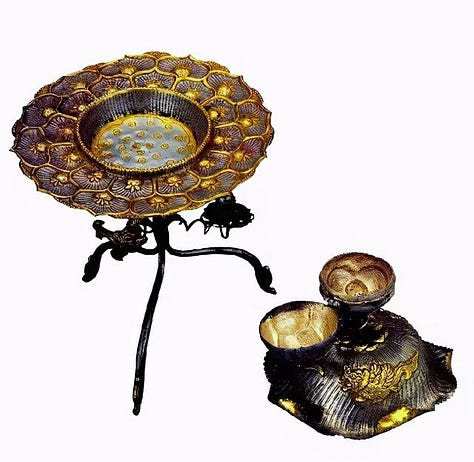
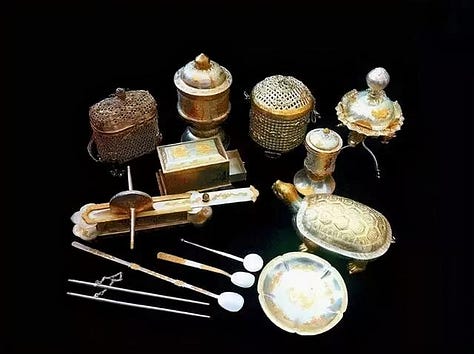
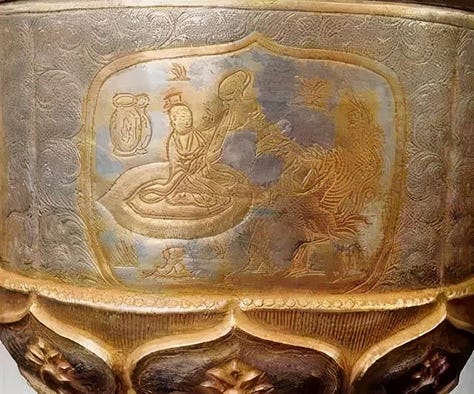
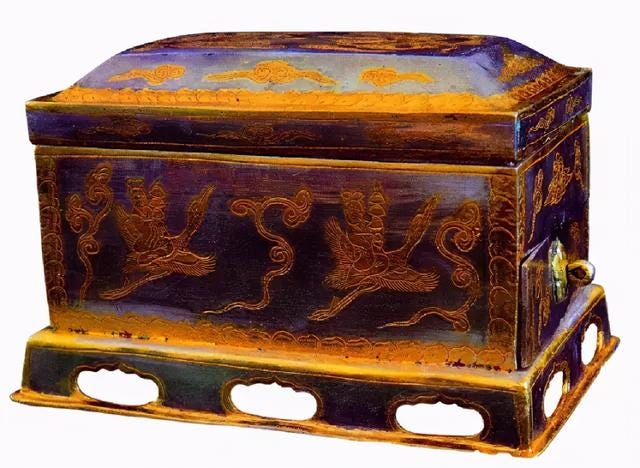
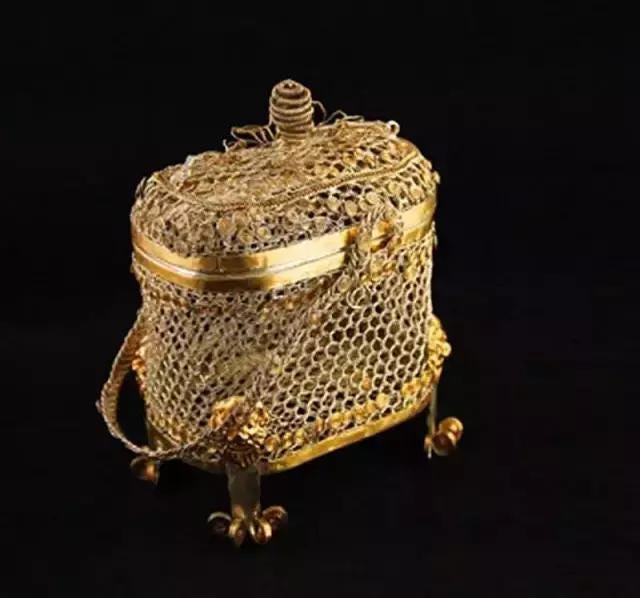
Everyone, from royals to commoners, drank tea. Monastic tea practice was based on tranquility and meditation. Meticulously planned tea gatherings amongst scholars and elites used high quality tea wares, bringing elegant sensibilities to the gatherings. Tribute teas of high quality and regional diversity were sent to the royal family, to use with their exquisite gold and silver tea wares.
For ordinary people, tea was part of the staple, everyday diet, often mixed with vegetables and herbs for a breakfast porridge. Tea-houses and tea-stalls could be found everywhere, from main streets, to markets and back alleys. Temples had tea-halls which provided free tea to common people,
Lu Yu’s Classic of Tea remains the foundational book for classifying tea. Sometime after him, the high official Zhang Youxin wrote 煎茶水记, Tea Brewing Notes, a book which assessed the quality of water.
I once carried bottles of the seven rivers in a boat, personally scooping water from them and comparing them; indeed, they were as described. When I was appointed governor of Yongjia, I passed the Tonglu River and arrived at Yanzi Creek. The stream was exceptionally clear, and the water was very cold. My family poured some old, spoiled tea over it, and it became incredibly fragrant. We also brewed fine tea with it, and its freshness and aroma were indescribable, far surpassing that of Nanling in Yangzhou.3
Others, like Pei Wen’s (裴汶) Tea Treatise, have been lost to history. Only the preface remains. A prefect of Huzhou, prefect of Changzhou and also once the Minister of Rites, Pei Wen was a renowned Tea Master of his time. The preface to Tea Treatise states
“Its nature is pure and refined, its taste is mellow and clean, its use is to relieve worries, and its effect is to harmonize”4
Wen Tingyun 温庭筠, the orphan descendant of nobles, avant guarde critic of the bureaucratic system, wanderer and lyric poet, wrote the Cai Cha Lu 采茶录, Tea Picking Record, in the late Tang. Only fragments of his three original volumes remain; the fragments divided into five sections , bian 辨 (distinguish), shi 嗜 (really like, or even, to be addicted to, yi 易 (changes), ku 苦 (bitter), and zhi 致 (to lead to or to transmit). One of his famous poems describes a Daoist making tea while reading the Huangting Jing (Yellow Court Scripture.)5
The works of Su Yi 苏廙, also writing in the late Tang, have also mostly been lost. Of his Xianya zhuan 仙芽传, the Biography of Transcendant (Immortal) Sprouts, only the Sixteen Types of Tea Soup (十六汤品) remain. It discusses the quality of heat, the speed of water-pouring, and the need for charcoal (“a friend to tea soup”) in firewood.
He compares the pouring of water to playing the zither: if played too fast or slow, the sound is ruined. A calligrapher’s skill is also invoked as a metaphor: if the pressure is too strong or weak, the ink will be wasted, as the pouring of tea, too fast or too slow, may cause the tea to be wasted.
He also compares the pouring of tea to create a ‘smooth flow’ like the flow of qi and blood.
If the hand trembles and the arm is too heavy, fearing to pour too much, the spout of the bottle will be half-open and half-closed, the tea will not flow smoothly, and thus the tea will not be pure and even. This is like the hundred meridians of a person; if the flow of qi and blood is interrupted, how can one live long? One should flee from death.6
How often do you think about the water flow when you are pouring boiling water into your teacup, or pot?
(If you are like me, never.)
Text within this block will maintain its original spacing when published
仙翁白扇霜鸟翎,拂坛夜读黄庭经
疏香皓齿有余味,更觉鹤心通杳冥
the elder transcendant's white fan, like frost on a bird's tall plumes
flicking over the altar at night, reading the Yellow Court Classic
 the aftertaste, luminous and lingering
furthermore, feeling the crane's heart
one can enter the far away, untouchable mystery
from Wen Tingyun's Xiling Daoist Tea Song
Bibiography
Tang, Jichong, 2024. "On the Intermingling of Tea Culture and Literati Life in the Tang Dynasty" in, Proceedings of the 2024 5th International Conference on Mental Health, Education and Human Development (MHEHD 2024
童正祥, 2019, 从风炉铭文看陆羽的茶道观, 天门市融媒体中心,2019-01-09。 Tong Zhengxiang,2019 Lu Yu’s View on Tea Ceremony as Seen Through the Inscription on the Stove, Tianmen City Media, 2019-01-09 https://www.tianmen.gov.cn/csly/cwh/201901/t20190110_1932248.shtml
Lu Guimeng 陆龟蒙 was a Suzhou writer in the late Tang. He did not succeed at officialdom and loved boating on Taihu, with a fishing rod and tea stove. Besides poetty, he also wrote an agricultural text, describing farming tools.
This quote is from the Baidu entry. It has been suggested the original name might have been The Water Classic. Lu Yu himself also wrote a book on the quality of water.
Original text 其性精清,其味浩洁,其用涤烦,其功致和。参百品而不混,越众饮而独高.
This is 西陵道士茶歌, or the Xiling Daoist Tea Song, by Wen Tingyun
更觉鹤心通杳冥, from Wei Tingyun's poem 西陵道士茶歌, Xiling Daoist Tea Song.
No posts
Comments
Nothing yet. Say the first thing.
Sign in to join the conversation.