
Since the first century, when Buddhism was first introduced into China, Daoism and Buddhism began cross-pollinating. Ideas and concepts moved from one to the other, and became part of the respective traditions.
四生六道 is a phrase originally stemming from Buddhism, then entered the Daoist tradition in the fifth century, through the Lingbao, or Numinous Treasure school.
Literally four lives, six dao, this concept is usually translated as “four births and six realms” or “four types of births and six destinies.”
四生六道, alternatively ordered as 六道四生, is a classification system of lifeforms. The 四生 four births refers to four different ways animals are born:
mammalian (humans and some animals)
birth via eggs as with birds and reptiles
the ‘wet birth’ of some insects
and metamorphis (butterflies and moths).
The liu dao 六道 six realms, refers to the realms of heaven, spirit, humans, animals, and the paths of hell and hungry ghosts.
The phrase appears in many Daoist ritual texts.
Two well known ‘festivals’ in the Chinese calendar are Zhong Yuan 中元 节(commonly known as the “hungry ghosts” festival) and Qingming 清明节, where ancestors are honoured. Both of these festivals include ritual prayers for salvation of the 四生六道, or all living beings.
In the Shangqing Lingbao Ritual, the liturgy begins with an appeal to stellar deities. The Middle Ladle, 中斗, is an asterism in the centre of the night sky, governing primordial energy. The Shangqing Lingbao ritual appeals to this stellar deity, stating this (celestial) palace governs the ten directions of the world, the four forms of birth and the six realms (四生六道), the souls, spirits and consciousness.
It is a deeply reverent ritual that calls upon all of the heavenly spirits and deities to help all beings.
Yin and Yang move in turn, calamities shift and change. Life and death cycle endlessly, who is foolish, who is wise? The wheel turns without end, the highest mystery of creation.
陰陽推運兮,劫數更遷。生死周流兮,孰愚孰賢,輪轉無窮兮,上玄造化.
In the following chaper of Conversations with Daoists, we head to the Yellow Dragon Ancient Temple at Luofushan, where a Daoist nun discusses the Four Lives Six Dao concept and muses on the etymology of Daoist terms. Daoist Huang talks about how cultivation has changed her life.
Strong winds blew in from the Yellow Sea. Biting and cold, the winds would pierce layers of warm clothing and push chill straight to the bones. Qingdao homes were freezing in winter, unless the building was equipped with nuan qi, literally warm qi, or central heating. Our building wasn’t. I went south for a while, in search of warmth.
I stayed in the provincial capital for only enough time to leave, exiting the train station for a brief walk to bus. The Cantonese winter had not yet set in; the days were warm and the breeze fresh. I was heading to the Yellow Dragon Ancient Temple (Huanglong Gu Guan 黄龙古宫) at Luofushan. Hou Baoyuan, the global abbot of Qingsong group of temples, had financed and constructed the temple on the ruined site of an old one -- the original Yellow Dragon Temple, built by Zhang Miaosheng in the Qing dynasty, had been destroyed in the 1960s. Only broken tiles had been left lying in the grass.
My journey on the train took around fourteen hours -- the fast speed rail had not yet been constructed. Zhang Miaosheng, who had built the first Yellow Dragon Temple, had also travelled from Laoshan. My trip to the southern mountain was by train and bus: much earlier, the road from Laoshan was punctuated by the riverine route of the Grand Canal.
During the Qing dynasty, the Daoist from Laoshan made his way heading south. His trip would have involved walking over the Shandong plains, through the provincial capital Jinan, and southeast towards a small, relatively unknown town of Linqing. Linqing (the town’s name means Approaching Clarity or Approaching Peace) was the first stop along the Grand Canal in Shandong.
` Constructed in the 6th century Sui dynasty, the Grand Canal was a tribute to extraordinary engineering. The section that passed through Linqing was a Yuan dynasty extension, linking the Yellow and Wei rivers. It passed across high mountainous areas, using sophisticated hydraulic engineering techniques, including locks, sluice gates, and sediment levelling strategies to safely join at the Yellow River.
The Grand Canal made domestic trade easier, and by the Qing dynasty, it was China’s major economic artery, distributing grain from the fertile rich fields of the south to the north.
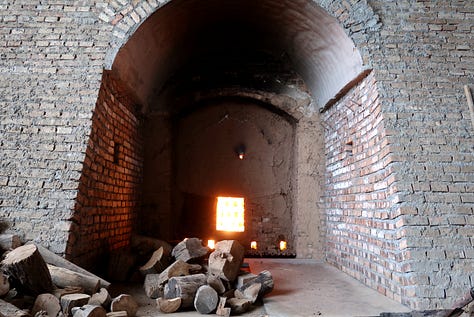
Perhaps Zhang ate tofu on flatbread – a specialty of Linqing – and then made his way to an innocuous grey-brick building, the Linqing Customs House. The bricks used for the custom house were of excellent quality – rich soil combined with expert firing techniques made them durable and resistant to corrosion – and remain valued today. When the Palace Museum in Beijing was undergoing restoration, they used bricks made in Linqing.
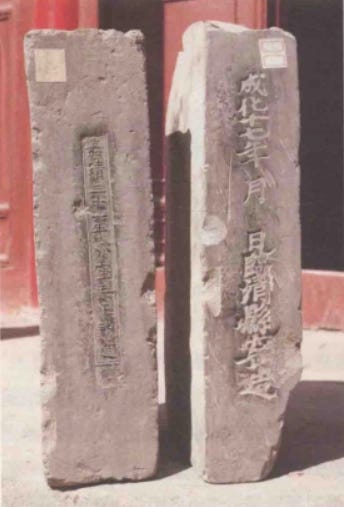
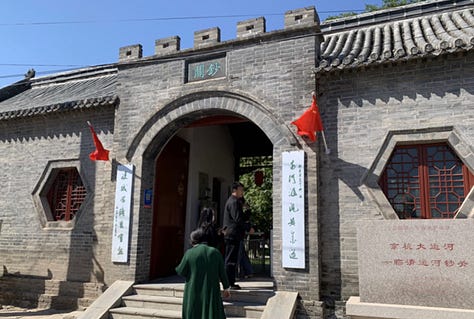
There he would buy his ticket, or possibly be waved through – until very recently, Daoist and Buddhist monks were afforded free travel on public transport. From there the boat would take him to Taierzhong, just north of today’s Xuzhou, a city which famed Qing emperor Qianlong called “number one town in the world” and was the last stop of the Grand Canal in Shandong. Legend has it that on his inspection tour, Qianlong visited the town. A child displayed great wit and talent, and the emperor afforded him a title. Proud of their local young achiever, the townsfolk carried the child was around on their shoulders to celebrate. Hence the town’s name became Taierzhong, “Carried Child town.”
From the “Carried Child Town” down to Huai’an, then onwards to the wealthy merchant city of Yangzhou, Zhang Miaosheng would have probably continued his journey by boat. The trip would have taken him from several weeks to a few months, depending on the season, the weather, and the cargo. He probably stopped along the way, visiting Daoist temples for a few days.
Perhaps he stopped at Yangzhou, and visited the Qionghua Temple, famed for being a place where generations of Celestial Master Daoists ascended to heaven. The temple was so named due to the qionghua, or viburnum flower, that had grown in the temple since the Song dynasty. It’ s beauty was so renowned that emperors came to see it. Known also as “snowbell”, its Chinese name, qiong, means a beautiful fine jade.
Zhang Miaosheng lived during the Kangxi emperor’s reign, a time when imperial favour was concentrated on the Celestial Masters tradition. The Emperor himself visited Yangzhou on his Southern Tour and visited Daoist temples whilst there. Perhaps Zhang stopped in the renowned city, as it was the last stop in the southern direction of the national waterway. It was common for travelling Daoists to seek refuge at Daoist temples along the way, as sanctuary, a place to rest, and and for opportunities to engage in collegial discussion.
From Yangzhou, the Grand Canal continued eastward to the prosperous lake-side city of Hangzhou, so Zhang would have continued his journey on foot. Probably passing through the trade hub of Jiujiang, a port city on Poyang Lake in Jiangxi, he may have stopped and perhaps wandered up to Lushan, famous for its spring like scenery. Daoism in Lushan had deteriorated under the Qing, with barely anyone left on Lushan but a hermit in a cave annotating the Huangjing scriptures, so more probably, he continued onto Jiujiang, Nine Waters. It was a thriving town, the centre of tea and rice trade. The Jade Void Temple, was the home of a Longhu mountain Daoist, appointed directly by the emperor, who oversaw all Jiangnan temples. The Qing emperors had recognised and appointed Longhu Celestial Masters Daoists as the official face of the religion south of the Yangtze.
From Jiujiang, it was another thousand kilometres to Ganzhou. The Gan River, unusually, flows north, from Ganzhou to Jiujiang, and from there into the Yangtze. Boats, travelling against the current, would have been slow, yet perhaps our travelling monk chose another water-craft - it would have been easier than walking across the Jiangxi countryside.
Zhang Miaoshen was getting closer to his destination. Today, it’s only a five-hour drive to cover the four hundred kilometres from Ganzhou to Luofushan – back then, it was probably a five-day walk. When he finally made it to the mountain, he had been on the road for quite some time. Zhang found the cave where Liu Yan, king of the Southern Han in the tenth century, had dreamed of a yellow dragon, and built a small temple. He named it after the emperor’s dream: the Yellow Dragon temple.
In the following section, we meet Sister Huang, who discusses the 四生六道 and the phrase’s appearance in rituals, muses on the meanings of the word 道 and discusses how Daoist cultivation changed her life.
Comments
Nothing yet. Say the first thing.
Sign in to join the conversation.