
Mystery met me at the railway station.
Amidst the crowds of people jostling to find their friends and family, the Daoist nun, whose name, Xuan, meant Mystery, was distinctive in her blue gown and top knot. At first I couldn’t find her, amongst the sea of people, then I felt a warm hand take mine. She whisked me away to a waiting car.
It was a thirty-minute drive to the Changchun Guan 长春观. We drove past East Lake and onto busy Wuluo Road, the long east-west throughfare that starts with the First Bridge Across the Yangtze and connects the three original towns that make up the modern city. Wuhan was once the heartlands of the ancient Chu kingdom, famous for its unique cultural heritage. Chu literature formed a foundational heritage in China’s cultural evolution, providing the elegiac, shamanistic Songs of Chu.
Laozi himself, according to Sima Qian’s Shiji 史記 (Book of Records” was “born in the village of Quren (曲仁里) in the southern state of Chu”1
I’d just come from Qingdao. It was a humid summer, and dampness saturated the atmosphere in my home on Laoshan Lu. The ground level in my apartment complex would always be wet in summer; moisture rose from the ground and left streams of liquid humidity over the tiled floors. We’d moved to the second floor to escape the pools of dank water that coagulated on the ground floor apartment in summer.
I’d taken the overnight sleeper train, travelling south through Jiangsu, on through Anhui and west into Hubei, to meet Daoist Xuan at her home temple in Wuhan. I’d met the nun at Beijing’s White Cloud Temple, during the historic Luo Tian Da Jiao, Daoism’s large, historic set of rituals I’d been privileged to be a part of.
We drove past East Lake, a large, 88 square kilometre freshwater lake in the centre of the city, surrounded by parklands.
“I’ll take you there tomorrow,” said Xuan. “It’s a beautiful park, bigger than Hangzhou’s West Lake. It’s a pity you have missed the plum blossoms. There are so many hues, it’s so beautiful.” She paused to give directions to the driver.
From the car window, occasional glimpses of East Lake shone through the streetscape. It wasn’t long before we arrived at the Changchun guan 长春观,the Eternal Spring Temple. The external walls were a coppery shade of red, bronzed by the afternoon sun. After the mountain-top temples at Laoshan, immersed in nature and oxygenated air, Changchun Guan looked incongruous on the busy city road.
The driver let us out.
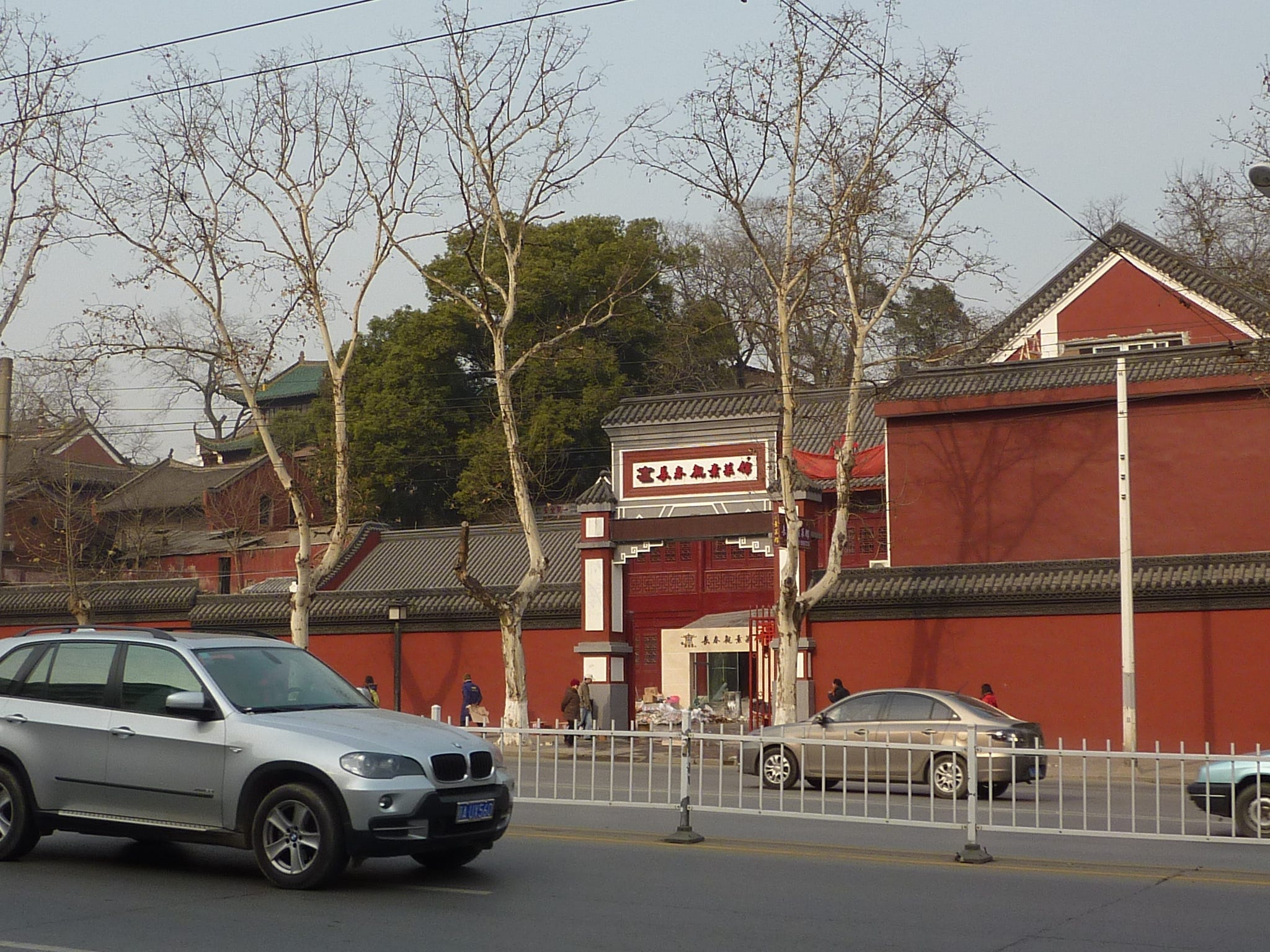
“Our temple is named after Ancestor Qiu,” Daoist Xuan said, as she led me to her office.
“Did he live here at some stage?”
“No. The temple originally had another name. After Ancestor Qiu died at the end of the Yuan dynasty, a Quanzhen descendant came from Beijing and was abbot here. He named it Changchun Guan after Qiu Chuji.”
“Who was the descendant?”
“Probably no-one you’ve heard of. He is not very famous now. His name was Ji Zhizhen. He had studied under Qiu Chuji’s disciple Li Zhizhen.”
“Li Zhizhen who went with Ancestor Qiu to visit Chingghis Khan?”
“Yes, that disciple. He wrote the book about Qiu Chuji’s journey.”
“Journey to the West?”
“Yes, the original one before the Monkey King stole the name!”
We both laughed. Li Zhizhen’s book about Qiu Chuji’s long walk to meet with the Mongolian ruler, written by his disciple and published by another in 1228, was the first book to be titled 西遊記, ‘west travel record’ or Journey to the West. Four centuries later, a Ming dynasty fiction novel with the same name was published; first translated into English in 1895 but more commonly known by Arthur Waley’s 1942 translation, entitled simply “Monkey.”
We’d arrived at Daoist Xuan’s office, and I put my bags in the corner.
“Let’s have some tea first,” she said, indicating a seat.
Her tea-making paraphernalia were sitting on her desk, next to a small stove. She took a pottery jug and poured water from a large canister into the kettle. “The spring water is from south of here. They deliver it.”
“There used to be a well at the back of the temple, where we got our water from,” she continued, as she placed the kettle on the camping stove. “It’s sealed off now.”
The White Crane Well is so named according to a local legend; some Daoists were struggling to get water out of the ground, when a group of cranes came over to help. The cranes dug at the well with their beaks, creating the White Crane Well.
Mystery adjusted the flame on the stove. “The water should boil gently, “ she said. “Then it’s the right temperature.” The nun had steadied her breathing and was totally focused on watching the water, adjusting the strength of the flames.
She scooped tealeaves from a container into the teapot. Fired from mineral-rich Yixing clay — a clay renowned as the best for making teaware — the teapot was a smooth rich brown.
“This is Hubei green tea,” she said. “It’s famous for the “three greens.”
She took two cylindric clay-fired cups, also coloured deep brown, and placed them on the tray. “When the leaves are picked, they are a delicate green, because they are picked as young leaves. After the tealeaves are dried, they become a bright kingfisher green colour. The tea in our cups — look, what do you think — is a clear green.”2
After pouring tea into the two cylindric cups, Xuan swirled the water around, then emptied them into the tray. “The first cup is to wash.”
She then took two smaller cups, placed them on the tray, then filled the two tall cups with just boiled water. Carefully, swiftly, she tipped the tall cups into the smaller cups. The tea was now in the smaller cups.
“Second cup for tasting.” She passed me the clay-fired cup and instructed me to taste. After I took a sip, she said, “No, like this.” She sipped a small amount, swirled it around in her mouth, then spat it onto the side of the tray. “You try. Then tell me the taste.”
I repeated her actions but was unsure if I had enough knowledge to discern the specific taste of this tea. “It’s a very fresh taste,” I replied. A faint aftertaste emerged that lingered in the palate.
She nodded and smiled, then tossed out the remaining water from the cup. The tray had small holes for the water to flow through. It dripped down in a pottery plate underneath.
“Third cup to drink.” We both drank the third cup after she had poured it. “The first two pours are to heat the cup and prepare for the tea. By the third pour, the tea has brewed enough.”
I sipped at the tea.
“This is cha gongfu,” she said. Gongfu Tea . “Gongfu” is a term which means mastery through effort, often used in martial arts, but can be applied to any discipline. In this case, it meant a kind of tea meditation, a skill acquired by constant practice.
Cha dao 茶道 is practised as cha gongfu.
Since Lu Yu wrote the Cha Jing 茶經,the Classic of Tea in the Tang dynasty, this kind of tea cultivation had become known as Cha dao 茶道, or the Way of Tea.
Changing the order of the words makes a different meaning. Dao cha 道茶 refers to Daoist tea, or tea in Daoist practice and culture.
More about the differences between the terms of tea here:
During the period between the Tang and the Song, tea culture remained alive. Many artisans fled north in the aftermath of the An Lushan, especially to the Liao Kingdom; tea ware continued to be produced there.3 In the south, the famous kilns of Jiangxi and Zhejiang continued to flourish. Jingdezhen made celadon wares during this period4 and the Yue kilns in the north of Zhejiang improved in quality.
The tradition of Dao cha 道茶 continued in the Song dynasty, with the advent of the Quanzhen school. Key Daoist figures of Quanzhen - founder Wang Zhe and acupuncturist Ma Danyang both wrote tea poems, which echoed their cultivation practices.
below the paywall we explore the Quanzhen tradition of tea as a metaphor for internal alchemy (neidan) or cultivation.
Comments
Nothing yet. Say the first thing.
Sign in to join the conversation.