
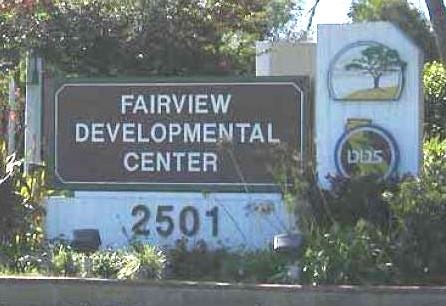
Early in the COVID-19 pandemic, the Federal Government proposed using the Fairview Developmental Center in Costa Mesa, California to quarantine travelers from the Diamond Princess cruise ship who had tested positive for the virus. After NIMBY-driven legal challenges by the city, which resulted in a restraining order blocking the plan, the Federal Government withdrew its proposal. Until I stumbled upon the news headlines surrounding the controversy, I hadn’t thought about Fairview in years.
Fairview was part of California’s network of large, public hospitals providing in-patient care and treatment for the “mentally disadvantaged,” beginning with the Insane Asylum of Stockton in 1853. Over the following century, the State opened several other institutions for patients who couldn’t take care of themselves or whose families couldn’t take care of them. These institutions housed not only those we would now consider developmentally disabled, but also people with epilepsy, severe autism, cerebral palsy and severe brain trauma. Demand was so high that many of these centers had waiting lists.
Fairview, one of the newest facilities, opened in 1959 with an initial 2,622-bed capacity and intended to eventually house 4,125 patients. But just ten years later, legislation known as the Lanterman Act granted greater rights to people with developmental disabilities. As a result, large institutions like Fairview began to decline in favor of group homes and smaller facilities. With rising maintenance costs and a steadily declining census, then-Governor Jerry Brown ordered Fairview’s closure in 2015. By the end of 2019, all remaining residents had been relocated. The closure may have been a blessing; a report by the Center for Investigative Reporting revealed disturbing incidents at Fairview between 2002 and 2011 including murders, neglect, sexual abuse, escapes and preventable falls.
A younger brother, whom I never knew, lived at Fairview for most of his short thirty-one-year life. He was born in 1970, at a time when babies with Down syndrome were almost automatically institutionalized at birth. Down syndrome is caused by extra genetic material from chromosome 21, leading to developmental and intellectual delays. Babies born with Down syndrome often have distinct physical features including low muscle tone, an upward slant to the eyes, and a single deep crease across the center of the palm.
At the age of twenty-seven, my mom had a less than 1-in-1,000 chance of having a baby with this genetic defect. But as Richelle E. Goodrich wrote in Smile Anyway “Statistics, likelihoods, and probabilities mean everything to me, nothing to God”.
At the time of my brother’s birth, my parents were already caring for my four-year-old sister and three-year-old me. The doctors who delivered him, as well as my dad, knew or were highly suspicious that he had Down syndrome but, being a more paternalistic era, they chose not to disclose this to my mom. My dad likely believed that the child would be severely disabled with no quality of life and that raising him would not only be hopeless but would take away from the children they were already raising.
My mom nursed the baby and cared for him for six weeks until the day he was picked up and taken to Fairview. No one asked for her consent; they simply told her to pack a bag for him. I still vividly remember the paper grocery bag waiting by the front door filled with baby bottles and clothes and my mom coming downstairs holding the baby in her arms, tears in her eyes. Neither she nor my dad ever spoke to us about the baby after that day; I assume it was too painful.
At that time, Fairview had a waiting list for admission as demand exceeded supply. My dad must have been the one to go there after the baby was born to try to get him a spot. I can only imagine what was said and done fifty years before, but soon after my dad signed the title of his motorboat over to a man of questionable moral character who was in charge of admissions, the baby was admitted as a ward of the state.
My dad died nine years later never having seen his son again. When my brother died at thirty-one in 2001, my mom was notified. She and my sister – adopted the year after the baby had been sent away-- went to view his body. They reported that he looked like my youngest brother born a year later but had my light coloring.
In 1970, prenatal diagnosis and legal abortion were not available in the United States. Nowadays, new parents are offered prenatal genetic screening and most Down syndrome pregnancies are aborted. Some parents, including those who reject genetic screening as well of those who discover the diagnosis prior to birth, do choose to keep and raise babies born with Down syndrome. Perhaps one can excuse my parents’ actions by saying “That’s just how it was back then” or “They did the best they could with the knowledge and capabilities that they had.” It is not my place to judge, nor can I say what I might have done in their shoes.
As a country, we have come a long way in our understanding and treatment of people with disabilities. But I believe it is time to remember him – David – to speak his name and his story aloud without shame, and to recognize him not only as part of our family’s history, but as part of this nation’s too
.
No posts
Comments
Nothing yet. Say the first thing.
Sign in to join the conversation.