
At a corporate dinner a couple of years ago, I found myself at a table with three people I barely knew. We were all executives, gathered for one of those events where you spend the first twenty minutes exchanging titles and job histories, and the next hour deciding whether you actually like each other. Somewhere in that second hour, as the conversation loosened up, the one single person at the table asked, “How did you meet your partners?”
What followed was not what any of us expected. The three of us didn’t tell polished love stories. We told convoluted tales of adversity and near misses. Stories about first impressions that turned out to be completely wrong. Stories about how we almost didn’t say yes to that date, and how close we each came to walking away before things even started.
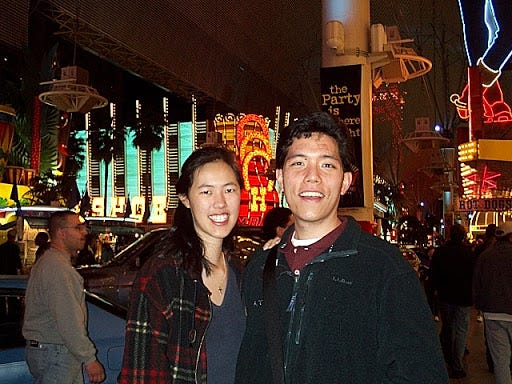
This brings me to the yellow tie.
I met my husband David at church my first weekend as a freshman at Duke. He was a senior at UNC, a couple of years older than me, wearing a pinstripe suit and a bright yellow tie. My first impression: he looked ridiculous, jokey, and unserious.
Over the following months, we moved in the same church community. He had a strange sense of humor, the kind that felt overly familiar. I told a friend at the time that he was borderline rude. What I didn’t know was that he thought his jokes were a way to be warm and inclusive, even disarming. I was a shy girl who didn’t appreciate it, and I avoided him whenever I could.
A year after we met, we ended up carpooling to a church retreat eight hours away. He offered to drive my friend and me. I agreed, mostly because my dad wanted a guy in the car for the road trip. At the retreat, he asked me out. I was so caught off guard that I asked him about a mutual friend I thought he was dating. He said, “What about her? She’s in China.” I genuinely believed he was asking me out while his girlfriend was abroad. A spectacular misunderstanding on both sides. I turned him down, and we went our separate ways.
Later that summer, we drove separate cars full of people to another retreat in Wilmington from Chapel Hill. During that retreat, he asked me out again. I decided to give him a chance. He had just graduated and was heading to law school, so we had only a couple of weeks anyway.
He told me to meet him at the Ben and Jerry’s on Franklin Street in Chapel Hill. I dropped everyone off, then drove straight there. This was before cell phones. I waited. Fifteen minutes. Thirty. Forty-five. No David. I gave up and started walking back to my car, certain I’d been stood up. That’s when I heard honking and someone shouting my name from a passing car. It was him.
I reluctantly stayed for the date, mediocre as it was. I went home unconvinced. We parted ways when he left for law school in Boston. A few months of back and forth followed, and we ultimately decided against long distance. Then, on December 22nd, after a year and a half of misunderstandings, avoidance, and a disastrous first date, we officially decided to be together. And nearly three decades later, here we are.
The other two at that dinner table had their own versions of this story. One described a husband who pursued her for months while she remained uninterested. The other talked about a first date so awkward that he didn’t call her back. It was only by chance that he picked up when she called him. Three happy marriages that might never have happened in the internet age.
I’ve been thinking about how people met their spouses across time. For most of human history, proximity was the algorithm. A sociologist named James Bossard analyzed 5,000 marriage licenses in Philadelphia in 1931 and found that one-third of couples had lived within five blocks of each other before marrying. The probability of marriage fell steadily with increasing distance (Bossard, 1931). A follow-up study in Duluth found the same pattern. You married people who lived extremely close to you, sometimes in the same building.
That started to change after World War II. Friends overtook proximity as the primary matchmaker, rising from about 20 percent of couples in 1940 to a peak of 40 percent by 1990. For more than six decades, your friends were essentially curating your dating life. They knew you and they knew the other person. When you connect two people, what do you share? Not a photo of them or some quote. You share what you have in common, and why they connected you. Any introduction carried implicit information: this person has been seen, and someone who cares about you thinks it’s worth your time.
Then the internet arrived, and that vetting disappeared. Meeting through friends peaked around 1995 and has been declining ever since. By 2013, online dating eclipsed friends as the most common way couples in America meet, according to Stanford sociologist Michael Rosenfeld’s landmark study. By 2024, roughly 60 percent of new couples report meeting online (Rosenfeld, et. al).
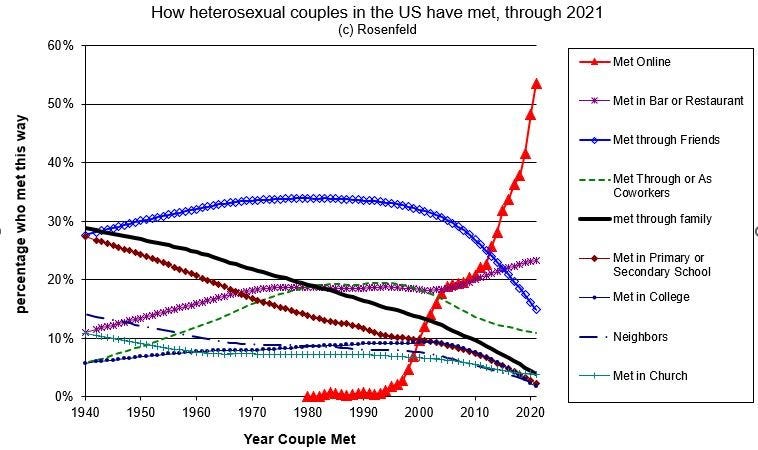
This is more than a shift in technology. It is a collapse of context.
When a neighbor introduced you to someone, that neighbor had already witnessed them living their life. When a friend set you up, they knew your quirks and hobbies . The introduction was knowledge transfer. That has been replaced by a profile made up of a few photos and a handful of pithy sentences, a format that rewards the first impression above everything else because there are a thousand more profiles behind this one, and you can always keep scrolling.
We have trained ourselves to decide who someone is in three seconds and move on if they don’t immediately impress us. There’s a strange irony in all of this. We live in a culture that celebrates the slow burn. Romance novels are built entirely around the distance between the meet-cute and the happily ever after. The adversity is the story. Pride and Prejudice without Darcy’s insufferable first impression is just two people who got along fine from the start. Enemies-to-lovers, second-chance romance, opposites-attract reluctant partners: these narrative arcs aren’t about a swipe and a match. They’re about the journey of a relationship.
Relationships thrive in friction and grow through adversity. Yet we have built a dating culture that eliminates every one of those conditions, handing all the power to the first impression and assuming something better is one swipe away.
The first impression is almost always incomplete. And sometimes, as I learned, just wrong.
My mother knew that someone I dated before David wasn’t right for me. She never said a word. When I finally ended it and asked her why she had stayed quiet, she said, “I was afraid that if I objected, it would push you closer to him. I needed you to come to that conclusion yourself.” She was wise enough to know that some conclusions had to be made by myself.
The man in the yellow tie went from someone I found off-putting to someone I built a life with. Our relationship didn’t change overnight, but he kept showing up time and time again. Whenever my kids ask about how much I disliked their father when we first met, I tell them: “Your dad is a fun-gi. He grows on you.” They think it’s hilarious.
Think about the relationships that matter most to you right now. How many of them started exactly the way you expected? How many required patience, a second chance, a willingness to look past the thing that almost made you walk away?
Technology allows us to judge people on very little data. We can write them off because of a photo or a few words. Think about how much less rich our lives are because we judge too fast or cut off too soon.
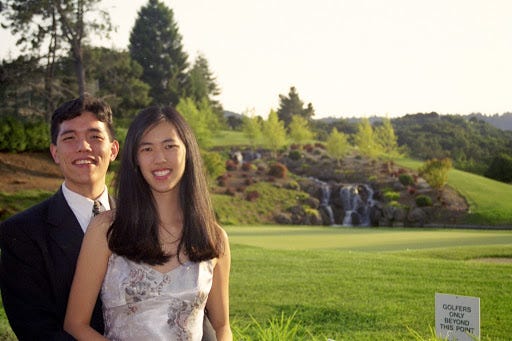
And then harken back to a world where we see each other as fully. That is what we miss if we judge too soon.
No posts
Comments
Nothing yet. Say the first thing.
Sign in to join the conversation.