

Last year, I shared that I had been diagnosed with early-stage breast cancer and posted Drawing the Cancer Card, sharing my experience. I have become a fervent advocate for screening and early detection.
I never thought I would be here saying this a year and a half later, but I may be drawing the cancer card again. It feels surreal to even type that out.
I did a routine colonoscopy a few weeks ago. I had one a decade ago and an upper endoscopy five years ago. I even did a full-body scan with CT contrast last year in Taiwan.
Everything seemed rather normal, but when I woke up, the doctor said he removed two polyps, but also that he saw a suspicious obstruction and did a biopsy. Immediately, the first card was turned, and it was a bad one.
The biopsy came out clear, but apparently, that happens a lot with colon growths because the cancer is hidden inside, in a spot that was inaccessible during the procedure. So I did an abdominal CT scan. Another card drawn. Turns out, the growth is not small (about 3.5 cm across), which is bad news, but the next card was in my favor because it is in a good place for surgical removal.
I asked the surgeon how likely it was cancer. He hesitated. He has done hundreds of these surgeries and finally said, “There is no way to tell, but maybe 60%? Either way, it has been removed.” I am a quantifier, and I find comfort in knowing the odds. More than a 50% chance of cancer, bad card.
I did another test to check some markers, and the results were within the normal range. A good card this time.
Next was a chest CT to see if it has spread. Another card drawn. Turns out no news is good news. Same shadow on the liver, but otherwise normal. Then the surgery, which I go into today. If they remove it fully, that is a good card. If it is not removable or causes complications, it is a bad card. Next is the actual dissection and testing of the interior cells, as well as the biopsy of the lymph nodes. More and more cards to see where you land.
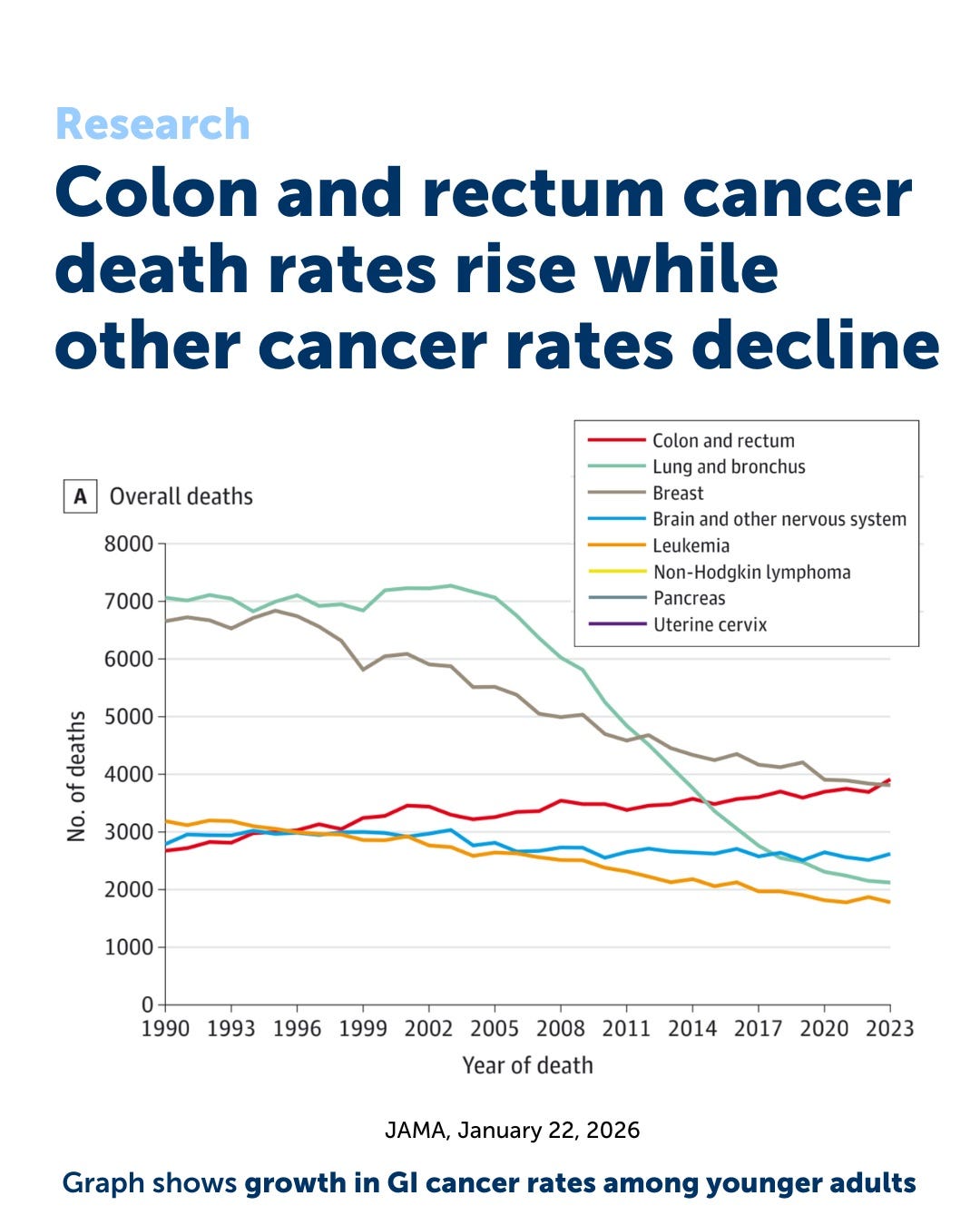
Source: Colorectal Cancer Alliance
I just turned 50 this year, and I am still young in cancer terms. It is clear there has been something growing for some time. Cancer knows no age limit. In fact, deaths from colorectal cancer among those under 50 have been rising while other cancers are falling, the exact pattern in the chart above. According to the New York Times, researchers have identified a “birth-cohort effect” in colorectal cancer, where each generation born since the 1950s carries a higher risk than the one before it, with those born in 1990 roughly twice as likely to develop colon cancer and four times as likely to develop rectal cancer as those born in 1950. It is unclear what is causing the increase, though researchers suspect it could be a mix of the Western diet, ultra-processed foods, increased use of antibiotics, or lower intake of fiber.
Life is full of surprises. I was super excited to send my middle child off to Duke for her freshman year. Our startup is getting some traction, and I finally feel like I have my arms around everything. Then you draw the wrong card, and everything screeches to a halt.
I keep coming back to something my friend Mauria told me during my breast cancer diagnosis. She said each visit, each test, each phone call is its own card. You don’t get to see your hand in advance. You only get to decide how you play the card in front of you, right now, before the next one is dealt. I thought I had learned that lesson already. I did not expect to need it again so soon.
My goal is to not overthink it. Don’t anticipate the negative. Just let the cards come as they come.
David has been steady through all of it, the way he always is, though he still has a tendency to keep saying, “Everything will be fine,” as a way to reassure himself and me. I sent him my Chicken Talking to Ducks article to remind him how that went last time.
We finally told the kids. They had a muted reaction. We had to move our flights to make the surgery date, so we told Bethany first to ask if she wanted David to stay with her for the one extra day. She was unsure, but told her dad to come home with me to make sure everything went well. Jonathan is still home and taking care of his little sister while we send Bethany off before heading into his junior year at Boston College.
Many years ago, when Danielle was about six, I had a bad headache. David joked, “It’s not a tumor.” She asked what a tumor was. Then, once we told her, she said, “Mommy. Please don’t die. If you die, I’ll be really sad, but I’ll also be a little bit happy.” I asked her why. She replied, “I would be sad because I wouldn’t have a Mommy anymore, but then we can finally get a dog.”
When we told her about the latest news, she said, “So if you die, can I finally get a cat?” I said, “Absolutely not,” and we laughed through the tense moment.
Fear doesn’t get easier the second time. If anything, because now I know exactly what is ahead, it feels more daunting. I don’t want the kids to live with that fear and dread, so I want to focus on what is right in front of us. Both my parents died of cancer, and I know what that process looks like. I don’t want that shadow hanging over their heads as it did for our family for so many years.
A couple of weeks ago, as the second round of cards started flipping, I was hosting a dinner at my house. A woman I had met before but didn’t know well told me that after reading about my breast cancer diagnosis last year, she scheduled her mammogram. She found out she had breast cancer. Because she caught it early, she has recovered. She wanted me to know that sharing our story helped change her life.
I never thought writing about my own diagnosis would impact others, but my promise to Mauria was that I would urge everyone we knew to get the screening. Later I told her that I think about 40 or 50 people had mentioned getting the mammogram, and at an average diagnosis rate of 13%, perhaps we helped half a dozen people catch their cancer early enough to be easily treated.
Standing in my own kitchen, hearing someone tell me how early detection traced back to something I wrote, I understood in a new way why I keep doing this publicly instead of privately.
I guess I thought my advocacy work for early breast cancer detection through mammograms was part of my calling. Now, apparently, the colorectal cancer world would like me to join the chorus to advocate for more colonoscopies too.
Advocacy only works if you actually do it. I write about early detection. I tell other women to get their mammograms. But the reason this growth was found at all is that I did not skip the colonoscopy even though I had done a full-body scan last year. Writing about vigilance and practicing it are two different disciplines, and this was a reminder that I have to keep doing the second one.
The body does not check your calendar. I had a launch, a send-off, a full life moving at full speed, and none of that mattered to a cell that had been growing quietly for who knows how long. You do not get to negotiate timing with your own biology. You only get to decide how you respond when it interrupts you anyway.
Knowing the odds is not the same as controlling them. I am a quantifier. Give me a percentage and I will hold onto it. But 60% is still a coin flip with weight on one side, and I have had to sit with the discomfort of a number that is informative but not decisive. Some things you cannot spreadsheet your way out of.
One card at a time is the only sustainable way to live this. I cannot solve for positive biopsy results, the chest CT, the surgery, and the lymph node pathology all at once. Trying just leads to frustration and anxiety. The only thing that actually works is playing the card in my hand today and setting the rest down until they are dealt.
The chart at the top of this piece is not abstract to me anymore. Colon and rectal cancer deaths have been rising in younger adults for two decades while nearly every other major cancer has been in decline. That is not a coincidence, and it is not something that only happens to other people. I am 50 and active. I cook most meals at home and work out regularly, and I still ended up here. I had two polyps removed during the colonoscopy, one of which was pre-cancerous.
Colonoscopy screening guidelines have already caught up to this reality. Both the American Cancer Society and the U.S. Preventive Services Task Force now recommend starting screening at 45 instead of 50, specifically because of the rise in cases among younger adults. But guidelines only save lives if people follow them, and right now, fewer than one in four adults between 45 and 49 have been screened. Knowing the right answer and acting on it are not the same thing, which is a theme that keeps showing up everywhere in my life this year.
If you are over 45, or younger with a family history or any symptoms that do not resolve, please do not wait for a friend’s birthday request or a scare in your own body to make the appointment. I did the colonoscopy because it was time, not because anything felt wrong. That is exactly why it worked.
I do not know yet what card I will draw next. I will not know until after the surgery, and then again after the pathology, and then again after whatever comes after that. Maybe I am in the 40%, and this was all a scare that I can put behind me. Or maybe I have a long road ahead. Or somewhere in between. I know how to do this now because I have done it before. I will play the hand I am dealt, one card at a time, and I will share what I learn along the way to help others remember to schedule their screenings.
As you read this now, consider what you have been putting off, and take action. It could make all of the difference.
No posts
Comments
Nothing yet. Say the first thing.
Sign in to join the conversation.