
From his Paris days in his 20s, to his reinvented life as a cartoonist as he turns 70, Peter Moore journals his life every day; he’s at 7 million words and counting. But it’s his quirky drawings that make me laugh. That seemed like a good topic for a [b]old-adjacent conversation, so we dove in. Here’s one of Peter’s cartoons, truly clever and original, and reprinted without his permission.
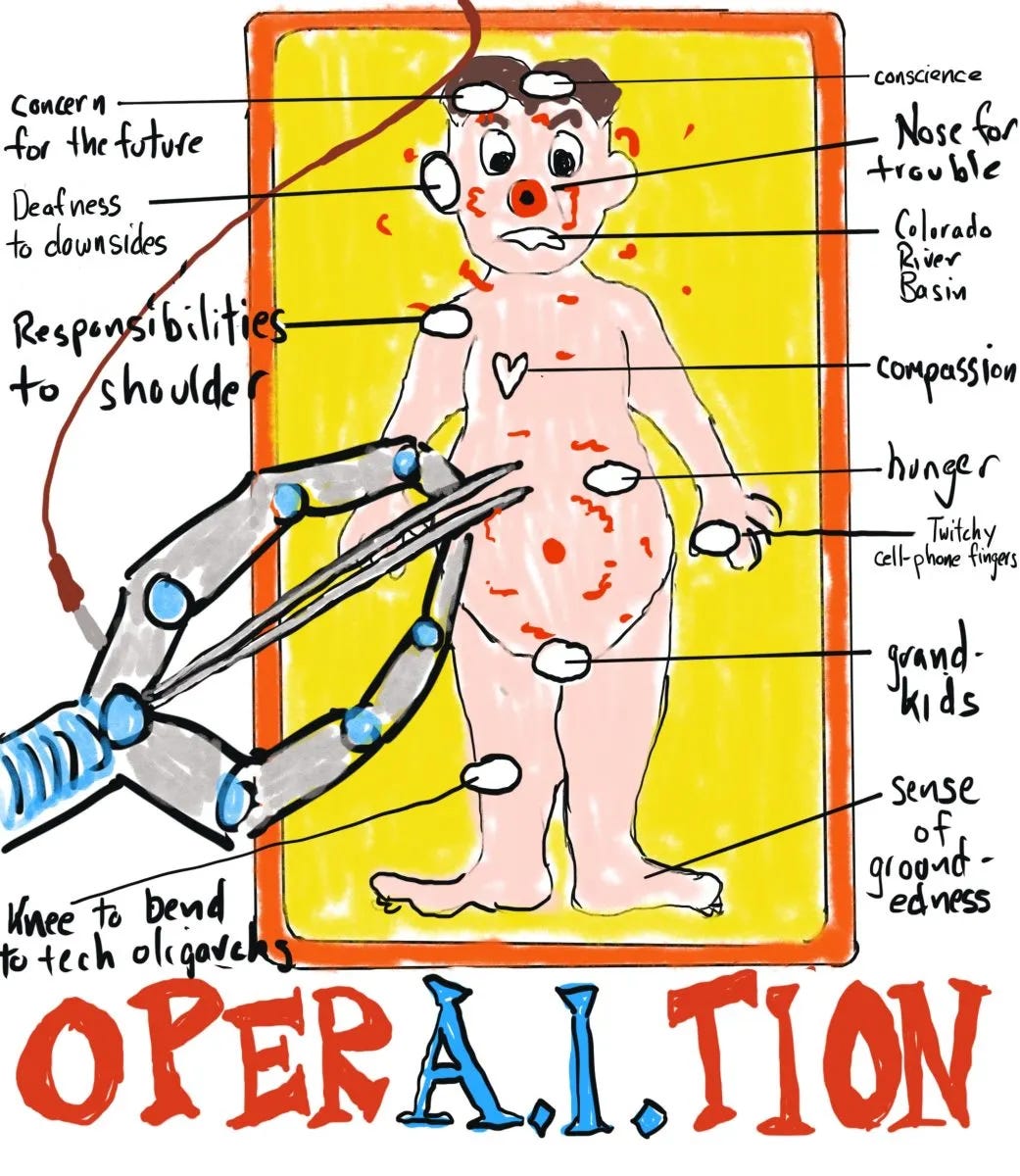
I fed the transcript of today’s LIVE conversation into ChatGPT and asked it to summarize. AI’s instant take on our chat is pretty much on the mark, although I don’t think either one of us was quite this coherent, and ChatGPT draws more conclusions than either Peter or I intended. I’m leaving it at that for today.
Thanks to everyone for tuning in, and especially for the good comments and questions from MLR, Mike Bryskier, and DonnaMaria.

“This lively, funny conversation between Debbie Weil and Peter Moore ranges across creative reinvention, cartooning, writing, journaling, Substack, money, marriage, aging, and what makes a life worth living. Moore, 69, describes how a long career as a magazine editor unexpectedly evolved into a new identity as a writer-cartoonist after he lost his major magazine job and the pandemic disrupted his freelance work. A daily journal he has kept since 1978—now totaling millions of words—became the raw material for an illustrated memoir and eventually his Substack. The conversation repeatedly returns to a larger theme: you don’t have to know exactly what you’re doing before you begin something new. Moore’s willingness to say yes and then figure out how to do it becomes a model for later-life reinvention. Debbie and Peter also explore the value of humor, the difficulty of persuading readers to pay for creative work online, the peculiar behavior of Substack readers, and the difference between wanting a long life and wanting a good one.
Peter spent roughly 30 years in magazine and book publishing, including a long tenure at Men’s Health, where he eventually became editor. He describes the magazine years as both lucrative and exhilarating.
Losing his job at Men’s Health was a major rupture. By the pandemic, other freelance work had disappeared as well.
That disruption created the opening for something completely different: memoir, drawing and eventually cartooning.
Peter had always known he could write and be funny. What surprised him was discovering that he could combine writing with drawing.
The breakthrough was realizing that his “cartoonist self” could make fun of his “writer self.” That tension became central to his voice and work. This was my favorite thing that Peter said!
Debbie seizes on this as something Substack could use more of: less solemn self-importance and more willingness to laugh at oneself.
Peter has written a journal entry every day since October 12, 1978.
He estimates that the journals contain more than seven million words and encompass virtually his entire adult life.
Entries can range from a couple of sentences to thousands of words.
He generally writes in the evening, recording what happened that day rather than using the journal as a conventional morning creativity exercise.
The journals preserve births, marriage, deaths and other major life events, along with countless ordinary days.
During the pandemic, this enormous personal archive gave him the source material for a memoir.
The journal began almost casually when his brother gave him blank books. Peter wrote about October 12, then October 13, then October 14—and simply never stopped.
Peter initially imagined illustrating his memoir somewhat in the tradition of illustrated literary books: a few drawings accompanying sections of the manuscript.
The drawings proliferated until the project became an illustrated memoir.
When he began publishing on Substack around 2021, he paired memoir excerpts with comic illustrations.
Eventually he realized that cartooning wasn’t merely decoration for his writing; it was becoming a creative identity of its own.
A memorable turning point came in an art class. Peter had painted a perfectly respectable landscape but found it boring. He added foxes and rabbits traveling in opposite directions like commuters. When his classmates applauded, he realized that his artistic impulse was not simply to represent the world but to reinterpret it humorously.
Drawing also gave a lifelong professional talker, writer and editor another way to communicate—one that allowed him, as he puts it, essentially to shut up for three hours.
Peter’s career repeatedly advances because he offers to do something before he completely knows how to do it.
After his cartoons led to a column for the Colorado Sun, he began doing radio commentaries through KUNC.
He then proposed creating animations to accompany the commentaries.
Once they said yes, he went home and figured out how to animate his drawings in Procreate, frame by frame.
Debbie identifies this as one of the most important ideas in the conversation, particularly for people approaching or beyond conventional retirement age.
Instead of asking, Am I qualified? Can I really do this?, Peter’s approach is closer to: announce what you want to do, create the opportunity, and then learn what you need to learn.
Peter also argues that people are far too judgmental about their own creative ability. He says he “can’t draw” in the conventional virtuoso sense either; what matters is that the marks he makes are recognizably and authentically his.
An art teacher once told him that anyone who can write cursive has enough manual dexterity to draw—a notion Debbie particularly likes.
Peter describes his humor as extremely deadpan; his wife has often had to explain to baffled people that he is joking.
But humor is more than joke-making for him. It is a way to step outside your own life and observe it.
Everyone says foolish things, gets misunderstood, behaves badly and lands in ridiculous situations.
The humorist can stand slightly apart from those moments, recognize their absurdity and forgive himself.
Peter’s basic choice is simple: life provides plenty of reasons to cry, but he would rather laugh.
Debbie connects this to her own frustration with the earnestness of much writing about aging—and with the seriousness she sees on Substack Notes.
Both suggest that humor can coexist with serious subjects rather than trivialize them.
One of the conversation’s most charming detours concerns Peter’s wife, Claire.
In 1978, Peter was studying at the Alliance Française in Paris while Claire was studying nearby in Middlebury’s French program.
Claire regularly ate at the Alliance Française cafeteria—meaning they repeatedly occupied the same space without meeting.
Years later, there was another near encounter in Sorrento, Maine: Peter was onshore while Claire happened to be aboard a passing sailboat.
They finally met in Knoxville, Tennessee, when Claire came for a job interview and Peter was assigned to take her to lunch.
Peter says that even before meeting her, he saw her résumé and thought she was “the one.”
Debbie and Peter use the story to muse about fate, chance, partners and the strange alternate lives that might have unfolded if encounters had happened differently.
Debbie raises a question that clearly interests both of them: if readers value good writing and cartooning, why are so few willing to pay for it?
Peter traces much of the problem to the early internet, when publishers trained readers to expect online content for free.
They contrast that expectation with established publications such as The New Yorker, The Atlantic and major newspapers, where readers understand that subscriptions cost money.
Peter sees Substack as increasingly legitimate as a publishing platform, especially as prominent journalists and writers have migrated there, but says that legitimacy hasn’t necessarily translated into adequate income for less-famous writers.
Peter acknowledges that he is fortunate: the money he earned during his magazine career means that “old me can subsidize new me.”
Yet money still matters psychologically. Throughout his career, being paid was evidence that the work had value. He describes financial reward as a form of validation.
At the same time, he makes paid material available to people who genuinely cannot afford it if they contact him.
Debbie and Peter discuss the phenomenon of the “lurker”—someone who reads faithfully but rarely comments or otherwise engages publicly.
Peter tells of attending his mother-in-law’s memorial service and being astonished by how many relatives approached him with detailed knowledge of his Substack despite never commenting online.
Debbie has noticed the same phenomenon among family and longtime friends: they may send a thoughtful private email but resist leaving a public comment.
They speculate that people who know a writer personally may feel especially exposed when commenting publicly.
The exchange is a reminder that visible engagement—comments, likes and restacks—is not necessarily a reliable measure of actual readership or impact.
Peter originally started his Substack to publish material connected with his illustrated memoir.
But the platform itself began pushing him in unexpected directions.
That is part of its value: rather than simply being a distribution mechanism, it has become a place where Peter can experiment with writing, illustration, cartoons and storytelling.
Debbie recognizes something similar in her own experience: publishing consistently can begin to redefine who you think you are, which then raises the question, Where is all this going?
Both retain the career-long instinct to wonder what the current work might become next.
Peter’s working title for the memoir is Portrait of the Artist as a Young Nincompoop.
It draws on his journals from his early twenties, especially his experiences in Paris and Europe—falling in and out of love, reading, exploring and trying to figure out what kind of life he wanted.
Looking back, Peter sees his younger self as both naïve and surprisingly perceptive about what mattered to him.
He is currently trying to find an agent, although the publishing industry’s difficulty categorizing an illustrated memoir has made that challenging.
More importantly, he does not see this as a one-off book. He already imagines five more books, drawing stories from the journals and illustrating them.
Substack, therefore, may be less the final destination than a creative proving ground that could lead to an agent, publisher and series of books.
Beneath the jokes is a serious conversation about what it means to keep creating as one gets older.
Peter is approaching 70 but is talking not about winding down but about a new series of books and an expanding creative identity.
Debbie explicitly frames his story as an example for people wondering whether they can reinvent themselves after 65.
Both emphasize creative expression as worthwhile in itself, even if it never produces enormous financial rewards.
Technology—including Substack and digital drawing tools—can make that creative expansion possible rather than being something older people should fear.
Debbie closes by returning to a question Peter had initially refused to discuss: living to 100.
Peter’s objection is essentially about quality versus quantity. He has no desire simply to accumulate years if those years mean extreme physical decline and dependence.
His father strongly shapes this view. At 73, his father went out for a run and died suddenly—apparently from a heart attack or stroke.
The death was of course painful for Peter, but he also sees something enviable in the trajectory: his father went almost instantly from being vibrant, funny, loving and engaged to being gone.
That story brings the conversation full circle. Peter has many things he still wants to make, but the goal isn’t simply to stay alive long enough to reach some arbitrary age. It is to remain engaged, creative, curious and fully himself for as long as he is here.“
END OF AI SUMMARY

Available for iOS and Android
Comments
Nothing yet. Say the first thing.
Sign in to join the conversation.