
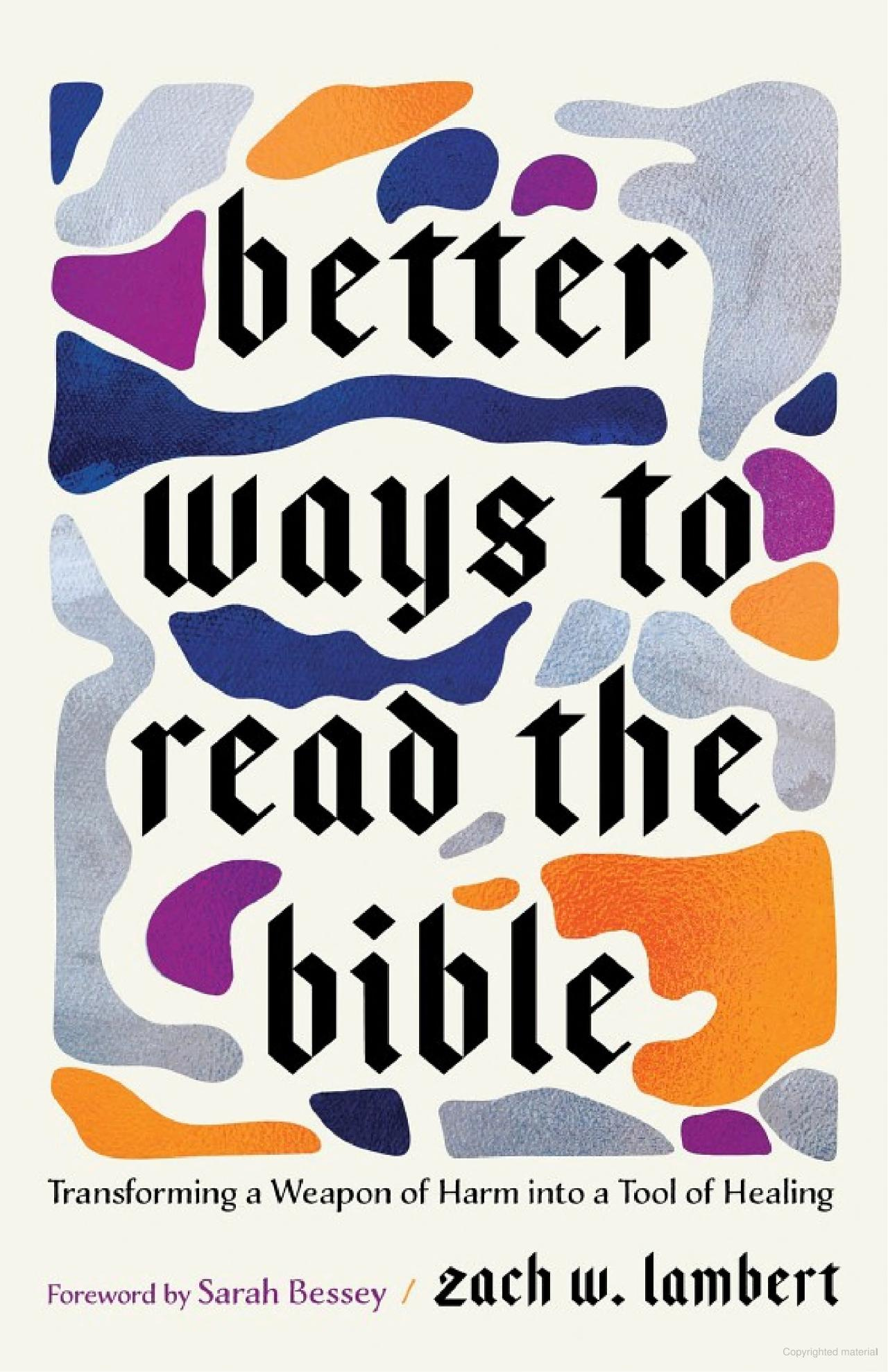
In my last post, I began a review of the book Better Ways to Read the Bible by Zach W. Lambert. In it, I cover the first half which describes four harmful lenses through which we can read the Bible. Check it out here:
Reviews
·
October 21, 2025

Although I don’t use much social media, I do scroll Substack Notes. It’s there that I came across Zach W. Lambert, a pastor in Austin (where I happen to live). I had not heard of his church, Restore, and I still haven’t watched any of his sermons. But I’ve appreciated his heartfelt and compassionate approach to engaging with society that echoes what I observed about J…
In this post, I review the final part of the book, which is about four lenses that bring healing.
This chapter begins by addressing the topic of deconstruction. In the context of Christianity, deconstruction refers to a process in which one actively re-evaluates the building blocks of their faith. Sometimes, this leads to the Christian reconstructing their faith into something that looks somewhat different but remains intact, and sometimes it results in them losing it altogether.
While I haven’t undergone as dramatic a deconstruction process as some, I have certainly struggled with some Christian teachings as I wrote about in the first part of this review. And I have read and listened to many Christians who have gone through this process, such as Dan Koch (whose podcasts I’ve found very valuable). I like what Lambert says about deconstruction, and it definitely aligns with my own experience and observations:
Some evangelical leaders assert that people deconstruct so they can sin more freely and feel justified while doing so, because they are being held captive by Satan, or because it’s the “sexy thing to do.” But in my experience, people don’t deconstruct because it’s “sexy” or because they’re looking for excuses to sin. They do it because the Christianity they’ve encountered is so unlike Christ.
He also quotes Russell Moore, whom I’ve referenced before:
The culture often does not reject us because they don’t believe the church’s doctrinal and moral teachings, but because they have evidence that the church doesn’t believe its own doctrinal and moral teachings. They suspect that Jesus is just a means to an end - to some political agenda, to a market for selling merchandise, or for the predatory appetites of some maniacal narcissist.
Not one of them walked away because they wanted to curry favor with “elites” or because they wanted to rebel. If anything, the posture of many of these people was not that of the Prodigal Son off in the far country so much as that of his father, waiting by the road for a prodigal they loved and wanted to embrace again: their church.
100%. This relates to my recent post about witness and is part of the motivation for my pastor and I starting the JustChristian initiative I wrote about recently.
Lambert goes on to make the argument that unlike most other religions, Christianity is not fundamentally a book or text-based religion. The Bible is not the ultimate source or focus of our faith: Jesus is. The Bible tells us about Jesus but the only reason the Bible even exists is because Jesus came, died and rose again. As Lambert puts it:
We don’t know about Jesus because of the Bible; we know about the Bible because of the resurrection of Jesus. […] This fundamental reality should change the way we read and relate to the Bible, as well as how we construct, deconstruct, and reconstruct our house of faith. If anything in our house of faith contradicts the words or works of Jesus, we must choose Jesus. […]
The Bible isn’t what I’m following; Jesus is. I’m not a “little Bible”; I’m a “little Christ.” […] Christians spend so much time arguing about what is “biblical” and “unbiblical” when we really should be distinguishing between what is Christlike and un-Christlike.
So, what does it mean to be Christlike? For the answer, Lambert focuses on the three clearest answers Jesus gives throughout his entire ministry.
The first is to have faith. Faith isn’t the same thing as belief. To have faith is not to believe all the right things but to believe in the right person. Nor is faith in conflict with doubt. Rather, Lambert asserts that the opposite of faith is certainty. To be faithful is to trust in God, which is a lot easier when we realize we don’t have all the answers.
The second answer Jesus gives is to forgive those who sin against us “not seven, but seventy-seven times” (Matt. 18: 22). This answer is a callback to a passage in Genesis 4 about Lamech, a descendant of Cain. Lamech was a violent and vindictive man who boasted: “If Cain is avenged seven times, then Lamech seventy-seven times.” As Lambert puts it: “Lamech was all about unrelenting revenge, but Jesus is all about unrelenting forgiveness.”
The final answer Jesus gives is this famous instruction: “‘Love the Lord your God with all your heart and with all your soul and with all your mind.’ This is the first and greatest commandment. And the second is like it: ‘Love your neighbor as yourself.’” (Matt. 22: 37-40, NIV).
Lambert comes to essentially the same conclusion I did after reading through the gospels:
“If we are interpreting the Bible in ways that do not yield more love of God and neighbor, the two things Jesus says are most important, than we are interpreting it incorrectly.” […]
When multiple interpretive options exist - and they almost always do - we must choose the interpretation that most closely aligns with the person, work and teachings of Jesus Christ, which looks like sacrificial love for all people.”
This chapter is about how important it is to understand the context in which the Bible was written so we can better understand how to appropriately apply it to our own. To make this point, Lambert focuses on the role of women in the church.
Although he doesn’t really address the absence of women among the twelve disciples, he does make a point that was not new to me: that Jesus and the early church elevated women in ways that were highly unusual for their patriarchal society. Lambert lists many examples of women throughout the Bible who played critical roles in God’s plan. Women were honored to be the first to know of the Messiah’s coming, were prophets, liberators, teachers and evangelists. So why do so many Christian churches (including my own) believe that only men should preach?
Lambert addresses the main verse that is often used to justify this view. In 1 Timothy 2, Paul says “a woman should learn in quietness and full submission. I do not permit a woman to teach or to assume authority over a man; she must be quiet.” Taken at face value, this seems pretty clear-cut, but in keeping with the point of this chapter, Lambert explains the larger context that we read about in 1 Timothy 1-2. This instruction was directed specifically at a church that was dealing with women who were dressing immodestly and spreading false teachings. Lambert also points out the singular “woman” as an indication that this applied to a specific circumstance and that these verses also include other instructions that we don’t take as universally applicable, such as instructions for men to raise their hands when they pray.
Lambert also addresses the “wives, submit to your husbands” instruction from Ephesians 5 which has been used to suggest that men are inherently more suited to leadership. He points out that it follows a verse that says to “submit to one another,” and precedes verses which tell the husband his responsibilities to his wife. I do think it’s fair to point out that the nature of how husbands and wives are to submit to each other differs in these verses, and Lambert doesn’t explain verse 23 which states “the husband is the head of the wife as Christ is the head of the church.” That said, the emphasis on the husband’s duties to his wife, including to “love his wife as he loves himself” is again a rather radical teaching for a society that treated women as second-class.
Lambert believes that for their culture, Jesus and Paul were quite radical feminists. This may not seem to be the case when read through a modern lens, but this again is why context is key. If we ignore context, we risk interpreting the Bible incorrectly: such as by concluding that verses meant to promote respect and equality among the sexes instead justify subjugation.
I know that the policy of many churches for women not to preach is based on more than a couple verses and that reasonable people can question Lambert’s interpretations, but I do agree with Lambert's point about the importance of reading the Bible - especially challenging verses like these - in the context in which they were written. And I particularly appreciate the ways in which he connects these verses to the larger narrative of the Bible which was truly liberating for women at the time.
In this chapter, Lambert draws from liberation theology to emphasize the ways in which Jesus focused on the poor and marginalized in his ministry. Jesus tells us in Matthew 25 that we will be judged for how we treat the least among us. As St. Augustine wrote: “Christ is needy when a poor person is in need… Christ is hungry when poor people are hungry.”
Lambert notes a contrast between this calling and the threat many Christians saw in ideas like diversity, equity and inclusion (DEI) or “wokeness.” Lambert argues that this opposition came from a desire to maintain power and influence and that fighting against justice was a means to that end. I think there’s some truth to this - the elevation of those who have experienced the lingering effects of slavery and racism to positions of power is a threat to those who already hold them. And I agree that much of what motivated the “woke” movement was inspired by many of the same values Jesus advocated for, such as helping the oppressed and lifting up the marginalized. Wouldn’t one expect followers of Christ to be in favor?
I think this is a complicated topic. On the one hand, I agree with Lambert that the obsession of many conservative Christians on DEI and “woke ideology” was driven more by political objectives than anything they read in their Bibles. But I also think it’s fair to note the ways in which many of the advocates for these ideas took them too far through a “cancel culture” that imposed purity tests and real consequences on decent people they deemed not sufficiently aligned with their worldview. A worldview which, let’s face it, became too quick to oppose things they didn’t like as forms of “white supremacy,” often to the detriment of those they sought to help.
Both sides have a point here. The left took things too far in their quest to correct the wrongs of the past, and the right neglected to recognize that those wrongs persist in the form of disparities in the opportunities and treatment of millions of our fellow Americans. It’s a genuine shame that the extremes of our political divide turned what could have been an opportunity for reconciliation and greater justice into another cultural battle whose consequences we’re living with today.
One thing that stuck with me from this chapter was a somewhat unique take on Luke 21: 11-4, in which Jesus says of a poor woman’s giving to the church: “‘Truly I tell you,’ he said, ‘this poor widow has put in more than all the others. All these people gave their gifts out of their wealth; but she out of her poverty put in all she had to live on.”
A common understanding of this verse is that it’s about the value of sacrificial giving, and I do think that’s partially true. But Lambert argues that this verse has been abused to convince poor people to give more than they can afford, and that this is not actually what this verse is about. Lambert points out that this verse immediately follows this description at the end of Luke 20 of the church leaders: “They devour widows’ houses and for a show make lengthy prayers.” Lambert argues that Jesus’s recognition of the widow’s gift is not to hold it up as an example to follow, but as evidence of the ways in which the powerful of the day exploited the vulnerable. I’d never noticed this before, but I think he has a point. It’s a far cry from the commandment in Deuteronomy 14: 28-29 to give the tithes to the foreigners, fatherless and widows.
As an outspoken pastor of an “affirming” church (one which does not view homosexuality as a sin and will perform gay marriages), I expected Lambert to address this topic at some point. He finally does so in the final chapter.
I have had gay coworkers, roommates and friends and honestly have never found them to be anything but “normal,” decent people. I don’t believe they chose to be gay, nor do I believe their sexual orientation is something that they can choose to change. Whatever caused them to be gay, it is what it is. I believe the same can be said of many transgender people.
So, what is a Christian to do with that? If these lifestyles are sinful, as some verses in the Bible seem to suggest, why did God create people this way? Sure, one could ask this about birth defects or disease, but is that how we’re supposed to view homosexuality? An unlucky symptom of a broken world that means such people must resign themselves to a life of sexual and emotional frustration if they are to be right with God?
Lambert rejects the premise that these are sinful lifestyles. Part of his argument I agree with - that the verses in the Bible that are used to denounce homosexuality are often misinterpreted and misapplied. But he goes further, arguing that the peculiar frequency with which “eunuchs” are favorably treated in the Bible is evidence that the Bible is actually actively affirming of these sexual minorities.
Let’s take the first argument. Lambert acknowledges the existence of six “clobber verses” that are used to denounce homosexuality, which on their face seem straightforward. It’s noteworthy that none of them come from the gospels, but some do come from the New Testament, including 1 Corinthians 6:9-10 (NIV): “Neither the sexually immoral nor idolaters nor adulterers nor men who have sex with men nor thieves nor the greedy nor drunkards nor slanderers nor swindlers will inherit the kingdom of God.”
Now, the most obvious observation to make about this verse is that “men having sex with men” is listed alongside “greed,” “drunkenness” and “slander,” and yet it seems whenever this verse is brought up it is to single out the apparent sinfulness of homosexuality and why it must be opposed in society, while neglecting the other sins on this list. But Lambert points out that there is a translation and interpretation issue here as well. Apparently the “men having sex with men” portion was not generally interpreted to refer to homosexuality until the Revised Standard Version did so in 1946. Previous interpretations included “abusers of themselves with mankind” (KJV) and “boy molester” (Luther’s bible). This aligns with the argument that the kinds of homosexual acts that occurred in those days were not anything like the monogamous, consensual adult relationships many gay people have in modern times. Rather, sexual slavery and exploitation, including with children, were common forms that this took, and the more likely object of scripture’s denunciation.
Lambert’s argument that the Bible is actually favorable to homosexuals and other “sexual minorities” is based on its positive portrayal of eunuchs in both the Old and New Testaments. My understanding of “eunuch” is that these were celibate or castrated individuals for generally ceremonial reasons, not people who experienced same-sex attraction or were transgender. But Lambert argues that they are similar in that they were an example of a “sexual minority.” I think it’s an interesting argument, and it is noteworthy how relatively often and respectfully the Bible references such individuals.
Ultimately the argument I find most persuasive is that the Bible’s supposed denunciations of homosexuality are at best ambiguous when applied to the loving, monogamous form that they often take today, and as such Christians should not be confident in this interpretation. They likely do refer to promiscuous and exploitative sexual activity which we should view as sinful, whether it’s homosexual or heterosexual. And on transgenderism and marriage, I see biblical passages like Matthew 19:4-6 as primarily a description of generally understood reality (that there are two sexes) and an endorsement of marriage as an institution. Yes, it is clearly describing heterosexual marriage, and I can understand why some Christians conclude from this that the church should this only perform heterosexual marriages. But to draw from this an explicit denunciation of gay marriage - particularly when performed by secular institutions - is to read something that isn’t there.
All of which is to say: I am not convinced that the Bible has a clear stand on the morality of healthy homosexual relationships or gender dysphoria or gay marriage. The passages used to justify discrimination and judgement toward individuals fitting these descriptions are more likely referring to something more specific and which would be sinful if it involved cisgendered heterosexuals as well. I’m also not convinced that the Bible endorses homosexuality or transgenderism, but it does endorse love toward minorities and social outcasts, including eunuchs, and that’s enough for me to conclude that the way the church has often treated such individuals is a grave injustice.
Lambert cites some devastating statistics about the harmful consequences of the church’s rejection of homosexuals, including depression, suicide, homelessness, and rejection by their families and church communities. And lest you think these people rejected God first and this is what led to these consequences, Lambert notes an incredible survey finding: while only about 9% of people who left the church as adults are open to returning, 76% of LGBTQ+ people say they are. In other words, they didn’t leave the church - the church left them.
Lambert’s main point with this chapter is that this is a tragedy, both for the people we’ve pushed out of Christian community, as well as that community which is poorer for their absence. Misguided convictions about LGBTQ issues have borne bad fruit in the church which has harmed the lives and faith of many and deprived the church of their joy and God-given gifts.
I really enjoyed Better Ways to Read the Bible. I found it very easy to read, highly resonant with my own life experience, and generally well-argued. Lambert takes some liberties with biblical interpretation, and I didn’t find every one of his claims entirely persuasive, but his overall message and argument is sound. The modern Christian church, especially in America, has been guilty of making secondary beliefs primary, often to the great detriment of the faith and lives of people. Yet for all the ways the Bible has been misused to do harm, it is also the greatest hope for humanity when we focus on Jesus and his revolutionary teachings. Contrary to what some may assume about a “liberal” Christian author, I found Zach Lambert to be serious about understanding the Bible and sincere in his love for Jesus and others - especially those the church has hurt. Isn’t that what matters most?
No posts
Comments
Nothing yet. Say the first thing.
Sign in to join the conversation.