
Having taste is an under-remarked-upon part of being a book editor or any profession that bridges the gap between art and commerce. It’s what is depended on but isn’t talked about, largely because it seems so amorphous to define. As we discuss identifying new talent and computerized plagiarism, taste is more important than ever. There are some people who know how to spot talent and others who don’t. But what is taste?
Recognizing quality and intentional skill where it may not be apparent.
That’s where having taste starts, with the real ability to recognize not only a book’s quality but understand the largely unseen skills that went into producing it. That’s a two-step, not one-step process. It it helps to bring in fine art by way of example. Most people, myself included, can’t tell you what skills make a Rothko or a Pollock special. A lot of people encounter these paintings for the first time and think they are pretty cool or just that they look like kid art. It takes a deeper understanding of the techniques and the evolution of the artform to fully appreciate that these paintings aren’t as simple as they seem. Whereas something like a van Gogh shouts its quality and skill to any casual observer (why van Gogh paintings are on more keychains, t-shirts, and tchotchkes than Rothko’s or Pollock’s). This is applicable to every artistic medium. You have some taste if you can spot a well-written book (more difficult than you think!), but even more if you can explain why that well-written book’s sentences and style are effective. Even better if you work to understand how and why the form has evolved over time.
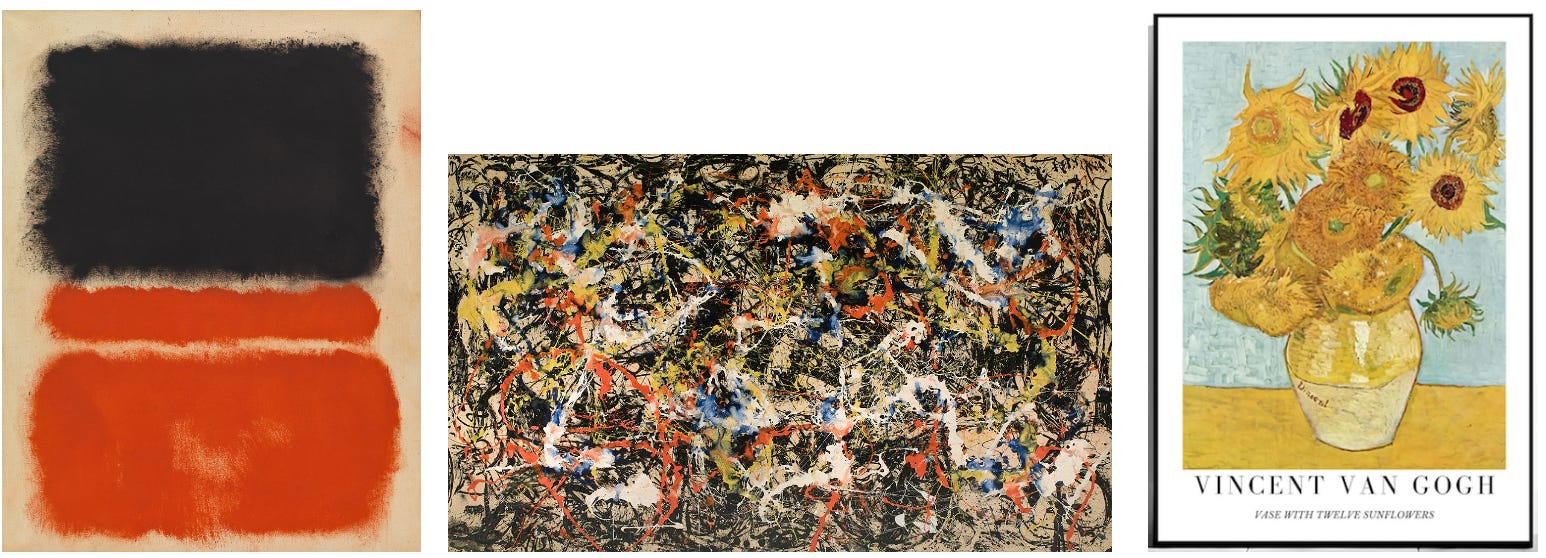
That’s the first (two-step) part of the definition of taste: discernment. The second part of the definition is where it may not be apparent. Taste demands keen consideration. If the quality and skills are more apparent, i.e. Van Gogh, less taste is required to discern it. After developing the ability to spot something good and understand why it is good, taste is about the work it takes to find and/or explain it. Unearthing a 1995 dystopian novel in translation is an impressive display of taste. Once it goes viral on TikTok, its subsequent discovery becomes less of an act of taste.

It’s important to note that taste is not strictly highbrow. You can be a connoisseur of something extremely simple and accessible and (seemingly) uncomplicated. Have you ever seen a video of some random person taste testing seltzer blind who is able to identify each one out by name? This is a literal taste test, an exercise in discernment. The difference between a seltzer expert and a sommelier is just the complexity, both real and perceived, of these talent spotting skills as recognized by the wider world. However, both your French vintner and your old man in a New York bodega are both on the same continuum—they both are exercising taste.
In broad strokes we tend to value the former type of taste monetarily (popular taste) and the latter (hyper-specific taste) with cultural capital (that eventually can turn into monetary capital). Figuring out the most addicting flavor of Dorito has more monetary value than knowing how to pick out the best ingredients at the farmer’s market. In book terms this might be the difference between knowing what a great beach read is versus what might be nominated for the Booker translation prize. Similar skills with different applications and rewards.
“Having taste is defined by risk. Whether it is indie films, experimental literature, high fashion, or a brand-new sound, there is far more uncertainty when you’re sticking your neck out for something that isn’t obvious. You can’t have great taste if you stay in the comfort zone of your specialty and rely on a sort of buttoned-up expertise.”
To gain taste you have to A) push yourself outside your comfort zone of what you understand and B) at least try to understand and appreciate those new things. You have to read/watch/listen to/look at things outside of what you naturally gravitate to. This is a bit counterintuitive because developing taste requires careful study of quality and craft, but it also goes beyond mere specialization. The specialization piece lets you know how certain similar looking things are actually different (like different brands of plain seltzer), but taste says that you can pick which one is better (Vintage, obviously, who would gainsay the true connoisseur?).
Developing taste is all about consuming and then comparing and analyzing books against each other. Oft repeated on Dear Head of Mine is the example of a typical English major going straight into book publishing and trying to apply a classical academic lens to contemporary literature. Having such a narrow view, even if that view is focused on the greatest literary works of all time, prevents you from gaining or having taste. Join a book club and experience reading at the whims of other people— it will help you develop taste more than a graduate program.
In other words, having taste is defined by risk. Whether it is indie films, experimental literature, high fashion, or a brand-new sound, there is far more uncertainty when you’re sticking your neck out for something that isn’t obvious. You can’t have great taste if you stay in the comfort zone of your specialty and rely on a sort of buttoned-up expertise. Just like you couldn’t find a great new painting if you only studied post-modern painters, you can’t understand literature if you just read the classics or just stick to the New York Times bestseller list.
Underrated entirely by snoots the world over is that you must try to understand things you do not like and why you do not like them. The people who I have known who legitimately have the best taste tend to say what they think in a fairly unjudgmental way. They aren’t desperate for you to agree with them or shut you down if you don’t. They could tell you why Dan Brown is good or why they don’t care for Richard Powers.1
Not only does reading widely help you narrow in on the small differences in quality and construction, but it fulfills that second requirement of taste in helping you find new, interesting stuff that won’t ever be found if you stay in your bubble of personal preference and proficiency.
“The whole point of the concept is that there’s an objective quality outside of what is inherently and naturally appealing to everyone.”
The best way to measure taste is by testing it. You recommend, wear, point out something and other people respond. It becomes something akin to a reputation, the kind of reputation that takes an extremely long time to build— if most people can’t take the time to have taste, then imagine how long it takes for those same people to notice someone else has taste.
While proving your taste is about convincing other people the books you like have value, taste is not popularity. Maybe that’s obvious. The whole point of the concept is that there’s an objective quality outside of what is inherently and naturally appealing to everyone. To extend our food metaphors even further: no one is surprised that you can come up with a new bacon dish that’s delicious, but if you turn a lentil into the star of the show it’s legitimately impressive.
Taste making and market making are two separate but often interrelated and overlapping skills: there’s spotting what is objectively worthy and spotting what will be popular. Plenty of editors—most of them, probably—have a little bit of each. But not all people have both. The true artistes tend to be completely baffled by — and sometimes overly dismissive of — what is popular. The pleasure-minded tend to be completely baffled by— and sometimes overly dismissive of — what is formally challenging. A lot of us exist somewhere in the middle.
Things spotted by tastemakers often develop over time to become appreciated— they start with a few people recognizing their quality and slowly build out. There are taste making literary agents (and editors) who when they send you a manuscript, you open it with a certainty that it will be baseline worth reading from end-to-end—that’s taste even if the manuscript isn’t sold for a million dollars or the book never sells a million copies. Whereas editors and literary agents who are good market makers are good at identifying what will be a hit, the market tests this hypothesis instantly and they receive their scorecard.
“Taste doesn’t insist upon itself.”
Why taste is hard to measure is not because it’s as subjective as many would assume, but because there isn’t a clear or immediate accounting as there is with popularity. Taste doesn’t insist upon itself.
Taste may not be an innate quality— you’re not just born with it, it can be trained—but it probably gets mistaken for one for the reason that taste cannot be faked. We all know someone, whether its in books, film, or music that has a sort of put-upon taste. Like they looked at a bunch of “best of” lists and carefully calibrated their favorites based on how they think others will perceive them.2 Part of what inspired this essay was another essay on Substack about tech bros understanding that taste is valuable and that they want it, but of course, quite laughably, they can’t manufacture it. Take one look at Mark Zuckerberg trying to look like the platonic ideal of a GQ writer and you can see why for yourself.

It is also a funny illustration of the idea outlined above regarding specialization—here’s a group of people with a hyper niche specialization (technology) not realizing that knowledge alone cannot equal taste. Taste is not an equation to be solved. The act of mimicry is inherently anti-taste. What’s so energizing about the concept in general is that it is not a “fake it till you make it” situation. To prove you have taste, you to go out there and plant your flag, maybe shout about how what you’re standing on top of is really good, and do so again and again. Taste is beautifully human, vulnerable, and flawed that way.
People who want to be seen to have taste and lord it over others or try desperately to convince you that they have it usually don’t. If the derogatory term gatekeeper were ever applicable it would be here. These people are trying to convince everyone else that taste is exclusive and monopolized when it is anything but. They are promoting that voice in reader’s heads that says “if I don’t understand this literary masterpiece then I must be dumb,” because if readers really examined closely, they would realize these wannabe tastemakers are emperors with no clothes.
“Make no mistake, nothing is better that someone with taste because nothing saves you more time.”
The work never ends with taste because there is a fine line between having conviction and being delusional. We all get caught up on our own personal likes and dislikes. We get obsessed with aspects of art that we inflate the importance of that, for all intents and purposes, we are wrong about. And yet we must continue to have conviction and own up to admitting they are delusions every once in awhile.
Consider the classic Madievsky Rule in which all literary fiction (especially by women) is rated 3.5/5 stars. That means most fiction is stuck right in between average (3) and good (4) for most readers. 3.5 is a number that perfectly exemplifies the tension between conviction and delusion. It is where the proving grounds of taste is. 3.5 is where art that is trying to both reach people and be unique falls, in the valley between the 5-star blockbuster reads and the 5-star award-winners. At 3.5 out of 5 the voters are saying: we don’t know what to make of this. This is where someone with taste can step in and be a book’s champion.
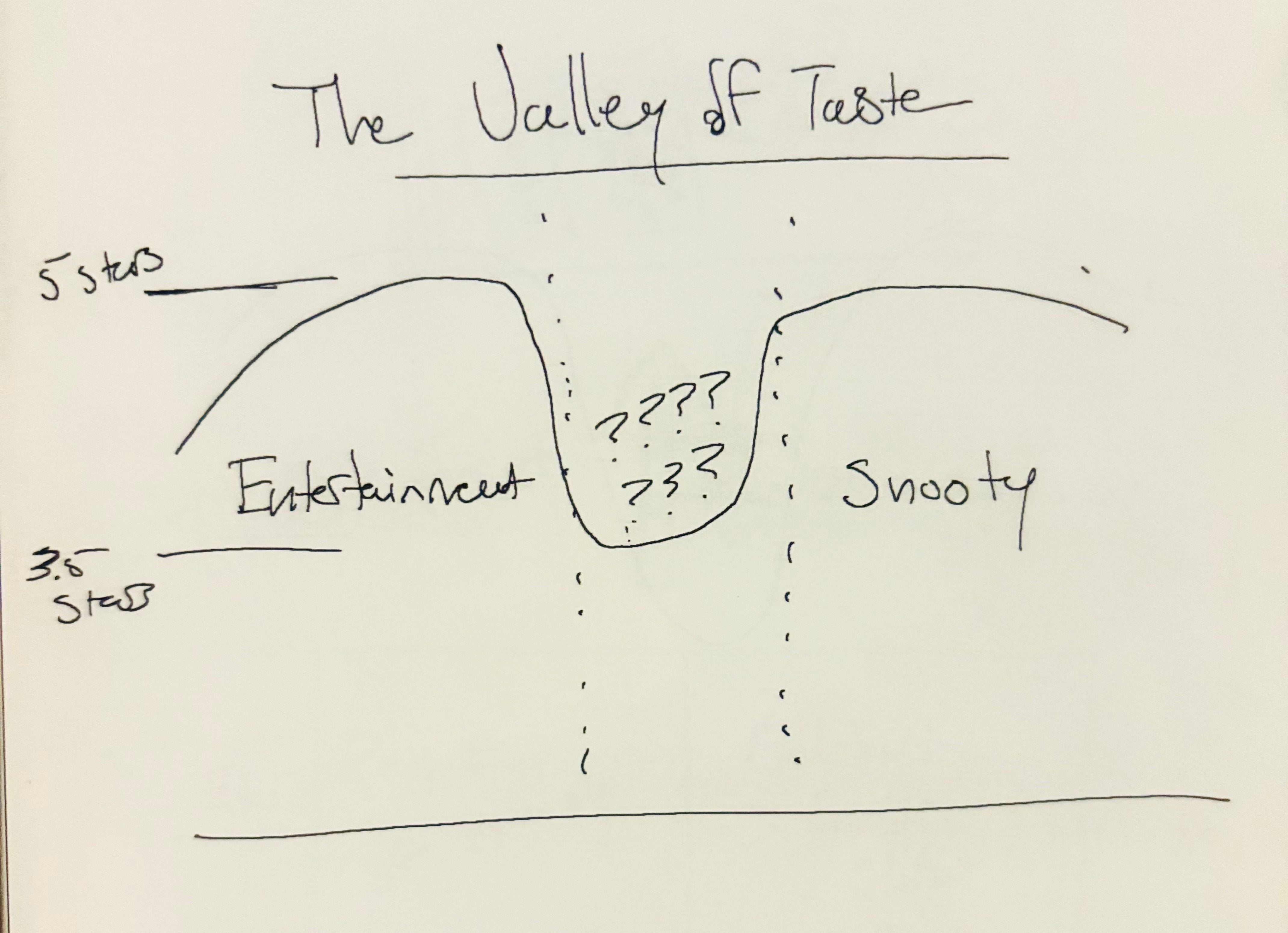
Make no mistake, nothing is better that someone with taste because nothing saves you more time. Enjoy the people in your life who do this hard work, build the skills to discern and take the time to find great books in this valley. If you can find a good half dozen people who know what they’re talking about, your to-read, to-watch, to-listen pile will be forever filled to the brim. Then it’s your duty to return the favor by sampling widely and taking the risk to say that what you think is three-and-a-half stars is actually five-point-o.
Completely random examples.
Comments
Nothing yet. Say the first thing.
Sign in to join the conversation.