
August 18, 2026
For a year, America’s media companies have responded to the Trump administration’s pressure campaign the same way: check-writing, settlement-signing, quiet capitulation. Paramount paid. Networks softened. Executives learned to smile through gritted teeth.
This morning, Disney broke the pattern.
In a federal lawsuit filed Tuesday in the District of Columbia, The Walt Disney Company and ABC accused the Federal Communications Commission of waging a “retaliatory campaign” against the network — not because ABC broke any rule, but because the administration doesn’t like what ABC puts on the air. It is, without exaggeration, the most direct legal confrontation any major media company has mounted against this administration’s war on the press.
The Mouse has lawyered up. And the lawyers it hired should terrify the FCC.
You don’t need a law degree to see what’s been happening here. You just need a calendar.
In April, FCC Chairman Brendan Carr — a Trump loyalist who has made no secret of his grievances with Disney — ordered eight ABC-owned stations to file for license renewal years ahead of schedule. Those licenses weren’t due for review until October 2028. The FCC hadn’t ordered an early review like this in more than half a century.
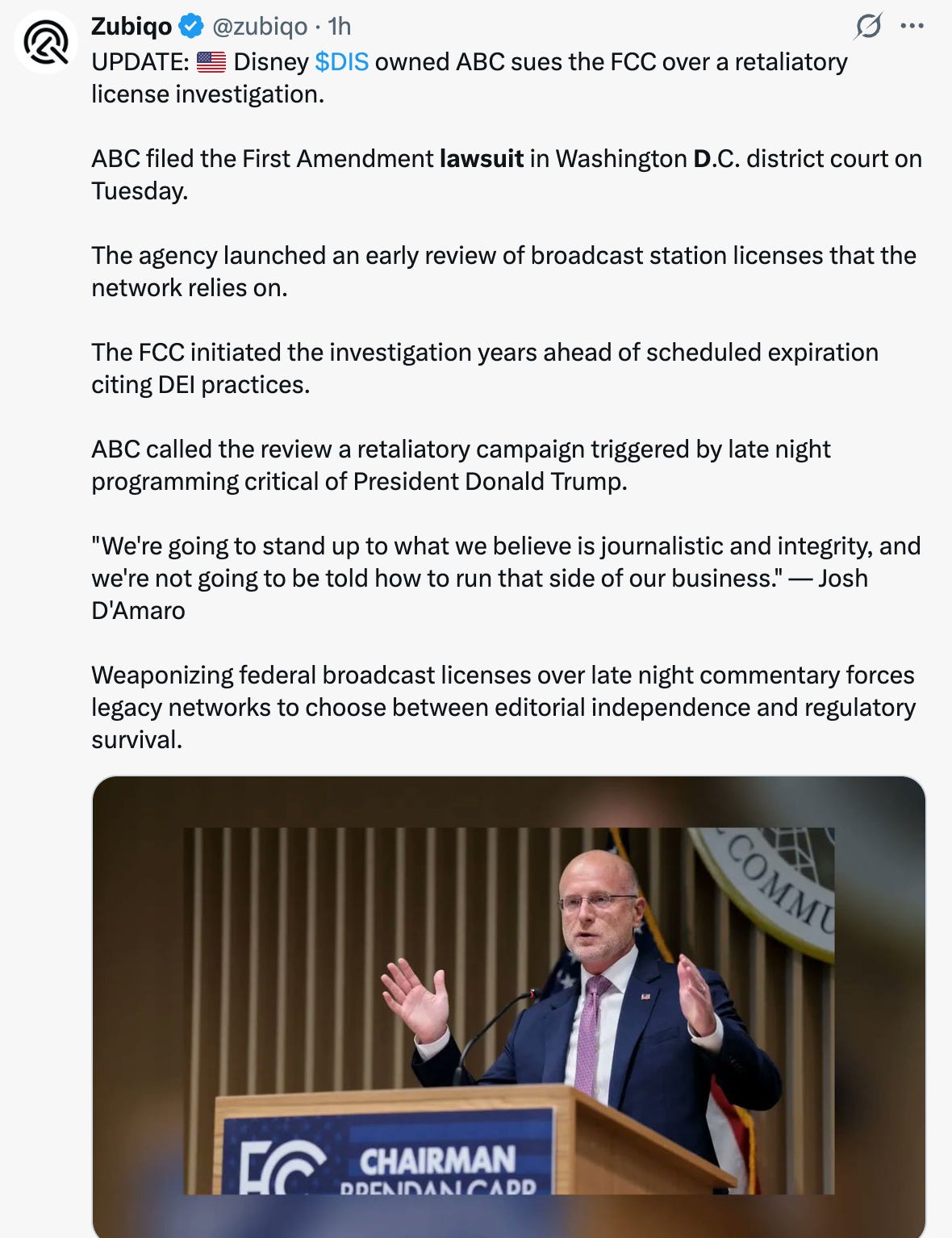
And when did this unprecedented order land? One day after President Trump publicly demanded that ABC fire Jimmy Kimmel over a monologue joke about the First Lady.
One. Day.
That’s not regulation. That’s a message.
The campaign didn’t stop there. Carr’s FCC opened an investigation into “The View” — a daytime talk show — dusting off an “equal-time” election rule that has barely been enforced in decades, seemingly because the show’s hosts are outspoken Trump critics. Carr has floated accusations that Disney may be engaged in “illegal DEI discrimination.” He publicly bristled when ABC declined to carry a Trump primetime address on its linear network. And Trump himself has posted openly about late-night hosts being relentlessly negative toward him, musing about whether broadcast licenses should simply be terminated.
He said the quiet part out loud. Repeatedly. In writing. And Disney’s lawyers put those posts directly into the complaint.
Disney’s complaint doesn’t mince words. The company calls the FCC’s actions an “existential threat” to its stations and says it came to court reluctantly — because the only other option was total surrender to the administration’s demands.
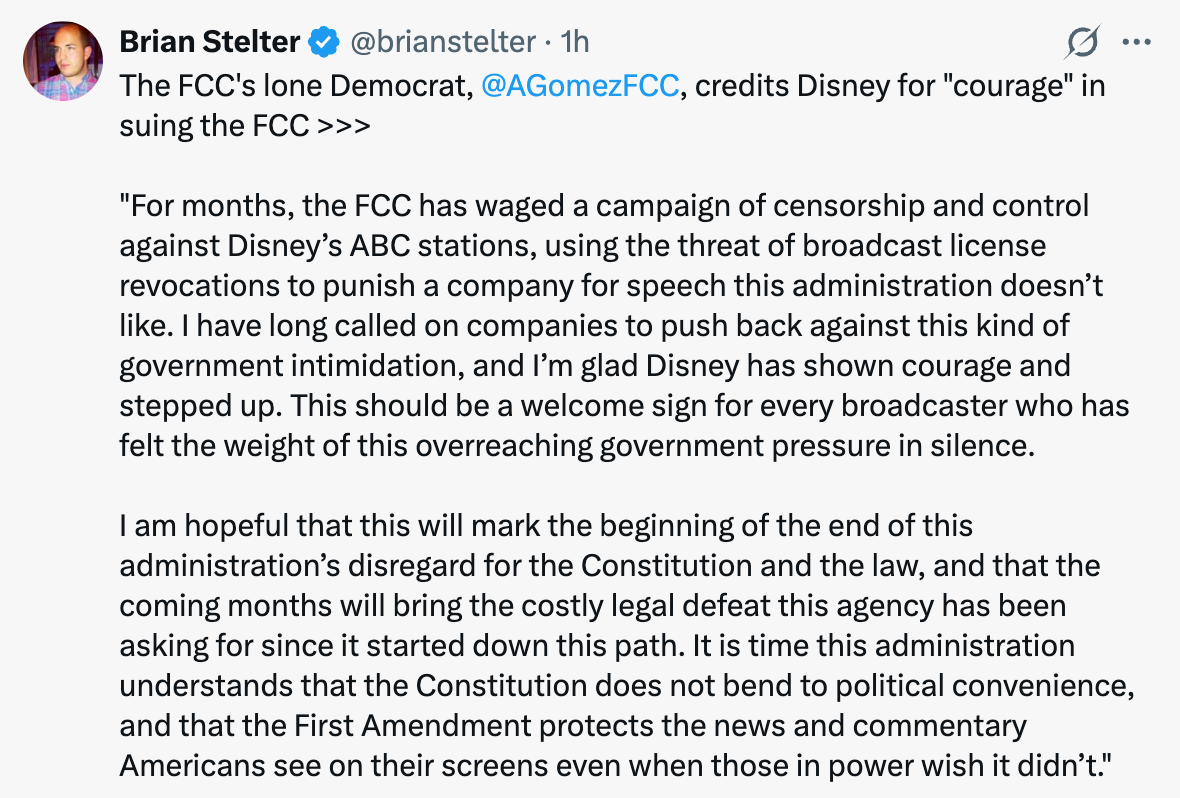
The suit frames the case around a single, devastating question: can the federal government use its regulatory machinery to punish a media organization for coverage it dislikes? Disney’s answer, and the First Amendment’s answer, is obviously not — which is why the company is asking the court for a temporary restraining order to freeze the license proceedings immediately. The public comment period closed earlier this month, meaning the FCC could act at any moment. Disney isn’t waiting to find out what that action looks like.
The lawsuit also reveals something chilling: the pressure is already working. Disney says the FCC’s scrutiny has affected what airs on “The View.” Think about that. A government agency’s investigation has already changed the content of an American television program. That’s not a hypothetical First Amendment injury. That’s a live one.
And note who signed the complaint: Beth Wilkinson and Paul Clement. Clement is one of the most decorated conservative Supreme Court litigators alive — a former Solicitor General under George W. Bush. When Disney wants to tell conservative judges that this isn’t a partisan fight but a constitutional one, hiring Paul Clement is how you say it.
Let’s be honest about the graveyard behind this lawsuit. CBS’s parent company chose settlement over confrontation, cutting a check to make Trump’s lawsuit over a “60 Minutes” edit disappear while a merger hung in the balance. Other outlets have paid, apologized, or gone quiet. Every settlement taught the administration the same lesson: pressure works, and the invoice gets paid.
Disney just changed the lesson plan.
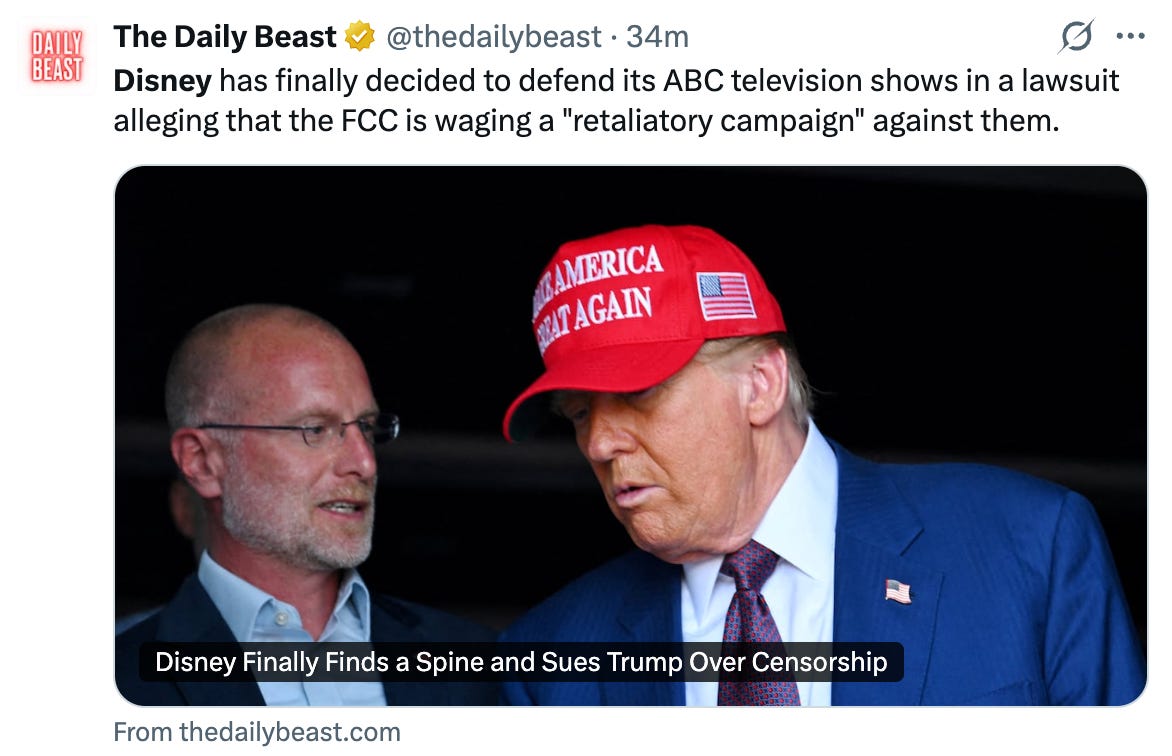
Disney CEO Josh D’Amaro previewed this posture last week, telling CNBC the company’s position was clear and that ABC would not be told how to run its journalism. Today, the company put institutional money, institutional lawyers, and institutional risk behind those words. That matters — because Disney is not a scrappy digital outlet or a hedge-fund-hollowed newspaper. It’s one of the most powerful entertainment companies on Earth, with theme parks, a streaming empire, and a global brand that it just put on the line to defend its news division.
First Amendment organizations across the spectrum have condemned the FCC’s moves against ABC. Carr’s defenders — including allies who argue ABC operates as a partisan mouthpiece — insist the administration is within its rights. A federal court is now going to decide who’s correct. Finally.
Play it forward. What does a Disney victory actually look like?
The immediate effect: the early license renewals die. A TRO followed by a permanent injunction would end the FCC’s leverage over those eight stations, and likely kneecap “The View” probe along with it. The administration’s favorite weapon — the license threat — gets taken off the table.
The precedent: a federal ruling that the FCC cannot open “pretextual” proceedings to punish editorial decisions would be a landmark. It would put every future administration — Republican or Democrat — on notice that broadcast licensing is not a content-control mechanism. The First Amendment case law here (think Bantam Books, think the recent NRA v. Vullo decision, where the Supreme Court unanimously held that government officials can’t use regulatory threats to punish disfavored speech) is genuinely on Disney’s side. A win would cement it in the broadcast context for a generation.
The industry effect: this is the part the administration should fear most. Every general counsel at every network is watching this case. If Disney gets its injunction, the calculus flips overnight. Settlement stops looking like the safe play and starts looking like the sucker’s play. Comcast, Nexstar, Sinclair, every station group that’s been holding its breath — they all suddenly have a roadmap and a precedent. The chilling effect thaws.
The political effect: a loss in court would strip the FCC pressure campaign of its legal fig leaf. It becomes much harder for Carr to claim he’s doing neutral “public interest” review when a federal judge has ruled the whole enterprise was retaliation. Congressional oversight gets teeth. Future threats get laughed out of the room.
And if Disney loses? Then we learn something darker: that a determined administration really can convert the licensing power into an editorial veto, and that the only broadcast speech that’s safe is the speech the White House likes. That’s the stakes. Both directions.
For months, the question hovering over American media has been: will anyone actually fight? The answer, as of this morning, is yes. The company that owns Mickey Mouse, Marvel, and Monday Night Football just walked into a federal courthouse and accused the President’s FCC of an extraordinary assault on free speech.
It shouldn’t have taken this long. It shouldn’t have required an existential threat to eight broadcast licenses. And it’s a genuine indictment of the industry that the boldest First Amendment stand of this era came only after the settlements, the firings, and the quiet edits.
But it happened. Disney gets its flowers today. Every other network gets a mirror.
Your move, everybody else.
Sources: court filings and reporting from CNN, Reuters, Bloomberg, Variety, NBC News, and CNBC, August 18, 2026.
Comments
Nothing yet. Say the first thing.
Sign in to join the conversation.