
August 18, 2028
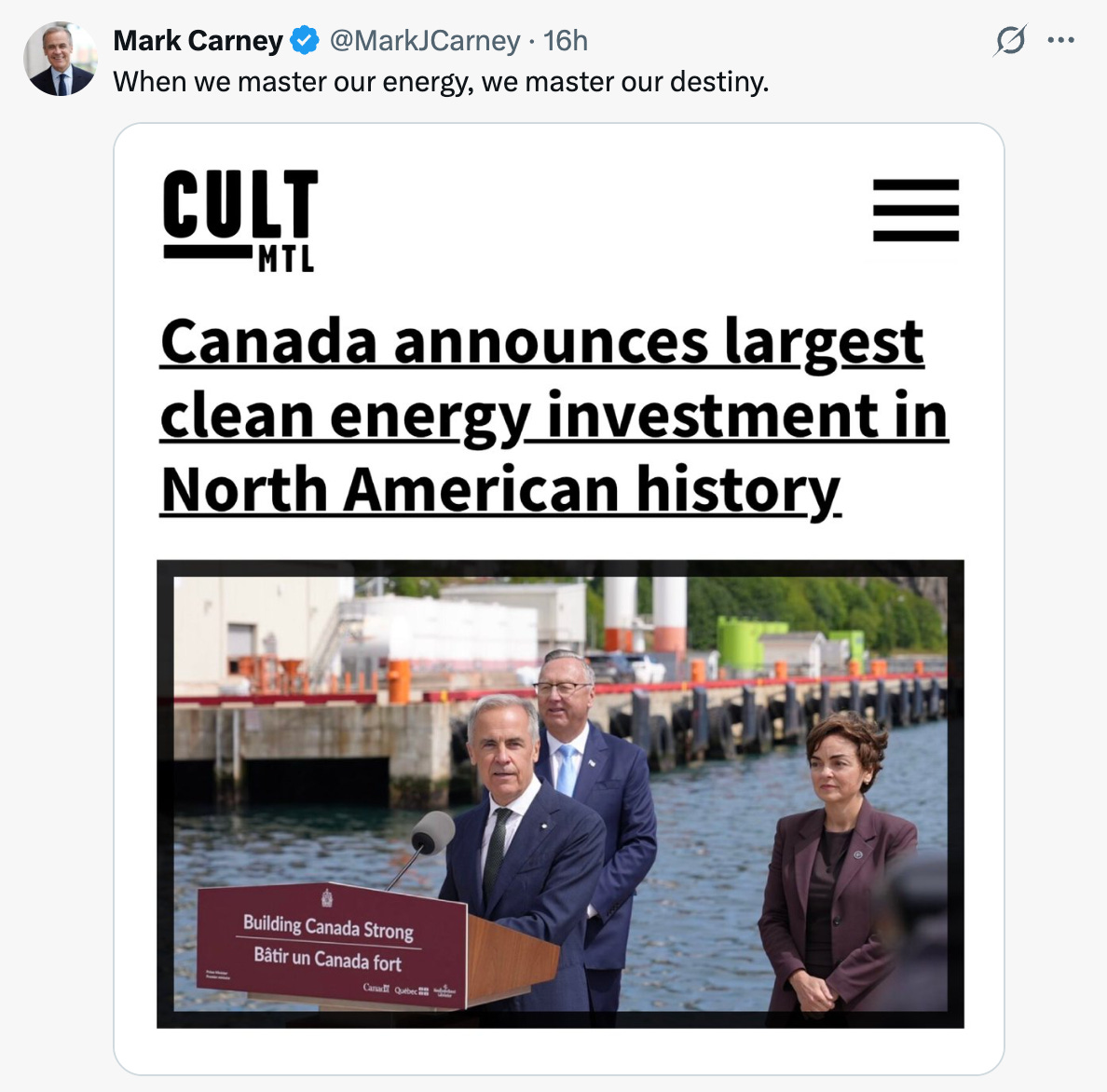
Yesterday in St. John’s, Mark Carney announced the largest clean energy investment in North American history. Ever.
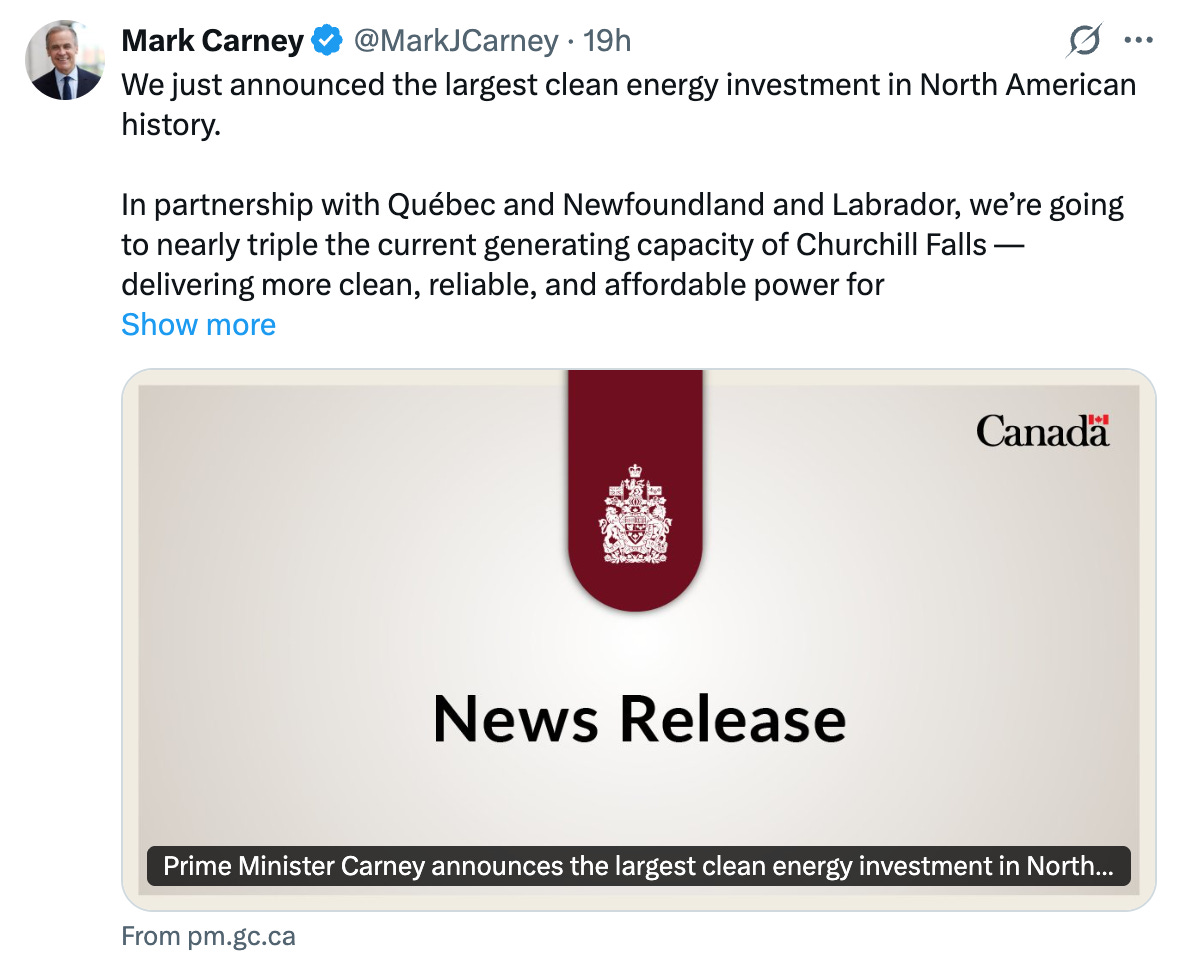
Seventy. Billion. Dollars.
The American press won’t cover it, and half of Canada was at the beach. Ottawa is putting up $10 billion in federal financing to upgrade and massively expand the Churchill Falls Generating Station, build the long-cursed Gull Island hydro project, partner with the Innu of Labrador on a major onshore wind development, and string the transmission lines to carry all of it. Total package: nearly $70 billion. Output: 14,000 megawatts of clean, renewable power — almost triple what Churchill Falls produces today.
That’s enough electricity to light, heat, and cool every home in Toronto, Montreal, and Vancouver. Combined. It’s 23,000 jobs — welders, electricians, engineers, crane operators — and a projected $31 billion added to Canada’s GDP through the early 2040s.
But the megawatts aren’t even the best part of this story. The best part is that this deal buries the single most humiliating contract in Canadian history. And the second-best part? None of it happens without Donald Trump acting like a drunk landlord threatening to evict the whole neighbourhood.
Let’s take this from the top.
If you didn’t grow up in Newfoundland, you might not understand why “Churchill Falls” is a swear word on the Rock. Here’s the short version.
In the 1960s, Joey Smallwood wanted to develop one of the largest hydroelectric sites on the planet, out on the Churchill River in Labrador. Problem: the only practical way to get that power to market ran through Quebec, and Quebec knew it. After years of negotiations that Newfoundland entered with roughly the leverage of a guy selling a car at 2 a.m. from a payphone, the 1969 contract was signed.
The terms? Hydro-Québec got to buy nearly all of Churchill Falls’ power at a fixed price — which worked out to a comically low 0.2 cents per kilowatt hour — and resell it at market rates. For 65 years. The price didn’t rise with inflation. It actually declined over the life of the deal. Then the 1970s oil shocks hit, electricity prices went vertical, and Quebec started printing money off Labrador’s river while Newfoundland — one of the poorest provinces in Confederation — watched billions upon billions flow past them like the water over the falls.
Newfoundland fought it. They went to the Supreme Court of Canada. Twice. They lost. They tried recalling the water rights through legislation. Lost again. The contract was ironclad, the resentment generational. Kitchen tables in St. John’s have hosted more Churchill Falls rants than a talk radio call-in line. Fifty-seven years of it.
That contract wasn’t set to expire until 2041. As of yesterday, it’s dead. Terminated. Torched. Along with the half-baked 2024 MOU that a lot of Newfoundlanders feared was just the sequel to the same movie.
Under the new agreement, Newfoundland and Labrador becomes the primary beneficiary of its own resources — with real control over whether it uses that power to build its own economy or sells it to outside markets. Premier Tony Wakeham summed up the mood of an entire province when he said this wasn’t about what could be torn up, but what could be built up. Quebec, for its part, locks in decades of reliable clean supply through an actual partnership instead of a hostage arrangement. Carney called it cooperative federalism. I’d call it two provinces finally realizing the guy robbing both their houses lives south of the border.
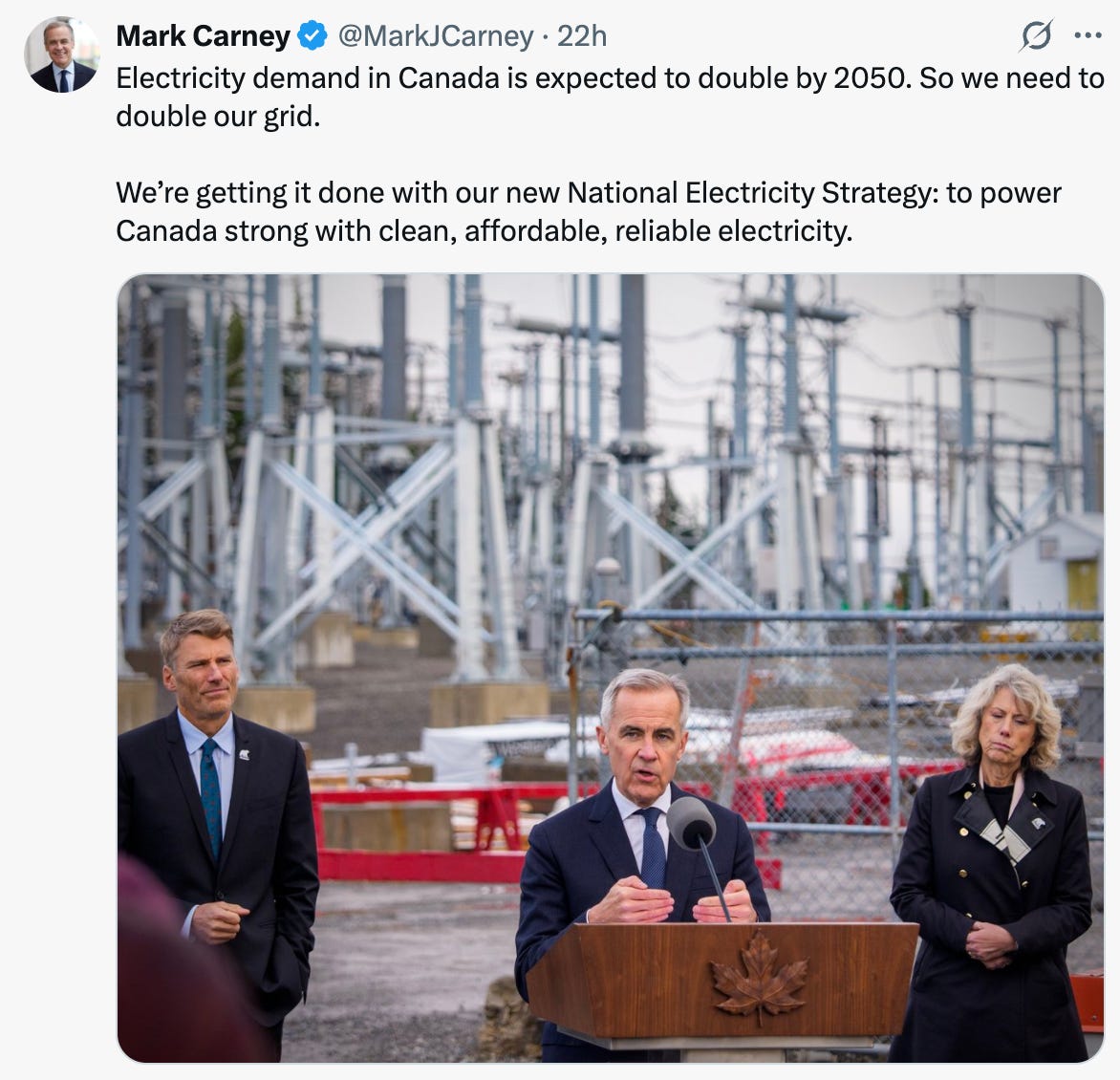
Here’s what most people don’t get about the next 25 years: electricity is the new oil. AI data centres, electric everything, industrial decarbonization — the countries that can generate massive amounts of cheap, clean, reliable power will own the century. The ones that can’t will rent it.
Canada is already starting from an obscene position of strength. Roughly 80% of our electricity generation is non-emitting. We have the lowest residential electricity costs in the G7 and the second-lowest industrial rates in the G7 and the OECD. That’s not a talking point — that’s a competitive weapon. When a company is deciding where to build the next battery plant, the next smelter, the next data centre, “cheapest clean power in the developed world” ends the conversation.
And this deal isn’t just about generation. The feds are fast-tracking the Labrador Trough — a world-class mining belt straddling Labrador and Quebec, loaded with the high-purity iron ore the world needs to decarbonize steel — through the Major Projects Office. New transmission to power mine electrification. Feasibility work on the Kami iron project. Infrastructure for the Lac Knife graphite deposit that feeds battery supply chains. Rail and port capacity at Pointe-Noire. Power plus minerals plus the infrastructure to move both. That’s not a press release. That’s an industrial strategy.
Oh, and the Innu of Labrador aren’t a consultation checkbox this time — they’re co-investors in the wind development, with the Indigenous Loan Guarantee Program doubled to $10 billion. Compare that to 1969, when Indigenous people in Labrador weren’t asked about anything at all.
Here’s the part that should make every Canadian laugh into their (Canadian) beer.
None of this — not the speed, not the unity, not the political will — exists without Donald Trump spending the last year and a half treating Canada like a repo job.
The 51st state garbage. The claim that America “subsidizes” us. Tariffs on our energy. Tariffs on steel and aluminum. Tariffs justified by wildfire smoke, which is genuinely the first time in recorded history a country has been sanctioned for weather. And now the threat of 50% Section 338 tariffs — a Depression-era trade weapon dug out of the 1930 Tariff Act, aimed at hockey sticks and wine, with last-ditch talks happening in Washington literally the same day Carney stood in St. John’s.
Trump thought economic pressure would soften Canada up for annexation. Instead, he accomplished what no Canadian politician managed in 57 years: he made Quebec and Newfoundland shake hands. He made “buy Canadian” a national religion. He got American booze pulled off shelves coast to coast. He resurrected the Liberal Party from the political morgue and handed the country to a central banker whose entire personality is “call my bluff, I dare you.”
Every threat from Mar-a-Lago was a brick in this deal. When your biggest customer starts screaming that he doesn’t need anything you have while simultaneously trying to steal your house, you stop building your economy around his mood swings. You build your own grid, your own corridors, your own supply chains, your own markets. Trump’s bombastic bullshit didn’t weaken Canada. It was the greatest team-building exercise in Canadian history.
And now, hold up the mirror — because the contrast is almost cruel.
While Canada was announcing 14,000 new megawatts of clean power, the United States is running its energy policy in reverse. The Trump administration has been strangling wind and solar with both hands: gutting the tax credits, cancelling $679 million in offshore wind funding across eleven states, and halting the Revolution Wind project off Rhode Island — a wind farm that was already two-thirds built, 45 of 65 turbines standing in the water — over unspecified “national security” concerns. Hundreds of projects stalled behind a federal blockade so absurd a district court had to step in.
At the same time, Washington is ordering utilities to keep dying coal plants alive past their retirement dates — at a cost of millions of dollars a day, paid by ratepayers — while the Energy Secretary blames renewables for prices that fossil-heavy grids are driving up all by themselves.
The result? Trump campaigned on cutting Americans’ electricity bills in half. Instead, electricity prices are up roughly 16% on his watch, tens of millions of American households are struggling to pay their utility bills, and analysts project $43 billion in added health costs by 2040 from keeping coal smoke in kids’ lungs. All while AI data centres send demand through the roof on transmission infrastructure that hasn’t been meaningfully upgraded since shag carpet was in style
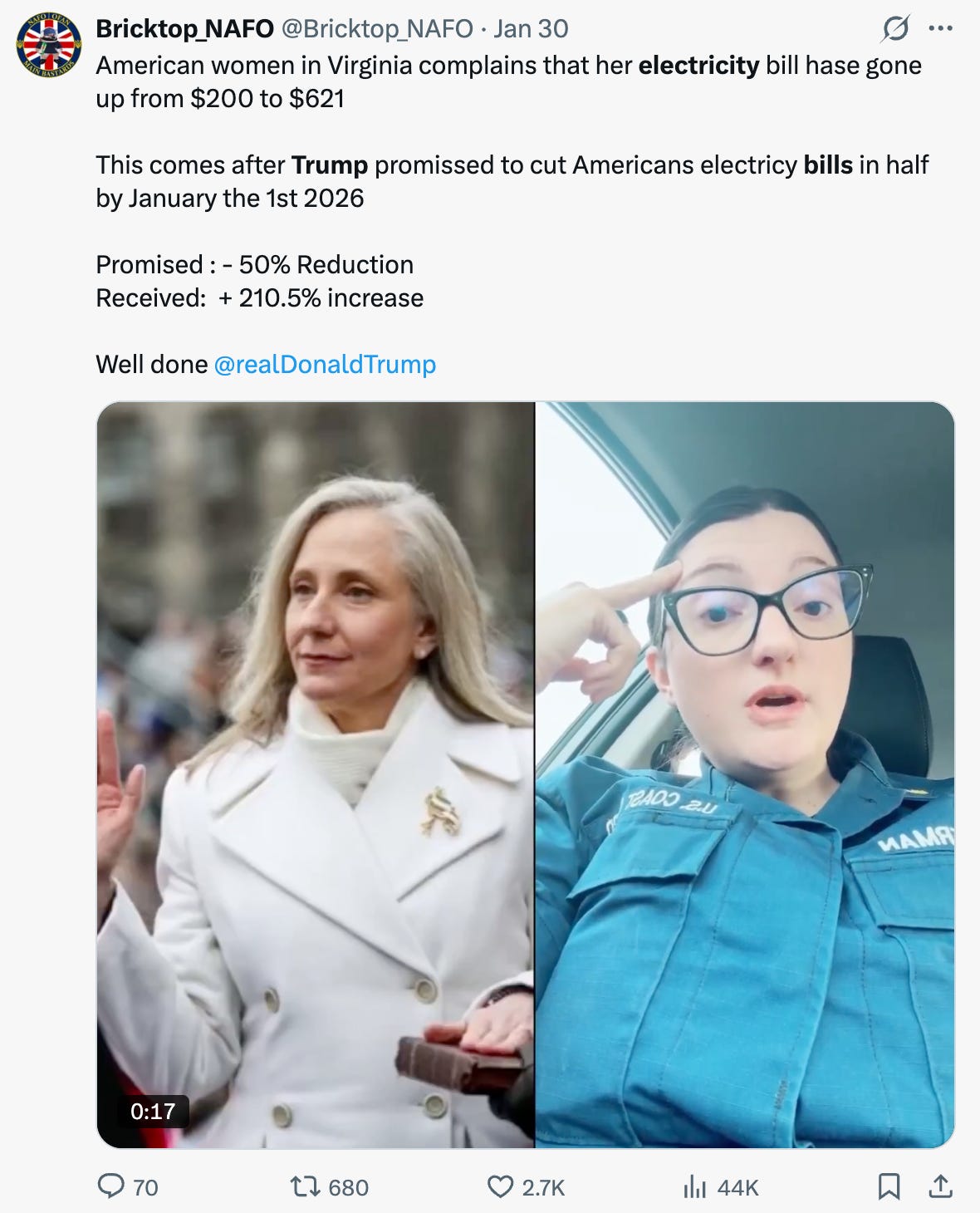
The richest country on Earth is cancelling half-finished wind farms to bail out coal plants during an electricity crisis. That’s not energy policy. That’s spite with a utility bill attached — a deliberate march back to the fossil fuel Stone Age, priced directly onto American kitchen tables.
Their play is nostalgia. Ours is physics. Water falls, turbines spin, and the lights stay on for less money than anywhere else in the G7.
Fifty-seven years ago, Canada signed the worst deal in its history because one province had no leverage and nowhere else to turn. Yesterday, Canada tore that deal up and replaced it with the biggest clean energy build this continent has ever seen — because a bully to the south taught us, the hard way, what happens when you have nowhere else to turn.
The 1969 contract took two generations to fix. The lesson took eighteen months of Trump to learn: nobody is coming to save us, and nobody needs to. We have the water. We have the wind. We have the minerals. We have the workers. And as of yesterday, we finally have provinces acting like they’re on the same team.
Master energy, master your destiny — that was Carney’s line in St. John’s. Corny? Sure. True? Ask Newfoundland, who waited 57 years to be the primary beneficiary of its own river.
Not bad, Eh?
Sources: Prime Minister’s Office news release (Aug. 17, 2026); Government of Newfoundland and Labrador (Aug. 17, 2026); The Canadian Press/BNN Bloomberg; CBC News; Policy Options (IRPP); Washington Post; Time; CNN; Energy Innovation analysis; AP.
Comments
Nothing yet. Say the first thing.
Sign in to join the conversation.