
The Stop Insider Trading Act is a good name for a bill. Pretty much everyone agrees that members of Congress should not be permitted to use information unavailable to the rest of us to make money in the stock market.
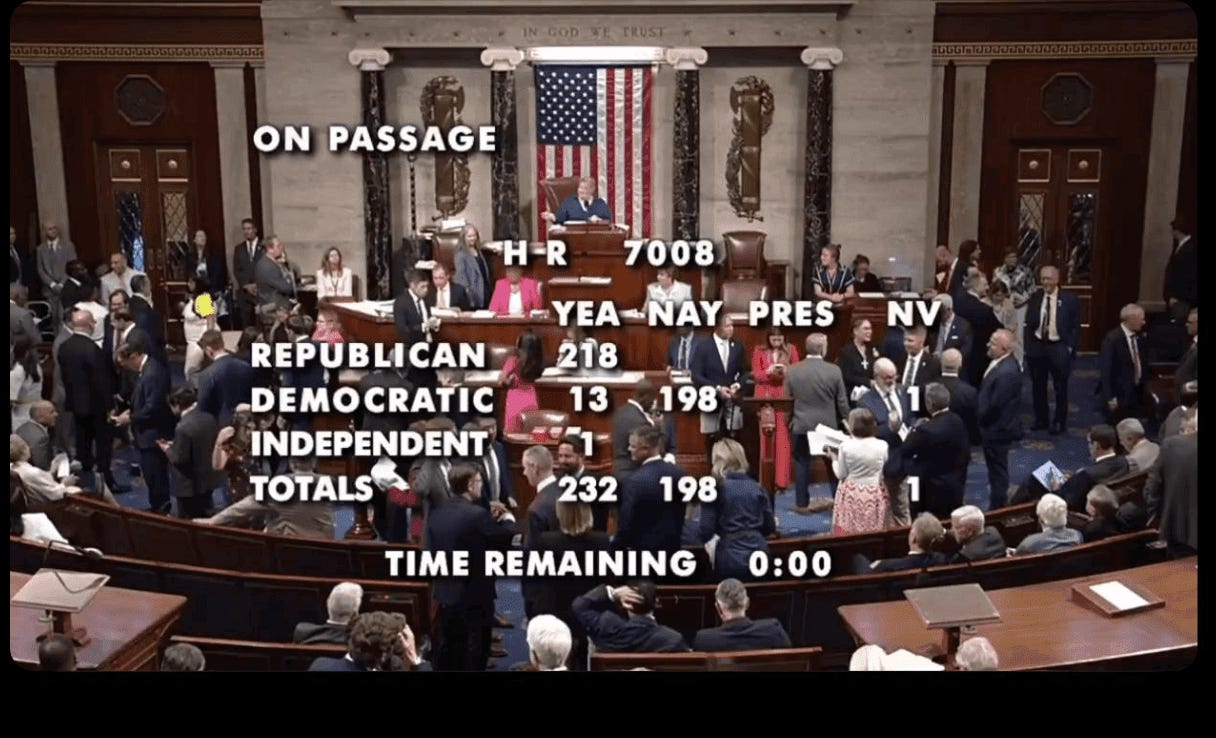
And right now, House Republicans are talking a lot about how they voted to pass it. They are telling constituents that they voted to stop congressional insider trading. They are chastising Democrats for voting against the bill (though 13 did). And they are calling on the Senate to take it up.
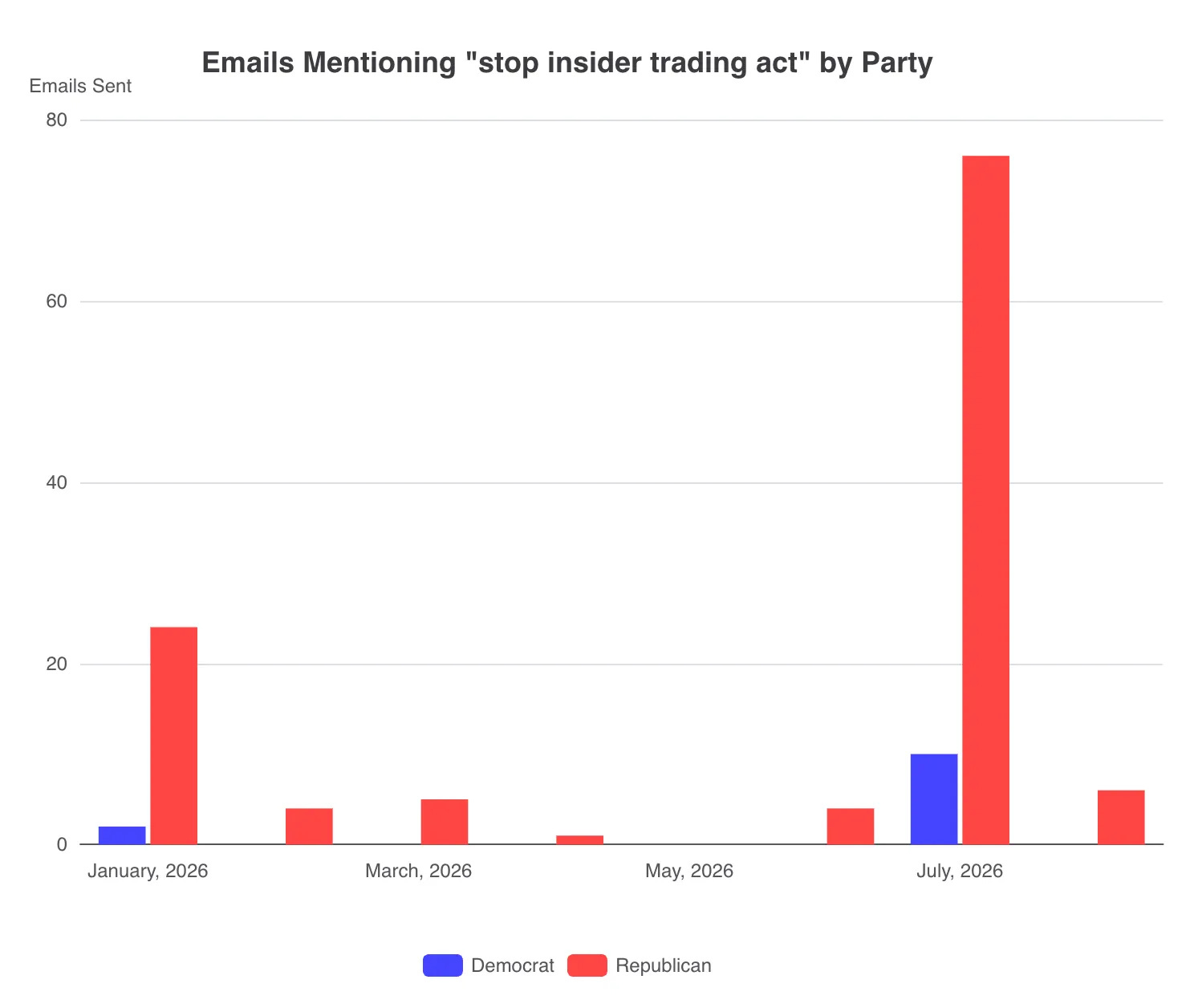

On its face, this sounds like an unusually straightforward bit of congressional ethics reform. Except that by the time the bill actually reached the House floor, it wasn’t just a congressional stock-trading bill anymore.
And that makes this a useful little case study in something I find a bit frustrating about congressional communication: sometimes lawmakers turn a popular policy proposal into a vote that is much more useful as a campaign message than it is actually an attempt to make law.
What’s not being said in most congressional communications about the vote on this bill is that in between when it was introduced and the time of it’s last roll call vote, House Republicans added in pieces of the SAVE Act starting in section 3. Seriously, go read the bill text and it’s jarring how it moves from a straightforward bill about stock trading to talking about voter ID changes.
Democrats and the Senate have been unwilling to accept federal voter ID regulations instead preferring the status quo where states retain the power to determine how voter registration happens.
This unwillingness to accept is known by House Republicans. So communications that tout passage of this bill in the House are (and the effort all together) nothing more than puffery about a nice sounding vote to use as a talking point in the campaigning of the August recess.
Members attend classified briefings. They write legislation before the public knows what will be in it and they have a better sense of what will pass or fail. They summon regulators, corporate executives, military leaders, and agency officials. They know about coming appropriations, investigations, regulations, deregulations, and government contracts.
In fact, it’s necessary that our national lawmakers have this sort of inside information in drafting coming regulations or de-regulations, government contracts, appropriations, investigative oversight, and more. But it’s not necessary that they use that inside information to make stock trading decisions that puts them ahead of everyone else.
Congress attempted to deal with this problem with the STOCK Act of 2012, which clarified that members of Congress are subject to federal insider-trading laws (representatives can not engage in trading on nonpublic information) and created disclosure requirements for securities transactions with a $200 penalty fee per violation.
But that law doesn’t ban members from owning or trading individual stocks. For the first 9 years of the law there was no public indication that any legislator or staffer had paid one of these $200 fees, despite hundreds admitting they had missed disclosure deadlines. In 2023 Business Insider put together a list of legislators who had violated the act. In 2025 Rep. Val Hoyle (D-OR) paid the fee after self-reporting that she missed a disclosure deadline inadvertently.
There have been high profile instances of suspected violations that the media cover from time to time. In early 2020 Sen. Richard Burr (R-NC) sold a substantial portion (estimated between $600,000 - $1,700,000) of his stock portfolio after receiving private briefings about the emerging coronavirus threat while publicly offering considerably more reassuring assessments. He denied trading on nonpublic information and was not charged.
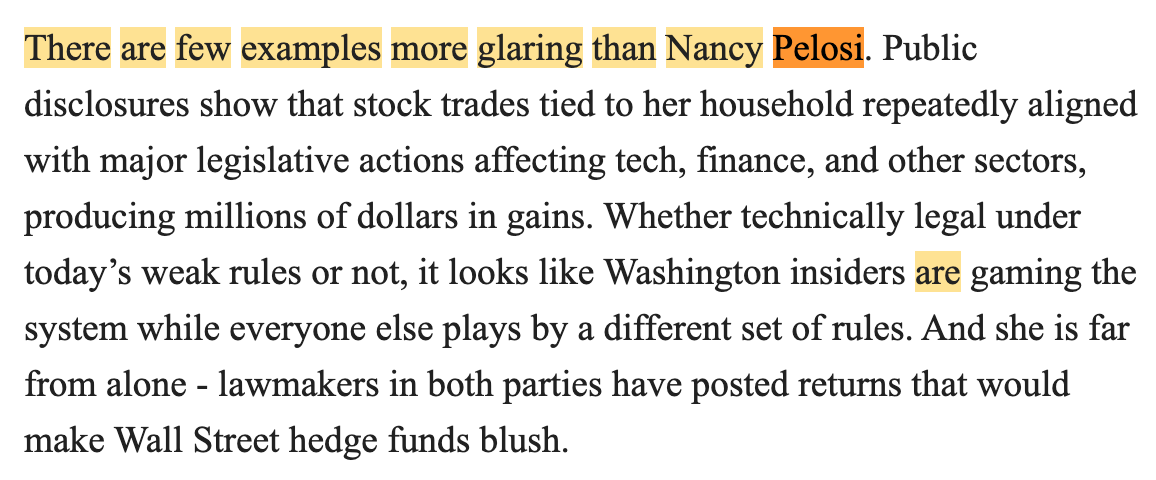
Former Speaker Nancy Pelosi has become the most cited example as a suspected insider trading in violation of the STOCK Act. Reports of her trading activities regularly appear in the news. Pelosi’s gains + the fact that bill imposed new rules that congressional disclosures of member stock transactions should be made available online inspired enterprising people to put that data to use in their own investment strategies and the data has led to the stock trading app Autopilot and the monitoring websites Capitol Trades and Stock Tools AI. And Congressional Republicans talk about Pelosi and her trades in their official constituent e-newsletters:
In the past year Rep Jefferson Shreve (R-IN) has traded the most; since he’s been in Congress his trading total volume is more than $207,000,000 with more than 600 trades.
Republican Rep. Bryan Steil introduced H.R. 7008, the Stop Insider Trading Act, on January 12, 2026. In many ways this bill is far more restrictive than the STOCK Act.
The legislation would prohibit members of Congress, their spouses, and dependent children from purchasing new securities in publicly traded companies while the member is serving.
Before an intended sell order a member would have to publicly announce the planned sale at least 7, but no more than 14 days beforehand. Violations are set at a penalty of $2,000 or 10 percent of the transaction, whichever is larger, plus forfeiture of gains.
In the first few months of this year Republicans had been selling the ideas of the bill to their constituents saying that in response to investigations something had to be done to stop legislators from profiting off of insider information so that the rules of everyone else apply to them.
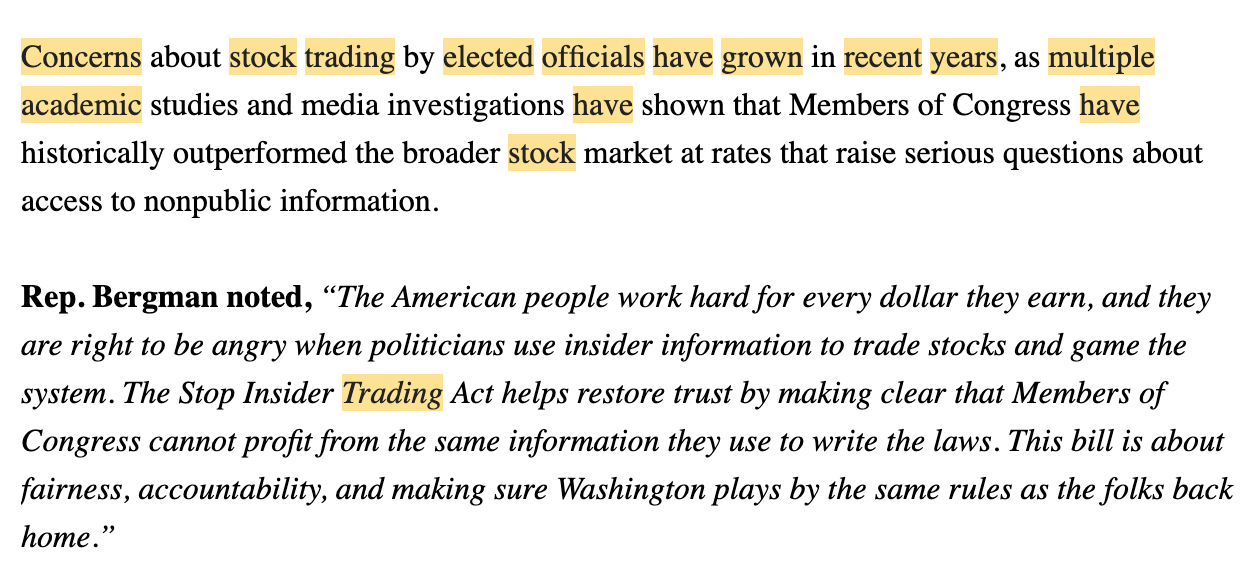
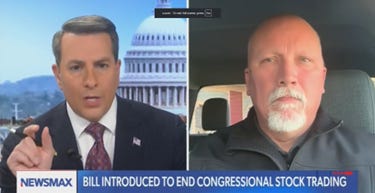
Seems like it could be pretty straightforward and maybe bipartisan, no?
At first Democrats took to pointing out the shortcomings of the Steil bill, they wrote about how it’s not a way to stop insider trading because even though new trades are banned, the legislation does prevent members or their families from reinvesting dividends from stocks they already own when they enter Congress.
Norma Torres offered an amendment to fix that loophole during a mark up in the Committee on House Administration. She wrote to constituents:
“If we are serious about banning Members of Congress from trading stocks, then we need to actually ban Members of Congress from trading stocks,” said Congresswoman Torres. “Allowing Members to reinvest dividends is still stock trading. If you are constantly reinvesting money in a company, you still have a vested interest in that company’s profitability. It’s a nice loophole for the wealthiest among us. They can still trade stocks and just call it by a different name.”
“If my colleagues want to allow Members to keep the stocks they own when they enter Congress, then at a minimum those holdings should be frozen, no reinvesting, no growing the portfolio,” Torres continued. “This is a reasonable, common-sense amendment that closes a clear loophole and helps restore public trust.”
This amendment was voted down. As were others offered by Congressional Democrats.
Congresswoman Emilia Sykes spelled out the other shortcomings as she sees them:
While the Stop Insider Trading Act creates new restrictions on stock transactions by Members of Congress, it leaves significant loopholes that allow conflicts of interest to continue. Among them, the legislation:
Exempts the President and Vice President from its restrictions,
Does not require covered officials to divest all covered investments,
Does not ban trading of commodities or futures,
Does not ban trading of stock in privately held companies,
Allows Members of Congress to keep stocks they already own and continue selling those holdings, and
Does not require the House Ethics Committee to publicly disclose fines imposed on Members for violations.
When Republican leaders brought H.R. 7008 to the House floor in July, they added a set of federal voting requirements drawn from the SAVE Act, and the debate was mostly over because that’s a non-starter for most Democrats.
Republicans this week were more focused on pushing through their ridiculous Stop Insider Trading Act. This legislation is a sham, as it doesn’t actually enact a full ban on Member stock trading. It allows Members to own and sell stocks while acting on legislation that impacts the value of those stocks for their personal benefit. … And even worse, Republicans slipped in a federal voter ID requirement to the bill drawn from their so-called SAVE America Act — which is voter suppression masked as reform.
There are competing bipartisan bills that go further in their limitations. The Restore Trust in Congress Act would prohibit members, spouses, and dependent children from owning or trading individual stocks and require divestment within specified timeframes. But this bill has seen no movement.
Whatever you think about voter ID, it has nothing to do with whether members of Congress should be allowed to trade stocks. In merging them together Republicans got to take a vote that they wanted, could tell the president that they tried to get his desired SAVE Act pieces passed, and they ensured that this insider trading bill would not become law. They get to say “I voted to stop insider trading in Congress!” and paint Democrats or the Senate as bad guys, when it was known from the get go, that this was not a way to get this type of reform passed.
A legislator doesn’t necessarily need a proposal to become law for a vote on that proposal to be politically useful. And sometimes it’s more useful if it doesn’t become law because they can say I tried and they can knowingly avoid the impact of the regulation.
Thanks for reading DCinbox Insights! Know Someone who would like this one?
Comments
Nothing yet. Say the first thing.
Sign in to join the conversation.