
Senator Lindsey Graham used official e-newsletters in a way that a number of the longer serving senators do, which is infrequently. He’s been in the database since the beginning and over the last 16 years sent only 27 official e-newsletters.
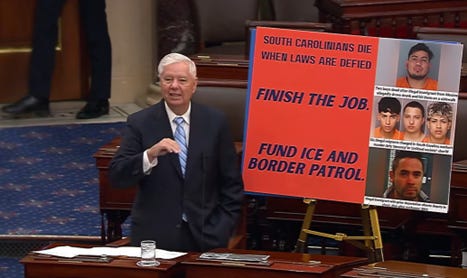
There are now just 24 Senators left in DCinbox that were present when the repository began. I don’t know if that’s a lot or a little, but it means one quarter of our upper chamber hasn’t changed in the last 16 years.
When legislators die I have two things I generally do. First, I see what they wrote to their constituents in their official capacity in their e-newsletters through DCinbox.com. (All paying DCinbox subscribers are welcome to see all the Lindsey Graham e-newsletters and their metadata - just send me a message with the best email address to send these to and they’ll be on their way). I also check the database to see what other members wrote about him. Second, I go to Congress.gov to see what bills they sponsored that passed to get some small sense of legislative accomplishments.
Senator Lindsey Graham most often wrote about topics on the budget, debt, taxes, exercising fiscal restraint, jobs, labor, business, and the economy in general nearly half of his messages include something about the way the government takes in and spends money and the impacts on our economy. He did chair the Senate Budget Committee in his later terms, so that means much of his work was focused on those topics institutionally.
But even earlier in his time in Congress he told constituents about his differences with President Obama on the one piece of this greater topic, “While President Obama does not believe we need the discipline of a Balanced Budget Amendment, I do.”
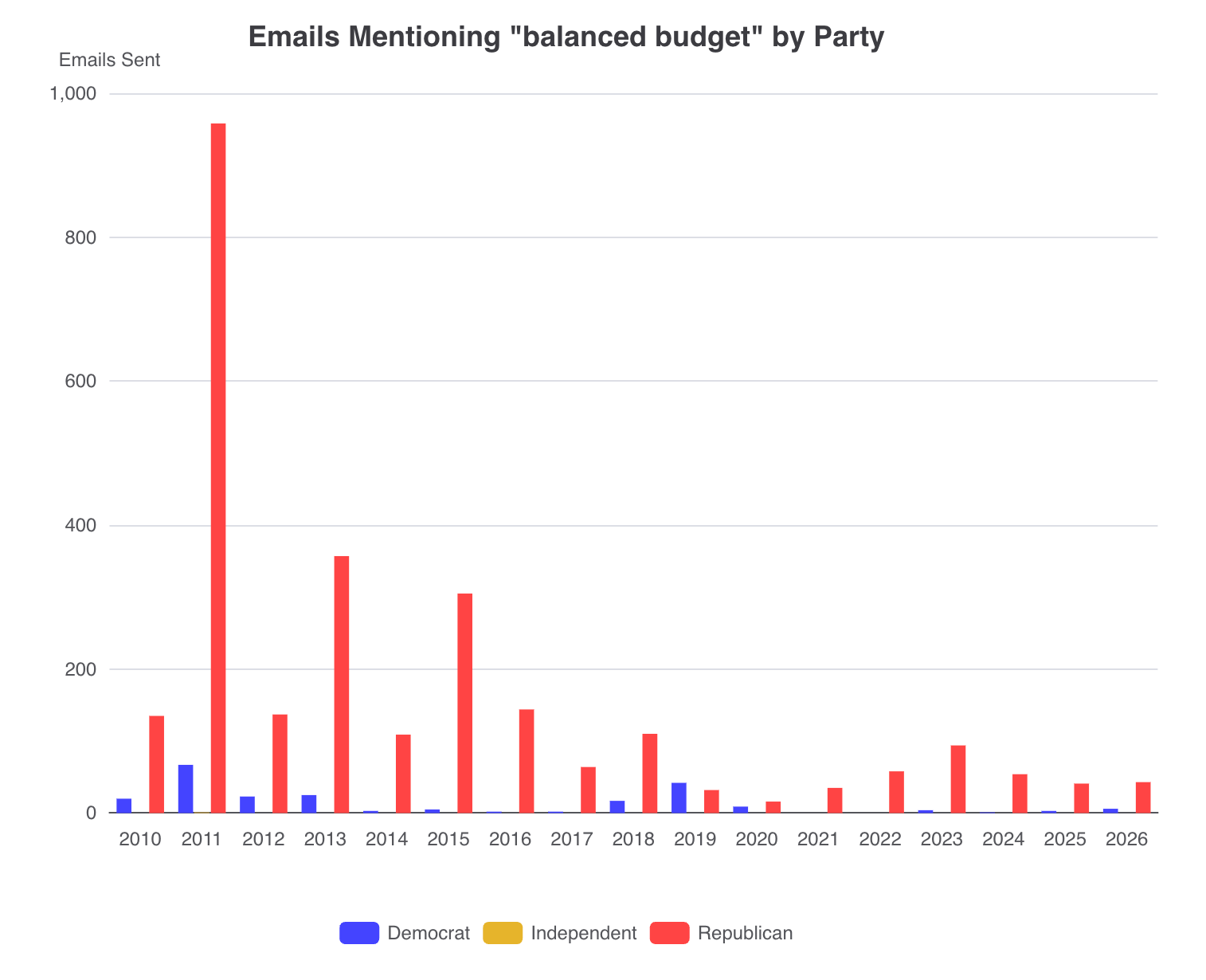
Graham’s support for a Balanced Budget Amendment fit squarely within broader Republican messaging at the time. “Balanced budget” was one of the defining fiscal phrases of the Obama years. Republican members mentioned it hundreds of times annually, peaking at nearly 1,000 official communications in 2011 as debates over deficits and government spending dominated.
The issue never completely disappeared for Republicans, but it became far less central after Republicans won the White House. Today, references to a balanced budget still appear in congressional communications, almost entirely from Republicans, but at a much small fraction of their earlier levels.
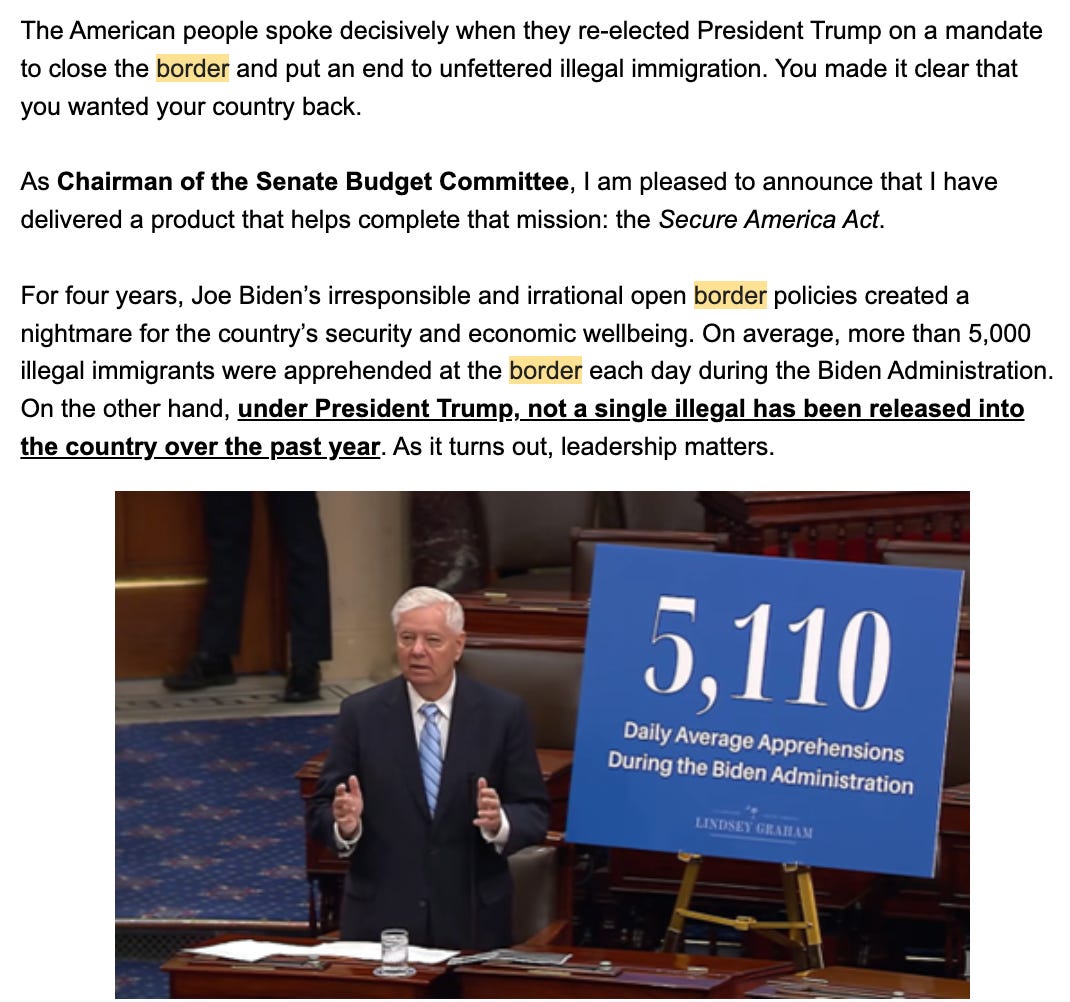
While fiscal issues remained a constant throughout his career, the emphasis of his newsletters shifted over time. In 2011 he called the National Labor Relations Board “the Grim Reaper of job creation” and tried to change things during the Obama Administration on how the NLRB approached questions of immigration and described it as an aggressive federal actor interfering with Boeing and South Carolina’s economy. By the end of his tenure, immigration had become the central focus of his constituent communications. His final official e-newsletter, sent on June 9, framed the newly enacted Secure America Act as both a budgetary achievement and a fulfillment of President Trump's immigration agenda:
One thing he never wrote about in his official e-newsletters was his family, many members make passing references to their families in these communications but Graham was never married and had no children, so there are fewer people for him to tell constituents about than many other Senators. In this was Graham was unusual among his colleagues only eight of the Senate’s 100 sitting members are unmarried, (single, divorced, or widowed). He did write about military families with some regularity.
But since his death, his family has become part of Senate history. His sister, Darline Graham Nordone, is the first sister ever appointed to fill her deceased brother’s vacant U.S. Senate seat. She is also the first woman to represent South Carolina in the Senate.
Family appointments after a senator’s death aren’t unprecedented, but until this week they have always involved widows rather than siblings. If you’re curious about that history, I wrote more about it here.
As to how Senator Graham how he appeared in DCinbox in the eyes of other legislators I asked one of my current summer research assistants from Brooklyn Tech High School, Zachary Posnick, to find and analyze all the mentions of him from others. This work was done immediately after his death and before any condolence or remembrance e-newsletters came in.
We counted references whenever a newsletter mentioned “Lindsey Graham,” “Senator Graham,” “Sen. Graham,” “Graham (R-SC),” “Graham of South Carolina,” “Graham-Cassidy,” or even Graham in close proximity to John McCain. A search for just “Lindsey Graham” would have missed roughly 95 percent of the references because members almost always refer to one another formally rather than by their first names.
The biggest spike in mentions came in 2017, driven largely by Democrats. That was the year Graham co-authored the Graham-Cassidy health care proposal, Republicans’ final major attempt to repeal and replace the Affordable Care Act. Because Senate Republicans were trying to use the budget reconciliation process, they faced a September 30 deadline to pass the bill with a simple majority. The result was a frantic few weeks of lobbying and messaging. Democrats flooded constituents’ inboxes warning that the proposal would reduce Medicaid funding and weaken protections for people with pre-existing conditions. Ultimately, the effort fell apart when Senator John McCain, Graham’s longtime friend and closest ally in the Senate, announced that he would oppose the bill.
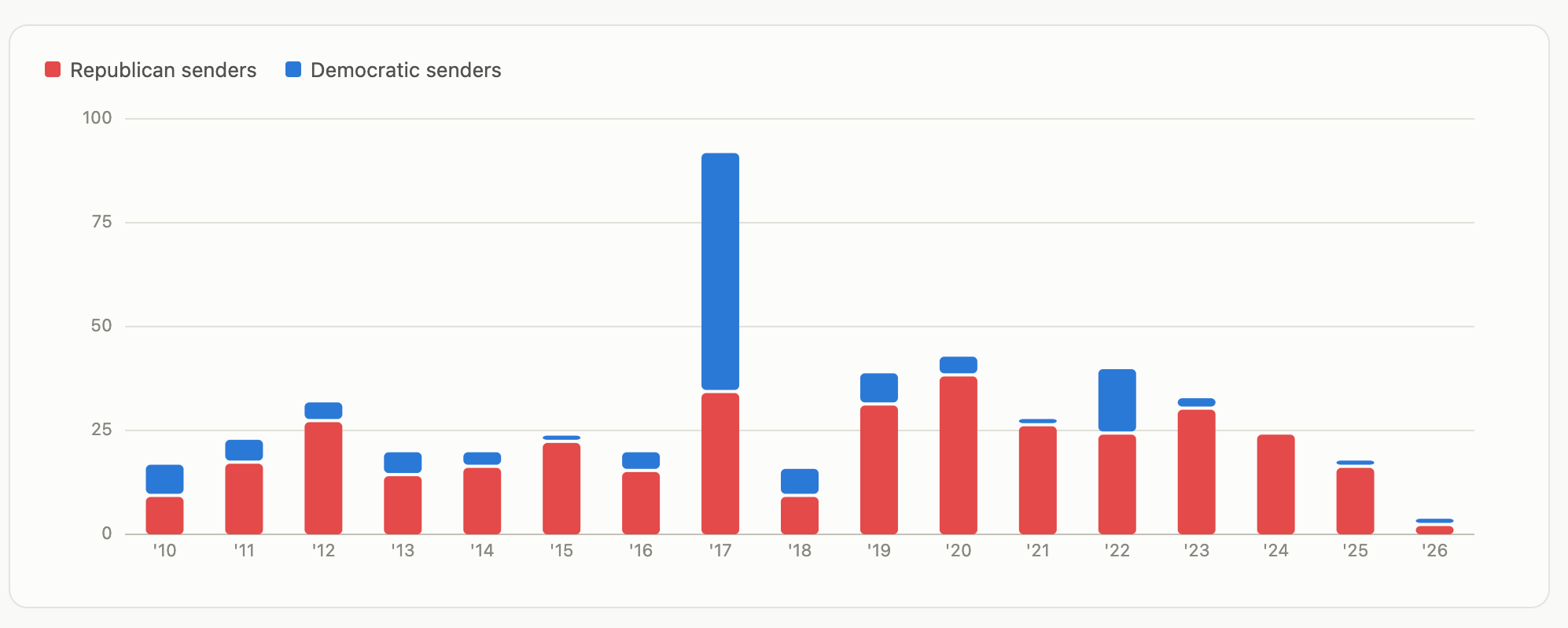
Graham generated another noticeable surge of Democratic attention in 2022, just months after the Supreme Court’s decision in Dobbs v. Jackson Women’s Health Organization overturned Roe v. Wade. During that time many Republicans argued that abortion policy should now be left to the states and cheered this decision, but Graham introduced legislation to establish a nationwide ban on abortions after 15 weeks of pregnancy. Democrats immediately seized on the proposal as evidence that congressional Republicans were pursuing a national abortion ban. Within days, members like Diana DeGette, Ted Lieu, Ilhan Omar, Anna Eshoo, Ben Cardin, and Paul Tonko were highlighting Graham’s bill in their own constituent newsletters.
But Republicans tended to talk about him more overall. Here’s who most mentioned him:
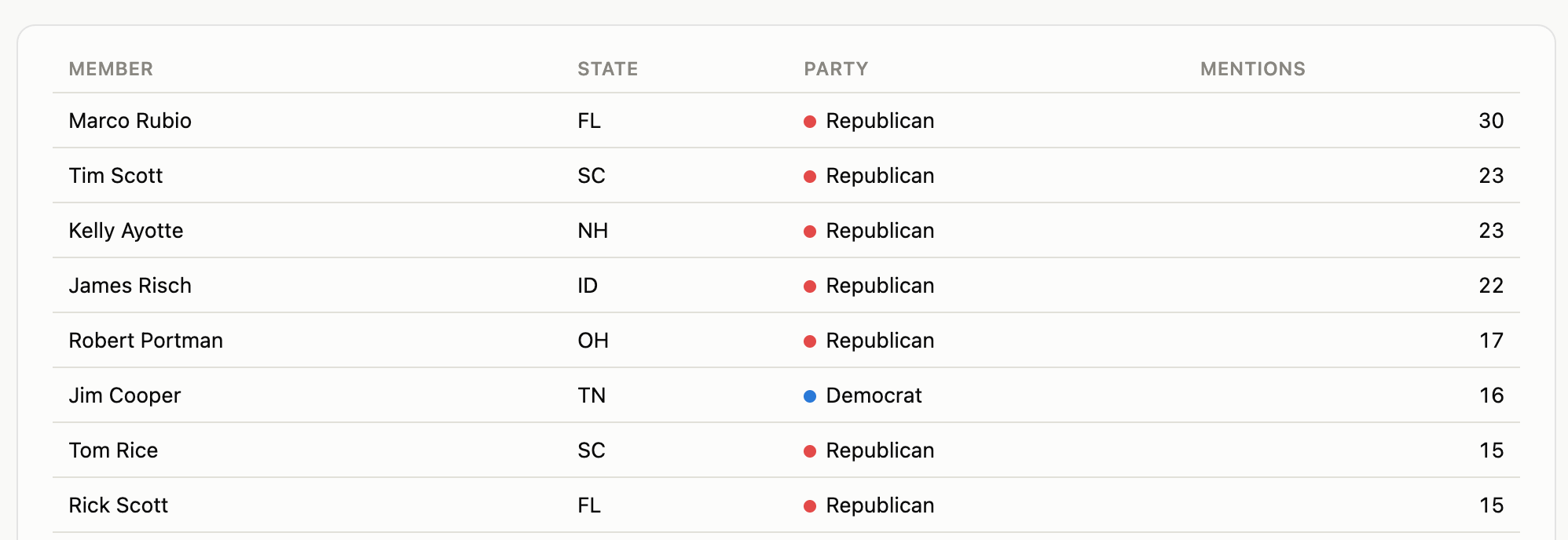
Some of the names aren’t surprising. Tim Scott appears near the top of the list because, for much of the period DCinbox covers, he was South Carolina's other senator.
I didn’t have well developed priors on this, but I was somewhat interested to find out Marco Rubio was the leader. Rubio wrote about joining Graham to push back against proposed NOAA regulations, urging the Biden administration to ensure Israel had the military capabilities to deter a nuclear-armed Iran, introducing a resolution to hold Vladimir Putin and members of the Russian government accountable for war crimes committed during the invasion of Ukraine, and a number of other joint efforts.
Kelly Ayotte's frequently updated constituents on legislation she and Graham worked on together, including the Terrorist Firearms Prevention Act of 2016.
Very few bills introduced ever become law, and those who study congress as quick to point out that there are many other things that our representatives and senators do. I know this, but it’s still neat for me to figure it out.
I’ve put my process up here for anyone who wants a <1 minute tutorial on how to do this. Here’s the results for the 31 years that Lindsey Graham was in Congress:
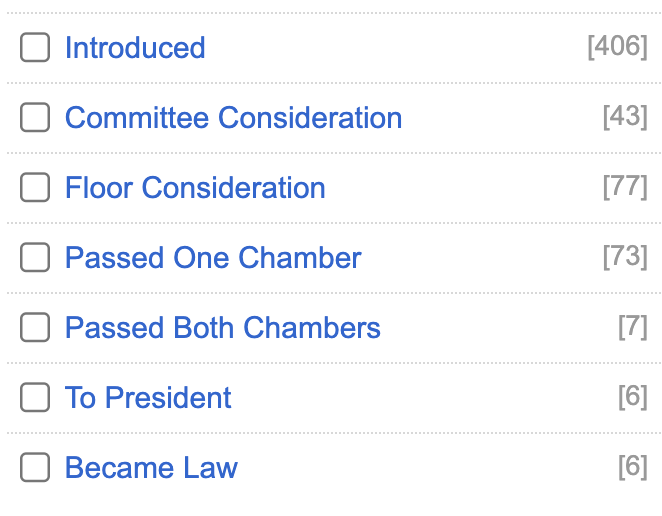
So 6 things that he introduced became law. Here’s what they were:
1. S.2 — 119th Congress (2025-2026) Secure America Act
2. S.3427 — 118th Congress (2023-2024) Overtime Pay for Protective Services Act of 2023
3. S.5036 — 116th Congress (2019-2020) Secret Service Overtime Pay Extension Act
4. S.4996 — 116th Congress (2019-2020) Bankruptcy Administration Improvement Act of 2020
5. S.3201 — 116th Congress (2019-2020) Temporary Reauthorization and Study of the Emergency Scheduling of Fentanyl Analogues Act
6. S.2061 — 112th Congress (2011-2012) Former Charleston Naval Base Land Exchange Act of 2012
His most recent piece provided “$70 billion in funding to the Department of Homeland Security (DHS), U.S. Customs and Border Protection (CBP), and U.S. Immigration and Customs Enforcement (ICE) through FY2029 for immigration enforcement, border security, and related activities.” Given the recent fatal use of force on a mistaken target, this is probably going to not be a focus in remembrances of him.
One thing that has always stood out to me as a Lindsey about Lindsey Graham - it’s that’s he’s the only Lindsey to ever serve in Congress (so far). He had a focus that aligned with his committee position. He has supporters and those in opposition to his efforts. There’s not a lot of bigger “insights” to this sort of use of this sort of email history…sometimes that's all DCinbox is, a chance to preserve small details so they don’t disappear.
Comments
Nothing yet. Say the first thing.
Sign in to join the conversation.