
It’s the 4th of July and I’m in Philadelphia for it at the National Constitution Center. I wondered what the weather was like back in 1776 on this day and sure enough Thomas Jefferson was kind enough to jot it down and a set of smart and caring people have digitized his writings. In 1776 the temperature got to 76 degrees by 1 pm. Today we are fixing to get to near 100. Things change over time and we end up adapting, they didn’t have AC, hopefully all the modern technologies that allow us to cool off will hold.
The reality that things change over time and that we have to adapt to them once we realize that is the theme of the insight today, using Amazon and US government policy as an example. This insight was aided with the research assistance of Dennis Glynn.
Members of Congress don’t talk about Amazon or Jeff Bezos that much in their official e-newsletters, but when they do the examples show how complex and multi-perspective an issue the sometimes biggest company in American can be for members of Congress.
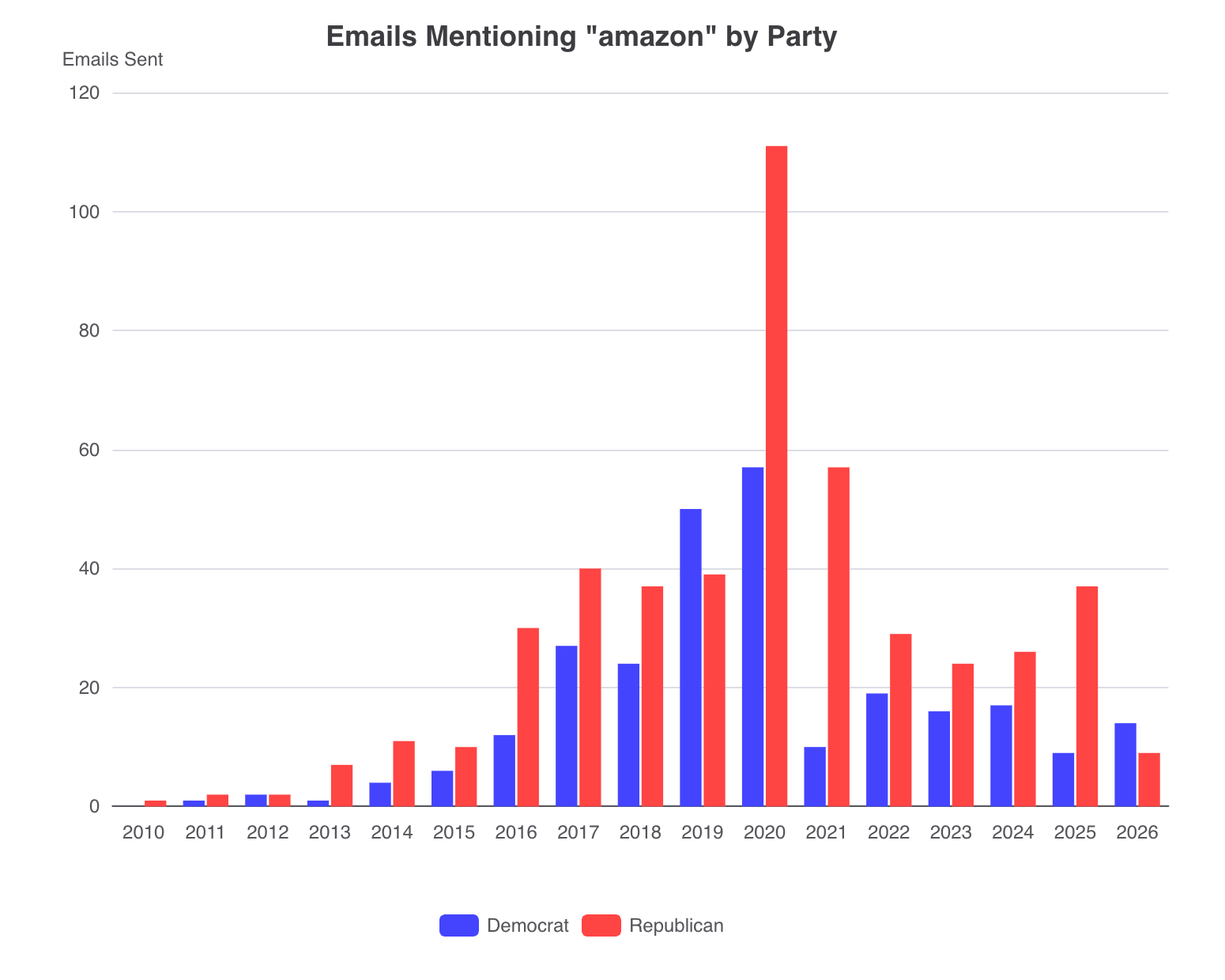
There’s a lot to consider from a government and policy view including, tax exemptions (Amazon operated for 22 years under a framework where it did not collect sales tax across most of the United States), wages and government assistance (the estimate cost of SNAP and Medicaid benefits for Amazon’s U.S. warehouse workforce sits somewhere around $1.14 billion annually), increases in public section pension holdings from Amazon’s appreciation (U.S. public pension funds hold an estimated $55-80 billion of Amazon stock, jobs for US workers (it employs over 1 million workers), worker protections, unionization, an so many more interesting issues.
Today I’m focusing on a 2025 complaint lodged by Missouri congressman Sam Graves, who is a Republican and the chair of the House Transportation and Infrastructure Committee. His focus is very interesting because it shows what America has done in the past that’s been “right”, but given that no one making laws has perfect future vision can sometimes turn “wrong”.
Back in the 1950s, when Congress and the Eisenhower administration were figuring out how to finance the maintenance of the would-be Interstate Highway System, different funding ideas were touted (like a lot of tolls) but the eventual winning idea was a federal “gas tax” on all motor fuel sold in the US. This was deemed the fairest way to do things because the amount of gas consumed is a fair approximation of road use. It’s also a simple and efficient way to collect money that allows those who use roads to continue to do so - and for everyone who doesn’t use roads themselves to benefit from the immersive connectivity of having a functional interstate highway system. These gas taxes don’t go the the federal government coffers to get mixed in with all other tax revenues, they are set into their own dedicated bucket in a vehicle known as the “Highway Trust Fund” (HTF) (that was an accident pun, but I like it). Gas taxes make up 83% of the overall HFT yearly income, while taxes on tires and heavy trucks make up the rest. Both of those targets were also thought to be fair for the specific taxes to fund the highways, because they are also correlated with use and, in turn, the need for maintenance.
This is a pretty forward thinking, functional way to make policy that allowed us build, expand, and care for our highways. It also helped us build additional routes of transportation including buses, railways, subways, ferries, and other modes of public mass transit, because a portion is set aside into the Mass Transit Fund for those modes.
This was competent, good policy making.
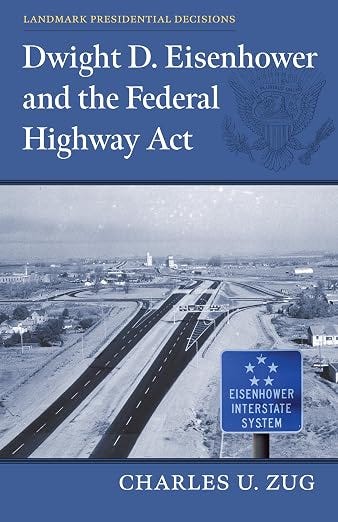
If you want to get into the legislative/executive back and forth of this time, check our Charles Zug’s Dwight D. Eisenhower and the Federal Highway Act.
But today over 5 million of the cars on our roads don’t pay excise taxes on gas because they run on electricity. Now you might say, “well 5 million is a lot, but that’s a small number of cars on the road”. And that’s right, there are nearly 300 million cars on the road in the US. So only about 1-2% of cars using US roads don’t face gas taxes and that’s only a little bit of lost revenue. But there are at least two reasons why this new reality might make us want to revisit this sort of policy space.
First is principled fairness: EVs still require roads, still benefit from pavement, bridges, traffic systems, safety investments, delivery routes, and all the other benefits of essential infrastructure.
Second is who has EVs. This policy now functions as literal free rider problem, where gasoline car drivers are subsidizing roads for EV drivers (less of an accident pun - not really even a pun). Amazon says it now has more than 30,000 electric delivery vans across the United States (which from what I can tell is the most). The company’s goal is at least 100,000 electric delivery vans globally by 2030. DHL also uses some EVs, as does FedEx, and food/drink distributors like PepsiCo have like 1,500 (they also have driverless trucks doing road trials now).
Individually driven Teslas account for 2-3 million of the EV cars on the road.
So the first point of just basic fairness is sorta obvious. The other part about who has fleets of these vehicles shows how sometimes we can create inadvertent, unintended subsidies for companies by not changing our laws.
Amazon reported $489.657 billion in net sales attributed to the United States in 2025. Based on estimates of how many miles their EVs probably travelled in 2025, they’d only owe about $9-24 million in “lost” gas taxes. Which is just a tiny part of those annual sales, but it is probably worth reconsidering what we are doing here because the Highway Trust Fund is under pressure. The CBO says fuel-tax revenues have fallen short of federal spending on highways, bridges, and mass transit for more than two decades which then requires transfers from the general fund, and CBO now projects that Highway Trust Fund balances will be exhausted in 2028.
And of course, EVs are good in lots of ways. They produce less exhaust and in turn less, they are quieter, and a shift away from fossil fuels is something everyone - even those without EVs - can benefit from environmentally.
But “good” tech can still break old policy math.
The gas tax worked for a very long time because it used to be a decent stand-in for road use. If you used the roads more, you generally bought more gas and so you paid more into the system that maintained the roads.
But the world is different now and is poised to get even more different. It is a law built for one transportation world that is now operating inside a new one that the people who wrote the law originally did not contemplate. And to their credit, members of the House have introduced a bipartisan proposal that would require EVs to pay a $130 annual fee for road repairs, with plug-in hybrids paying $35.
The Highway Trust Fund was a smart, durable, competent policy design for the world of the 1950s. It helped build and maintain the roads that made modern American life possible. And it’s an example of government not sucking. The fact that things have changed means that we will have to re-up our commitment to figuring things out so that we can keep everything moving and re-up our care for fairness in policy.
Happy 4th!

Comments
Nothing yet. Say the first thing.
Sign in to join the conversation.