
How are you feeling, Stars fans? Bored, perhaps? That makes sense. It’s the tailend of August. Antsy? That makes sense. It’s the tailend of August. Excited? That also makes sense. It’s the tailend of August!
Maybe it’s the Jason Robertson saga, or maybe it’s just how many talking points we ran through after the playoffs, but the regular season starts next month. With that extra regular season game, September 29 is when everyone gets rocking and rolling. Dallas’ first game is October 2. We’re practically there, magistrates and noblemen. This time last year, fans were super pumped. It wasn’t just about getting a full season with Mikko Rantanen. It was also about the organization on the whole. People were confident in the roster Jim Nill had built. There weren’t issues with how the cap was managed. Dallas’ drafting resume continued to be lauded as the envy of the league. Trades, free agency, vision — the Stars had it all. And now?
And now there’s a lot less faith. It’s as if everything has been cast in doubt. At least according to The Athletic’s yearly fan poll. Seems like everything that was once true just 12 months ago is now totally wrong; or at least varying degrees of mostly-to-sort-of wrong.
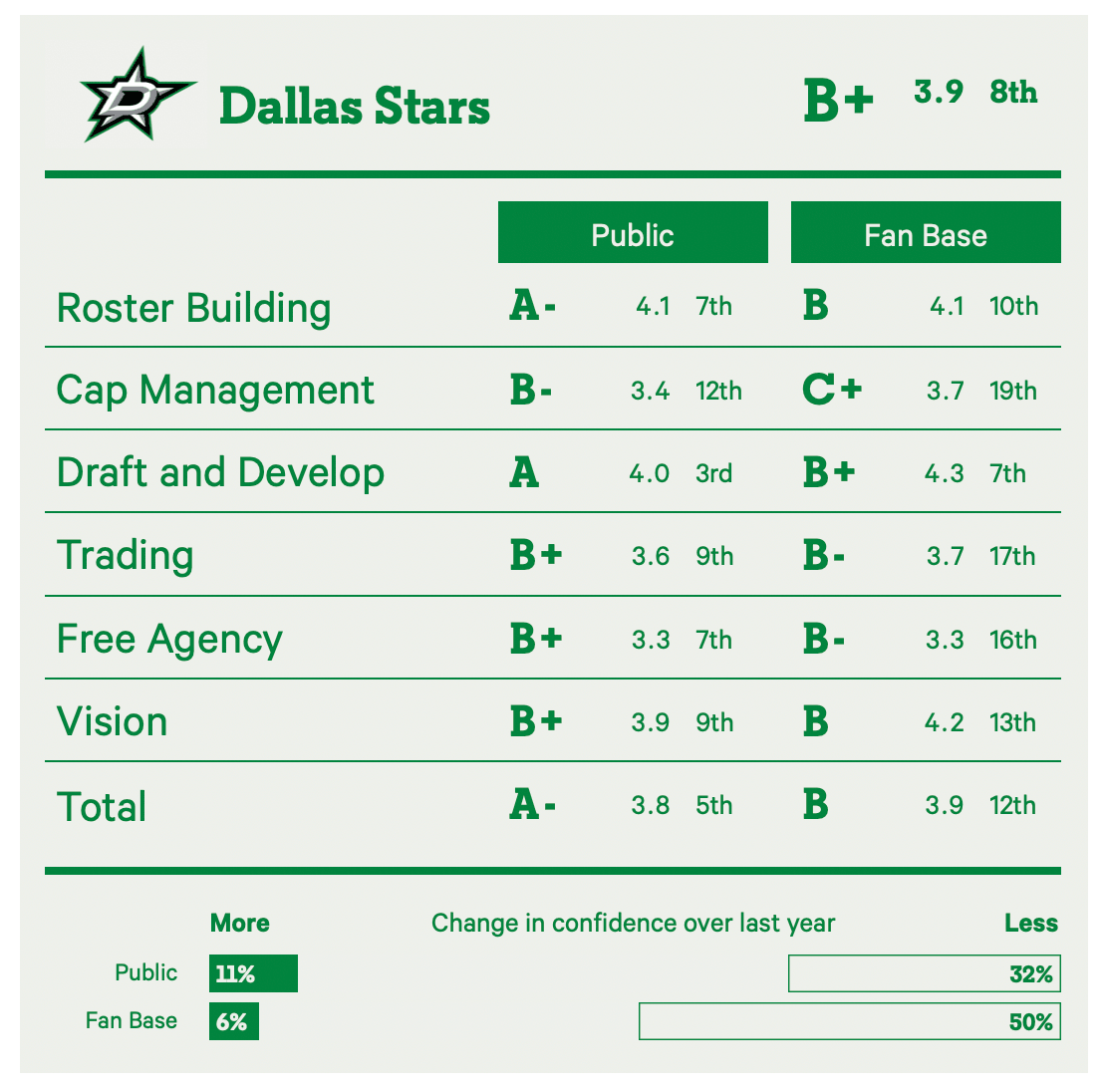
Does a first-round exit carry that much weight?
Well, sure. It’s a tough break, it satisfies nobody, and it’s such a drastic departure from the previous seasons where Dallas looked like a borderline Cup favorite. But how much of this fan ranking comes from a place of analysis, and how much of it comes from the sensation of whiplash?
The article highlights two pullquotes that represent the half-full and half-empty glasses: on the one hand, injuries are out of any team’s control. On the other, “small mistakes have started to pile up.” Both are valid and fair. And both are arguably true. The real question is which of these carries more weight. Put your optimism goggles on, and the potential lineup of Minnesota, Colorado, and Vegas is not insurmountable. Dallas has played these teams in the past, and matched up well against them in the past. Do they beat Carolina in this puck utopia of a run, however?
As for small mistakes, there’s certainly a list. Switching from Pete DeBoer to Glen Gulutzan is not something I’m willing to judge right now, but there’s no doubting that Gulutzan brought in more uncertainty on principle. In practice — well, read on below. The glut of defenders Nill has had to offload for value subtracted (Matt Dumba, Ilya Lyubushkin, Ryan Suter in his last year) not to mention the trade deadline adds like Cody Ceci and Tyler Myers have cost enough picks to make the case that Dallas’ prospect pool has taken a hit as a result. The offensive depth of the team has gone from dynamic to flat, with forward penalty killers comprising the DNA of the bottom six. None of these are franchise-killing mistakes, but there’s absolutely a cost.
I don’t believe any of this is reason enough to throw out the last several years of high level hockey, though. Since 2023, Dallas has 21 playoff wins, which is the fifth-highest mark. This is still a team in its prime. It’s also a team I can see pulling off something like what Vegas did; a team many thought had lost the juice (even if they hadn’t, which should have been patently obvious) and went so far as to fire their coach at the eleventh hour. I don’t believe for a second John Tortorella magically turned things around. What I do believe, however, is that you can always bet on a good process leading to good outcomes, regardless of how slow the pendulum swings. There is not a team in the West that I would confidently say can dispatch the Stars with ease when healthy. That doesn’t make them the favorite over a team like Colorado, granted. But this would always be a transition year. January, the trade deadline, and the 2027 summer: these are the team’s future milestones. Any positive outcomes on all or some of the above, and I’m going to the cookout. No movement or more depth defenders? Then nothing’s on the grill and it’s time to ask the hard questions.
And on that note…
Former NHL video coach Steve Peters did some film room breakdown of the Dallas Stars defense the other day. And it was not in any way favorable. In fact, it’s kind of damning. At least at first glance (and maybe second glance but more on that in a second).
The Cliffsnotes:
Dallas’ 1-2-2 neutral zone forecheck was too passive
It allowed opponents to attack with too much speed
Rather than lock things down, it led to added defensive breakdowns
Of course, this isn’t really news for Stars Stack readers. In November, we talked about Dallas’ struggles in the neutral zone and the wide gap between the forwards and the defenders. In January, we looked at how this affected the forwards as offence generators. In March, we considered why this was problematic for Dallas’ score sequencing and how playing so many score-close games was not intentional. And finally in April, we dug deep into Gulutzan’s system itself, looking at the good (shot suppression), the bad (chance creation), and the ugly (rush defense).
As much as I enjoy Peters’ breakdowns, and as correct as he is, towards the end he starts comparing Dallas’ forecheck to Carolina’s. The difference is stark, as you’d expect. The Hurricanes play tight against their opponents, leaving them no room for error and lot of room for opponents to make mistakes as forecheckers breath down their necks. Dallas is the complete opposite, giving opponents far too much room, and thus letting opponents dictate the rules of engagement.
But it’s worth noting that the Hurricanes are playing a system they’ve perfected for the eight years Brind’Amour took over as head coach. It’s also worth noting that the same system we laud as ‘the gold standard’ was heavily scrutinized for many years as a system that didn’t allow its’ forwards to be creative, potentially explaining why Carolina was such a poor finishing team. And in point of fact, Brind’Amour’s team eventually had to adapt. Over the last two seasons, they’ve shifted from a forechecking dump and chase team to a forechecking rush team.
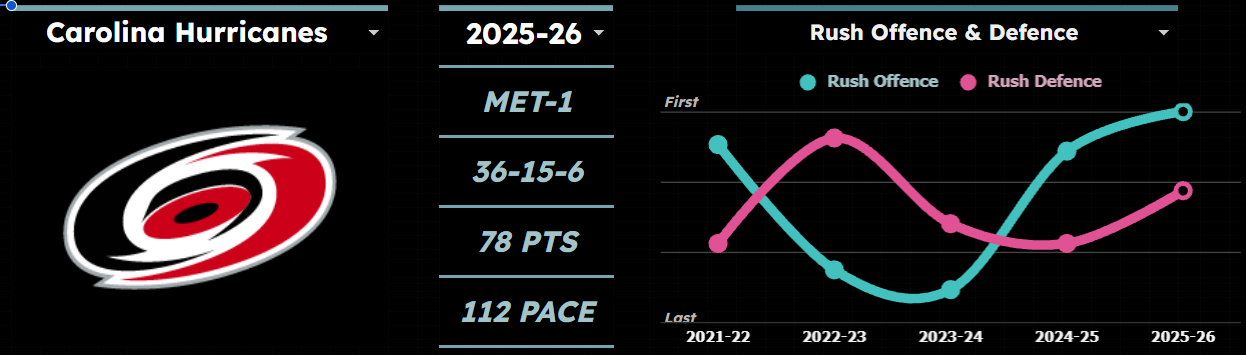
How does Gulutzan’s system change over time and will it? One thing Peters misses in his analysis — yet another reason why limitations are just as present in fancy stats as there is in the film room — is roster makeup. Carolina is one of the fastest teams in the Eastern Conference. It’s there in the EDGE data. Dallas, conversely, is one of the slowest teams in the entire NHL: bottom five, in fact.
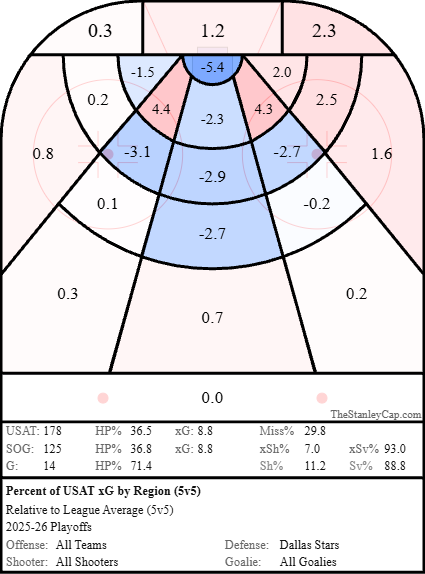
Question: what would Dallas look like if they played Carolina’s system? I won’t pretend like this question is rhetorical because it’s not. But you’d be hard pressed to find a slow team that happens to be elite on the forecheck. Boston, for example, was a very good team last season. They were also the second-slowest team in the league (behind Calgary), and had one of the weakest forechecks. Systems and rosters go hand-in-hand. Maybe it’s possible that a slow team can play an aggressive forecheck but I suspect that would be difficult. For that reason, I’m willing to give Gulutzan credit for showing more consideration for his roster’s makeup. While they gave up too much in the neutral zone, they still collapsed well down low, keeping the shot quality on unblocked shot attempts (or USAT xG) extremely low.
This, of course, changed in the postseason. Dallas was still strong overall, but Minnesota managed to penetrate specific areas of weakness.
The task ahead is one I’m willing to grant Gulutzan a grace period on given that he’s already shown an ability to change the system to his specs; as we saw with the defensive change away from DeBoer. But Gulutzan has to find that balance.
Analytics
Figuring out what happened to the stingy Dallas defense versus Minnesota
·
May 18
I know I’m repeating myself but in this day and age, I suppose you have to. Once more for the cheap seats (not that this goes out to my readers, who are awesome): Glen Gulutzan’s efforts to fix Dallas’ defensive issues from last season was and is a smashing success. This season: 8th in shot attempts against per 60, 2nd in goals against, and 6th in scoring chances against. The season before? (Respectively) 22nd, 13th, and 23rd.
No, I’m not talking about his overall rankings. Although yes, I wrote about that too at the other place. Here I’m just talking about his Dallas ranking. For those interested, here they are:
Lian Bichsel
Jakub Vaněček
Måns Goos
Atte Joki
Emil Hemming
If you’re wondering why Bichsel is there, it’s because Pronman includes players under the age of 23. Keep in mind, I don’t really have a problem with this approach. If you only include players who are not in the NHL, then you end up with an unfinished picture of a team’s emerging core. After all, teams deserve credit for drafting players who develop ahead of schedule. Conversely, evaluating a team’s outer core becomes more difficult, as teams can be unfairly docked for having a “weak” pipeline over something as superficial as graduation. There’s no real valid way to rank team pipelines IMO, which is why I think ranking players not in the NHL is best, not because it makes more sense, but because it’s cleaner.
So: thoughts on these rankings? I disagree. It’s not without merit, granted. Vaněček really is all that. A player with top four upside, who profiles like a strict quick transition defender, to me screams NHL profile. Goos having potential to play a quality backup, is a good bet. And so is Joki, who is already playing professional hockey and showing strong two-way chops as a center with size. Hemming being in the OHL can be considered a modest knock against him.
However, I still have Hemming ranked as Dallas’ top prospect. For reasons I wrote about more in-depth earlier this summer when digging into the film room.
For me, the key is that Hemming took a massive step forward in his D+1 year. I didn’t see a poor player in his AHL cameo. In addition, his OHL playoff performance with Barrie wasn’t just strong; it was elite. He finished top three in OHL playoff scoring, tallying 28 points in 21 games, and second in postseason goals with 15. He has far and away one of the most projectable profiles too. He can shoot, he can pass, he plays both sides of special teams, he’s fast, he drives the net, and he’s got pro size.
However, beyond that I feel like Dallas has more players that belong in that potential complimentary tier, such as Cameron Schmidt, Tristan Bertucci, 2026 LW prospect Ryan Brown, and Aram Minnetian. It’s by no means enough to push Dallas higher in the prospect rankings. The Stars have a weak pool and I’m not denying that. But what it lacks in high level projectables, it makes up for in broad depth.
As always, thank you dear reader/subscriber. This place will be a little quiet for the next two weeks. I’m doing seasons previews for the NHL as a whole at Sticks and Salvos, Monday through Friday. I’m also working on some personal writing. However, this place won’t be silent. I’ll have two pieces for next week, and once September 18 hits, which is when some of the CHL starts taking the ice, I’ll ramp up the prospect coverage. I’ve decided to dedicate myself to doing game recaps, so once the season begins, we’ll rock and roll. This Thursday I’ll be doing one last report card: grades for all the most common line combos and defense duos. It’ll be for paid subscribers, so consider becoming a paid subscriber!
Comments
Nothing yet. Say the first thing.
Sign in to join the conversation.