
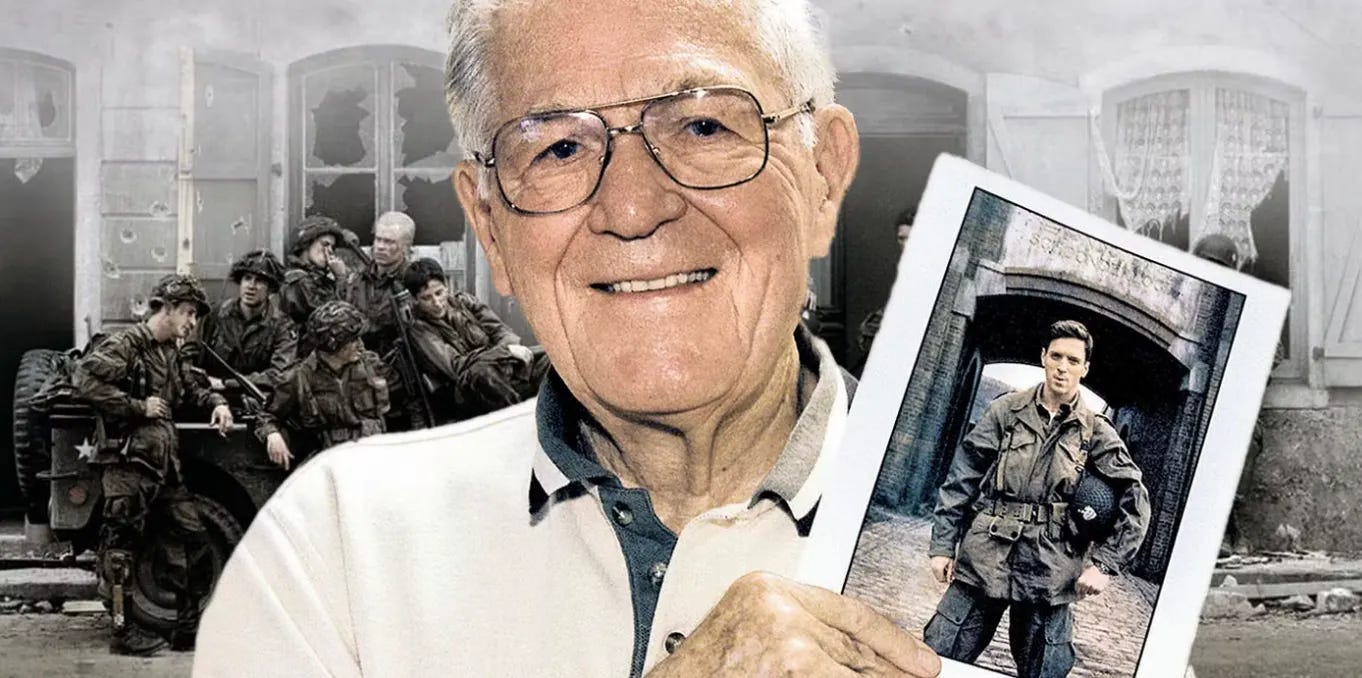
While folding laundry recently, I allowed myself a YouTube indulgence and began rewatching Tom Hanks’ HBO miniseries adaptation of Stephen Ambrose’s Band of Brothers. If you have never seen it, do yourself a favor and add the story of a company of paratroopers in the European Theater of Operations to the list. There were so many individual and collective heroes in the 11 months of intense combat Easy Company participated in that it is hard to keep track, but the thing I keep coming back to is the leadership, from officers and NCO’s alike. The series seems to have been written almost as an intentional leadership study. There is good leadership, bad leadership, and, if you pay attention, some average leadership. The best individual leader is an original platoon commander named Dick Winters, who is moved up to company commander on D-Day, and after months of naked heroism in that role, is promoted onto the battalion staff. It was only 5 months in command, but the manner in which he did it has, through Ambrose’s work, become a part of American combat lore.
There is an interview with Winters as an old man that I find more compelling than almost anything dramatized in Band of Brothers. The interviewer, John Payne, brings him back to Holland, October 1944, to a fight dramatized in the series. Winters, through a small communications snafu, had sprinted ahead of his men and run up onto a dike, fully exposed to the Waffen SS Company on the other side of it. A German, who was supposed to be keeping watch for his unit, stood in front of Winters, only 2 paces away. Winters, his voice breaking decades later, tells what happened next. The German smiled. The universal human expression of “I am not a threat.”
Winters shot him in the chest.
The seconds that followed were extraordinarily violent and extraordinarily effective. Easy Company joined Winters on line. Fire poured into the SS company. Easy, through Winters, had the drop on the Nazis and slaughtered them. Decades later, in the recorded interview, Payne asks Winters to discuss his state of mind in that moment on the dike. Winters replied, “The man standing on that dike is not the man talking to you today.”
And something clicked for me.
We often ask young men to do things they will not possess the wisdom to understand until they are much older. Combat is one, dramatic example. Combat is taking a 20-year-old deeply trained in certain responses to certain stimuli. He grows to love his fellow soldiers, and then we drop them in an environment where hesitation can be, and is often fatal. Where they are asked to make decisions in seconds that philosophers could debate for centuries. Then, physical injuries and death notwithstanding, he goes home.
Surviving those early experiences, even dominating them as a good soldier does, is not the same as understanding them or, short of that, at least properly contextualizing them.
The young Winters on the dike did not have time to develop a theory about courage that justifies his responses in war. There was no time to contemplate mortality or leadership or the morality of killing. There were just Germans in front of him and Americans behind him. His training told him what to do; his body supplied an almost unimaginable quantity of adrenaline; and he went into some automatic mode we all possess but few ever access.
Then he shot a man smiling at him. Understanding came later. There’s another interview as part of the series, where Winters, reflecting on the moment, says,“If you’re a leader, you lead the way. Not just on the easy ones. You take the tough ones too.”
That is almost certainly easier to understand at sixty than it is at twenty-six. At twenty-six, you just do it. You climb on the dike and shoot a man in the chest.
The first time I engaged and killed the enemy, many people were shooting, so who is to say that my bullets struck him at all? Immediately afterward, I had a lump in my throat that took days to go away. But it did.
I remember the MRE I ate after the gunfight ended and how terrible it tasted, like absolute cardboard in my mouth. But it wasn’t the MRE. It was me, trying to force-feed myself sustenance with a bone-dry mouth and trying not to think about what I had learned in my Catholic upbringing. There wasn’t time to process killing then, nor was there the wisdom, or even the distance, to start the living with it. Only distraction was available.
In those years between flipping the safety on an M-4 off and old age, there isn’t necessarily a grand philosophical calculation. There was once training and pride trumping fear and frozen moments, followed by decades, and, for me, odd moments where I became aware of someone else’s experience that mirrored what I saw. It is in those moments that what we ask young men to swallow comes back, still tasting like cardboard. It’s not the guilt that gets you, not anymore. I’ve long rationalized the war, and thought I would have done better to have killed more.
Of them.
It might have saved one of us.
What still tastes like cardboard and snot to me is seeing that pain in others. Experiences come first in life, context second, and meaning, if it arrives at all, a distant third. It’s a childlike response, because we were children. You simply don’t have the vocabulary to process what you experienced. You react to a meeting engagement or an ambush, and maybe you perform brilliantly, but maybe you barely survive. Some unknowable percentage of what happened is preparation, and another is character, and some of it is the dumb luck of where a bullet happened to travel.
Sometimes the memories are accompanied by the oddly melancholic realization that nothing in ordinary life feels quite as consequential as what happened when you were young. You can spend years trying to recreate that intensity. I’ve chased it in trauma bays and jujitsu mats and boxing rings, lord knows. But during that period you also watch other people become young men while you become an older one. You’re not that young man standing on a dike anymore, and that seemed to be what Winters was trying to communicate. He wasn’t repudiating the young man, but he also wasn’t boasting about him. It was an observation across the chasm of a life.
A bullet passing six inches to the left does not prove character, and I’m not special to have lived. It was too random for that. Courage and chance are both so deeply peppered across battlefields that existing now has less to do with something earned than I care to admit. Conversely, acknowledging luck does not require pretending that nothing was earned at 26.
I earned the right to know certain things about myself, but it took a long time to understand it. I discovered what happened when fear arrived and someone still needed to move forward. I discovered I could do what I had trained for in real life, the most empowering thing you can ever learn. I learned the difference between men who only talked about courage and men who quietly possessed it, and learned to be honest about the times I was the former and the times I was the latter. I was both of those, at different times.
Winters said, “When you’re a leader, you lead the way.” Young men hear that as an instruction, but an old man understands it as something much larger. You have to lead the way in making sense of it all as well, maybe more so. Maybe the most important thing I can offer to a young man is some cataloguing of my attempt to make sense of it.
We should try as hard as we can to never romanticize the transaction. A country takes people at precisely the age when they are strongest, most aggressive, and thirstiest for adult identity and sends them into the mud to kill other young people.
Nothing Winters did at forty or fifty or seventy could compete dramatically with what he did at twenty-six. There would never be another moment where he felt his heart pounding with that violent need for life that is so hard to explain on the page. Some part of Winters must have missed that person and, if he was honest, every single detail of that moment: the feel of the gravel underneath boots, the sweat, the snug id of a carbine pressed firm into your shoulder, the recoil, and the feeling that you were fast and everything else was slow. You can spend the rest of your life looking backward, trying to remain the twenty-six-year-old on the dike.
But the old Winters understood something the young Winters couldn’t: if you are fortunate enough to survive for another fifty years, the purpose of those years isn’t to keep proving that you once deserved them. It is to figure out what they taught you.
One of the privileges of my life as I age has been the opportunity to revisit moments that once seemed merely chaotic and discover that they contained lessons hidden inside them. As young men, we possessed something that, as old men, we no longer possess or no longer have access to: extraordinary physical capability, aggression, instantaneous courage, and a sense of invulnerability that belongs to young men.
But now I have this perspective to share. You will someday encounter moments when fear, responsibility and uncertainty arrive simultaneously. You will not have enough information, and you will not feel ready. Luck matters more than you would like to admit. But if you’re a leader, you don’t just take the easy ones; you take the tough ones too. And if you’re lucky enough to stay alive for years and decades, it will take you that long to see yourself again, if you ever do. Don’t try to decide immediately what the experience meant. You can’t. You have to turn your back on it.
Live awhile. The young man on the dike will be there waiting when you’re ready to talk to him.
No posts
Comments
Nothing yet. Say the first thing.
Sign in to join the conversation.