
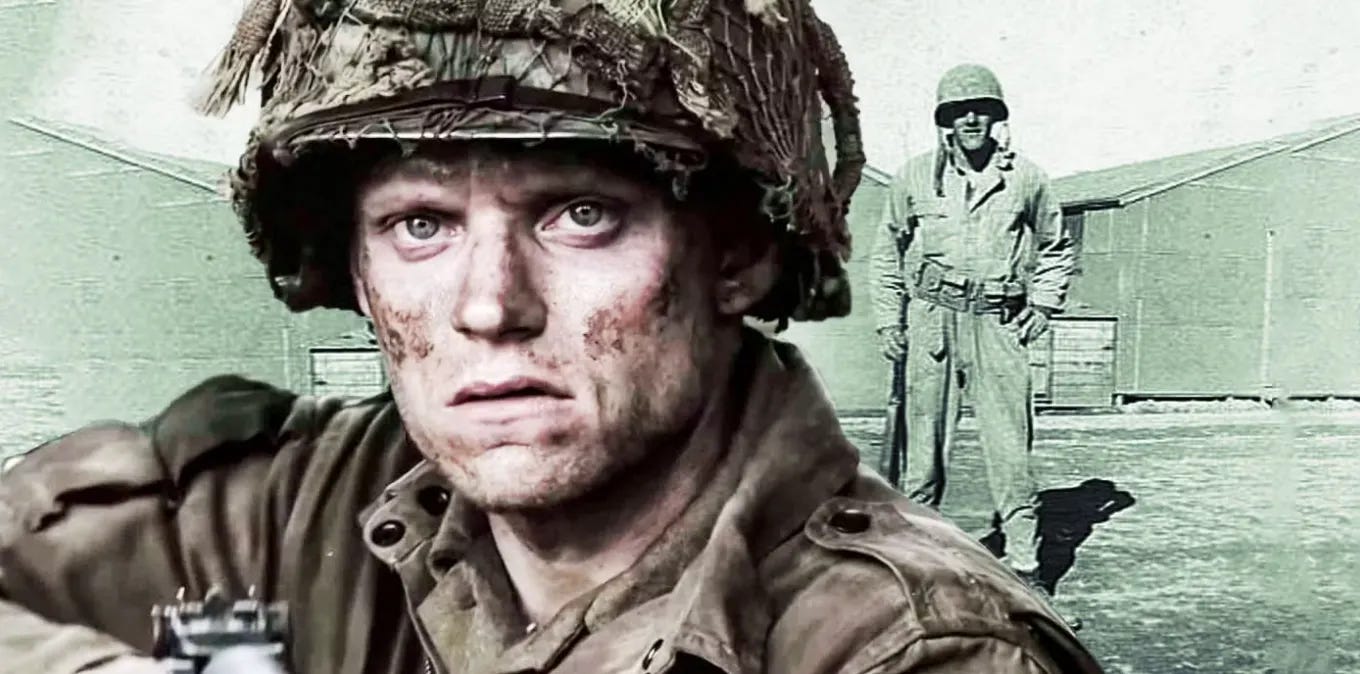
Combat underlines strength and exposes fear in its rawest form. During the World War II battle for Carentan in the epic HBO miniseries Band of Brothers, Easy Company finds itself under relentless assault by a numerically superior German force. As machine-gun fire tears across the bocage, Private Albert Blithe panics, as he has done throughout his brief time in France. He remains frozen in his foxhole, crying, unable to fire his weapon while the men around him fight desperately to keep from being overrun. Then Lieutenant Dick Winters, his company commander, does something extraordinary. Instead of threatening court-martial or worse, Winters races across the line of foxholes, fully exposed to enemy fire. Standing over Blithe, he shouts above the roar of combat: “You can do it, Blithe! Fire your weapon, Blithe! Give it to ‘em!” It is not a rebuke; it is faith that inside this man cowering in a foxhole is a soldier ready to fight and kill and die with just as much courage as his fellow soldiers. Winters reaches the part of Blithe that fear had buried. Blithe rises, shoulders his rifle, and joins the fight.
Most people would not describe that moment as empathic. They would call it leadership, courage, or battlefield inspiration, which, of course, it is. But it’s more fundamental than that. Winters understands that Blithe is not choosing fear; he is trapped inside it. Instead of judging him from the outside, Winters intuits what it feels like to be inside that foxhole, overwhelmed by terror, and gives Blithe exactly what he needs: not pity or an ass-chewing, but belief. That is empathy. It is the ability to enter another person’s experience and understand their needs, even if, in that moment, they cannot articulate those needs themselves.
The real-life historical encounter between Winters and Blithe was less cinematic but more revealing. After the fighting at Carentan, which saw Easy advance across an open causeway and take numerous fatalities, Winters encountered Blithe at the battalion aid station amongst a coterie of wounded GI’s. Blithe told him that he could not see. He was suffering what was then called hysterical blindness, an involuntary physical manifestation of overwhelming psychological stress. Now, in a 2026 Emergency Department, we would call that a conversion disorder. It’s close enough to malingering that it is often impossible to tell if the symptoms described even exist. Yet Winters did not ridicule him or order him back to the line. He talked to him. He reassured the frightened twenty-year-old that he would be evacuated back to England and that he was going to be all right. Blithe suddenly announced that he could see again. Winters, in an interview available on YouTube, later remembered the incident with astonishment: the young soldier had become so frightened that he had effectively shut down, and what he needed at that moment was simply another man to calm him.
Both the historical event and the dramatization by HBO illuminate the same truth. Winters’s empathy did not require softness or lowering a standard. It certainly did not require pretending that fear did not matter in combat. Easy Company needed Blithe to function, other men could die if he did not. Winters’s empathy was useful precisely because it allowed him to understand what was preventing Blithe from meeting the standard and then help him meet it. Fear in combat is pervasive, and I felt it during my time in combat continuously. A memory I will never forget is the cramps in my right hand during my first night in Fallujah. The cramps were from squeezing the pistol grip on my M-4 like a vise, for hours, without even being aware of it. I remember wondering, truly perplexed, why my hand hurt so much? Fear coursed through my body, even as I stepped into the city as laconically as I could manage in front of a squad of more experienced SEALs, a Wintergreen Skoal in my lip, to mask the dryness in my throat.
Empathy should be understood as an essential masculine virtue rather than as some feminine counterweight to masculine strength. Empathy makes strength useful. A man can be physically powerful and externally fearless, but if he cannot understand the people around him, his ability to lead them will always be limited. Fathers need empathy to understand their children and physicians need it to understand patients. When you are responsible for some aspect of other humans, you must be able to leave your own experience and imagine what the world looks like from another vantage.
That does not mean agreeing with everyone. Empathy is not sympathy, approval, or weakness. Understanding why someone is afraid does not require agreeing that he should remain afraid, just as understanding why someone has failed does not mean excusing the failure. Winters didn’t allow Blithe to set his rifle down and wait for the shooting to stop, but understanding Blithe’s fear is what allows him to lead Blithe through it.
American masculinity increasingly seems caught between two terrible alternatives. One version tells men that traditional masculine virtues themselves are suspect: that aggression, competitiveness, and toughness are no longer relevant. The reaction of the “manosphere” has been an equally impoverished masculinity built around domination: never apologize, humiliate weakness, and treat compassion as evidence that someone lacks the stomach for the real world.
Neither provides men a true north.
The first can leave young men ashamed of instincts that, properly disciplined, are enormously valuable, and the second gives those instincts no moral purpose. A man is told to become harder without ever being told what his hardness is for. Masculine strength is a counterbalance for all of humanity, for those who, because of their own relative weakness, are vulnerable.
The purpose of becoming strong is not simply to demonstrate that you are stronger than somebody else or to dominate, it is to carry burdens others cannot and to enter places other people are afraid to enter. Empathy gives that strength direction to be applied.
We must teach our boys and young men that another person’s vulnerability is not primarily an opportunity to establish dominance. If every frightened person is a coward and every struggling person a loser, then empathy becomes almost impossible to learn, and eventually the boy applies the same standard inward. He learns that his own fear must be hidden rather than mastered. This outwardly “tougher” world view produces extraordinarily fragile men, incapable of true excellence, which requires self-examination.
Dick Winters offers a different model. Winters could recognize Blithe’s fear because he felt it as well, as he recollects in the YouTube videos he recorded for posterity. He had parachuted into occupied France, watched men die, led attacks against German positions, and been wounded himself. But he functioned despite fear, and this allowed him to recognize what was happening to the terrified young paratrooper in front of him. And instead of using that distance to elevate himself above Blithe, he performed the extraordinarily masculine act of raising Blithe up.
Blithe was twenty years old in that field outside Carentan. Later, he volunteered for a risky patrol and was shot in the neck. Winters thought he would die. But he didn’t; instead, he recovered, remained in the Army, and served during the Korean War, including making a combat jump in Korea into a drop zone surrounded by Chinese soldiers. He was awarded a Silver Star and became a Master Sergeant, making a career of military service. The frightened young man who temporarily could not see became an accomplished professional soldier.
A hero in his own right.
There will always be moments when men need someone to demand more from them, the proverbial kick in the butt. Kindness is not the same as indulgence. But there will also be moments when a man has reached his limits in the moment. Dick Winters did not make Albert Blithe less afraid. He showed him that being afraid did not mean he was finished. These are lessons we ought not to forget in an age of internet cruelty and faux masculinity, as so many of our current leaders have.
No posts
Comments
Nothing yet. Say the first thing.
Sign in to join the conversation.