
By Billie Walker.
It’s been over a decade since Sky Ferreira’s “Everything Is Embarrassing” became canonised as a modern anthem, and we are still cringing at everything. Those in relationships are hiding their boyfriends, while singles are using stills of Carrie Bradshaw at Big’s door to signify the often humiliating nature of having a crush. To quote another disheartened pop star, in a more recent song which captures the prevailing mood: “love is embarrassing“.
For the most part, Hollywood has ignored this cringe phase, intent on either swerving sex altogether or attempting to relive cinema’s erotic past, whether by resuscitating the erotic thriller or kink-focused films like Babygirl, Pillion and Sanctuary. In a 2025 UCLA study, 48.4% of gen Z viewers polled believed there’s “too much sex and sexual content” in film & TV. But have we misunderstood young people’s aversion to sex on screen? In the aforementioned study, teens and tweens also described wanting “realistic, relatable stories”. Perhaps it is the gap between the mostly slick, idealised depictions of sex on offer and the very real sexual anxieties of viewers that puts them at odds, rather than the conservative prudishness of which gen Z is routinely accused.
This year, cinema is finally catching up to our current sexual speed (roadblocks and all). So far we’ve had a failed threesome (I Want Your Sex), a failed foursome (The Invite), a sex worker’s failed commission (Blue Film) and a screenwriter whose disassociative issues get in the way, at least initially, of her banging her lifelong crush (Teenage Sex and Death at Camp Miasma). Not only do these films embrace the cringe-worthy mishaps of intimacy, they also highlight one of the biggest mood killers in modern romance: the gap between perception and reality.
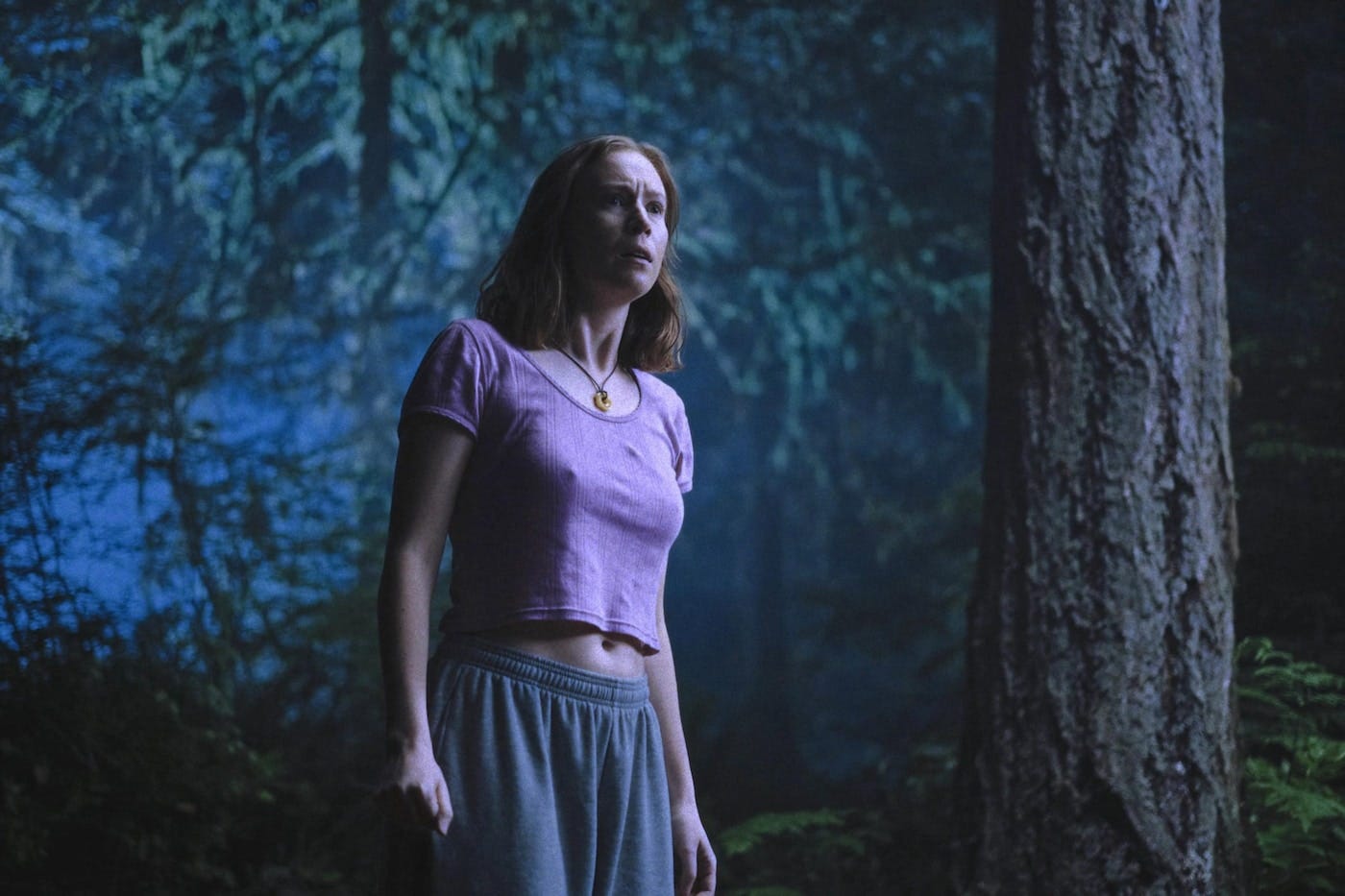
As well as reflecting the growing heteropessimism that fuels online discourse, many of 2026’s buzziest films address alternative sexual practices such as nonmonogamy and kink, exposing both their limitations and our misconceptions around them. From the outside, practitioners of polyamory may seem emotionally literate and sexually confident, but how we talk about and understand our sexuality doesn’t always translate into how we behave. Jane Schoenbrun’s Teenage Sex and Death at Camp Miasma follows filmmaker Kris (Hannah Einbinder) as she approaches retired scream queen Billy (Gillian Anderson), in the hope of convincing her to appear in a reboot of the cult slasher film she starred in decades prior. Their collaboration is soon complicated by a shared sexual tension, and while Kris is open about her sexuality and wears her polyamory as a badge of honour, this doesn’t make her any more skilled at seduction.
In fact, is it the sexually mature Billy who has to take charge, setting the stage for romance with a candlelit fried chicken dinner and roaring fire. Kris these cues correctly, but her response is fumbling: rentering the room topless, she attempts to seize the moment, but quickly crumbles when the pair get down to it, before confessing that she struggles not to dissociate during sex. For the rest of the film, it is Billy’s patience and understanding that coaxes Kris out of her shell and allows her to embrace connection (helped along by a surreal bout of extreme B movie violence.)
Olivia Wilde’s The Invite is a comedy of sexual errors in which Joe (Seth Rogan) and Angela (Wilde) host their neighbors Piña (Penelope Cruz) and Hawk (Edward Norton) for a night of wine and nibbles. The Invite is less concerned with the lived reality of the polyamorous couple and more with what they represent to Joe and Angela: an escape from the coldness of their own marital bed. In both films the humour is derived more from our assumptions about polyamory, rather than the relationship style itself. As with any other sexual practice, choosing polyamory doesn‘t automatically grant someone wisdom and experience, but in our image-obsessed world we tend to take the surface level as the whole story and idealise those who present themselves as sexually adventurous. The Invite pierces that illusion, even as sex therapist Piña ends up being the most dignified character.
In Gregg Araki’s forthcoming I Want Your Sex, Elliott (Cooper Hoffman) embarks on an affair with his artist boss Erika Tracy (Olivia Wilde) and soon takes on a submissive role, his eyes thrust open to the world of kink. The film’s young characters mostly express their openness through external signifiers, including a garish pink punchneedle penis rug that flops on the apartment floor of Elliott’s best friend Apple (Chase Sui Wonders). Not incidentally, Apple is the most sexually skittish of the lot. On the other side of the spectrum is Erika, who disdains gen Z’s rabbit-in-the-headlights approach to intimacy. But as liberated as she proclaims to be, there‘s a cynicism to Erika, who sells artworks made up of kink paraphernalia ripped from its context and shoved into gallery spaces. Much of the conversation around Araki’s latest film focuses on his concern over gen Z’s sexual expression, but Araki spotlights the role millennials have played in forging a culture which opts for commodifying and pathologising sexuality over feeling it.
Easily the darkest film in this year’s cinema of sexual failures is Blue Film, in which sex worker Aaron spends a night with an anonymous client, who is later revealed to be his former high school English teacher and a convicted pedophile. Blue Film contains not one but three attempts at sex acts that are unsatisfactory, whether for Aaron, the client or both. By the final act, Aaron‘s dominant facade has fallen away and he is begging to be topped. But the two men’s desires are never fully compatible. Through their mutual inability to satisfy one another, however, they form a complex bond, far more meaningful than if this had been a simple, or successful, transactional exchange.
If The Invite is a comedy of sexual errors then Blue Film is its dramatic counterpart; both films demonstrate that you can learn as much about yourself and relationships from sexual failure as from success. Along with Camp Miasma, they feel like an antidote to many of our anxieties around modern dating, and the impossible expectations which trap people further into isolation. Incels whose fear of sexual failure turns violent and embittered; those that opt for AI relationships over human interactions, and ‘gooners’ or pornosexuals (a sexual subculture who choose marathons of masturbation to online porn over other people) may be extreme cases, but they are part of a wider trend towards sexual abstinence. In Daniel Kolitz’ essay The Goon Squad, published in Harper’s, one pornosexual is quoted as saying his biggest fear about real-world dating is “the impossibility of ever knowing what’s really going on in your partner’s (or anyone else’s) head.” Even if we don’t go to such avoidant lengths, many of us are plagued by similar uncertainties, still scared of the almost inevitable rejections and failures of dating. But in seeking to avoid embarrassment, we risk missing out on the hard-won wonders of human connection.
The ecstatic ending of Teenage Sex and Death at Camp Miasma may be the most explicit example yet of what seems to be a widespread urge from directors to embrace the uncertainty and messiness of real intimacy. In 2026, on-screen sex is defined by its fumbles and failures, reminding us that mistakes are not just an inevitable part of dating, but potentially a transformative one too. To err is human, and to embrace our sexual failure might just fix us.
No posts
Comments
Nothing yet. Say the first thing.
Sign in to join the conversation.