
Welcome to Dark Markets, a newlsetter about Silicon Valley ideology, financial fraud, and frontier technology. I’m David Z. Morris, PhD historian of technology, longtime investigative reporter, and author of Stealing the Future: Sam Bankman-Fried, Elite Fraud, and the Cult of Techno-Utopia.
Late last week Dar Sleeper, a VP and designer at humanoid robotics firm 1x, jumped on Twitter to complain about the way Wired had covered an exclusive look at the hands of their forthcoming robot, Neo.
Sleeper’s complaint has become yet another rallying point for the venture capital class to excoriate, basically, the entire idea of journalism - that is, the idea that anyone should have a platform for expressing an objective third-party opinion. Yet again the tech elite closed ranks around the idea that they should ‘tell their own stories’ through outlets they control.
This is of course emotional cope from people who can’t admit that they desperately need and want the attention of credible journalists, while also fearing it. Even given the much-reduced state of the journalism industry - largely undone by the tech industry, notably - journalists are one of a very small group of outsiders who still have some independent power that Silicon Valley can’t entirely control.
And boy, do they hate that.
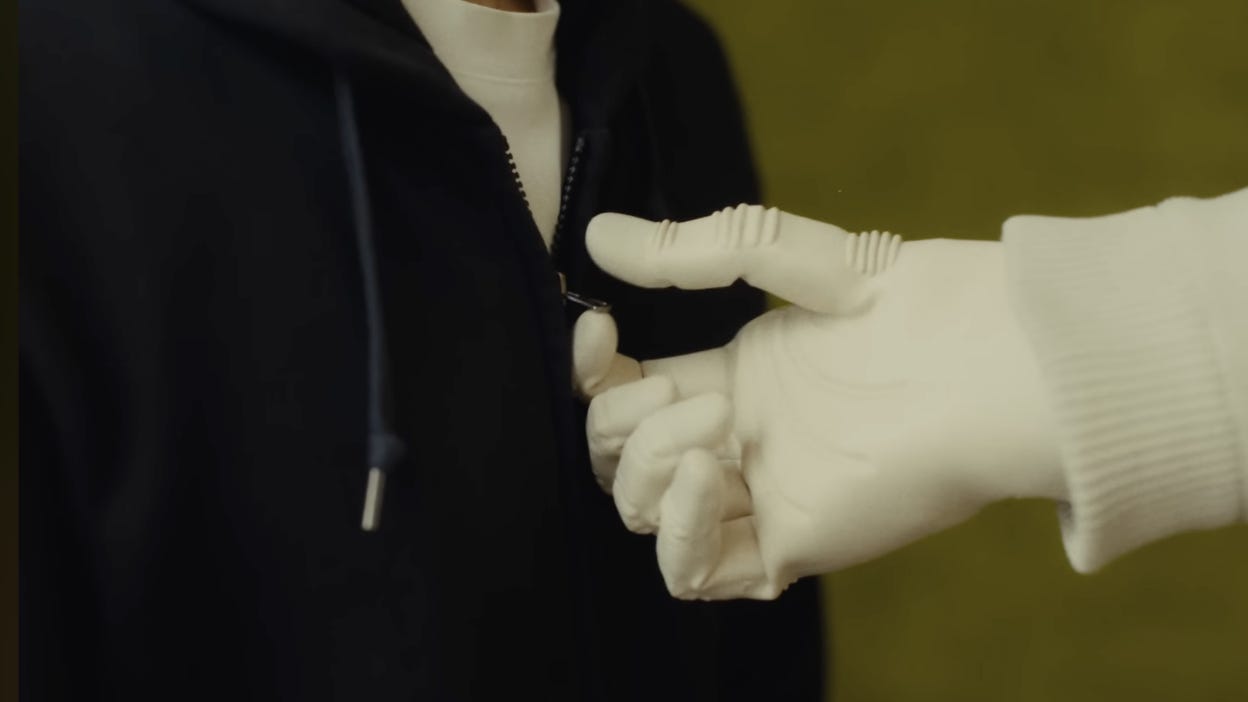
The original piece, note, just argues the ads are “sensual.” And it’s indisputable that “sensual” in the simplest sense is exactly what Neo is selling. The entire concept of the “soft” robot is that it will be easier for humans to interact with - and, yes, it seems clearly part of the pitch, to touch.
Sleeper complained that the Wired article was “about how we are sexualizing robotics,” and included a note to the author of the piece, Boone Ashworth.
That note is worth printing in full:
“I wanted to let you know that I didn’t enjoy your article at all.
I understand the need to be inflammatory because that seems to be the only thing that gets clicks these days but that doesnt mean you shouldn’t recognize when something special is in front of you.
I trusted our PR team in saying we should offer you the exclusive on what is one of the most important technological developments in the history of Mankind and I deeply regret it.”

dar@radbackwards
I gave WIRED the exclusive on our hands launch, and they wrote a really weird article about how we are sexualizing robotics… wired.com/story/the-1x-n… I felt pretty betrayed because that’s not what they told me they were writing about not is that what I’ve ever been about…
7:15 PM · Jul 11, 2026 · 2.37M Views
436 Replies · 202 Reposts · 4.26K Likes
So are the charges fair? Let’s look at the actual Wired article (archive.is).
It’s actually very, very short, so here are the two most relevant passages of Ashworth’s piece:
“1X says the goal is full automation for Neo, but for now, the robot is partly teleoperated, as a Wall Street Journal video noted last year. That means human operators can take control of Neo remotely and even look through a camera to view the space around it.”
This is relevant because the tele-operation part of the Neo value proposition is genuinely freaky - you’re giving some stranger from halfway across the world direct control of a human-like machine in your house whose hands seem strong enough to do some real damage.
The teleoperation is also relevant to the other key passage. Ashworth continues:
The marketing for Neo’s new fingers feels very sensual. Smooth jazz plays in the background of a soft, warmly lit video. The robo digits curl around a wine glass, turn off a light, unzip a jacket, and gently fondle some grapes. In previous ads, the humans stand just very close to Neo and look at it flirtatiously. (After this story was published, a 1X representative clarified that the company does not view Neo or any of this marketing material as flirtatious.)
And that’s it. That is essentially the full exent of the discussion of sexual elements of the robot. And if you look at those ads, this is an accurate description.
Dar Sleeper’s allegation that the Wired article is “clickbait” is stupid on its face, because it’s based on an outdated understanding of how media works in 2026.
A legitimate publication like Wired is of course looking for clicks, but they’re not searching for the kind of mass virality implied by the allegation of “clickbait” or being intentionally “inflammatory.” They’re not making money by putting programmatic advertising in the faces of ten million people - Wired is a subscription publication, and they’re looking for paying subscribers who want the information they’re selling. This article specifically was paywalled.
The title of a piece like this, further, is where the “clickbait” would be. And this one - “The 1X Neo Robot has Freaky Fast Fingers” - is objectively not clickbait. If it were trying to be clickbait, it would lean much harder into the sex stuff 1x is complaining about. (It’s actually not a great headline, frankly).
What Wired’s general strategy and the content of this article serves, then, is not the manipulative impulse to drive clicks. The article was specifically and clearly written for a niche of readers who care about the tech industry, and who actually want to have a neutral, third-party read of what’s going on. And that includes valuing the knowledge that some of the ads for the 1x Neo lean into intimacy.
I think it’s a valid observation about a few moments of the ads themselves, even if debatable. And to be clear, Ashworth at no point alleges that 1x is secretly creating a sexbot and disguising it as a household chore-doer - only that their marketing has some surprising undertones. Further, Wired is not the only outlet to make the observation - Mashable called the rollout ad “creepy.” That suggests Ashworth didn’t just make something up that has no grounding in reality - other commentators felt the same way about the ads.
The original piece, note, just argues the ads are “sensual.” And it’s indisputable that “sensual” in the simplest sense is exactly what Neo is selling. The entire concept of the “soft” robot is that it will be easier for humans to interact with - and, yes, it seems clearly part of the pitch, to touch.
That doesn’t necessarily imply sex! And the fact that some of your customers certainly will try to have sex with the robot doesn’t implicate you as the manufacturer. But you have chosen a very difficult marketing task - intentionally evoking intimacy while, (taking 1x at their word) trying to steer clear of sexuality or “flirtation.”
That’s not an easy line to walk, and I think it’s entirely fair for Boone Ashworth to weigh whether or not Neo is walking it. Wired is among other things a business publication, and it digs into the possible success or failure of businesses, not just technologies.
Whether it’s fair or not, the comments about the “sensual” nature of Neo’s marketing identify a very real risk for the company - careless marketing that gets their product labeled a sexbot in the public mind, making them embarrassing to own or talk about. That’s a real business risk, built into the model of what 1x is selling.
And that business risk is what their attack on journalism is trying to distract you from.
Or are they trying to distract you at all?
Dar Sleeper’s complaint accomplished at least two things. First, it ingratiated him and 1x to right-wing, anti-journalism tech types including Coinbase CEO Brian Armstrong, who opined that traditional media “hate tech” and that more brands should “go direct,” that is, create their own media. a16z and Coinbase have been on this for years, with Coinbase releasing a film about itself in 2022, for example.
But those efforts are inescapably futile. I’ve literally never seen a public discussion and attention around a piece of owned media of the sort that is triggered on a daily or weekly basis by real journalism. That’s because most people, or at least most news readers, actually do understand that you can’t fully or automatically trust what someone is saying about themselves.
This is the hateful trap the tech oligarchs find themselves in: they know they need a free press, but they compulsively continue to attempt to pull away from and delegitimize it. In ways that I’m not going to unpack right now, this is closely related to the utilitarianism that dominates Silicon Valley, with its implicit assumption that the smart techie is already correct, and therefore that any criticism is simply slowing down the inevitable flow of history.
You can see this in Dar’s note, where he describes his own product as not just “something special,” but as “one of the most important technological developments in the history of Mankind.”
That’s a hell of a claim to make confidently about something you yourself created! Maybe you want a bit of an outside perspective on that! Maybe there are things you haven’t thought of? It’s possible!
And of course that’s why people really hate being written about, even when it’s massive free advertising for your company: it’s uncomfortable to seriously consider what other people think about you and your actions. Being written about is not fun, ever!
Meanwhile, a journalist’s job, to a significant extent, is to keep an eye out for things going wrong. In fact, that’s why people still read stuff like Wired, with a bit of a critical edge. They know that companies don’t magically tell the truth about themselves!
And so complaints like Dar Sleeper’s wind up being weirdly contradictory - note that he includes a link to the article! He actually wants to draw attention to the Wired piece while at the same time complaining about it. It’s weirdly similar to Donald Trump’s love-hate relationship with the New York Times, whose attention he covets while constantly expressing loathing for the organization.
In this case, it’s not merely a childish view of the world - “write about me, but only in ways I approve!” - it’s actually pretty obvious two-faced marketing strategy. As many have noted, this small, paywalled article might not have actually gotten any real attention if it weren’t for Dar Sleeper’s viral and arguably misleading complaint.
In other words, Wired did the journalism part.
It was 1x Technologies who made the clickbait.
No posts
Comments
Nothing yet. Say the first thing.
Sign in to join the conversation.