Super Smash Bros. Melee Development Documentary
To start things off, I present to you my first documentary about Melee’s development, Elevated: The Development Story of Super Smash Bros. Melee. This is a 2021 video I uploaded that covered most of the story.
Watch on YouTube: "Elevated: The Development Story of Super Smash Bros. Melee documentary"
Here is Sakurai’s video covering Melee:
Watch on YouTube: "Sakurai's video covering Super Smash Bros. Melee"
Super Smash Bros. Melee Development Timeline
Based on the incredibly helpful Melee development timeline from SourceGaming, below is a chronological list of when we know things happened by date.
Super Smash Bros. Melee: a development timeline
Event Milestone 30 entries, May 1999 to August 2005
Pre-production 1999 to 2000
-
Sakurai reveals that Melee exists, posting a poll on the Smash Bros. DOJO site asking what fans would want in a theoretical sequel. At E3 he sees Smash 64's reception and the Project Dolphin tease.
-
The poll closes.
-
Sakurai publicly states that no sequel is planned. His mind was already made up.
-
Project proposal and initial design documents completed, including a concept for a GameCube controller with a jog dial.
-
Modeling and rigging completed for the Meowth trophy, used for Spaceworld's Meowth's Party tech demo.
-
Early fall 2000
Development begins. Only a GameCube emulator is available, not real dev kits.
-
The team receives actual Dolphin development kits.
Production 2001
-
Sakurai draws storyboards for the opening cinematic, giving up his New Year's vacation.
-
The team commits to an orchestral soundtrack, with Shogo Sakai taking over from Hirokazu Ando.
-
Recording begins on over 4,000 original sound effects. Sysdolphin 1.0 is finished.
-
Twelve HAL staff fly to E3. Melee is revealed that evening at Nintendo's private pre-E3 show.
-
Melee hits the E3 show floor. The team has grown past 50 people. Yuji Naka and Hideo Kojima both approach Sakurai about their characters. Too late.
-
Aug 24 to 26, 2001
Space World 2001 at Makuhari Messe. Premium Fight, the first ever Melee tournament, draws thousands.
-
Sep to Oct 2001
A larger build tours the Cube Clubs, adding Zelda, Sheik, and Samus.
-
Japanese and North American build 1.00 completed.
Launch Nov 2001 to May 2002
-
Released in Japan.
-
Released in the United States.
-
Inducted into Famitsu's Platinum Hall of Fame.
-
A Japan-only event disc build is compiled.
-
Dec 22 to 23, 2001
Jump Festa 2002 hosts the first tournament played on the final build.
-
Early 2002
Toys R Us runs Fighting Road 2002. Participants wrote about the experience here and here. Japan Railways runs a Melee stamp rally.
-
Version 1.02 completed.
-
Version 1.03 completed for PAL.
-
Released in Europe.
-
Released in Australia.
After 2002 to 2005
-
Sakurai appears on the radio show Tokyo Game Lounge.
-
Aug 17 to Oct 13, 2002
Toy Festa, a national Toys R Us tournament, draws roughly 15,000 entrants across 124 stores.
-
The New Japan Philharmonic performs an arrangement of Melee's music in Tokyo.
-
Dec 2002 to Jan 2003
The concert recording ships as a CD.
-
Melee gets its own GameCube bundle.
Sakurai’s video about the Smash Bros. DOJO!! websites:
Watch on YouTube: "Sakurai's video about the Smash Bros. DOJO!! websites"
Development Trivia
Gameplay and Mechanics
- Melee uses “Ready… Go!” instead of “3, 2, 1… Go!” because of the “lengthy” loading times compared to Smash 64.1
- Glancing blows (phantom hits) were an intentionally added feature in Melee. 2
- Smooth landing (L-canceling) was modified from Smash 64 from cutting the landing lag to 0 to cutting the landing lag in half.3
- Grabs and throws were made deliberately weaker in Melee compared to Smash 64.4
- Stamina Mode originally had players start with 170HP instead of 150HP.5
- Sakurai acknowledges the utility of a wavedash, calling using the technique a kind of backdash, when a fan explains how he discovered it with Luigi. However, he questioned how useful it was.6
- The two ideas guiding the whole design were “easy to learn, difficult to master” (Bushnell’s Law, named for Atari founder Nolan Bushnell) and Risk and Return, where a riskier decision should pay out proportionally.7
- Sakurai deliberately sped Melee up compared to Smash 64, making characters fall faster and moves come out quicker.7
- Every fighter got a side special, which absorbed some of the 64 cast’s old neutral specials like Ness’ PK Fire and Link’s boomerang.7
- Other techniques new to Melee included holding down smash attacks, walking while carrying large items, jumping from ledges, wall-jumping, dash grabbing, pummeling, up and down throwing, and power shielding.7
- Throwing with the R button existed at one point, but was cut.7
- Shielding used the GameCube’s analog triggers, so a shallow or deep press changed the shield’s size. Pressing Z let you grab or drop items in the air, use a light shield, or grab in the air, and those characters also got grapple recoveries off walls.7
- Wavedashing came out of a physics quirk the team found late in development. By the time they noticed the air dodge could carry momentum into the ground, release was too close to do anything about it, and they didn’t think much of it anyway.7
Characters and Movesets
- The full title of Marth’s debut game was omitted because of the game’s in-game character count limit for game titles listed on trophies.8
- Sakurai acknowledged that Pichu technically can’t learn Skull Bash or Agility in the Pokemon games, but had to use those moves anyway as Pikachu’s clone character.9
- Roy was added specifically to promote the upcoming Fire Emblem game, The Binding Blade on GBA.10
- Zelda with a Sheik transform was decided from the very beginning of Melee’s development.11
- Sakurai considered unique model swaps as costumes for characters more challenging than mere color palette swaps due to character creators valuing their creations’ individuality.12
- Sakurai wanted to keep Samus’ gender a mystery in Smash 64 akin to how it was a special reveal in the first Metroid game, so he intentionally chose to not give her voice sounds in Melee as well.13
- Mewtwo’s Confusion used to have less lag, but was changed when you could use it for a nearly infinite combo.14
- Giga Bowser and Bowser are separate characters. Bowser and Giga Bowser’s portrayal were both inspired by Sakurai’s perception of the “beastlier” Bowser with which he was familiar from the NES era games, despite Nintendo’s direction to take the character in a “cutsier” direction.15
- DK being hit by that ball of energy in the opening movie is in fact Mewtwo’s shadow ball.16
- Deciding to include Mewtwo had to do with considering what an interesting moveset that would include using supernatural powers and also the voice actor of a leading character in a worldwide movie may have mass appeal.17
- The team originally thought only 16 characters were possible in the time they had. They got to 26.7
- Mario was the first character built, and became the foundation for everyone else. Each character had a dedicated designer in charge of them.7
- Ness was almost replaced by Lucas from Mother 3, but with that game stuck in development limbo they kept Ness.7
- Wario was left out because Sakurai didn’t want too many Mario characters, not because of the vote count.16 He did finish just behind Bowser and Peach in the poll, by roughly a single vote, but the roster balance is the reason Sakurai actually gave.7
- Falco got in because he shared a physique with Fox and was the easiest to build. Both use their Star Fox 64 designs, since Star Fox Adventures hadn’t shipped yet.7
- Jigglypuff started as a joke character and Sakurai was on the fence about bringing it back. Pichu took over the deliberately-weakest role, and Jigglypuff got tweaks to compensate.7
- Every Pokemon uses its anime voice instead of the 8-bit cries from the Game Boy games. Masafumi Mima, voice director of the Pokemon anime, came in to direct the same actors for Melee.7
- Fire Emblem was almost cut from the American release, since no Fire Emblem game had come out in the west yet. Nintendo of America pushed to keep Marth and Roy in because they were too fun to lose.7
- Roy was built to feel like an amateur swordsman, with more obvious weaknesses than Marth but a stronger neutral special in Flare Blade.7
- Ganondorf only exists because of two lucky breaks: an existing model from the 2000 Zelda Space World teaser, and Captain Falcon’s animations to build on.7
- Young Link was added because most Zelda games feature Link as a child, and because Link felt too slow in Smash 64.7
- Sakurai kept the Zelda transform a secret, revealing Sheik as a fighter first and only showing Zelda and the transform later. Sheik was a lot of work, since Ocarina of Time was the only reference material that existed.7
- Mr. Game & Watch was originally going to move frame by frame like his original appearance, but that got scrapped for being too hard to control.7
- The Ice Climbers’ two-character mechanic came from the simultaneous two-player mode in their NES game, and was the main reason they got in at all.7
- Dr. Mario kept Mario’s animations exactly, since he’s the same character. Only the attack and movement properties differ. Sakurai is also a huge fan of the Dr. Mario music.7
- Sakurai passed on Dedede and Meta Knight because they were his own creations and he wanted to avoid his own bias. He later admitted he had underestimated how popular they were.7
- Nintendo, Creatures, and The Pokemon Company all shared a Tokyo building with HAL’s development studio, which is why cross-company checks were so easy to get.7
- Rare trophies were planned, but only the motion sensor bomb survived. Perfect Dark’s design got swapped for GoldenEye’s since Perfect Dark was M-rated and might have affected Melee’s rating, with “Top Secret” used as the origin in the trophy description. The Cloaking Device got the same treatment in the west.7
Stages
- Each series was meant to get a front stage and a back stage. Front stages are more straightforward, back stages are built around a gimmick. That’s the system behind most of the cut stages below.7
- There wasn’t time to finish a second Ice Climber or Game & Watch stage, and Fire Emblem never got one at all.7
- Three Smash 64 stages came back and had to be rebuilt from scratch, including Whispy’s wind.7
- Sprout Tower was the original backstage for the Pokemon franchise which became PokeFloats.18
- Melee stages were made deliberately smaller compared to 64’s to help with character visibility.19
- Kingdom of Akaneia was a canceled Fire Emblem stage, which would feature trebuchets, dragons, and mages.20 This is likely what the empty stage AKANEIA on the disc is. Akaneia (romanized Archanea in the west) is the continent from the first and third Fire Emblem games, and it’s also the internal name of the Fire Emblem song used on Temple. Think Brawl’s Castle Siege.2122
- PokeFloats reused the Pokemon Stadium models with a cel-shaded treatment.7
- Venusaur and other Pokemon originally were to appear on the Pokemon Stadium stage (like in Saffron City in Smash 64) and use moves. But due to the complications around getting the models and animations to appear with the programming constraints, the feature was removed. He did, however, retain as much of this progress as possible into the Pokeball item. Whether or not canonically Pokemon could use the moves they were using in the game was not as much of a priority although some research was done. The main priority was not overlapping with other Pokemons’ abilities.23
- Summit was a stage considered as the back Ice Climber location. It was planned but was eventually canceled (likely ICETOP on-disc).24 Flat Zone has several unused animations for the Game & Watch games Fire and Parachute that still exist in the games files.
Watch on YouTube: "Unused Flat Zone animations for Fire and Parachute in Melee" Corneria has some unused animations as well, with some of the buildings collapsing (thanks, nyancat128!).

Cut Stages on the Disc
The debug menu’s Versus level select has six unused entries. Only two load without external codes. Most of them use whatever song is currently playing, since they never got music of their own.22 I went through all six in detail here:
Watch on YouTube: "A Deep Dive Into Melee's Cut Stages"
- DUMMY isn’t a real stage at all. The game checks a file string pointer during stage initialization, and when it comes back null it builds this instead: pitch black, one tiny platform, and blast lines placed so far out that you can’t be KO’d. Miss the platform and you fall forever. It usually crashes on load, and a Gecko code forces it.2122
- TEST is a long sprawling playground of slants, slopes, moving platforms, and different ground types, almost certainly built for testing. It borrows Corneria’s music, has no grabbable ledges, and you can’t drop through any of its platforms. The backdrop is a photo of Caffe Verona, a since-closed coffee shop in Palo Alto, which was a stock image commonly used for OpenGL testing at the time and appeared in early editions of the OpenGL Programming Guide.2122
- TSeak is Sheik’s own Break the Targets stage, cut when she ended up sharing Zelda’s. What’s left is one gray platform with grabbable ledges and three targets, with an oddly close left blast zone. It may have been the template every Target Test stage started from.2122
- ICETOP and 10-2 are both just Icicle Mountain without music. 10-2 would have loaded right after 10-1 in Adventure Mode. The clincher: Summit’s internal file name in Super Smash Bros. Ultimate is
icetop, which strongly suggests Melee’s second Ice Climber stage was going to be something close to what Brawl eventually shipped.2122 - AKANEIA is the Fire Emblem stage.
AKANEIAis also the internal name of the Fire Emblem track that plays on Temple, and there’s a texture inSdMenu.usdwith Japanese text reading Akaneia.22
Stage Naming Trivia
- Rainbow Cruise is a literal translation of the Japanese name, but the stage is a direct reference to Super Mario 64’s Rainbow Ride, so it was likely just misnamed in localization. The PAL versions of both Melee and Brawl call it Rainbow Ride. Ultimate later locked in Rainbow Cruise.21
- PokeFloats’ Japanese name translates to “Pokemon Subspace.” Nothing in the stage itself suggests the Pokemon are floats. That’s purely an English-language invention.21
- Smash 64’s “Congo Jungle” was a spelling error, quietly corrected to Kongo Jungle when the stage returned in Melee.21
- The Donkey Kong stage themes are swapped internally. The DK Rap remix that plays on Kongo Jungle is filed as
GARDEN, and the Jungle Japes theme is filed asKONGO, which suggests the tracks traded places late in development.22
Audio and Music
- Originally, Corneria and Venom’s stage music were swapped.25
- The tracks in Melee’s OST that use an orchestra include:26
- Melee’s Opening
- Great Bay
- Fountain of Dreams
- Corneria
- Venom
- Pokemon Stadium
- Every character’s victory fanfare
- (Mute City uses live electric guitar)
- Continued from Smash 64, Sakurai used the Japanese Mario Kart voice actor for Luigi as a reference, which is why his voice is higher-pitched than Mario’s.27
- Sakurai wanted to include the Dark World theme from Zelda: A Link to the Past as a music track but was unable to for an unspecified reason.11
- Sakurai included Mach Rider music in Melee because he liked it.14
- Sakurai himself came up with the voice lines for the characters, including Mewtwo’s victory lines.28
- Music tracks for Temple and Onett went through several revisions, you can hear early versions of it in various uploaded media.
Watch on YouTube: "Early versions of Temple and Onett music from Melee's development"
- There were four musicians on the team: Hirokazu Ando as sound and music director, Tadashi Ikegami on sound effects and voice coordination, Shogo Sakai, and Takuto Kitsuta.7
- Sakurai offered to pay for the orchestra out of his own money. HAL hadn’t planned on using one, and he pushed until they agreed.7
- Melee was Sakurai’s first project developed on optical disc, which is the only reason streaming audio and live recorded music were possible at all. That orchestra decision became the catalyst for the Press Start concert series, which ran for ten years.29
- The menu theme went through several revisions. A rejected version survives as the Trophy Lottery music, internally named
MENU02, and it actually shipped in the Japanese kiosk demo. Smash 4 and Ultimate later offered it as a selectable menu theme.722 - Temple was the hardest track to land. Sakai used the dungeons of the original Legend of Zelda as his reference, comparing their eeriness to the Japanese ghost story Yotsuya Kaidan. It went through roughly six revisions, and Sakurai once came back fifteen minutes after hearing a version to say “sorry, the fans will not accept this.” An early rendition still sits on the official website as
shrin_botsu, and the final track ended up a remix of Zelda II’s Palace theme instead.730 - Onett was based on Bein’ Friends from EarthBound, and was meant to have a saxophone that never got recorded.7
- Fourside went sci-fi because the stage is set at night. Had it stayed a daytime stage like the SNES original, it might have been a salsa track.7
- Sakurai asked Sakai to weave the Metroid elevator music into the Brinstar theme.7
- The DK Rap was meant to be Ando’s, but technical problems handed it to Sakai. James W. Norwood Jr. had recorded his vocals against the Donkey Kong 64 version at a fixed tempo, while Melee’s backing track changed speed for each crew member, so his takes had to be sped up and slowed down to fit. Two days of work.7
- Green Greens is a MIDI track, not a live recording.7
- Ikegami recorded over 4,000 original sound effects and reused almost nothing from Smash 64. Sakurai, who gave notes on nearly everything else, left him alone on this.7
- Donkey Kong got animal noises rather than speech, even though Grant Kirkhope was voicing him in most other games at the time.7
- The Japanese Star Fox 64 cast reprised their roles. In English, the cameos went to the Star Fox Adventures cast, including Chris Seavor, who created Conker.7
- Fox and Falco’s cut victory lines are still on the disc as
SFXV_FOX_KINISURUandSFXV_FALCO_OMAENO, translating to “don’t worry about it, Falco” and “is that all you’ve got.”3122 - The Great Bay placeholder sound
ST_GREATBAY_TKLE_LAUGHis Boo’s laugh from Super Mario 64, and the filename says it was meant for Tingle showing up on the stage.3122 - Pikachu and Pichu both have unused clips named
SUTEMI, which is a judo throwing technique, so they were most likely recorded for Pikachu’s back throw.3122 - Zelda has two unused alternates,
SFXV_ZS_ZELDA_N_AIandSFXV_ZS_ZELDA_FIRE, for Nayru’s Love and Din’s Fire.3122 - The opening of the Special Movie cuts about nine seconds off its own sound file, which leaves the Ice Climber bonus stage theme and most of A Link to the Past’s Fairy Fountain theme unused on the disc.22
The Announcer
- Dean Harrington voiced the announcer, Master Hand, and Crazy Hand.732
- He recorded alone, in a single session of about two to three hours, and didn’t know what Super Smash Bros. was when he walked in. There was no script until he arrived.32
- The delivery is modeled on a circus ring announcer. That was Harrington’s own idea, pulled from going to circuses as a kid in Connecticut, after the director asked him for something “dynamic.”32
- Master Hand was directed to sound like the bad guy, Crazy Hand to sound insane. The laughs and the defeat groan were built around those two notes.32
- He had worked with Jeff Manning, the Smash 64 announcer, on other projects, but had never heard his Smash work and wasn’t influenced by it.32
- They recorded the game’s title at least 20 different ways and threw nothing away. Some of those takes survive on the disc, including
SFXNR_NINTENDOHALLSTAR, the announcer saying “Nintendo All-Star” from the first game’s Japanese title, which goes unused even in the Japanese version.3222 - There’s also
SFXNR_TITLE_SAKURAIinnr_title.ssm, which is someone other than Harrington reading the game’s title, and sounds an awful lot like Sakurai himself.22 - Several announcer lines were recorded and never used, including “how to play,” “and,” and “wins.” The last one had been used in Smash 64’s team battle results screen and didn’t carry over.22
- Harrington doesn’t recall ever recording call signs for Banjo and Kazooie, James Bond, Wario, King Dedede, Sonic, or Snake, which suggests none of them got as far as voice work.32
- Two announcer lines in the game aren’t Harrington at all. Jigglypuff is Purin in Japan, Rondoudou in French, and Pummeluff in German, and each name needed its own clip. Rather than record the French and German ones, the team lifted them straight out of the French and German releases of Pokemon Stadium 2 and added an echo so they’d sit alongside the rest. They’re the only announcer clips in Melee not spoken by the Melee announcer.22
- Nobody knows what day the session happened. Harrington’s paperwork is long gone, and Lynn Harris, the voice director who booked him, couldn’t find her records either. He believes every take still exists on reel-to-reel tape somewhere at HAL or Nintendo.32
Cut and Unused Content
Cut from Melee, and what's left on the disc
Thirty one stages, items, characters and modes that didn't ship in 2001, sorted by how much of each one still exists in the retail game.
10 still run, 9 leave files behind, 12 documented only
Tier 1 Still runs in the game 10
- DUMMY Stage Not a real stage. The game builds it when a file pointer comes back null. Pitch black, one tiny platform, and blast lines so far out that you can't be KO'd.
- TEST Stage Slopes and moving platforms for testing. The backdrop is a photo of Caffe Verona, a coffee shop in Palo Alto, a stock image used for OpenGL testing at the time.
- TSeak Stage Sheik's own Break the Targets stage, cut when she ended up sharing Zelda's.
- ICETOP Stage Loads as Icicle Mountain with no music. Summit's file name in Ultimate is icetop.
- 10-2 Stage Also loads as Icicle Mountain with no music.
- Ditto Poke Ball Filed under its Japanese name, Metamon. Pops out, shouts, and vanishes.
- Giga Bowser Character Fully playable through the debug menu.
- Clone slide out Interface An animation for clone characters sliding out on the character select screen. Never used.
- Character intros Cutscene Intro sequences for all 25 characters, none of them used.
- Tagtsukamu Boss attack A fourth Master Hand and Crazy Hand team attack. It's an unfinished grab.
Tier 2 Files remain, the feature doesn't run 9
- Final Smashes Move Ganondorf and Mario have unused clips filed as KIRIFUDA, meaning trump card. The Japanese term for a Final Smash is Saigo no Kirifuda.
- Timed mine Item Lifted from GoldenEye. A texture and a looping ticking sound are all that's left.
- Blindfold Item Every character in the game carries an unused animation called ItemBlind.
- SELECTVOICE Interface Animated characters on the select screen. Every character has a silent SELECTVOICE file except Captain Falcon's, which is barely audible.
- Fox and Falco rivalry Voice Victory dialogue recorded for the two of them against each other.
- Zelda spell takes Voice Alternate readings for Nayru's Love and Din's Fire.
- Tingle Cameo An appearance on Great Bay. The placeholder sound is Boo's laugh from Super Mario 64.
- Early title screen Interface An earlier version, from before Intelligent Systems was added to the credits.
- Announcer lines Voice Unused takes including "Nintendo All-Star", "how to play", "and", and "wins".
Tier 3 Documented, nothing left on the disc 12
- AKANEIA Stage The Fire Emblem stage, with a castle, dragons, mages, and catapults. Only the name is left, shared with a music track.
- Sprout Tower Stage The original Pokemon back stage, replaced by PokeFloats.
- Sukapon Item A rideable item. A data mine found no text, no debug entry, no graphics, and no sound, so it was cut very early.
- Assist Capsules Item The direct precursor to Assist Trophies.
- 8 player mode Mode Sakurai called it "more than impossible" on the hardware.
- Trophy exchange Mode Trading trophies with friends.
- Board the Platforms Mode Carried over from Smash 64, then dropped.
- Melee News Flash Feature A news portal built into the game itself.
- Skeleton models Asset Dropped from Smash 64.
- Navi Taunt An appearance inside Link's taunt.
- Hitbox display Training Cut for taking away too much of the fun.
- Fire Emblem trophies Trophy Too complex to model in the time available.
- Melee removed skeleton models from Smash 64 because the team ran out of time and they weren’t sure it was possible to read and retain bone models from a disc rather than the cartridges used for the previous game.25
- Sakurai has desired a reply function at least since Melee.25
- A name tag showing up during Shiek’s recovery was a feature they didn’t have time to remove.33
- Exchanging battle data and exchanging trophies was planned for Melee, but cut due to risks of accidents occurring on the new GameCube hardware.3
- Assist Capsules, the precursors of Assist Trophies, were considered at one point as items, but were scrapped.34
- Fox and Falco’s unique dialogue for specific winning conditions was a cut feature, but the audio lines were left on the disc accidentally.3536
- Navi would have appeared in Link’s taunt, but the team ran out of time.35
- Showing hitboxes in Training Mode was considered, but ultimately cut because it would have “taken away too much of the fun.”37
- Fire Emblem trophies were planned for Melee, but because of the complexities of the models that would be required to create, they ended up scrapping them.38
- Board the Platforms was initially planned for Melee, but was cut.13
- Ditto was originally a Pokemon in the Pokeball item and a reference to it was accidentally left in the player’s guide. Remnants of Ditto remain on the disc where you can see him appear through hacking and hear his Japanese cry when it appears.39 It’s filed under its Japanese name, Metamon, only one can be on screen at a time, and Ultimate finally shipped the idea properly by having Ditto transform into whoever summoned it.22
- Final Smashes were planned for Melee and cut over hardware limits.7 The disc backs this up. Ganondorf and Mario both have unused clips filed as
KIRIFUDA, meaning trump card, and the Japanese name for a Final Smash is Saigo no Kirifuda, or final trump card. Captain Falcon’s unused “Blue Falcon!” line is there too, and became part of his Final Smash in Brawl.22 - 8-player mode was attempted. Sakurai’s verdict was that it was “more than impossible” on GameCube hardware. It finally arrived two games and thirteen years later in Smash 4.722
- A Melee News Flash portal inside the game would have served tips from the website.7
- A timed mine, a second item pulled from GoldenEye, left behind both a texture in
MnExtAll.datand a looping ticking sound. A variation of that same tick was later reused in Kirby Air Ride by the same team.722 - A blindfold item would have temporarily blinded whoever it hit. Every character in the game still carries an animation called
ItemBlind, showing them stunned and reaching out for something, and no shipped item does that.722 - The character select screen originally had animated characters on selection, like Smash 64. Every character still has a
SELECTVOICEsound file, and all of them are silent except Captain Falcon’s, which plays very faintly.722 - Clone characters were supposed to slide out from underneath their base counterparts on the select screen. It was scrapped at the last second, which is why the clone icons are still offset. The animation can be turned back on with a Gecko code.740
- Every character had a completed intro sequence, about a second long, presumably for All-Star Mode. They’re the only way to see the opponent portraits for Sheik, Ganondorf, and Roy, since you never fight them in Classic Mode.722
- Every character also has unused
SelectedandSelectedWaitanimations. Some are clearly unfinished, with Marth and Young Link clipping through their own props and Ganondorf and Falco getting a single static frame. Several were later reused in Brawl as results-screen idles and taunts.22 - Master Hand and Crazy Hand had a fourth team attack, a grab called
Tagtsukamuwith its own grip, failure, and cancel animations. It’s incomplete, Crazy Hand has no hitboxes for it, and triggering it locks both hands up permanently. Master Hand also has a fist-clenching idle that the AI never leaves enough time to play.722 - Ganondorf has a second jab,
Attack12, which is just Captain Falcon’s animation imported wholesale. It has no hitboxes, and it’s what surfaces in the version 1.0 Bunny Hood glitch.22 - Peach’s file names suggest Vegetable and Toad were originally swapped. Turnip pulling is filed as
SpecialN, the neutral special slot, while Toad’s animations carrySpecialLw. Toad remains the only counter move in the series not mapped to down special.22 - Sheik’s Break the Targets stage was scrapped late in development.7
- Great Bay’s laboratory was enterable in earlier builds, with openings on both sides and a roof you could stand on. It got sealed up and pushed into the background, but the interior textures and pipe models are still inside it.722
- There’s hidden food tucked into several stages: a rice ball inside the planter outside Onett’s drug store, a tiny sushi board in Mushroom Kingdom’s scale platforms, and a strawberry on Yoshi’s Story.3122
- The RANDOM option on the stage select screen has its own 3D preview render, sitting just off-screen to the right. It’s a tilted, tall structure that matches no stage in this game or the last one.22
- Master Hand and Crazy Hand have unused left-hand and right-hand emblem graphics. In the final game they just share the generic Smash logo.22
- Captain Falcon’s side smash sound is filed as
FIREKICK, and his side smash in Melee doesn’t set anyone on fire. His Smash 64 version did.3122 - An earlier title screen survives in
GmTitle.usd, matching what shows up in pre-release footage.3122 - Roy’s sheath and accessory textures hide the text “©HAL LABRATORY.INC”, misspelled. No other character has a signature like it, which suggests it went in late.22
- Several trophies carry odd reflection maps. The Metroid trophy reflects part of the Super Metroid title screen, Metal Mario reflects Yoshi’s Island in grayscale, and a number of them reflect a screenshot of Osohe Castle from promotional material for the cancelled Nintendo 64 version of Mother 3.22
Pre-Release Screenshots
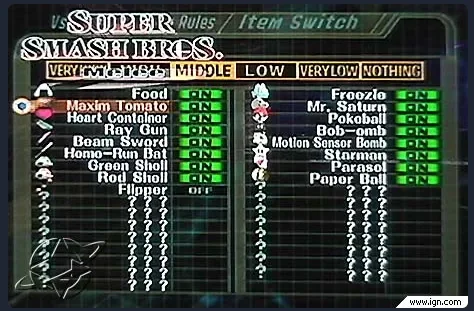
- An early item screenshot named the “Party Ball” item “Paper Ball”, “Maxim Tomato” instead of the full “Maximum Tomato”, and “NOTHING” instead of “NONE” for item spawn frequency.41
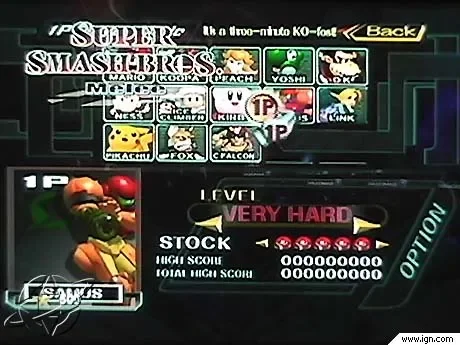
- Early character selection screen for single player mode has the character portraits far to the right with more UI differences. 41
Development and Production
Smash 64 and Melee, Side By Side
| Smash 64Nintendo 64, 1999 | MeleeGameCube, 2001 | |
|---|---|---|
| Playable fighters | 12 | 26 |
| Polygons per fighter | about300dropping to roughly 200 with three or more players | Higherexact figure not documented |
| Fighter texture | 64×64or 32×32 pixels | Not documented |
| Mediathe two rows below were only possible on disc | Cartridge | Optical disc |
| Music | Programmedsequenced, not recorded | Streamedrecorded live by a full orchestra |
| Opening | None | CG movieSakurai storyboarded it over his New Year's vacation |
The Melee Team
- people at the start
- ~50
- people by the end
- ~200
Who was on it
- Programmerssplit across players, items, game systems, menus, and maps
- 15
- 3D modelersin-house
- ~10
- From Creatures Inc.
- ~20
- Tokyo animation studioseach handled several scenes of the opening movie
- 4
- MusiciansHirokazu Ando as sound and music director, Tadashi Ikegami on sound effects and voice coordination, Shogo Sakai, and Takuto Kitsuta
- 4
- AnnouncerDean Harrington, who recorded alone in a single session of about two to three hours
- 1
- Head of debuggingSatoru Iwata, who took three weeks away from his executive job to do it
- 1
What shipped
- Trophies
- 293
- Original sound effects
- 4,000+
- Playable fightersthe team thought 16 was the limit
- 26
- Months of development
- 13
- Had the dev team had more development time, Sakurai would have prioritized resting and recovering from his overwork rather than developing new content.12
- Sakurai clarifies when he says “adult circumstances” he just really means complicated circumstances.
- Sakurai states that fans can’t really realistically conceptualize how many more characters could have been added to Melee had they removed other unrelated features. It’s not a 1:1 situation. Changing properties of clone fighters is significantly easier than creating new animations, making significant model changes, or programming new abilities. A removal of a clone character, therefore, wouldn’t necessarily mean it would be possible for a completely unique character inclusion. For example, Sakurai said he couldn’t just add King Dedede as a model replacement for Kirby.
- The development team had a spec sheet they’d use to consider characters, and as they scrapped each one, they’d mark the character’s face with an “X”.
- Satoru Iwata stepped in to help with debugging in the final weeks of Melee’s development. Specifically, he took three weeks away from his executive job to become acting head of debugging at HAL, did a full code review, fixed bugs himself, and pulled his entire team in to help.7
- Asked what the project was actually for, Sakurai was blunt: “We needed the GameCube to sell well. While other companies were trying to create innovative games, we aimed to find the best way to make the GameCube succeed. I believed that broadening the GameCube’s appeal was essential, so I chose Super Smash Bros. as the best option within my capabilities.”31
- The project started without knowing when the GameCube would ship or when dev kits would arrive, so the plan was deliberately built to flex. Supporting Japanese and English in a single build turned out to be much harder than anyone expected, though designing for it from the start proved more efficient than bolting it on.31
- Sakurai’s own numbers on the generational jump: a fighter in Smash 64 ran about 300 polygons, dropping to roughly 200 with three or more players, with textures at 64x64 or 32x32. He jokes that’s why Samus’ legs turned into triangles.29
- Sakurai often worked 40 hours straight, went home to sleep for four, and came back. He knew the lifestyle was destructive and did it anyway.7
- He collapsed after the orchestra recording session. Four hours of taking notes while watching in-progress movie renders against a live orchestra, and the next day he was in the hospital on an IV. He was back at work the day after. It was the only forced break he took during Melee.7
- He directed by emotion rather than instruction. He asked Sakai for a hidden menu theme that felt “refreshing,” which meant nothing to Sakai, and kept telling the motion team to make Sheik “twist her body more,” which baffled them until it landed.7
- The team was about 50 people at the start and nearly 200 by the end.7 That broke down to 15 programmers split across players, items, game systems, menus, and maps, plus roughly 10 3D modelers in-house and about 20 more from Creatures Inc.31
- The opening movie went to four Tokyo animation studios, each handling several scenes, with Sakurai overseeing all of it. HAL is in Yamanashi, so supervision meant hundreds of emails and frequent trips to Tokyo, and he used the commutes to review in-progress game work.7
- Melee has 293 trophies, many of them full of early and reused models thanks to crunch.22 A few were reduced-polygon imports from other games or promotional material, like Tanooki Mario, but most were built from scratch.7
- The Classic Mode trophies preserve earlier versions of the fighter models. Samus’ is based on her NES design rather than the Super Metroid design used for the playable model, Donkey Kong’s has no teeth, and Mario’s is slightly squished with simpler textures. The Yoshi trophy contains an early version of the Yoshi model that would appear in Mario Party 4, predating that game by nearly a year.22
- Meowth may have been considered as a fighter. Its trophy file carries the
Rsuffix otherwise reserved for playable characters, its model is fully rigged, and Melee is the only game in the series where Meowth isn’t a Poke Ball summon.22 The Meowth model and rigging were finished in August 2000 for Spaceworld’s technical demo. - Two Nintendo of America staff, Leslie and Bill, flew to HAL in late August 2001 to work on the English translation, arriving and leaving with Typhoon No. 11. The HAL diary describes them as coming from “an American port town famous for Ichiro and the great demon god,” meaning Seattle. Leslie is almost certainly Leslie Swan, whose early Peach voice lines are still on the disc.31
- Smash 64’s website existed because Sakurai was frustrated that the game’s depth wasn’t reaching people. He first wrote it up as a “Book of Secrets” handed to press, decided it accomplished nothing, then built the public site himself, alone and overnight, on an HTML tool. Melee’s site inherited the name as News Flash Smash Bros. Ken, and he wrote that one himself too, while directing the game. He answered user comments personally, years before that was normal.42
- On what that crunch actually felt like, Sakurai doesn’t soften it: “Melee’s development, even remembering it now, was insanely hard. Brutal. No breathing room at all.”42
- The game shipped with its developer tools intact but locked behind a missing file. Melee checks for
develop.iniin the root directory at boot, and it isn’t on the disc. Add an empty file with that name and the full debug suite unlocks, across every revision, region, and demo build. Players didn’t find the debug menu until around 2003, via an Action Replay code by Rune of GameShark Central.22 - One of those developer features was USB2EXI, a setup for capturing screenshots and dumping log output to a PC over a GameCube development box. That’s what the leftover string
please setup server for USBin the game’s executable refers to.22 - The executable also hides a developer signature:
by sugano & yoshiki, for Takayuki Sugano and Yoshiki Suzuki.22 - Every build stamps its own compile date, which is where the timeline dates above come from: October 31, 2001 for the Japanese and North American 1.00, November 22 for 1.01, February 13, 2002 for 1.02, and March 13, 2002 for PAL. There’s also a Japan-only event disc dated December 11, 2001.22
Fan poll closed May 31, 1999
What fans asked for, and what included
Sakurai asked fans who they wanted in a Smash sequel. These were the top ten finishers, and what Melee did with each.
- Playable in Melee4
- Trophy only4
- Blocked entirely2
- Playable in a later game3
| Rank | Character | Outcome in Melee | Playable later |
|---|---|---|---|
| 1 | Bowser | Playable | |
| 2 | Peach | Playable | |
| 3 | Wario | Trophy onlyLeft out because Sakurai didn't want too many Mario characters, not because of the vote count. | Brawl |
| 4 | King Dedede | Trophy onlySakurai's own creation, and he passed to avoid his own bias. He later admitted he had underestimated how popular Dedede was. | Brawl |
| 5 | Ganondorf | PlayableOnly exists because of two lucky breaks: a model from the 2000 Zelda Space World teaser, and Captain Falcon's animations to build on. | |
| 6 | James Bond | Blocked entirelyLicensing, Pierce Brosnan's likeness rights, and real guns against a family rating. | Never |
| 7 | Mewtwo | Playable | |
| 8 | Banjo & Kazooie | Blocked entirelyRare was in England, approvals were slow, and Nintendo was likely preparing to sell its Rare shares. A planned trophy got cut. | Ultimate |
| 9 | Toad | Trophy onlyStill not playable as of Ultimate. | Not yet |
| 10 | Mew | Trophy only | Not yet |
Diddy Kong and Sukapon were the only Nintendo-owned characters in the poll that didn't appear as trophies.
Considered Characters
- Other retro reps: Balloon Fighter, Urban Champion, Bubbles, Excitebike Racer.43
- Takamaru from the Mysterious Murasame Castle was considered for a Smash 64 sequel game, but didn’t consider it likely.44
- Ayumi Tachibana from Famicom Detective Club was considered, but ultimately only included as a trophy since an overseas audience wouldn’t be familiar with her.45
- Lucas from Earthbound 644626
- Wario, if just one more character could have been added to Melee. But instead, Sakurai opted to include Marth, Roy, and Mewtwo instead.3316
- Sukapon wasn’t able to appear as an in-game item where characters could ride him due to complicated circumstances (and that appearing in later installments would be unlikely). But he was planned and had progress made at one point.81747
- Mach Rider came up when a fan asked Sakurai about who he’d include in a Smash 64 sequel. His reason was simply he liked the character’s name. He mentioned people from his generation would want more characters from Mach Rider and The Mysterious Murasame Castle.4849
Requested Characters
- Hideo Kojima begged Sakurai to include Solid Snake in Melee, but the game was too far along in development for the inclusion to be feasible.50
- Sonic the Hedgehog was a request from Yuji Naka to Sakurai at Space World, where Sakurai responded and said “I wish you’d have said something sooner!”5152
Acknowledged Characters
- Banjo and Kazooie, which Sakurai mentioned would be a character pair thought to be an obvious inclusion in the game, were sadly absent due to complicated matters.1
- Sakurai confirmed there were never plans to add Saki from Sin and Punishment.25
- Sakurai states characters from Animal Crossing are clearly not suitable for Smash.53
- James Bond was “blocked on all sides” due to representation of real guns, actor’s portrayal and likeness, original work is a movie, not a game, and the associated game is by Rare.54
- Meta Knight, mentioning both Marth and Roy already have swords, and Meta Knight is also surprisingly versatile - so those would be considerations if decided.55
- King Dedede can’t be added as a mere model swap of Kirby.55
- Regarding both Meta Knight and Dedede, he noticed they were fairly high up on the popularity polls, and would keep it in mind for the future.56
- Slippy and Peppy were acknowledged as interesting picks, since “it would feel more satisfying to have the whole team together, wouldn’t it?”36 They, along with Falco, were also once considered as alternative costume options for Fox in Smash 64.
The Continued Story of Super Smash Bros. Melee’s Development
A follow up to my first documentary, I go a bit deeper into the archives of HAL Labs, E3 2001 footage, and interview former Nintendo World Report staff member Jonathan Metts as he recounts his experience at E3 2001. I also review some of the newer videos Sakurai’s uploaded that has shed some light on Melee’s development in the years since my first documentary.
Watch on YouTube: "The Continued Story of Super Smash Bros. Melee's Development documentary"
Specifics from early E3 footage
- All shields were red.
- You could grab the ledge of the laser cannon on the Great Fox on the Corneria stage.
- You could jump again after an air dodge.
- Link’s sword had no swing trails.
- Hitstun and the timing for Falcon punch were identical to Smash 64.
- Various character animations were less exaggerated and simpler.
The build was small. The only playable characters were Bowser, Fox, Captain Falcon, Ness, Mario, Link, Samus, Yoshi, Donkey Kong, and Pikachu, with matches running one to four players for three minutes.7 Zelda was pulled from the select screen entirely, since her transform was still a secret.
Nearly every stage looked different from the final:7
- Pokemon Stadium had a completely blank background. Other material from this period shows a Pokemon Trading Card Game Fire Energy symbol used as a placeholder.
- Rainbow Cruise looked significantly different, and no gameplay footage of that version survives.
- Early Battlefield and Final Destination designs appear very briefly.
- Mushroom Kingdom still had pipes, like the Smash 64 version.
- Green Greens was darker and wider, with Whispy blowing constantly.
- Fourside was simpler, without the multicolored lights.
- Brinstar had no Chozo statue in the background.
- Yoshi’s Island was much larger, with more rotating blocks and moving note blocks.
- Fountain of Dreams had a darker palette and two platforms instead of three.
- Yoshi’s Story was much larger, with a curved path, a walkoff section, and blue off-stage platforms attached to levers.
- Temple had extra brown platforms and an elevator on the right side. You can still see that part of the stage in the final game through the Special Movie.
- Great Bay’s laboratory sat in the foreground instead of the background, you could go inside it, and it had three steel beams instead of five, closer to Majora’s Mask.
Adventure Mode differed too. Its Mushroom Kingdom had an orange block that isn’t in the final version and no checkered flooring at the end, and Escape Brinstar’s on-screen text read “Go Ahead” rather than “Code Red.” Two fanfares from this build went unused.7
IGN captured this build on July 24, 2001, between E3 and Space World. Listen for the single player victory fanfare, which is an early version that never shipped. It gets cut off partway through here, then plays again in full right at the end.
No copy of the E3 2001 demo build is known to exist. If you have one, please get in touch.
A few things about how Melee actually landed at the show, from Jonny Metts, who was covering it for Planet GameCube:
- Melee got no stage presentation at the press conference. Like most of Nintendo’s lineup that year it appeared in a montage with nobody introducing it, no feature rundown, and no release date.57
- Planet GameCube got the B-roll on VHS, which held extended uncut footage that wasn’t shown at the event, and watched it in a hotel room with about 20 people shouting at the screen.57
- Nintendo’s booth had a central grid of kiosks plus an outer ring of “theater rooms” draped in black cloth, effectively private demo rooms you couldn’t tell were there. Metts slipped into one and thinks that’s where he played Melee for the first time. Against a show floor he describes as louder than several simultaneous rock concerts, that quiet dark pocket is a large part of why the demo landed.57
- The detail people fixated on was the texture work. Metts watched someone pause the game and spin the camera in on Mario’s overalls to look at the stitching and the buttons, and remembers thinking it was a strange amount of detail for a game where the camera stays zoomed out. Years later he’d recognize it as the beginning of how Smash presents itself.57
- Melee ran crisper and faster than the other GameCube games on the floor, and was the consensus game of Nintendo’s show.57
- Planet GameCube later broke the secret character list a couple of weeks before launch, which upset a lot of fans and Nintendo.57

Watch on YouTube: "Early E3 2001 Melee gameplay footage"
Watch on YouTube: "Additional E3 2001 Melee demo footage"
Post-Release
- Ocarina of Time Link can be seen in an earlier version of Brawl.
- Melee sold over 350,000 copies in Japan in its first week and another 250,000 in the United States in nine days. Despite a December release it still finished as the 19th best-selling game of 2001, and roughly three in four GameCube owners eventually owned it. It launched at $49.99, later joined Player’s Choice, and got its own console bundle on August 24, 2005.7
- Reviews were strong across the board: 9.6 from IGN, 8.9 from GameSpot, and a 10 from Eurogamer.7
- A widespread hoax claimed Sonic was an unlockable fighter, backed by an obviously doctored screenshot. Nintendo eventually added a line to the FAQ on Melee’s Nintendo.com page addressing whether Sonic or Knuckles were in the game. The answer was no.7
- Melee was nearly re-released on Wii as-is, with online play and no balance changes at all. That was Nintendo’s backup plan if Sakurai turned down making a sequel, and Iwata reached out to him in 2005 just in case.31
- Sakurai left HAL after Kirby Air Ride in 2003.7
- After the reveal, fans read the opening movie as a roster tease and started guessing Ridley, Samurai Goroh, and Wolf. Sakurai posted on the News Flash site in early August to clarify that not everyone in the opening would be playable.7
- Peach’s portrait at the start of Mario & Luigi: Superstar Saga closely resembles her Melee portrait, and the early showcase build of Mario Kart: Double Dash used Melee’s Mario and Luigi models as placeholders.31
Version and Regional Differences
- The North American and Korean discs contain an empty file called
usa.ini. Delete it and the game boots as the Japanese version. Add it to a Japanese disc and you get the international one. That works because those releases ship both.datand.usdcopies of nearly every file.22 - The mine item is different in all three regions. Japan got the Sensor Bomb using Perfect Dark’s design, North America got the Motion-Sensor Bomb using GoldenEye’s, and Europe got the Proximity Mine, which pairs GoldenEye’s model with the Japanese name and description. Sakurai’s stated reason for dropping the Perfect Dark references internationally was its M rating against Melee’s family audience. Perfect Dark and Rare are still credited at the end.22
- Tamagon, from the Famicom game Devil World, is only obtainable in the Japanese version, though the trophy exists in every release.22
- The Samus Unmasked and Mario & Yoshi trophies were given out at Japanese events by writing them directly onto your memory card alongside Captain Olimar. That’s exactly what the Toys “R” Us Toy Festa save file did.227
- The PAL version dropped both the Japanese language option and the 15-minute Special Movie to make room for five languages. The Special Movie’s file is still there, but it contains a duplicate of Captain Falcon’s clear movie instead.22
- PAL also rebalanced the cast, weakening Captain Falcon’s knee, Fox’s smashes and recovery, and Sheik’s up smash and down throw, turning Marth’s tipped down aerial from a spike into a weaker meteor, and adjusting weights for Fox, Mario, Marth, Bowser, Kirby, and Yoshi.22
- Daisy’s trophy has a third eye hidden behind her hair in Japanese and early American versions. The eye texture is actually tiled across her whole head, and the developers made all of them invisible except the one in back. Fixed in PAL and 1.02.227
- In version 1.0 the Home-Run Contest stadium was far too small, and hitting the sandbag past a certain distance registered as “No Distance” instead of a score. Later revisions expanded the stadium enormously.22
My Very First Games of Super Smash Bros. Melee
On June 19th, 2002, my brother and I got to play our first Melee matches on the retail version of Melee, version 1.0, on our cousin’s GameCube.
Captured in all its VHS glory, you can watch below.
Watch on YouTube: "David and his brother's first games of Super Smash Bros. Melee on VHS"
Full Jonny Metts Interview About E3 2001
Here’s my full interview with Jonathan Metts, formerly of Nintendo World Report back when it was Planet GameCube and his experience going to E3 2001.
Watch on YouTube: "Full interview with Jonathan Metts about E3 2001 and Melee"
Further Reading and Watching
- HAL Diaries Blog
- Smash 2 Poll
- Early Smash History - Melee Stats
- Melee’s Development Interview
- Unused Content - Melee on The Cutting Room Floor Wiki
- Unused Content in Melee - SmashWiki
- Game Design: Risk and Return (GDC 2004)
- Sakurai responds to a fan desiring commercial “Smash Bros. figures” - interesting that Amiibo would eventually be an option.
- ChainSwordCS Alt Melee Documentation
- Melee Beta YouTube Playlist
- Space World 2000 game footage
- Clean B-roll game footage
- Nintendo Booth Footage
- E3 2001 Sizzle Reel
- Space World 2001 Raw Tapes B-Roll
- GameWave (ゲームウェーブ)
- Nintendo World Report
- Jonny Metts’ E3 2001 Audio Diary
- Chief Neif’s post replies on X about hidden food in Melee stages
- A list of every known Super Smash Bros. Melee ISO
- Dean Harrington, Melee announcer interview on Source Gaming
Footnotes
-
Elevated: The Development Story of Super Smash Bros. Melee, my 2021 documentary ↩ ↩2 ↩3 ↩4 ↩5 ↩6 ↩7 ↩8 ↩9 ↩10 ↩11 ↩12 ↩13 ↩14 ↩15 ↩16 ↩17 ↩18 ↩19 ↩20 ↩21 ↩22 ↩23 ↩24 ↩25 ↩26 ↩27 ↩28 ↩29 ↩30 ↩31 ↩32 ↩33 ↩34 ↩35 ↩36 ↩37 ↩38 ↩39 ↩40 ↩41 ↩42 ↩43 ↩44 ↩45 ↩46 ↩47 ↩48 ↩49 ↩50 ↩51 ↩52 ↩53 ↩54 ↩55 ↩56 ↩57 ↩58 ↩59 ↩60 ↩61 ↩62 ↩63 ↩64 ↩65 ↩66 ↩67 ↩68 ↩69 ↩70
-
Super Smash Bros. Melee on The Cutting Room Floor and its sub-pages ↩ ↩2 ↩3 ↩4 ↩5 ↩6 ↩7 ↩8 ↩9 ↩10 ↩11 ↩12 ↩13 ↩14 ↩15 ↩16 ↩17 ↩18 ↩19 ↩20 ↩21 ↩22 ↩23 ↩24 ↩25 ↩26 ↩27 ↩28 ↩29 ↩30 ↩31 ↩32 ↩33 ↩34 ↩35 ↩36 ↩37 ↩38 ↩39 ↩40 ↩41 ↩42 ↩43 ↩44 ↩45 ↩46 ↩47 ↩48 ↩49 ↩50 ↩51 ↩52
-
Sakurai’s video covering Super Smash Bros. Melee (Japanese audio) ↩ ↩2
-
The Continued Story of Super Smash Bros. Melee’s Development, my follow-up documentary, including translated HAL Laboratory staff diary entries and the Melee developer roundtable ↩ ↩2 ↩3 ↩4 ↩5 ↩6 ↩7 ↩8 ↩9 ↩10 ↩11 ↩12 ↩13
-
Dean Harrington, Melee announcer interview on Source Gaming ↩ ↩2 ↩3 ↩4 ↩5 ↩6 ↩7 ↩8
-
UnclePunch on the unused character select screen animation ↩
-
Inside Super Smash Bros. Melee from IGN ↩ ↩2
-
Sakurai’s video about the Smash Bros. DOJO!! websites (Japanese audio) ↩ ↩2
-
The Great Sukapon Search in Melee by Source Gaming ↩
-
Full interview with Jonathan Metts about E3 2001 and Melee ↩ ↩2 ↩3 ↩4 ↩5 ↩6
Comments
Nothing yet. Say the first thing.
Sign in to join the conversation.